
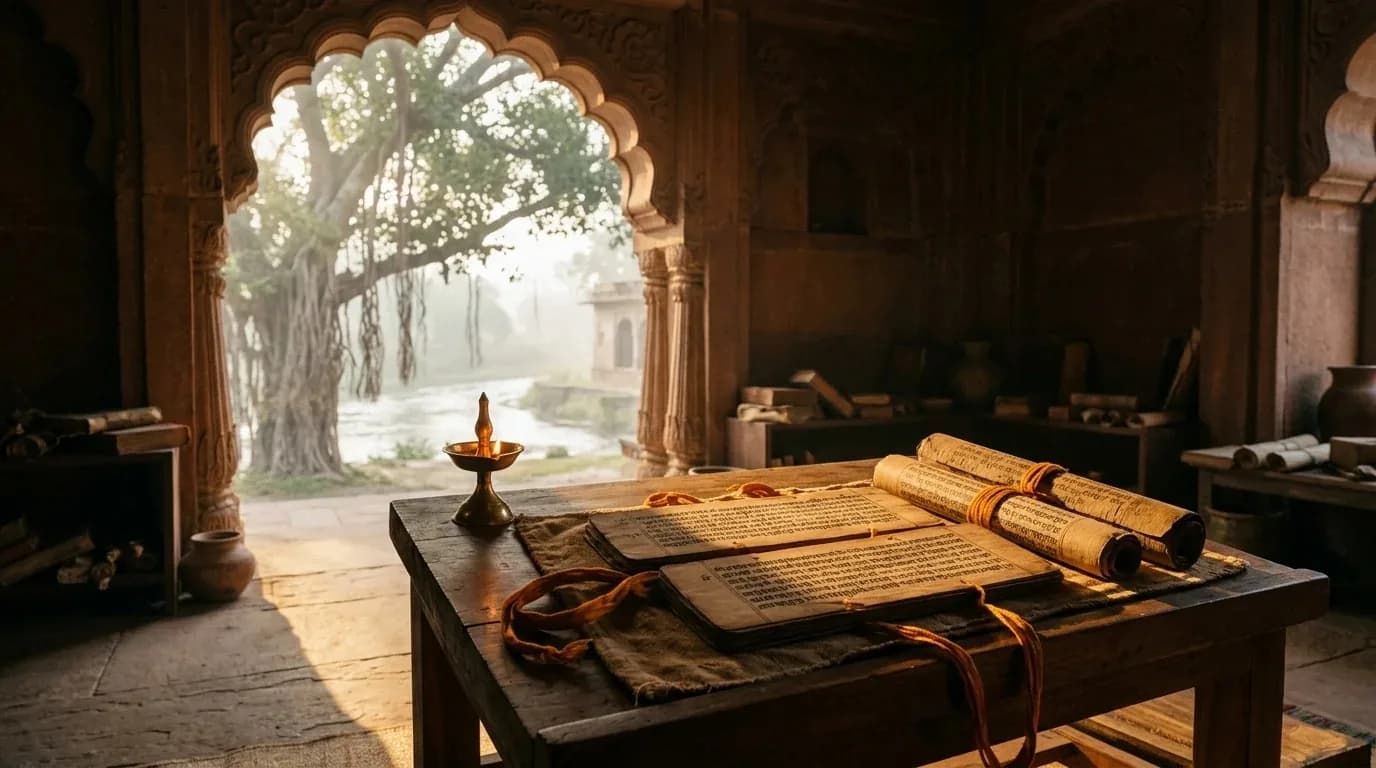
Wisdom that Transcends Generations.
Sanatan Dharma encompasses diverse philosophical traditions, sacred texts, spiritual practices, and ways of understanding life. Explore their origins, meanings, and interpretations through a structured journey into India's intellectual and spiritual heritage.
अविच्छिन्न ज्ञानपरंपरा · Generational continuity preserved through timeless enquiry
सत्यं वद धर्मं चर — Speak the truth, walk the path of righteousness, and honour eternal wisdom.
Dharma (धर्म)
Duty, righteousness, intrinsic nature, and cosmic sustainment
Derived from the root "dhṛ" (to uphold or sustain), Dharma signifies the moral, ethical, and cosmic order that supports existence, varying according to individual context, life stage, and social responsibility.
Karma (कर्म)
The causal law of volitional action, moral agency, and consequence
Karma refers to intentional action and its inevitable psychological, ethical, and metaphysical repercussions, operating as an autonomous cosmic mechanism of moral accountability across lifetimes.
Atman (आत्मन्)
The true self, unconditioned witness consciousness, and indwelling spirit
The transcendent, unchanging self or pure witness consciousness within the individual, distinguished from the transient physical body, sensory faculties, and mental fluctuations.
Brahman (ब्रह्मन्)
The ultimate reality, infinite source, and ground of being
The supreme, boundless cosmic consciousness and ontological foundation of all existence, defined as existence-consciousness-bliss (Sat-Chit-Ananda), both transcending and pervading the cosmos.
Moksha (मोक्ष)
Spiritual liberation from cyclic limitation, existential sorrow, and karmic bondage
The highest human aspiration (Parama Purushartha), representing liberation from the cycle of birth, death, and rebirth (Samsara) and the attainment of supreme freedom, peace, and self-realization.
Ahimsa (अहिंसा)
Non-harming, universal empathy, and radical reverence for all life
The foundational ethical vow of non-violence in thought, word, and deed, reflecting the philosophical insight that all sentient life shares the same underlying consciousness.
Rigveda Samhita (ऋग्वेद संहिता)
Vedic Literature
The foundational text of Indian civilization, containing cosmological intuitions, contemplative prayers, liturgical poetry, and invocations of cosmic deities representing natural forces and moral principles.
Samaveda Samhita (सामवेद संहिता)
Vedic Literature
The Veda of sacred melody and liturgical song. Most verses are drawn from the Rigveda, set to specific musical scales and tonal modulations (Svara) designed for contemplative ritual recitation.
Explore the Foundations of Dharma
Discover the ideas, texts, traditions, and practices that have shaped Sanatan Dharma across generations.
Foundations & Concepts
Core metaphysical and ethical principles: Dharma, Karma, Atman, Brahman, Moksha, and Ahimsa.
Sacred Scriptures
The canonical repository: the four Vedas, Upanishads, Bhagavad Gita, Epics, and Agamas.
Philosophical Traditions
Classical Astika systems (Nyaya, Vaisheshika, Samkhya, Yoga, Mimamsa, Vedanta) and Vedantic schools.
Spiritual Practices
Everyday living traditions: Puja, Mantras, Yoga, Samskaras, and lineage customs.
Teachings & Verses
Carefully verified primary Sanskrit verses with IAST transliteration, translation, and commentary.
Foundations of Sanatan Dharma
Six core ideas that anchor Indian spiritual and philosophical inquiry. Each concept is rich, multi-layered, and understood through diverse school perspectives.
Dharma
धर्मDerived from the root "dhṛ" (to uphold or sustain), Dharma signifies the moral, ethical, and cosmic order that supports existence, varying according to individual context, life stage, and social responsibility.
Karma
कर्मKarma refers to intentional action and its inevitable psychological, ethical, and metaphysical repercussions, operating as an autonomous cosmic mechanism of moral accountability across lifetimes.
Atman
आत्मन्The transcendent, unchanging self or pure witness consciousness within the individual, distinguished from the transient physical body, sensory faculties, and mental fluctuations.
Brahman
ब्रह्मन्The supreme, boundless cosmic consciousness and ontological foundation of all existence, defined as existence-consciousness-bliss (Sat-Chit-Ananda), both transcending and pervading the cosmos.
Moksha
मोक्षThe highest human aspiration (Parama Purushartha), representing liberation from the cycle of birth, death, and rebirth (Samsara) and the attainment of supreme freedom, peace, and self-realization.
Ahimsa
अहिंसाThe foundational ethical vow of non-violence in thought, word, and deed, reflecting the philosophical insight that all sentient life shares the same underlying consciousness.
The Scriptural Foundations
The sacred library of Sanatan Dharma spans unauthored primordial sound (Shruti), remembered tradition and epics (Smriti and Itihasa), and temple ritual codes (Agama). Different lineages recognize these texts with contextual reverence.
Vedic Literature (चतुर्वेद संहिता)
Apaurusheya · Shruti BaselineRigveda Samhita
The foundational text of Indian civilization, containing cosmological intuitions, contemplative prayers, liturgical poetry, and invocations of cosmic deities representing natural forces and moral principles.
Samaveda Samhita
The Veda of sacred melody and liturgical song. Most verses are drawn from the Rigveda, set to specific musical scales and tonal modulations (Svara) designed for contemplative ritual recitation.
Yajurveda Samhita
The practical guide for the Adhvaryu priest, containing prose mantras and detailed procedural guidance for solemn yajnas, consecrations, and cosmic invocations.
Atharvaveda Samhita (अथर्ववेद संहिता)
The Veda of everyday life, containing prayers for healing, domestic well-being, societal harmony, statecraft, mathematical concepts, and sublime philosophical hymns including the celebrated Bhumi Sukta (Earth Anthem).
Philosophical Texts (प्रस्थानत्रयी)
Metaphysical AnchorsThe Principal Upanishads (दशोपनिषदः / मुख्योपनिषदः)
The contemplative and intellectual culmination of Vedic wisdom (Vedanta), shifting inquiry from external ritualism to inward self-realization, investigating the relationship between Atman and Brahman.
Srimad Bhagavad Gita (श्रीमद्भगवद्गीता)
A sublime philosophical dialogue on the battlefield of Kurukshetra between Bhagwan Shri Krishna and the warrior Arjuna, addressing duty, existential crisis, righteousness, and liberation in the midst of worldly conflict.
Brahma Sutras (ब्रह्मसूत्राणि)
A masterwork of systematic theology that synthesizes and harmonizes apparently divergent Upanishadic passages into a non-contradictory metaphysical architecture.
Epics & Narrative Traditions (इतिहास एवं पुराण)
Living Cultural MemoryValmiki Ramayana
The foundational epic poem (Adi Kavya) narrating the life of Maryada Purushottam Shri Rama, demonstrating the living application of Dharma through human relationships, filial duty, statecraft, and fidelity.
Vyasa Mahabharata
An epic encyclopedic narrative centering on the dynastic Kurukshetra war between the Pandavas and Kauravas, exploring the complexities, moral dilemmas, and paradoxes of Dharma in an imperfect world.
The 18 Mahapuranas (अष्टादश महापुराणानि)
Expansive cosmological compendia preserving ancient genealogy, temple legends (Sthala Mahatmya), festival origins, ritual instructions, and devotional allegories making profound metaphysics tangible for the public.
Other Textual Traditions (धर्मशास्त्र एवं आगम)
Ethics & Sacred PracticeDharmaśāstra Literature (धर्मशास्त्र साहित्यम्)
Classical civil, legal, and social treatises that codified societal ethics, judicial dispute settlement, marriage traditions, and ritual purifications suited to specific historical times (Yuga Dharma).
Agamas & Tantric Literatures
Extensive authoritative canons governing temple consecration (Pratishtha), sacred architecture (Vastu), iconographic sculpting (Shilpa), daily ritual worship (Kriya), and esoteric yoga practices.
Explore the Philosophical Schools
Rather than dogmatic conformity, Indian thought developed rigorous, complementary inquiry systems. The six Astika Darshanas and diverse Vedanta traditions each articulate distinct understandings of epistemology, ontology, and liberation.
Nyaya
न्याय दर्शनThe foundational school of Indian logic and debate. Nyaya developed formal five-step syllogisms, fallacy classifications, and rules of disputation (Vada, Jalpa, Vitanda) used across all subsequent philosophical debates in India.
Vaisheshika
वैशेषिक दर्शनAn empirical and naturalistic inquiry into physical reality, atomic theory (Paramanu), and the classification of the cosmos. Vaisheshika teaches that material substances are composed of indestructible, indivisible spherical atoms of earth, water, fire, and air.
Samkhya
सांख्य दर्शनThe oldest systematic rational cosmology in India. It enumerates 24 evolutes of Prakriti emerging from the equilibrium of the three Gunas (Sattva, Rajas, Tamas): Mahat (Intellect), Ahamkara (Ego), Manas (Mind), five sensory capacities, five action capacities, five subtle elements (Tanmatras), and five gross elements (Mahabhutas).
Yoga (Classical)
योग दर्शन (अष्टाङ्ग योग)The practical, experiential methodology for spiritual liberation. Patanjali outlines the eight limbs (Ashtanga): Yama (ethical restraints), Niyama (observances), Asana (posture), Pranayama (breath regulation), Pratyahara (sensory withdrawal), Dharana (concentration), Dhyana (meditation), and Samadhi (absorption).
Purva Mimamsa
पूर्व मीमांसा दर्शनThe science of scriptural interpretation, linguistics, and ritual ethics. Mimamsa established sophisticated principles of hermeneutics to resolve ambiguities in sentences, contexts, and injunctions.
Uttara Mimamsa (Vedanta)
उत्तर मीमांसा (वेदान्त दर्शन)The crown jewel of Indian philosophy. Vedanta interprets the contemplative culmination of the Vedas, generating several major sub-traditions that continue to define contemporary Hindu thought.
Ancient Wisdom, Everyday Understanding
How does timeless philosophy translate into daily life? Practices vary meaningfully by region, community, family lineage, and personal temperament.
Puja & Ritual Worship
Puja is an intimate act of hospitality and communion with the Divine. Rather than an act of placating a distant deity, it welcomes Bhagwan as an honored, beloved guest into the home or temple altar.
- Shodashopachara (16 sacred offerings including Dhyana, Asana, Padya, Arghya, Snana, Vastra, Chandana, Pushpa, Dhoopa, Deepa, Naivedya, and Aarti)
- Panchayatan Puja (Harmonious worship of five deities: Shiva, Vishnu, Devi, Surya, and Ganesha)
- Manasa Puja (Internalized mental worship, visualized with pure devotion)
Mantras & Sacred Chanting
Mantras are precise acoustic formulas preserved in the Vedic language whose correct phonetic cadence (Svara) and rhythmic repetition (Japa) attune individual awareness to universal cosmic frequencies.
- Pranava (The sacred syllable Om, primordial sound of Shabda Brahman)
- Gayatri Mantra (The Rigvedic prayer for spiritual illumination of intellect)
- Maha Mrityunjaya Mantra (The healing, fear-dissolving invocation of Shiva)
- Three modes of Japa: Vachika (spoken aloud), Upamshu (whispered), and Manasika (silent internal contemplation, the highest mode)
Yoga & Meditation (Sadhana)
An integrated spiritual discipline uniting physical poise, breath mastery, sensory moderation, and unbroken meditation (Dhyana) to transcend identification with mental chatter.
- Asana (Steadiness and ease in posture for seated meditation)
- Pranayama (Conscious breath regulation harmonizing vital energy)
- Pratyahara (Sensory withdrawal turning attention inward)
- Dharana, Dhyana & Samadhi (The threefold inner absorption, Samyama)
The 16 Samskaras (Life-Cycle Rites)
Sacred ceremonies designed to sanctify human life from before conception to final biological transition, infusing every developmental milestone with spiritual consciousness and familial affection.
- Garbhadhana & Pumsavana (Conscious parenthood and prenatal consecration)
- Namakarana (Naming ceremony establishing identity and ancestral connection)
- Annaprashana (First offering of solid food)
- Upanayana (Sacred thread investiture inaugurating educational student life)
- Vivaha (Sacred matrimony uniting two souls and families under Dharma)
- Antyeshti (Final funeral rites returning the physical elements to the cosmos)
Ethics, Responsibility & Conduct
Sanatan Dharma places righteous conduct (Sadachara) as the primary verification of authentic spirituality, emphasizing unpayable debts (Rina-traya) repaid through lifelong service.
- Rina-traya (The three debts: Deva Rina to cosmic forces, Rishi Rina to teachers and wisdom, Pitru Rina to ancestors and family)
- Pancha Maha-yajnas (Daily observances: honoring the Divine, sages, ancestors, fellow humans, and nature/animals)
- Dana (Selfless charity and philanthropy given without expectation or condescension)
Family & Living Traditions
Traditions are kept alive through domestic altars, ancestral observances (Kula-achara), pilgrimage to sacred geography (Tirtha Yatra), and seasonal community gatherings.
- Kula-devata & Grama-devata veneration (Honoring ancestral protective deities)
- Tirtha Yatra (Conscious pilgrimage to holy riverbanks, temples, and mountain shrines)
- Satsanga (Assembly with noble, truth-seeking companions and teachers)
- Seasonal fasting and observances (Ekadashi, Navratri, Shivaratri)
Wisdom in Every Verse
Explore authentic primary verses from the Bhagavad Gita, Upanishads, and Vedas with verified Sanskrit, precise IAST transliteration, and traditional commentaries.
कर्मण्येवाधिकारस्ते मा फलेषु कदाचन। मा कर्मफलहेतुर्भूर्मा ते सङ्गोऽस्त्वकर्मणि॥
karmaṇy-evādhikāras-te mā phaleṣu kadācana | mā karma-phala-hetur-bhūr-mā te saṅgo'stv-akarmaṇi ||
“You have a right to your prescribed duty alone, never to its fruits. Do not let the fruits of action be your motive, nor allow yourself to be attached to inaction.”
Contextual Foundation
Spoken by Bhagwan Shri Krishna on the battlefield of Kurukshetra when Arjuna was paralyzed by grief and moral uncertainty. Krishna outlines the foundational doctrine of Nishkama Karma—action performed with wholehearted excellence but free from anxious craving for results.
Commentary & Lineage Perspectives
Continue Your Journey
Deepen your understanding through carefully researched essays from the SattvaLok Journal, uniting classical scholarship with clarity.
Why India Has Many Traditions of the Same Festival: Pluralism Within Unity
A festival may be observed differently across regions, communities, and sampradayas. Explore why these differences exist and why preserving that diversity matters.
The Science Behind Panchang: Tithi, Nakshatra, Yoga, Karana & Vara
Learn how Panchang works, including Tithi, Nakshatra, Yoga, Karana and Vara, and explore the astronomical principles behind the traditional Hindu calendar.
Understanding the Bhasma Aarti: Sacred Metaphysics at Mahakaleshwar
Explore the history, tradition, significance, and cultural context of the Bhasma Aarti performed at Mahakaleshwar Jyotirlinga.
Can Technology Preserve Traditional Knowledge? The Ethics of Contextual AI
Digital archives, structured databases, AI, search systems, and multimedia can make knowledge more accessible. But technology also creates new questions about context, sources, interpretation, and authenticity.
Keep Exploring Sanatan Dharma.
Continue discovering the texts, philosophies, traditions, and practices that make up the diverse heritage of Sanatan Dharma across the SattvaLok ecosystem.
Discover SattvaLok