
Brahma Sutras (ब्रह्मसूत्राणि)(ब्रह्मसूत्राणि (वेदान्तसूत्राणि))
The Nyāya-Prasthāna of Vedānta: a masterwork of systematic exegesis and dialectical reasoning that synthesizes apparently divergent Upaniṣadic passages into an unshakeable, non-contradictory metaphysical architecture
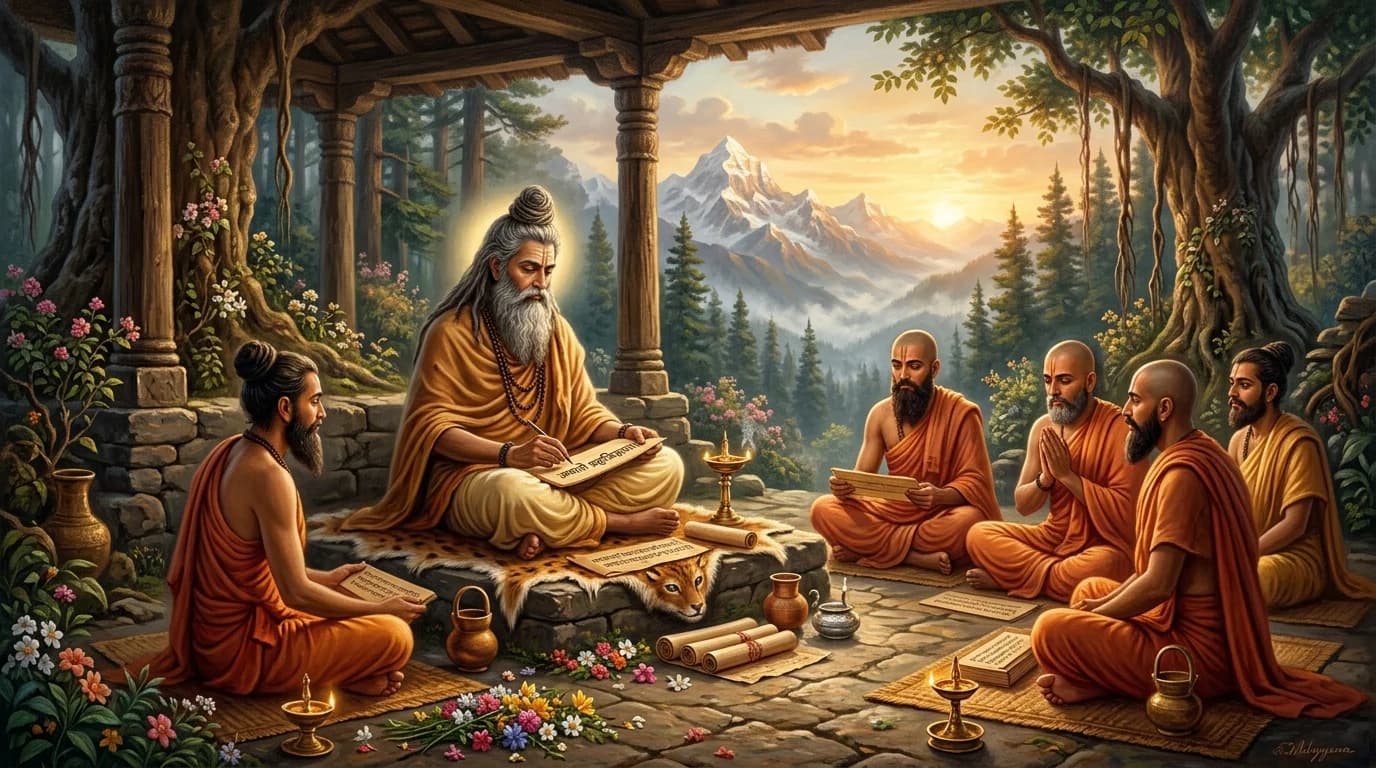
Section 1: Taxonomic Header & Etymology (Nirukta & Vyutpatti)
| Devanagari Forms | ब्रह्मसूत्राणि (neuter nominative plural compound of ब्रह्मन् [brahman] + सूत्र [sūtra]); singular: ब्रह्मसूत्रम् (brahma-sūtram) |
|---|---|
| IAST Transliteration | Brahma-Sūtrāṇi / Vedānta-Sūtrāṇi |
| Verbal Root (Dhātu) | Derived from two classical linguistic roots: (1) √bṛh (बृह् वृद्धौ — bṛha vṛddhau, Pāṇinian Dhātupāṭha 1.783, "to grow, expand infinitely, surpass all limitations without boundary"), denoting Brahman, the Supreme Ultimate Reality expounded in the Upaniṣads; and (2) √siv (सिवु तन्तुसन्ताने — sivu tantu-santāne, class 4, "to sew, thread, string together") or √sūc (सूच पैशुन्ये / सूचने — "to indicate, point out concisely") with the primary instrumental suffix -tra (Uṇādi Sūtra 4.160: ષિવાવ્યાભ્યં ત્રન્ — ṣivāv-yābhyāṃ tran), literally denoting "a thread" that strings together vast doctrines. |
| Grammatical Derivation (Vyutpatti) | Morphologically, the compound Brahma-Sūtra (ब्रह्मसूत्रम् / ब्रह्मसूत्राणि) resolves as a Ṣaṣṭhī-Tatpuruṣa compound: ब्रह्मणः सूत्राणि (Brahmaṇaḥ sūtrāṇi — "The aphorisms expounding Brahman") or as a Madhyamapadalopī-Tatpuruṣa: ब्रह्मप्रतिपादकानि सूत्राणि (Brahma-pratipādakāni sūtrāṇi — "Aphorisms that systematically establish and defend the knowledge of Brahman"). The term Sūtra denotes an elite genre of Sanskrit scholastic composition characterized by maximal syllable economy, absolute unambiguous clarity, and logical irreproachability. Just as an invisible thread holds together fragrant blossom-like flowers into an enduring garland without obtruding itself, so each Sūtra strings together apparently divergent Upaniṣadic declarations into a harmonious, non-contradictory metaphysical whole. |
“Knowers of the Sūtra tradition define a Sūtra as that which consists of minimal syllables (alpākṣaram), is free from ambiguity (asandigdham), embodies the essential marrow of truth (sāravat), is universally applicable (viśvatomukham), is devoid of superfluous filler syllables (astobham), and is logically irreproachable (anavadyam).”
— Quoted in Vācaspati Miśra’s Bhāmatī & Parāśara-Upapurāṇa“The aphorisms are designated as Sūtras because their purpose is to string together the blossom-like passages of the Upaniṣads into a unified garland.”
— Ādi Śaṅkarācārya, Śārīraka-Mīmāṃsā-Bhāṣya on Brahma Sūtra 1.1.2Semantic Evolution & Why “Religion” is an Inadequate Translation
Across Sanskrit philosophical literature, this single treatise is designated by four authoritative classical titles, each highlighting a distinct dimension of its epistemological and ontological scope:
The aphorisms that systematically establish Brahman, the ultimate subject matter of the Upaniṣads (Vedānta), demonstrating that all Vedic revelation culminates in the knowledge of the Supreme Self.
The "Subsequent or Higher Critical Inquiry" into the Jñāna-kāṇḍa (Knowledge Portion of the Vedas), contrasted with Maharṣi Jaimini’s Pūrva-Mīmāṃsā-Sūtra (the "Prior Inquiry" into the Karma-kāṇḍa or Ritual Portion).
The "Inquiry into the Embodied Self," demonstrating how the conscious self residing within the physical organism (Śarīra) relates to, depends upon, or is non-different from the Supreme Transcendent Brahman.
Mentioned by the grammarian Pāṇini in Aṣṭādhyāyī 4.3.110 ("Pārāśaryā-śilālibhyāṃ bhikṣu-naṭa-sūtrayoḥ"—The Bhikṣu-sūtras composed by Pārāśarya [Vyāsa, son of Parāśara]), because its contemplative assimilation was historically central to monastic renunciants (Bhikṣus / Sannyāsīs).
Section 2: Abstract & Philosophical Core
Within the Prasthānatrayī (the three canonical foundations of Vedānta), while the Upaniṣads constitute the Śruti-prasthāna (Revealed Foundation) and the Bhagavad Gītā constitutes the Smṛti-prasthāna (Remembered Ethical & Devotional Synthesis), the Brahma Sūtras of Maharṣi Bādarāyaṇa stand as the Nyāya-prasthāna (or Tarka-prasthāna)—the Logical and Hermeneutical Anchor.
Why was a logical canon needed after the Upaniṣads? Because the Upaniṣads are not a single textbook written by one author; they are visionary dialogues distributed across diverse Vedic Śākhās. Read in isolation without a rigorous hermeneutical key, different Upaniṣadic passages appear to present conflicting accounts: some passages declare that the universe arose from Non-Being (Asad vā idam agra āsīt — Taittirīya 2.7), while others declare it arose from Being (Sad eva somyedam agra āsīt — Chāndogya 6.2.1); some passages describe the Ultimate Reality as Prāṇa (Life-breath), Ākāśa (Space), Jyotiḥ (Light), or Vaiśvānara, raising the question of whether these denote physical elements, individual deities, Sāṃkhya's insentient Prakṛti, or the Supreme Brahman; and some passages describe Brahman as completely devoid of attributes (Nirguṇa / Neti-neti), while others celebrate Brahman as the omniscient Lord endowed with infinite auspicious attributes (Saguṇa / Satya-kāmaḥ satya-saṅkalpaḥ).
Maharṣi Bādarāyaṇa resolves these tensions through Mīmāṃsā (rigorous contextual exegesis) and Nyāya (dialectical reasoning). Organizing his treatise into 192 topical court-cases called Adhikaraṇas, he demonstrates that: (1) All Upaniṣadic passages converge harmoniously (Samanvaya) upon Brahman as the sole conscious cause of the cosmos; (2) No rival philosophical system—whether Sāṃkhya dualism, Vaiśeṣika atomism, Buddhist momentariness or idealism, or Jain relativism—can either account for the Upaniṣadic text or withstand independent logical scrutiny (Avirodha); (3) The diverse meditative disciplines (Vidyās) of the Upaniṣads form a coherent spiritual path (Sādhana) culminating in (4) Irreversible liberation from cyclic existence (Phala).
Four Foundational Pillars of Brahma Sūtra Philosophy (चतुर्विध मूल दर्शन)
Proving through rigorous contextual indicators (Ṣaḍ-Liṅgas) that all apparently divergent Upaniṣadic terms (such as Ākāśa, Prāṇa, Jyotiḥ, and Vaiśvānara) point uniformly to the conscious Supreme Brahman as the primary cause, rejecting the claim that insentient matter (Pradhāna) could be the creator.
Demonstrating that the Vedāntic doctrine of causality is free from internal and external contradictions, while systematically dismantling rival epistemologies and cosmologies—including Sāṃkhya, Vaiśeṣika atomism, Buddhist Vijñānavāda/Śūnyavāda, and Jain Syādvāda.
Systematizing the 32 contemplative Vidyās of the Upaniṣads (such as Śāṇḍilya-vidyā, Dahara-vidyā, and Pañcāgni-vidyā), establishing when divine attributes described in different Vedic branches must be combined (Guṇopasaṃhāra) or kept distinct.
Mapping the trajectory of the liberated soul: the burning of Sañcita Karma, the exhaustion of Prārabdha through experience, the departure along the luminous solar path (Arcirādi-mārga), and the eternal promise of non-return to mortal bondage (Anāvṛtti).
Section 3: Primary Scriptural Anchors (Śruti, Smṛti, and Itihāsa)
Now, therefore, the inquiry into Brahman.
Every syllable of this three-word aphorism has generated centuries of profound philosophical commentary: (1) What does "Atha" ("Now / Thereafter") presuppose? For Ādi Śaṅkarācārya (Advaita), atha does not require prior mastery of ritual Pūrva Mīmāṃsā; it requires the Sādhana-catuṣṭaya (the fourfold spiritual qualification: discrimination between the eternal and non-eternal, dispassion, the six virtues of mental tranquility, and burning aspiration for liberation). For Śrī Rāmānujācārya (Viśiṣṭādvaita), atha signifies the natural progression after studying the Karma-kāṇḍa (Pūrva Mīmāṃsā), where the seeker realizes that ritual action alone yields only temporary fruits, awakening the desire for eternal Brahman (treating Pūrva and Uttara Mīmāṃsā as a single unified Śāstra, Eka-śāstratva). For Śrī Madhvācārya (Dvaita), atha signifies auspiciousness (Maṅgala) and the attainment of spiritual eligibility (Adhikāra) grounded in unshakeable devotion to Lord Viṣṇu.
[Brahman is That] from which proceed the origin, sustenance, and dissolution of this universe.
Pointing directly to Taittirīya Upaniṣad 3.1.1 ("Yato vā imāni bhūtāni jāyante, yena jātāni jīvanti, yat prayanty abhisaṃviśanti, tad vijijñāsasva, tad brahmeti"), this Sūtra establishes that Brahman is the Abhinna-nimitta-upādāna-kāraṇa—simultaneously the intelligent Efficient Cause (Nimitta-kāraṇa, like the architect) and the substantive Material Cause (Upādāna-kāraṇa, like the clay or gold) of the cosmos. In Dvaita and Śaiva Siddhānta, this Sūtra is interpreted primarily as establishing the Supreme Lord as the sovereign Efficient Cause (Nimitta-kāraṇa) who governs creation, preservation, dissolution, regulation, obscuration, illumination, bondage, and liberation (Janmādy-aṣṭaka).
[Brahman is omniscient] because It is the source of Sacred Scripture; [and Brahman is known] because Sacred Scripture is the sole valid means of knowing It.
Both Śaṅkarācārya and Rāmānujācārya highlight the philosophical power of this aphorism against pure rationalism: because Brahman transcends sensory perception (Indriyātīta—having no physical color, shape, or measurable boundary), unassisted human inference (Kevala-anumāna) cannot independently establish Its true nature without falling into endless speculative contradiction (as seen between atomists, materialists, and dualists). Therefore, Śruti (Śāstra-yoni) is the indispensable epistemic lens, supported by confirmatory reason (Anukūla-tarka).
But That [Brahman is established by Scripture], because all Upaniṣadic texts harmoniously converge upon It as their ultimate purport.
Here Bādarāyaṇa refutes Jaimini’s strict ritualist dictum ("Āmnāyasya kriyārthatvād ānarthakyam atadarthānām" — Mīmāṃsā Sūtra 1.2.1, which claimed that Vedic passages not commanding an action are mere supplementary eulogies or Arthavāda). Bādarāyaṇa proves that statements revealing an existing reality (Siddha-vastu—such as "This Self is Brahman") are self-validating and supremely purposeful because they immediately dispel existential ignorance and grief.
There is no return [to cyclic bondage], on the authority of Scripture; there is no return, on the authority of Scripture.
The repetition of the final phrase "Anāvṛttiḥ śabdāt" marks the formal conclusion of the entire Vedānta-Sūtras. Having investigated Brahman through exegesis, defended It through logic, mapped the meditative disciplines, and delineated the journey of the departed soul, Bādarāyaṇa gives the supreme assurance: the soul that attains the experiential realization of Brahman never falls back into the transmigratory suffering of cyclic existence.
Section 4: Structural Architecture — The Four Adhyāyas & Adhikaraṇa Method
The 555 aphorisms of the Brahma Sūtras are organized into an extraordinarily coherent fourfold architecture: 4 Adhyāyas (Chapters), each divided into 4 Pādas (Quarters), comprising 192 topical units called Adhikaraṇas. Classical Vedānta models every Adhikaraṇa after an exacting judicial court-case:
1. The Five-Limbed Dialectical Unit (Pañcāṅga-Adhikaraṇa)(पञ्चाङ्गाधिकरण पद्धति)
“The subject under inquiry (Viṣaya), the philosophical doubt (Viśaya/Saṃśaya), the opponent’s prima facie objection (Pūrvapakṣa), the refutation (Uttara), and the established conclusion (Nirṇaya/Siddhānta)—these five constitute an Adhikaraṇa in the sacred Śāstra.”
— Classical Hermeneutical Maxim (Nyāya-Mīmāṃsā tradition)A specific, puzzling Upaniṣadic passage brought under rigorous investigation.
A legitimate dilemma arising from the polysemy or apparent ambiguity of the textual term.
The strongest possible argument presented on behalf of the opponent (e.g., Sāṃkhya, Cārvāka, or ritualist).
The decisive refutation of the objection using contextual markers (Liṅgas), proving the true purport.
Demonstrating how this conclusion links logically to the preceding topic, the Pāda, the Adhyāya, and the whole Śāstra.
2. The Four-Chapter Architectural Blueprint (चतुरध्यायी विन्यास)
| Adhyāya (Chapter) & Focus | Canonical Metrics | Pāda Breakdown (Quarters 1–4) | Core Philosophical Accomplishments |
|---|---|---|---|
Adhyāya I समन्वयाध्यायः Samanvaya-Adhyāya (Harmonization of Texts) | 134 Sūtras · 39 Adhikaraṇas | Pāda 1 (31 Sūtras): Clear textual indicators of Brahman (Spaṣṭa-brahma-liṅga): Ākāśa, Prāṇa, Jyotiḥ, and the Catuḥsūtrī. Pāda 2 (32 Sūtras): Subtle indicators referring to the Immanent Ruler (Upāsyabrahma): Manomaya, Antaryāmī, and Vaiśvānara. Pāda 3 (43 Sūtras): Passages indicating the Transcendent Self (Jñeyabrahma): Dyubhv-ādy-āyatana, Bhūmā, Akṣara, Dahara, and Aṅguṣṭhamātra. Pāda 4 (28 Sūtras): Systematic refutation of Sāṃkhya claims that Upaniṣadic words like Avyakta and Ajā denote insentient Prakṛti. | Proves that all Upaniṣadic terms for the Ultimate Cause denote the omniscient Brahman—never insentient Prakṛti (Īkṣater nāśabdam — 1.1.5). Establishes that Brahman is both Efficient and Material Cause. |
Adhyāya II अविरोधाध्यायः Avirodha-Adhyāya (Resolution of Objections & Dialectics) | 157 Sūtras · 47 Adhikaraṇas | Pāda 1 (37 Sūtras): Smṛti-virodha-parihāra: Defends Vedāntic causality and Satkāryavāda (Tad-ananyatvam ārambhaṇa-śabdādibhyaḥ — 2.1.14) against Smṛtis and logic. Pāda 2 (45 Sūtras): Tarka-pāda: Direct logical critique and refutation of Sāṃkhya, Vaiśeṣika atomism, Buddhist Sarvāstivāda/Vijñānavāda/Śūnyavāda, and Jain Syādvāda. Pāda 3 (53 Sūtras): Harmonization of Vedic cosmological accounts regarding the creation of the five elements and the eternal nature of the individual soul (Jīva). Pāda 4 (22 Sūtras): Harmonization of scriptural accounts regarding the vital life-breaths (Prāṇas), the sense organs (Indriyas), and the subtle body. | Defends Brahman’s causality; establishes non-difference of cause and effect (Satkāryavāda / Vivartavāda / Pariṇāmavāda); absolves God of partiality through beginningless Karma (2.1.34); refutes all rival cosmologies. |
Adhyāya III साधनाध्यायः Sādhana-Adhyāya (Spiritual Means & Contemplative Vidyās) | 186 Sūtras · 68 Adhikaraṇas | Pāda 1 (27 Sūtras): Vairāgya-pāda: Detailed analysis of the transmigration of the soul (Pañcāgni-vidyā) across death and rebirth to cultivate profound dispassion. Pāda 2 (41 Sūtras): Ubhayaliṅga-pāda: The four states of consciousness (waking, dream, sleep, swoon) vs. the immaculate twofold nature of Brahman (formless yet full of glories). Pāda 3 (66 Sūtras): Guṇopasaṃhāra-pāda: The synthesis or differentiation of divine attributes across the 32 Upaniṣadic meditations (Vidyās). Pāda 4 (52 Sūtras): Aṅga-pāda: The independent power of Brahmavidyā for liberation (Puruṣārthādhikaraṇa) and its relationship to ethical duties and the four Āśramas. | Systematizes all 32 Upaniṣadic Vidyās (Śāṇḍilya, Dahara, Madhu, Upakosala); defines Brahman as Arūpavat (transcending form) and Prakāśavat (self-luminous); demonstrates that knowledge alone produces Mokṣa. |
Adhyāya IV फलाध्यायः Phala-Adhyāya (The Ultimate Fruit of Liberation) | 78 Sūtras · 38 Adhikaraṇas | Pāda 1 (19 Sūtras): Āvṛtti-pāda: Necessity of repeated contemplation (Āvṛttir asakṛd upadeśāt), Jīvanmukti, and the destruction of past and future karmas (Aśleṣa-vināśa). Pāda 2 (21 Sūtras): Utkrānti-pāda: The departure of the subtle body and senses from the physical body at the time of bodily death. Pāda 3 (16 Sūtras): Gati-pāda: The luminous solar path of the deities (Arcirādi-mārga) leading the meditator to the realm of Brahmā / Parabrahman. Pāda 4 (22 Sūtras): Mukti-pāda: The supreme nature of the liberated state: manifestation of innate divine qualities, freedom from embodiment, and irreversible non-return (Anāvṛtti). | Establishes the destruction of Sañcita Karma upon Self-realization; describes the majestic experience of the liberated soul; and concludes the entire canon with the grand promise of irreversible freedom (Anāvṛttiḥ śabdāt — 4.4.22). |
Section 5: Comparative Darśana & Sampradāya Perspectives (Bhāṣya Analysis)
Because the aphorisms of the Brahma Sūtras are extremely terse and pregnant with meaning, every major founder (Ācārya) of a classical Vedāntic school validated their philosophical vision by authoring a comprehensive commentary (Bhāṣya) on this masterwork:
1. Advaita Vedānta (अद्वैत वेदान्त)
Ādi Śaṅkarācārya (c. 8th c. CE), Padmapāda, Vācaspati Miśra, Prakāśātman, Amalānanda, & Appayya DīkṣitaĀdi Śaṅkarācārya prefaces his commentary with the celebrated Adhyāsa-bhāṣya (Treatise on Superimposition), establishing that all empirical experience of agency and transmigratory limitation rests upon the mutual superimposition of the conscious Subject (Viṣayī / Ātman) and the inert Object (Viṣaya / mind-body), which are as radically opposed as light and darkness (Tamaḥ-prakāśavat). In interpreting Sūtra 2.1.14, Śaṅkara articulates Vivarta-vāda: the universe is not an actual modification of Brahman's substance, but an apparent phenomenological projection grounded in Māyā, just as a rope appears as a snake or clay appears as diverse pots. Śaṅkara maintains a strict distinction between Para-vidyā (direct knowledge of the unconditioned, attributeless Nirguṇa Brahman, leading to instantaneous Sadyomukti) and Apara-vidyā (contemplative devotion to Saguṇa Brahman / Īśvara, leading along the Arcirādi-mārga to Kramamukti).
2. Bhedābheda Vedānta (भेदाभेद वेदान्त — औपाधिक एवं स्वाभाविक)
Bhāskarācārya (c. 9th c. CE) & Yādavaprakāśa (11th c. CE)Writing shortly after Śaṅkarācārya, Bhāskarācārya fiercely rejects the doctrine of Māyā and the unreality of the world. Bhāskara defends Brahma-pariṇāma-vāda: Brahman possessed of infinite causal potencies undergoes a genuine, real transformation into the physical universe, just as milk transforms into curds or the ocean waves surge from water. In Bhāskara’s Aupādhika-bhedābheda, unity (Abheda) is eternal and natural, whereas difference (Bheda) is real but conditional (Aupādhika), generated by limiting adjuncts (Upādhis) like the intellect and physical organs. In soteriology, Bhāskara rejects solitary renunciation and champions Jñāna-Karma-Samuccaya: liberation requires the simultaneous, lifelong practice of obligatory Vedic ethical duties alongside continuous meditative self-knowledge.
3. Viśiṣṭādvaita Vedānta (विशिष्टाद्वैत वेदान्त)
Bodhāyana, Ṭaṅka, Dramiḍa, Śrī Rāmānujācārya (11th–12th c.), Sudarśana Sūri, & Vedānta DeśikaIn the celebrated Mahāsiddhānta of Sūtra 1.1.1, Rāmānujācārya formulates his Saptavidha-anupapatti (Sevenfold Logical Refutation of Advaita’s doctrine of Avidyā) and establishes Viśiṣṭādvaita (Non-Duality of the Qualified Whole). For Rāmānuja, Brahman (identified as Bhagavān Śrīman Nārāyaṇa) is the sole independent Supreme Soul (Śarīrī), while all sentient souls (Cit) and insentient matter (Acit) constitute His real, eternal body (Śarīra / Prakāra). Creation (2.1.14) is the transition from Sūkṣma-cid-acid-viśiṣṭa-brahma (Brahman with subtle, unmanifest souls and matter as His body) to Sthūla-cid-acid-viśiṣṭa-brahma (Brahman with manifest names and forms as His body). The soul is an aṃśa (organic attribute/spark) of the Divine (2.3.43). All change and imperfection belong exclusively to the bodily adjuncts, while the Divine Soul remains eternally untainted (Apahatapāpmā). Liberation is attained through loving meditation (Bhakti) or unconditional self-surrender (Prapatti / Śaraṇāgati).
4. Dvaita Vedānta (द्वैत वेदान्त / तत्त्ववाद)
Śrī Madhvācārya (13th c. CE), Śrī Jayatīrtha, & Śrī VyāsatīrthaŚrī Madhvācārya interprets the entire Brahma Sūtras through the lens of strict realism and unconditional theism. The central theme of the canon is the supreme, absolute independence (Svatantratva) and infinite auspicious perfection (Guṇa-pūrṇatva) of Lord Viṣṇu (Brahman), contrasted with all finite souls and matter which are eternally dependent (Paratantra). In Chapter 1, Madhvācārya applies the highest grammatical canon of Parama-mukhya-vṛtti to prove that every Vedic name and term ultimately extols the transcendent glory of Lord Viṣṇu. Madhva rejects both illusionism and material transformation: Brahman is the pure Efficient Cause (Nimitta-kāraṇa) who shapes real matter (Prakṛti) without becoming it. Reality is structured by Pañca-Bheda—five eternal, irreducible differences: between God and soul, God and matter, soul and soul, soul and matter, and matter and matter. Liberation is attained solely by divine grace (Prasāda) awakened through spotless devotion (Amala-bhakti).
5. Śivādvaita, Śuddhādvaita, Acintya-Bhedābheda, & Śrīkara-Bhāṣya
Śrīkaṇṭha Śivācārya, Śrīpati Paṇḍitācārya, Śrī Nimbārkācārya, Śrī Vallabhācārya, & Śrī Baladeva VidyābhūṣaṇaBeyond the three foundational schools, five additional classical Bhāṣyas illuminate the Brahma Sūtras: (1) Śrīkaṇṭha Śivācārya articulates Śivādvaita, identifying Parabrahman with Lord Śiva endowed with Cit-Śakti (Umā) as His supreme material cause and inseparable glory; (2) Śrī Nimbārkācārya establishes Svābhāvika-bhedābheda, viewing the relation between Brahman (Rādhā-Kṛṣṇa) and creation like that between the sun and its rays; (3) Śrīpati Paṇḍitācārya composes the Śrīkara-bhāṣya, articulating the Vīraśaiva / Liṅgāyata philosophy of Viśeṣādvaita / Śakti-viśiṣṭādvaita; (4) Śrī Vallabhācārya writes the Aṇubhāṣya, formulating Śuddhādvaita (Pure Non-Dualism untouched by Māyā) and Avikṛta-pariṇāma-vāda (unmodified manifestation of Brahman, like gold fashioned into ornaments); and (5) Śrī Baladeva Vidyābhūṣaṇa pens the Govinda-bhāṣya, establishing Gauḍīya Vaiṣṇavism's Acintya-bhedābheda (Inconceivable Simultaneous Oneness and Difference through the Lord's tripartite potencies: Antaraṅgā, Bahiraṅgā, and Taṭasthā Śakti).
Section 6: Hermeneutical Science — The Sixfold Criteria of Textual Purport (Ṣaḍ-Liṅgas)
How do the Brahma Sūtras objectively determine the central purport (Tātparya) of an Upaniṣadic discourse without arbitrary subjective speculation? Classical Vedāntic hermeneutics codifies the Ṣaḍ-vidha-tātparya-liṅga (the Sixfold Epistemic Indicators), summarized in the famous verse celebrated across both Advaita and Dvaita traditions:
“The harmony of opening and conclusion (Upakrama-Upasaṃhāra), repetition (Abhyāsa), epistemic novelty (Apūrvatā), the spiritual fruit (Phala), illustrative eulogies (Arthavāda), and logical demonstration (Upapatti)—these six are the infallible indicators for determining textual purport.”
— Classical Hermeneutical Canon (Madhvācārya & Prakāśātman)1. Upakrama-Upasaṃhāra-Aikya: Unity of Opening & Conclusion
उपक्रमोपसंहारैक्य (Upakrama-Upasaṃhāra-Aikya)The thesis enunciated at the inaugural inception of a scriptural chapter (Upakrama) must correlate precisely with its concluding resolution (Upasaṃhāra). For example, in Chāndogya Upaniṣad Chapter 6, the discourse opens with the proclamation: "In the beginning, my dear, this was Being alone, One only without a second" (6.2.1), and concludes with: "All this has That as its Self; That is the Truth; That is the Self; That Thou Art" (6.16.3). The identical non-dual reality frames the entire dialogue.
2. Abhyāsa: Emphatic & Intentional Repetition
अभ्यास (Abhyāsa)A central metaphysical truth is deliberately repeated multiple times throughout a discourse to eradicate doubt and signal core doctrinal focus. In Chāndogya Chapter 6, Uddālaka Āruṇi repeats the Mahāvākya "Tat Tvam Asi" (That Thou Art, Śvetaketu) nine successive times across nine distinct natural analogies (the rivers, the tree sap, the banyan seed, the salt in water), demonstrating that non-dual identity is the intentional thesis.
3. Apūrvatā: Epistemic Novelty & Suprasensible Uniqueness
अपूर्वता (Apūrvatā)The subject matter revealed by the text must be something that cannot be known through ordinary secular perception (Pratyakṣa) or unassisted rational inference (Anumāna). While sensory science can measure the empirical elements, the self-luminous Brahman is completely ungraspable by physical senses (Indriyātīta), making Śruti the sole valid epistemic instrument (Pramāṇa) that unveils It.
4. Phala: The Supreme Pragmatic & Soteriological Fruit
फल (Phala)The scripture explicitly delineates the liberating result or experiential benefit that accrues to the knower. In the Upaniṣads, the fruit of Brahmavidyā is not temporal heaven (Svarga) or earthly wealth, but the immediate and permanent eradication of existential grief, fear, and mortality (Tarati śokam ātmavit — Chāndogya 7.1.3; Brahmavid brahmaiva bhavati — Muṇḍaka 3.2.9).
5. Arthavāda: Persuasive Praise, Metaphor & Parables
अर्थवाद (Arthavāda)Supplementary narrative passages, allegories, and eulogistic statements embedded in the text serve to inspire the seeker, clarify difficult abstractions, and illuminate the primary thesis. The famous story of Satyakāma Jābāla being taught by the sacred fire, the bull, the swan, and the water-bird demonstrates how all of nature reflects the glory of Brahman.
6. Upapatti: Rational Demonstration & Concrete Analogies
उपपत्ति (Upapatti)The deployment of rational arguments, logical coherence, and empirical analogies within the scripture itself to render the suprasensible truth intelligible to the human intellect. In Chāndogya 6.1.4–6, the Upaniṣad uses the analogies of clay, gold, and iron: just as knowing a single lump of clay reveals the true nature of all clay pots (which are mere name and form), so knowing Brahman reveals the substantive truth of the entire cosmos.
Section 7: Living Praxis — The Ethics of Philosophical Inquiry (Vāda & Manana)
In the pedagogical, contemplative, and scholastic life of Sanātana Dharma, the Brahma Sūtras govern the second and third limbs of Vedāntic practice—Manana (rational reflection to remove intellectual doubts) and Nididhyāsana (deep meditative assimilation)—and establish an enduring culture of intellectual integrity:
1. The Pūrvapakṣa Ethic: Intellectual Honesty & Charitable Engagement
पूर्वपक्ष न्याय एवं सत्यनिष्ठाIn every Adhikaraṇa of the Brahma Sūtras, before a commentator states their own conclusion (Siddhānta), they are bound by Śāstric ethics to articulate the opponent’s position (Pūrvapakṣa) with such depth, rigor, and charity that the opponent themselves would acknowledge it as the most persuasive formulation of their stance. Caricaturing, straw-manning, or trivializing an opposing philosophy is condemned as an intellectual vice and a violation of scholarly Dharma. This ethos fostered India’s millennia-long tradition of civil, multi-lineage philosophical debate.
2. Vāda vs. Jalpa & Vitaṇḍā: The Spirit of Collaborative Truth-Seeking
वाद विरुद्ध जल्प एवं वितण्डाFollowing Nyāya and Vedānta norms, philosophical inquiry in the Brahma Sūtra tradition is conducted strictly as Vāda—a collaborative, ego-transcending dialogue between sincere seekers aimed exclusively at uncovering Truth. It is rigorously distinguished from Jalpa (combative verbal wrangling aimed merely at winning or defending personal prestige) and Vitaṇḍā (cynical destructive critique that attacks another’s position without putting forward any coherent alternative). In authentic Vāda, both teacher and student rejoice whenever Truth is clarified, regardless of whose prior assumption was corrected.
3. Āvṛttir Asakṛd Upadeśāt: Unceasing Contemplative Assimilation
आवृत्तिरसकृदुपदेशात् (ब्रह्मसूत्र ४.१.१)In the opening Sūtra of the final chapter, Bādarāyaṇa delivers a vital pedagogical reminder: mastering logical arguments, memorizing aphorisms, or winning philosophical debates is not synonymous with spiritual liberation. Intellectual understanding is merely the entry door. One must practice continuous, repeated contemplative meditation (Āvṛtti) on the non-dual Truth until conceptual cognition dissolves into direct, spontaneous, living realization (Brahmānubhava / Aparokṣānubhūti).
Section 8: Verified Academic & Traditional Bibliography
Primary Sanskrit texts cited according to their standard critical editions, supplemented by classical commentaries and twentieth-century Indological scholarship: