
Dharmaśāstra Literature (धर्मशास्त्र साहित्यम्)(धर्मशास्त्रसाहित्यम्)
Classical civil, legal, and social treatises that codified societal ethics, judicial dispute settlement, marriage traditions, and ritual purifications suited to specific historical times (Yuga Dharma)
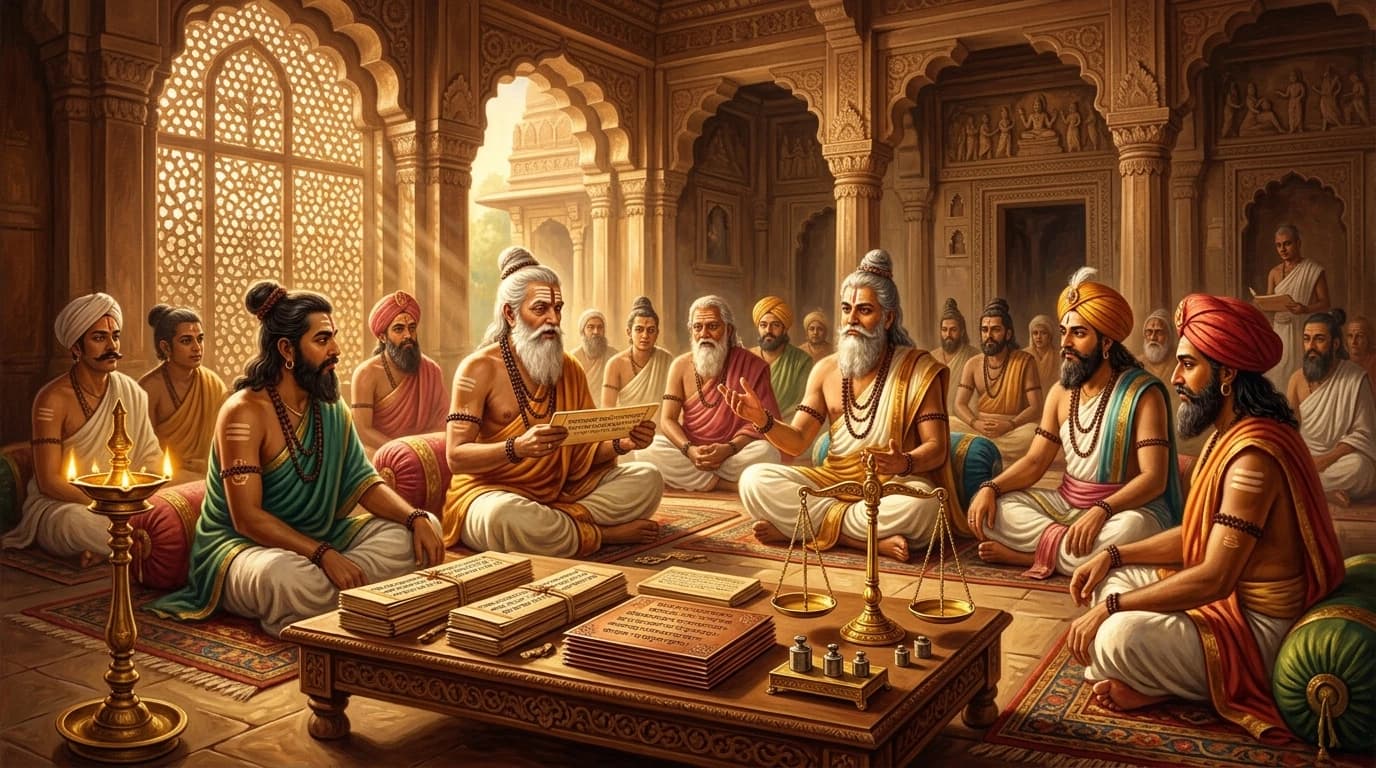
Section 1: Taxonomic Header & Etymology (Nirukta & Vyutpatti)
| Devanagari Forms | धर्मशास्त्रम् (neuter singular compound: dharma-śāstram); plural: धर्मशास्त्राणि, dharma-śāstrāṇi |
|---|---|
| IAST Transliteration | Dharmaśāstra / Dharmaśāstra-Sāhityam |
| Verbal Root (Dhātu) | Derived from two classical linguistic roots: (1) Dharma (धर्म) from √dhṛ (धृञ् धारणे — dhṛñ dhāraṇe, Pāṇinian Dhātupāṭha 1.948, class 1, "to hold, maintain, uphold, or sustain"); and (2) Śāstra (शास्त्र) derived from the verbal root √śās (शासु अनुशिष्टौ — śāsu anuśiṣṭau, class 2, "to instruct, command, govern, regulate, or teach") with the instrumental suffix -tra (Aṣṭādhyāyī 3.2.182: āto nup-upasarge), signifying an authoritative scientific treatise, code of laws, or instructional manual. |
| Grammatical Derivation (Vyutpatti) | Morphologically, Dharmaśāstra (धर्मशास्त्रम्) resolves as a Ṣaṣṭhī-Tatpuruṣa compound: धर्मस्य शास्त्रम् (Dharmasya śāstram — "The scientific treatise, instructional code, or regulatory manual of Dharma") or as an instrumental Karmadhāraya: धर्मप्रतिपादकं शास्त्रम् (Dharma-pratipādakaṃ śāstram — "The authoritative treatise that systematically establishes, regulates, and defends universal righteousness, civic law, and ethical conduct"). Unlike secular statutes derived solely from temporal sovereign fiat, Dharmaśāstra roots civil and criminal jurisprudence within cosmic sustainment (Ṛta/Dharma), balancing empirical governance with transcendent spiritual accountability. |
“That systematic body of Smṛti texts which codifies domestic conduct (Ācāra), civil and criminal law (Vyavahāra), and restorative penance (Prāyaścitta) in accordance with the Vedas and the virtuous consensus of society.”
— P. V. Kane & Classical Epigraphic Formula“Dharma sustains the created order and all peoples. Whatever embodies the capacity to uphold and preserve life is decisively recognized as Dharma.”
— Mahābhārata, Karṇa Parva 69.58Semantic Evolution & Why “Religion” is an Inadequate Translation
Across Sanskrit legal, civil, and ritual literature, Dharmaśāstra denotes three interdependent branches of codified jurisprudence:
The codification of individual duties, personal cleanliness (Śauca), dietary ethics, guest hospitality (Atithya), life-cycle sacraments (Saṃskāras from Garbhādhāna to Antyeṣṭi), and the daily ethical observances across the four stages of life (Āśramas).
The comprehensive architecture of positive civil and criminal law, court procedure, rules of evidence (Pramāṇa: witness testimony, documentary deeds, possession, and ordeals), contract enforcement, inheritance partition (Dāyabhāga), property boundaries, and royal justice (Rājadharma).
The science of moral remediation, psychological expiation, and restorative justice for intentional and unintentional transgressions (Pātaka), re-establishing spiritual equilibrium, civic belonging, and internal conscience without permanent retributive stigmatization.
Section 2: Abstract & Philosophical Core
While the Upaniṣads focus on transcendent Brahma-vidyā and the Itihāsas model Dharma through heroic narrative, the Dharmaśāstra tradition represents the systematic codification of daily ethics, civil jurisprudence, marriage (Vivāha), inheritance, royal governance (Rājadharma), and restorative justice (Prāyaścitta) across Indian civilization.
Classical Indian jurisprudence rejects both rigid, unchanging legal fundamentalism and arbitrary, rootless relativism. It anchors social stability upon four foundational principles: establishing Smṛti’s subordinate harmony to Vedic revelation, adapting legal and institutional norms dynamically to each cosmic epoch (Yuga-Dharma), identifying four complementary sources of authentic duty (Dharma-Mūla), and partitioning human action across the threefold subject matter (Tri-Skandha) of conduct, jurisprudence, and restoration.
The Four Foundational Principles of Dharmaśāstra Jurisprudence (चतुर्विध मूल सिद्धान्त)
Dharmaśāstras belong explicitly to the Smṛti category ("that which is remembered and transmitted by human sages based on Vedic roots"). As stated in Āpastamba Dharma Sūtra (1.1.1–2) and classical Mīmāṃsā maxims, whenever a rule in a Smṛti directly contradicts an explicit injunction of Śruti (Veda), the Śruti is authoritative. Smṛti derives its validity exclusively from its preservation of implicit or explicit Vedic wisdom.
Unlike rigid eternal dogma, Dharmaśāstras explicitly recognize that social rules and institutional customs must adapt across cosmic epochs (Yugas). As declared famously in Parāśara Smṛti (1.22): "Kṛte tu mānavā dharmās tretāyāṃ gautamāḥ smṛtāḥ / dvāpare dārvakāḥ proktāḥ kalau pārāśarāḥ smṛtāḥ" ("The social code of Manu applied in Satya Yuga, Gautama's code in Tretā, Śāṅkhya/Likhita in Dvāpara, and Parāśara's code is uniquely suited for Kali Yuga").
Codifying Manusmṛti 2.6 and 2.12, lawbooks trace authentic duty to: (1) Śruti (the timeless Vedic revelation); (2) Smṛti & virtuous character (Śīla) of those who know the Veda; (3) Sadācāra (the lived exemplary practice of wise elders); and (4) Ātmatuṣṭi (the approval of a purified conscience in ambiguous gray zones).
Every classical Dharmaśāstra is structured across three core pillars: Ācāra (daily personal rituals, cleanliness, hospitality, life-cycle rites, and spiritual discipline); Vyavahāra (civil and criminal jurisprudence, court procedures, evidence, contract law, debt, assault, property disputes, and royal justice); and Prāyaścitta (restorative penance, moral purification, and remedial action for ethical transgressions).
Section 3: Primary Scriptural Anchors (Śruti, Smṛti, and Itihāsa)
The entire Veda is the root source of Dharma, and [subsequently] the remembered tradition (Smṛti) and virtuous character (Śīla) of those who know the Veda, the lived exemplary conduct of virtuous elders (Sadācāra), and the satisfaction of one's own purified conscience (Ātmanas-tuṣṭi).
This seminal shloka provides the foundational constitutional axiom of classical Hindu jurisprudence. It establishes an inverted pyramid of legal authority: when an unambiguous Vedic injunction exists, it supersedes all secondary codes; where the Veda is silent, the Smṛtis of certified rishis prevail; where written texts offer no explicit rule, the Sadācāra (established living custom) of uncorrupted community elders provides the binding precedent; and when confronting novel moral dilemmas where customs conflict, the enlightened conscience (Ātmatuṣṭi) of a disciplined, desire-free person determines the righteous course.
Manu, Vyāsa, Viṣṇu, Hārīta, Yājñavalkya, Yama, Aṅgiras, Kātyāyana, Bṛhaspati, Śaṅkha, Likhita, Gautama, Āpastamba, and Vasiṣṭha—these are the classical promulgators of the Dharmaśāstras.
Maharṣi Yājñavalkya enumerates the classical authors whose legal treatises are recognized as canonical authorities across the Indian subcontinent. This tradition is polyphonic and collective rather than monarchical: no single ruler or prophet possessed a monopoly over law. Instead, diverse legal academies across the northern, southern, and eastern regions composed and debated specialized treatises, which later commentators harmonized into a Pan-Indian jurisprudence through Nibandhas and commentaries.
Section 4: Structural Architecture — Kalpasūtra Roots to Nibandha Compendia
The literature of Dharmaśāstra spans more than two millennia of continuous jurisprudential evolution, transitioning from archaic Vedic prose aphorisms to classical metrical treatises, sophisticated analytical commentaries, and comprehensive medieval legal digests (Nibandhas):
1. The Historical Evolution of Dharmaśāstra Literature (धर्मशास्त्र साहित्यस्य चतुर्विध विकास-क्रमः)
The literature evolved across four great historical phases over more than a millennium—from archaic Vedic prose aphorisms to classical metrical treatises, analytical commentaries, and encyclopedic medieval compendia:
| Historical Phase & Era | Phase Name & Sanskrit | Core Texts & Literary Form | Jurisprudential Milestones & Evolution |
|---|---|---|---|
Phase I c. 600–300 BCE | The Kalpasūtra Period (Dharma-sūtras) कल्पसूत्र काल (धर्मसूत्र साहित्य) | Gautama, Āpastamba, Baudhāyana, & Vasiṣṭha Dharma-sūtras Dense, rhythmic Sanskrit prose aphorisms (Sūtras) embedded within Vedic Śākhā appendices | The earliest formal legal and ritual prose manuals embedded within Vedic appendices, divided into Dharma-sūtras alongside Śrauta and Gṛhya Sūtras. Focuses on domestic sacrifices, personal purity, initial civic rules, and customary community sanctions. |
Phase II c. 200 BCE – 400 CE | The Metrical Smṛti Period (Mānava to Parāśara) पद्यमय स्मृति काल | Manusmṛti (Mānava-Dharmaśāstra), Yājñavalkya Smṛti, Nārada Smṛti, Parāśara Smṛti Flowing classical Sanskrit Ślokas (Anuṣṭubh meter) designed for widespread oral recitation | The transition from prose Sūtras to flowing Sanskrit Ślokas, led by the Manusmṛti, followed by the Yājñavalkya Smṛti and Parāśara Smṛti. Introduces systematic classification of eighteen titles of law (Vyavahārapada), specialized court evidentiary rules, and royal administration. |
Phase III c. 600–1200 CE | The Classical Commentary Period (Bhāṣya & Ṭīkā) भाष्य एवं टीका काल | Medhātithi’s Manubhāṣya, Vijñāneśvara’s Mitākṣarā, Jīmūtavāhana’s Dāyabhāga, Kullūka Bhaṭṭa Rigorous legal commentary, Pūrva Mīmāṃsā dialectic, sentence-by-sentence analytical gloss | Master commentators provided rigorous legal and philosophical analysis—such as Medhātithi's Manubhāṣya (9th c.), Vijñāneśvara's Mitākṣarā (12th c. commentary on Yājñavalkya Smṛti, which became the legal bedrock of the Hindu Law of Inheritance across most of India), and Jīmūtavāhana's Dāyabhāga (law code predominant in Bengal). |
Phase IV c. 1200–1800 CE | The Digest & Compendium Period (Nibandhas) निबन्ध एवं सारसङ्ग्रह काल | Smṛticandrikā (Devaṇa Bhaṭṭa), Caturvargacintāmaṇi (Hemādri), Vivādacintāmaṇi, Mayūkha treatises Exhaustive encyclopedic compendia arranging thousands of verses thematically across topics | Comprehensive legal encyclopedias synthesizing thousands of conflicting Smṛti rules for specific historical eras—such as Caṇḍeśvara's Smṛticandrikā, Hemādri's Caturvargacintāmaṇi, and Todar malla / Nīlakaṇṭha Bhaṭṭa's Bhūskara / Mayūkha treatises, resolving regional legal differences. |
2. The Threefold Subject Matter of Dharmaśāstra (धर्मशास्त्र त्रिस्कन्ध)
Every canonical Dharmaśāstra treatise is structured across three core institutional pillars: personal conduct (Ācāra), judicial dispute resolution (Vyavahāra), and moral rehabilitation (Prāyaścitta):
Institutional Content: Daily personal rituals, cleanliness (Śauca), hospitality, life-cycle rites (Saṃskāras), dietary ethics, morning and evening Sandhyā, and spiritual discipline governing the four life stages (Brahmacarya, Gṛhastha, Vānaprastha, Sannyāsa).
Canonical Maxim: Ācāraḥ prathamo dharmaḥ ("Righteous personal conduct is the foremost foundation of Dharma" — Manusmṛti 1.108).
Institutional Content: Civil and criminal jurisprudence, court procedures, evidence, contract law, debt, assault, property disputes, and royal justice (Rājadharma). Codified into the 18 Titles of Law (Aṣṭādaśa Vyavahārapada) including debt recovery, deposit disputes, partnership, boundary demarcations, and inheritance partition.
Canonical Maxim: Dharmo rakṣati rakṣitaḥ ("Dharma protects when it is protected; violated Dharma destroys the violator" — Manusmṛti 8.15).
Institutional Content: Restorative penance, moral purification, and remedial action for ethical transgressions. Bridges subjective psychological guilt with objective restorative deeds (tapas, charity, fasting, pilgrimage, and public restitution) to restore social and moral harmony.
Canonical Maxim: Kṛtvā pāpaṃ hi santāpāt tasmāt pāpāt pramucyate ("By genuine remorse, confession, and compensatory penance, the soul is liberated from guilt" — Manusmṛti 11.230).
Section 5: Comparative Darśana & Sampradāya Perspectives (Bhāṣya Analysis)
The legal, civil, and ethical jurisprudence of the Dharmaśāstras operates in profound synergy with classical Indian philosophy—drawing its hermeneutical rules of textual reconciliation from Pūrva Mīmāṃsā while subordinating external civil codes to the transcendent spiritual telos of Vedānta:
1. Pūrva Mīmāṃsā Hermeneutics & Legal Interpretation (मीमांसा न्याय)
Maharṣi Jaimini, Śabarasvāmin, Kumārila Bhaṭṭa, & Prabhākara MiśraClassical Dharmaśāstra utilized the linguistic and interpretive rules of Pūrva Mīmāṃsā (such as Śruti-Liṅga-Vākya-Prakaraṇa-Sthāna-Samākhyā) to resolve legal ambiguities, determine whether a scriptural statement was mandatory injunction (Vidhi) or optional recommendation (Niyama / Vikalpa), and distinguish civil law from moral counsel. When texts appear contradictory, Mīmāṃsā hermeneutics establishes that an explicit statement (Śruti) invalidates an indirect inference (Liṅga), ensuring that legal interpretation remains objective and resistant to individual caprice.
2. Vedānta & Transcendent Spiritual Conscience (वेदान्त एवं आत्मतुष्टि)
Medhātithi, Ādi Śaṅkarācārya, Vijñāneśvara, & Mādhava VidyāraṇyaMaster commentators like Medhātithi emphasize that while Dharmaśāstra regulates external social and civil conduct, ultimate spiritual liberation (Mokṣa) transcends legalism, requiring inward purity and Brahma-vidyā. In the Vedāntic perspective, external observance of statutory codes without internal non-attachment (Niṣkāma Karma) produces only temporary karmic merits (Puṇya). Dharmaśāstra functions as the indispensable preparatory moral foundation (Śama, Dama, Śauca) that cleanses the mind (Citta-śuddhi), enabling the aspirant to transcend social identity and awaken to the non-dual Self.
Section 6: Verified Academic & Traditional Bibliography
Primary Sanskrit texts cited according to their standard critical editions, supplemented by classical commentaries and twentieth-century Indological scholarship: