
Samaveda Samhita(सामवेद संहिता)
The Veda of sacred melody, liturgical song, and acoustic contemplative vibration
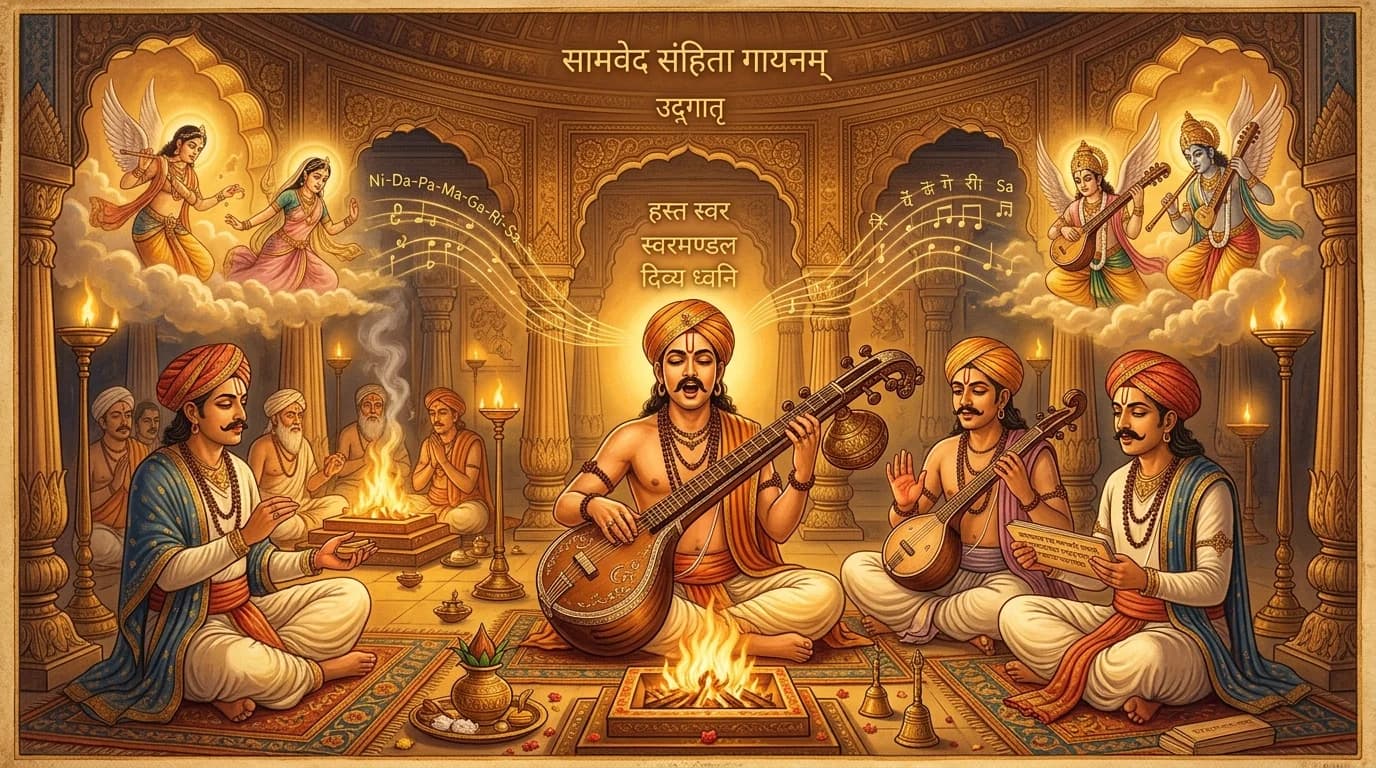
Section 1: Taxonomic Header & Etymology (Nirukta & Vyutpatti)
| Devanagari Forms | सामवेदसंहिता (Compound of सामन् [sāman] + वेद [veda] + संहिता [saṃhitā]) |
|---|---|
| IAST Transliteration | Sāmaveda-Saṃhitā |
| Verbal Root (Dhātu) | Derived from the verbal root √sā (सा — sātanānta, "to finish, bring to harmony") or √sam (सम् — saṃstave, "to praise, accord, unite"). |
| Grammatical Derivation (Vyutpatti) | In the Bhadra Upaniṣad and Chāndogya Upaniṣad (1.3.4: स इति प्राणः म इति सा तस्मात्साम — Sa iti prāṇaḥ, ma iti sā, tasmāt sāma), Sāman is etymologically resolved as the harmonious fusion of Sa (Prāṇa / cosmic energy / the verse) and Amā (Earth / speech / the melody). It denotes a sacred verse (Ṛc) set to vibrant musical modulation. Veda signifies unauthored primordial knowledge (Apauruṣeya-jñāna), and Saṃhitā designates the canonical, ordered liturgical compilation. |
“That which is designated as Sāman is essentially characterized by musical chanting (Gīti).”
— Maharṣi Jaimini (Mīmāṃsā Sūtra 2.1.36) & SāyaṇācāryaSemantic Evolution & Why “Religion” is an Inadequate Translation
The morphological compound Sāmaveda-Saṃhitā unites three foundational concepts of classical Vedic hermeneutics, moving from sonic vibration to liturgical system:
Derived from √sā ("to bring to harmony") and resolved in the Chāndogya Upaniṣad as Sa (vital breath) united with Amā (vocal sound). A verse becomes a Sāman when elevated by melodic scales and microtonal inflections.
Unauthored acoustic revelation heard (Śruti) by ancient Ṛṣis in states of superconscious meditation, transcending temporal biographical authorship.
The structured, systematic arrangement of verses designed for the Udgātṛ priest’s ceremonial recitation and internal contemplative absorption during solemn yajñas.
Section 2: Abstract & Philosophical Core
The Sāmaveda Saṃhitā is humanity's oldest surviving codification of sacred musical art, melodic science, and contemplative chant. While the Ṛgveda provides the raw verbal poetry (Ṛc), the Sāmaveda transforms that poetry into soaring liturgical song (Sāman), recognizing that human emotion, cosmic alignment, and spiritual liberation are most deeply awakened not by spoken prose, but through musical vibration (Nāda-brahman).
Out of its total 1,875 verses (in the Kauthuma recension), all but 75 mantras are directly drawn from the Ṛgveda (primarily Maṇḍalas 8 and 9, dedicated to Agni, Indra, and Pavamāna Soma). The genius of the Sāmaveda does not lie in inventing new poetic texts, but in musical transformation: rearranging and modulating those verses through the application of melodic notes (Svaras), prolonged vocalizations (Stobhas), rhythmic intervals, and choral harmonies.
Four Foundational Principles of Sāmavedic Philosophy (चतुर्विध मूल दर्शन)
Music is not treated as mere aesthetic entertainment, but as the direct acoustic embodiment of the Supreme Absolute. By attuning the human voice to precise microtonal intervals (Śrutis) and scales (Grāmas), the singer realizes identity with the cosmic order.
The chanting of Sāman requires rigorous breath control (Prāṇāyāma), uniting lung capacity, vocal vibration, and meditative interiority.
The Sāmaveda is intimately bound to the extraction and offering of Soma—the symbol of divine bliss (Ānanda) and expanded consciousness.
The philosophical crown of the Sāmaveda is the Chāndogya Upaniṣad, which begins with the contemplative meditation on the sacred syllable Om (Udgītha) as the essence of all existence.
Section 3: Primary Scriptural Anchors (Śruti, Smṛti, and Itihāsa)
We invoke Agni for our protection—the bountiful, the all-knowing invoker. Thee, O resplendent one, we praise in the ecstasy of our hymns.
When chanted in the Sāmaveda tradition, this foundational verse undergoes transformation into the Agneya Gāna (forest and village melodies), where letters are lengthened, sacred Stobha syllables (hoi, hau, vā, hi) are inserted, and microtonal inflections lift the listener from ordinary speech into meditative trance.
One should meditate on this sacred syllable Om as the Udgītha (the supreme chanted song). For one sings the Sāman starting with Om. Here is the detailed exposition thereof.
Opening the Chāndogya Upaniṣad, this verse establishes Om (Praṇava) not merely as an audible sound, but as the cosmic vibration underlying all creation. The Udgātṛ priest begins every chant with Om, signaling the elevation of speech from physical communication to divine communion.
Section 4: Structural Architecture & Recensions (Śākhās)
The Sāmaveda Saṃhitā possesses a unique two-part structure designed specifically for musical transmission, liturgical performance, and interiorized sonic meditation. Unlike the poetic arrangement of the Ṛgveda, the verses here are organized according to melodic application (Gāna), deity-dedication, and sacrificial sequence.
1. The Canonical Two-Part Division (द्विविध आर्चिक व्यवस्था)
| Section Name | Verse Count | Primary Liturgical Focus | Textual Organization & Chanting Mode |
|---|---|---|---|
The Pūrvārcika पूर्वार्चिक Pūrvārcika | 650 hymns | Individual meditation, foundational melody, and vocal exercises | Arranged in six Prapāṭhakas grouped by devatās: Āgneya Parvan (dedicated to Agni, the cosmic fire), Aindra Parvan (dedicated to Indra, supreme divine willpower), and Pavamāna Parvan (dedicated to Soma, ecstatic divine consciousness), concluding with an Āraṇyaka supplement for forest contemplation. |
The Uttarārcika उत्तरार्चिक Uttarārcika | 1,225 stanzas | Liturgical application in public Śrauta rituals (Stomas & Sattras) | Composed almost entirely of triplets (Tṛcas), where the first mantra establishes the melodic template (Yoni) from the Pūrvārcika and the subsequent two verses are sung according to that identical melody during major soma sacrifices. |
2. The Four Canonical Songbooks (गान-ग्रन्थ चतुष्टय — Gāna Corpus)
The verses of the Saṃhitā are chanted using four musical manuals that codify exact melody (Svara), vowel prolongations, microtonal shifts, and liturgical interjections (Stobhas):
Melodies sung publicly in settlements and community assemblies. These constitute the fundamental baseline melodies (Prakṛti) of the Sāmaveda tradition.
Esoteric, spiritually potent melodies reserved for chanting in wilderness and forest retreats away from profane domestic distraction.
Mystical transpositions and liturgical adaptations of Grāmageya melodies applied directly to the mantras of the Uttarārcika during actual sacrificial rites.
The most esoteric, secret musical adaptations applied to Āraṇyaka verses, practiced only by initiated master chanters.
3. Principal Extant Recensions (प्रमुख शाखा विस्तार — Three Living Lineages)
While the Caraṇavyūha records that the Sāmaveda once possessed 1,000 recensions (Sahasratmā sāma-vedastaḥ), three primary lineages have been preserved across the Indian subcontinent:
1. Kauthuma Śākhā
कौथुम शाखाThe most widely preserved and documented recension today. Characterized by balanced melodic cadence, systematic notation manuscripts, and extensive pedagogical literature.
2. Rāṇāyanīya Śākhā
राणायानीय शाखाClosely related to Kauthuma in textual content, with slight differences in musical accentuation, lengthening of vowels, and phonetic inflection during choral execution.
3. Jaiminīya (Talavakāra) Śākhā
जैमिनीय (तलवकार) शाखाA rare, archaic lineage preserving unique musical intervals, profound microtonal modulations, and distinct textual literature including the monumental Jaiminīya Brāhmaṇa.
4. The Associated Sāmavedic Corpus (सम्बद्ध ब्राह्मण, उपनिषद् एवं सूत्र साहित्य)
The liturgical, contemplative, and ritual texts organically linked to the Sāmaveda tradition:
Brāhmaṇas (ब्राह्मण ग्रन्थ)
Principal Upaniṣads (उपनिषदः)
Kalpa Sūtras (श्रौत एवं गृह्य सूत्राणि)
Section 5: Comparative Darśana & Sampradāya Perspectives (Bhāṣya Analysis)
In classical Indian hermeneutics, the Sāmaveda occupies a dual role: as an invariant ritual injunction (Niyoga) in Pūrva Mīmāṃsā, and as the supreme contemplation of non-dual acoustic reality (Nāda-Brahman & Udgītha) in Vedānta:
1. Pūrva Mīmāṃsā & Vedic Musicology
Maharṣi Jaimini & ŚabarasvāminMīmāṃsā establishes that the musical articulation (Gīti) of the Sāman is not arbitrary artistic license, but an invariant scriptural injunction (Niyoga). Every prolongation of vowels, tonal shift across the seven notes (Svaras: Krūṣṭa, Prathama, Dvitīya, Tṛtīya, Caturtha, Mandra, Atisvārya), and insertion of Stobha sounds (such as hau, hāyī, vā) carries exact ritual and spiritual efficacy. The acoustic form is ontologically inseparable from its transcendental fruit (Apūrva).
2. Advaita Vedānta & Nāda-Brahman
Ādi ŚaṅkarācāryaCommenting on Chāndogya Upaniṣad 1.1, Ādi Śaṅkarācārya explains that just as honey is gathered from diverse flowers and unified into a single nectar, all physical sounds and sensory perceptions resolve into Om and Sāman, leading the contemplative seeker to experience non-dual peace. In Vedāntic metaphysics, Sāman chant serves as an interiorized Upāsanā (contemplative meditation) where the Udgātṛ priest merges acoustic resonance into pure witness consciousness (Sākṣī-caitanya).
Section 6: Verified Academic & Traditional Bibliography
Primary Sanskrit texts cited according to their standard critical editions, supplemented by classical commentaries and twentieth-century Indological scholarship: