
Karma(कर्म)
The causal law of volitional action, moral agency, and consequence
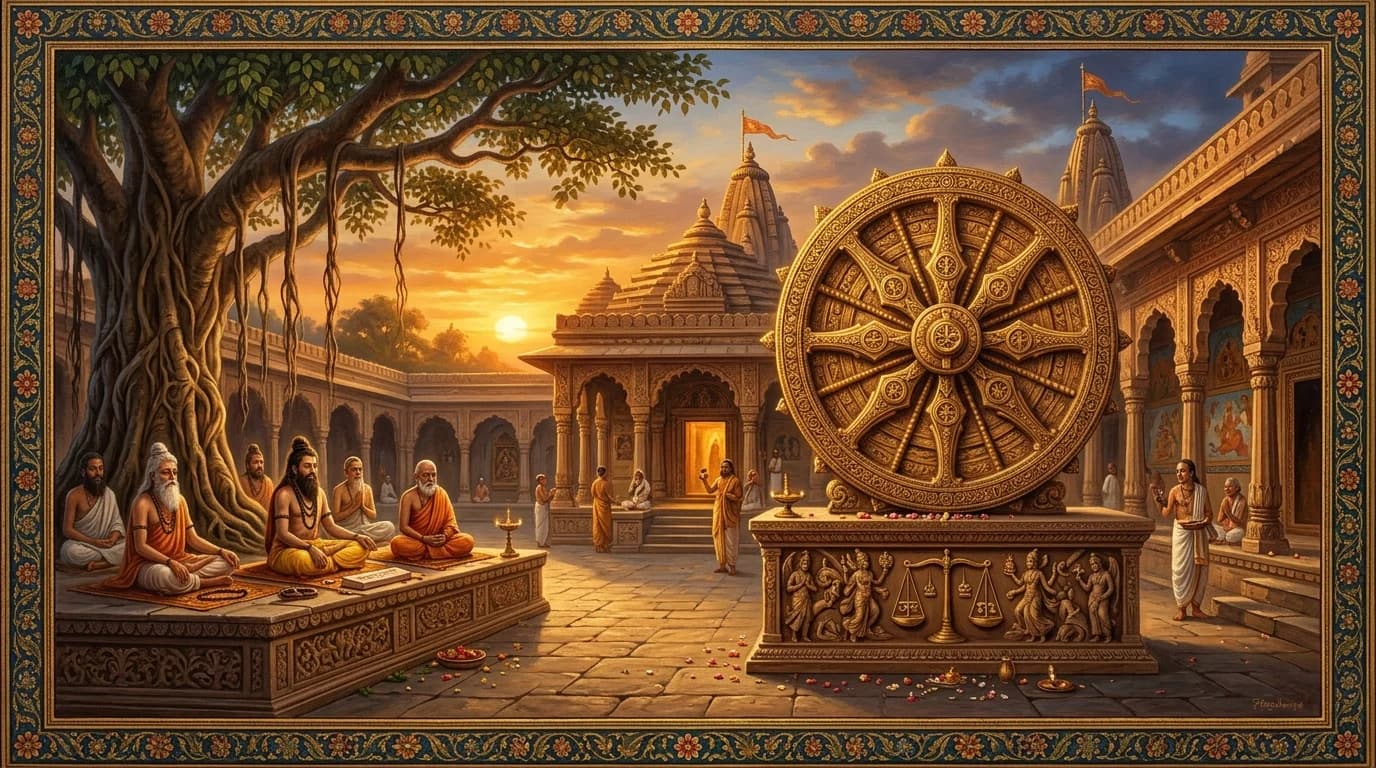
Section 1: Taxonomic Header & Etymology (Nirukta & Vyutpatti)
| Devanagari Forms | कर्म (Classical Sanskrit nominative singular); कर्मन् (Vedic and Classical neuter n-stem: kárman) |
|---|---|
| IAST Transliteration | Karma / Kárman |
| Verbal Root (Dhātu) | Derived from the Sanskrit root √kṛ (कृ), cataloged in Pāṇini’s Dhātupāṭha under class 8 (tanādigana, 8.10: डुकृञ् करणे — ḍukṛñ karaṇe, "to do, make, execute, accomplish, fashion"). The ubhayapada indicator ñ signifies that the root takes both Parasmaipada (active endings, when the result of action is directed outward) and Ātmanepada (middle/reflexive endings, when the fruit of action accrues back to the agent, kartṛgāmini kriyāphale). |
| Grammatical Derivation (Vyutpatti) | Formed via Uṇādi Sūtra 4.144 (sarvadhātubhyaḥ manin), which attaches the primary suffix -man (manin) to the root √kṛ with guṇa vowel strengthening (√kṛ + man → karman), signifying the act itself, its execution, and its enduring trace. |
“That which is performed or brought into being through volitional agency is Karma.”
— Classical Sanskrit Lexicons & Pāṇinian GrammarSemantic Evolution: From Liturgical Act to Universal Moral Causality
Across the history of Sanskrit thought, the term karman underwent a profound philosophical expansion across three distinct yet continuous horizons:
In the Ṛgveda and Brāhmaṇas, karman referred primarily to sacred liturgical action (Yajña) performed with exact phonetic and procedural precision to sustain cosmic order (Ṛta).
In the Bṛhadāraṇyaka and Chāndogya Upaniṣads, the concept of ritual efficacy was internalized and universalized. Every intentional human action—mental (Mānasika), vocal (Vācika), and physical (Kāyika)—was recognized as a seed planted in consciousness that shapes character and future embodiment.
In the Bhagavad Gītā, Mahābhārata, and the six Darśanas, Karma is articulated as a dual reality: it is both the volitional act performed in the present and the latent causal potential (Saṃskāra, Adṛṣṭa, or Apūrva) that bridges the temporal gap between an action and its eventual maturation (Vipāka).
Section 2: Abstract & Philosophical Core
Within Sanātana Dharma, the doctrine of Karma answers two of humanity’s deepest existential inquiries: Why do sentient beings experience vastly unequal conditions of joy, sorrow, and innate disposition? and How can an individual exercise authentic moral freedom within a lawful universe?
Karma is the extension of the law of cause and effect (Kārya-kāraṇa-bhāva) from the physical realm into the psychological and moral realms. Just as no physical event occurs without an antecedent cause, no moral choice vanishes into nothingness. Every intentional act operates simultaneously on two planes:
The Two Planes of Karmic Causality (द्विविध फल एवं संस्कार)
The immediate or delayed external consequence in the world, returning to the agent environments and relationships commensurate with their actions.
The immediate internal transformation of the agent’s own mind (Citta). Every repeated thought or deed grooves a subtle pathway (Saṃskāra) in the subconscious, crystallizing into habitual tendencies (Vāsanās) and character (Śīla).
Crucially, Indian philosophy distinguishes Karma from involuntary biological reflexes (Kriyā). Respiration, digestion, or accidental physical contact devoid of intent do not generate binding moral Karma. Binding Karma requires Abhisandhi (conscious intention) and Ahaṃkāra (egoistic identification with agency: "I am the doer, and the fruit belongs to me"). Consequently, when action is performed with full mindfulness and compassion, yet completely emptied of egoistic craving and possessiveness (Niṣkāma Karma), the act ceases to bind the soul and becomes the primary instrument of inner purification (Citta-śuddhi) and spiritual freedom (Mokṣa).
Section 3: Primary Scriptural Anchors (Śruti, Smṛti, and Darśana)
According as one acts and according as one conducts oneself, so does one become: the doer of good becomes good, the doer of harm becomes harmful. One becomes virtuous by virtuous action, and corrupt by corrupt action. Others, however, declare that a person consists of desire (Kāma) alone: as is one's desire, so is one's determinate will (Kratu); as is one's will, so is the action (Karma) one performs; and whatever action one performs, into that very state one is transformed.
Taught by Sage Yājñavalkya to King Janaka, this is the locus classicus of the Upaniṣadic psychology of Karma. Ādi Śaṅkarācārya notes in his Bhāṣya that outward action (Karma) is never an isolated event; it is the downstream crystallization of Kāma (deep-seated longing) and Kratu (focused cognitive determination). Transforming one's destiny therefore begins with purifying one's innermost desires and resolve.
Work performed for any purpose other than Yajña (selfless sacred offering) binds this world in the fetters of action. Therefore, O Kaunteya, perform your action for that sake alone, free from attachment.
Here Bhagavān Śrī Kṛṣṇa resolves the ancient tension between active life (Pravṛtti) and ascetic renunciation (Nivṛtti). Action itself does not bind the soul; only selfish motive (Saṅga) binds. Notice the verb sam-ā-cara ("perform thoroughly and well"): non-attachment does not mean careless or half-hearted execution, but supreme excellence offered to the Divine and the welfare of all beings.
For the true nature of right action (Karma) must be known, so too that of perverse action (Vikarma), and also that of inaction (Akarma); unfathomably subtle is the course of action. He who sees actionlessness in action, and action in inaction—he is wise among human beings; he is a yogi who has accomplished all action.
Why is the course of Karma subtle (gahanā)? First, someone may sit physically motionless (Akarma outwardly) while mentally seething with envy or ambition—thereby performing intense binding Karma inwardly ("seeing action in inaction"). Conversely, a sage or Karma-yogī may engage in strenuous worldly duty (Karma outwardly) while remaining anchored in the unchanging witness consciousness (Ātman) free from ego-agency—thereby remaining untouched by karmic bondage ("seeing actionlessness in action").
The latent reservoir of karmic impressions (Karmāśaya) has its root in the five afflictions (Kleśas) and is experienced in either the visible present birth or unseen future births. So long as that root remains intact, the reservoir ripens into three results: birth-environment (Jāti), duration of life (Āyuḥ), and the quality of life-experiences (Bhoga).
In his Yoga-bhāṣya, Maharṣi Vyāsa compares karmic seeds to grains of rice: so long as a rice grain is encased in its husk (Kleśas—specifically Avidyā or spiritual ignorance), it will sprout when watered. Once the husk of Avidyā is removed or the seed is roasted in the fire of meditative wisdom (Jñānāgni), the Karmāśaya can no longer sprout into future bondage.
Just as a seed cast without a cultivated field remains barren and fruitless, even so destiny (Daiva, the momentum of past actions) cannot accomplish anything without present human effort (Puruṣakāra).
Spoken by Grandfather Bhīṣma to Yudhiṣṭhira, this verse refutes fatalism (Daivavāda). What is called Daiva ("fate") is nothing other than Puruṣakāra (human effort) performed in the past; therefore, conscious human effort in the present has the power to modify, redirect, or overcome past momentum.
Section 4: The Architecture & Taxonomies of Karma
Classical texts organize the operations of Karma across three complementary analytical frameworks:
1. The Temporal Triad (Trikāla-Karma)(त्रिकाल कर्म वर्गीकरण)
Formulated across the Upaniṣads, Brahma Sūtras (4.1.13–19), and Vedāntic Prakaraṇa treatises (such as Tattvabodha and Vivekacūḍāmaṇi), karmic momentum is divided into three temporal states, illustrated through the classical Dhanurdhara-dṛṣṭānta (Analogy of the Archer):
| Category | Sanskrit Term | Causal Status | Classical Archer Analogy & Soteriological Impact |
|---|---|---|---|
1. Accumulated Repository | सञ्चित कर्म Sañcita Karma | Latent seeds of all past actions stored in the causal body (Kāraṇa-śarīra), awaiting appropriate conditions to sprout. | Arrows stored in the quiver on the archer's back. Upon the dawn of liberating self-knowledge (Jñāna), the entire storehouse of Sañcita Karma is roasted and rendered non-germinating (Bhagavad Gītā 4.37: jñānāgniḥ sarva-karmāṇi bhasmasāt kurute). |
2. Fructifying / Operative Karma | प्रारब्ध कर्म Prārabdha Karma | That specific portion of Sañcita Karma which has already been activated to construct the present physical body and its baseline life circumstances. | The arrow already released from the bowstring. Because its kinetic momentum is already in flight, Prārabdha continues until the physical body completes its natural span, though the wise person experiences it without inner suffering or identification. |
3. Current & Future-Oriented Karma | क्रियमाण / आगामी कर्म Kriyamāṇa / Āgāmī Karma | Volitional actions being performed in the present moment (Kriyamāṇa) and the future trajectories they set in motion (Āgāmī). | The arrow currently held in the archer's hand on the bowstring. The agent possesses full conscious sovereignty to aim, redirect, or withhold it. For a liberated sage (Jīvanmukta), present actions leave no binding trace—like a line drawn on water. |
Classification of Prārabdha Sub-types (वेदान्त-प्रक्रिया)
Experiences desired or actively sought through one's own inclinations and established habit patterns.
Experiences arriving unbidden and unsought through environmental, biological, or unforeseen cosmic circumstances.
Experiences endured through the conscious decisions, dependencies, or actions of others.
2. The Fourfold Ritual & Ethical Classification(चतुर्विध वैदिक एवं नैतिक कर्म)
Mīmāṃsā & Vedānta SystemsRegular practices of physical, mental, and ecological harmony—such as daily meditation (Sandhyāvandana), gratitude offerings, and the Pañca Mahāyajñas. Performing them purifies the mind (Citta-śuddhi); neglecting them causes spiritual stagnation (Pratyavāya).
Responsibilities arising on specific occasions—such as life-cycle rites (Saṃskāras), hospitality to an unexpected guest (Atithi-satkāra), or relief work during community crises.
Optional rites or worldly endeavors undertaken to secure a specific personal reward (wealth, prestige, or celestial enjoyment). While permissible within Dharma, Kāmya Karma perpetuates the cycle of desire and rebirth (Saṃsāra).
Actions that violate Satya and Ahiṃsā—such as cruelty, deceit, theft, or exploitation. These degrade the agent’s consciousness and generate Pāpa (moral demerit).
3. The Fourfold Qualitative Classification in Yoga
Purely harmful, cruel, and unethical actions performed by the malicious, producing acute internal suffering and spiritual degradation.
Ordinary external actions that inevitably mix benefit to some with unintended inconvenience or harm to tiny organisms, generating mixed karmic fruits.
Purely virtuous internal acts—such as austerity (Tapas), scriptural study (Svādhyāya), and meditation (Dhyāna)—that inflict zero harm on any living being.
The transcendent, non-binding actions of the realized Yogi who has renounced all egoistic craving for fruits and acts solely in alignment with universal consciousness.
Section 5: Comparative Darśana & Sampradāya Perspectives (Bhāṣya Analysis)
A major philosophical question unites and distinguishes the classical Indian schools: Since an action (Karma) is an event that ceases to exist the moment it is completed, and its fruit (Phala) may appear years or lifetimes later, what bridges the temporal gap between the perished act and the future result, and who oversees its distribution?
1. Pūrva Mīmāṃsā
Jaimini, Śabarasvāmin, Kumārila Bhaṭṭa, Prabhākara MiśraEarly Mīmāṃsā operates without positing a creator deity (Īśvara) as a judicial distributor of karmic fruits, arguing instead that cosmic moral law is completely self-executing. Commenting on Mīmāṃsā Sūtra 2.1.5, Śabara and Kumārila explain that a righteous act immediately generates an imperceptible, supersensible potency called Apūrva (अपूर्व — "that which did not exist prior to the act"). In the Bhāṭṭa school, Apūrva resides as a latent power within the eternal soul (Ātman) until the appropriate time, place, and physical conditions converge for its fruition.
2. Nyāya & Vaiśeṣika
Gautama, Kaṇāda, Praśastapāda, Vātsyāyana, UdayanaIn Nyāya-Vaiśeṣika, righteous and unrighteous actions deposit two specific qualities (Guṇas) directly into the substantive soul: Dharma (merit) and Adharma (demerit), collectively termed Adṛṣṭa (अदृष्ट — "The Unseen"). However, Udayana and Vātsyāyana (Nyāya-bhāṣya on 4.1.19–21) argue rigorously that Adṛṣṭa itself is unconscious (Acetanam / Jaḍa); an insentient moral trace cannot independently calculate cosmic justice or organize physical atoms into a matching environment. Therefore, Nyāya establishes Īśvara (God) as the omniscient efficient cause (Nimitta-kāraṇa) who supervises the maturation of Adṛṣṭa strictly in accordance with each soul's own moral choices.
3. Sāṃkhya & Classical Yoga
Kapila, Īśvarakṛṣṇa, Patañjali, Maharṣi VyāsaHere, Karma is stored within the Liṅga-śarīra / Sūkṣma-śarīra (the subtle body, specifically the Buddhi or Citta), which transmigrates from one physical body to another like fragrance carried by the wind from a flower. In Sāṃkhya Kārikā 67, Īśvarakṛṣṇa introduces the celebrated Kulāla-cakra-nyāya (Analogy of the Potter's Wheel): when the potter stops pedaling (upon attaining liberating wisdom), the wheel continues to spin for a brief period due to previously imparted momentum (Prārabdha-saṃskāra) before coming to a complete, peaceful halt (Kaivalya).
4. Advaita Vedānta
Ādi Śaṅkarācārya, Padmapāda, Sureśvara, Vācaspati MiśraŚaṅkarācārya analyzes Karma across two levels of reality: 1. Vyāvahārika Satya (Transactional/Empirical Reality): On the empirical plane, the law of Karma is inviolable. In Brahma Sūtra 2.1.34, Bādarāyaṇa and Śaṅkara absolve Īśvara of partiality (Vaiṣamya) or cruelty (Nairghṛṇya) in creation: Īśvara is like the rain (Parjanya). Rain falls equally as the universal common cause, while the specific rice, barley, or thorny shrub that grows depends entirely on the specific seed (Karma) planted by each individual Jīva. 2. Pāramārthika Satya (Absolute Reality): From the standpoint of the non-dual Ātman (Brahman), the Self is eternally actionless (Akartā), unattached (Asaṅga), and ever-free (Nitya-mukta). Agency (Kartṛtva) and enjoyership (Bhoktṛtva) belong only to the mind-body complex through superimposition (Adhyāsa). Consequently, Śaṅkara rejects Jñāna-karma-samuccaya (the claim that ritual action and self-knowledge can be combined as co-equal direct causes of liberation), because action rests on the sense of dualistic agency whereas self-knowledge dissolves it. Rather, selfless Karma Yoga purifies the mind (Citta-śuddhi), leading to the dawn of Jñāna, which alone reveals eternal freedom.
5. Viśiṣṭādvaita Vedānta
Śrī Rāmānujācārya, Vedānta Deśika, Sudarśana SūriRefuting the Mīmāṃsā notion of an autonomous, impersonal Apūrva, Rāmānuja defines Puṇya (merit) and Pāpa (demerit) directly in terms of Bhagavat-prīti (the pleasure of the Supreme Lord Nārāyaṇa) and Bhagavan-nigraha (His corrective displeasure). While individual souls (Jīvas) possess genuine moral agency (Kartṛtva) granted by the Lord—and are therefore morally responsible for their choices (Brahma Sūtra 2.3.41)—every action performed as Karma Yoga integrates self-discipline with devotion, culminating in Bhakti Yoga and Prapatti (wholehearted surrender to Divine Grace).
6. Dvaita Vedānta
Śrī Madhvācārya, Jayatīrtha, VyāsatīrthaMadhvācārya emphasizes that while the stream of Karma is beginningless (Anādi), it is completely dependent (Paratantra) upon the sovereign will of Lord Viṣṇu (Svatantra). Human beings act as real, responsible agents whose choices express their innate disposition (Svabhāva), yet they must renounce the false conceit of independent ownership over their powers (Kartṛtva-abhimāna-tyāga), offering every deed at the feet of Hari (Kṛṣṇārpaṇam astu).
7. Śaiva Siddhānta & Kashmir Śaivism
Meykaṇḍār, Tirumular, Abhinavagupta, KṣemarājaIn the Āgamic Śaiva traditions, Karma is classified as Kārma-mala—one of the three primordial fetters (Pāśa / Malatraya, alongside Āṇava-mala and Māyīya-mala) that contract the soul's infinite consciousness. While ethical and ritual Karma matures the soul to the point of Malaparipāka (the equal balancing and ripening of karmic tendencies), final liberation requires Śaktipāta—the descent of Lord Śiva's liberating grace (Anugraha).
Section 6: Karma vs. Fatalism — Moral Agency & Puruṣakāra
A persistent modern misconception equates Karma with passive fatalism—the belief that all suffering is unalterably pre-scripted and should not be alleviated. Classical Sanskrit literature systematically dismantles this distortion across three rigorous arguments:
1. Karma is Self-Authored Agency, Not External Fate
दैवं पौरुषमेव च (Daivaṃ Pauruṣam Eva Ca)The Yoga Vāsiṣṭha (Mumukṣu-vyavahāra Prakaraṇa, Sarga 6) declares that so-called "fate" (Daiva) is nothing more than a linguistic fiction for the momentum of one’s own past actions (prāktanaṃ pauruṣaṃ tadvai daiva-śabdena kathyate). Just as two rams fighting result in the stronger ram pushing back the weaker, vigorous, ethical present effort (Adyatana Puruṣakāra) overcomes weak or unwholesome past momentum (Prāktana Karma).
2. Moral Obligation to Alleviate Suffering
भूतदया एवं आर्त्तत्राण (Bhūtadayā & Ārta-trāṇa)To witness another being in distress and refuse help on the pretext of "it is their karma" is condemned in Dharmaśāstra and Itihāsa as a grave transgression (Adharma). While a person’s past circumstances may bring them into hardship, how witnesses respond is the witnesses’ own Kriyamāṇa Karma. Compassion (Dayā), medical healing (Āyurveda), charity (Dāna), and protection of the vulnerable (ārta-trāṇa) are mandatory Dharma.
3. Habit Formation vs. Determinism
वासना एवं विवेक स्वातन्त्र्य (Vāsanā & Viveka Svātantrya)Past Karma creates dispositions (Vāsanās—inward leanings or environmental weather patterns), not compulsions. Just as a sailor cannot control the direction of yesterday’s wind but has full mastery over the angle of the sails and rudder today, a conscious human being always retains executive discernment (Viveka) in the present moment.
Section 7: Living Praxis — Niṣkāma Karma, Yajña & Lokasaṅgraha
In everyday spiritual life, the philosophy of Karma translates into the transformative discipline of Karma Yoga, anchored on four practical pillars taught in the Bhagavad Gītā:
1. Niṣkāma Karma
निष्काम कर्म (Niṣkāma Karma)Renouncing attachment to outcomes does not mean apathy or mediocrity. The Gītā defines Yoga directly as skillful, poised excellence in action (Yogaḥ karmasu kauśalam). By pouring 100% of one's focus into the quality and integrity of the present effort rather than obsessing over future rewards or applause, anxiety dissolves and peak clarity emerges.
2. Samatva
समत्व (Samatva)Maintaining inner balance whether an endeavor yields praise or criticism, victory or setback (Siddhy-asiddhyoḥ samo bhūtvā samatvaṃ yoga ucyate). Equanimity prevents new karmic knots (Granthis) from forming in the heart.
3. Lokasaṅgraha
लोकसङ्ग्रह (Lokasaṅgraha)Introduced in Bhagavad Gītā 3.20 and 3.25 (cikīrṣur lokasaṅgraham), Lokasaṅgraha means acting continuously for the maintenance, upliftment, ecological balance, and ethical cohesion of society—even after one has no personal desire left to fulfill.
4. Īśvarārpaṇa-buddhi & Prasāda-buddhi
ईश्वरार्पण एवं प्रसाद बुद्धि (Īśvarārpaṇa-buddhi & Prasāda-buddhi)Īśvarārpaṇa-buddhi: Performing every domestic, professional, and civic duty as a sacred offering upon the altar of the Divine (yat karoṣi yad aśnāsi... tat kuruṣva mad-arpaṇam — Gītā 9.27). Prasāda-buddhi: Accepting whatever outcome arrives after one's best effort—whether pleasant or challenging—with serene grace as Prasāda (sacred gift and pedagogical feedback from the cosmos), free from bitterness or arrogance.
Section 8: Verified Academic & Traditional Bibliography
Primary Sanskrit texts cited according to their standard critical editions, supplemented by classical commentaries and twentieth-century Indological scholarship: