
Yajurveda Samhita(यजुर्वेद संहिता)
The operational manual of Vedic ritual engineering, sacrificial architecture, and physical consecration
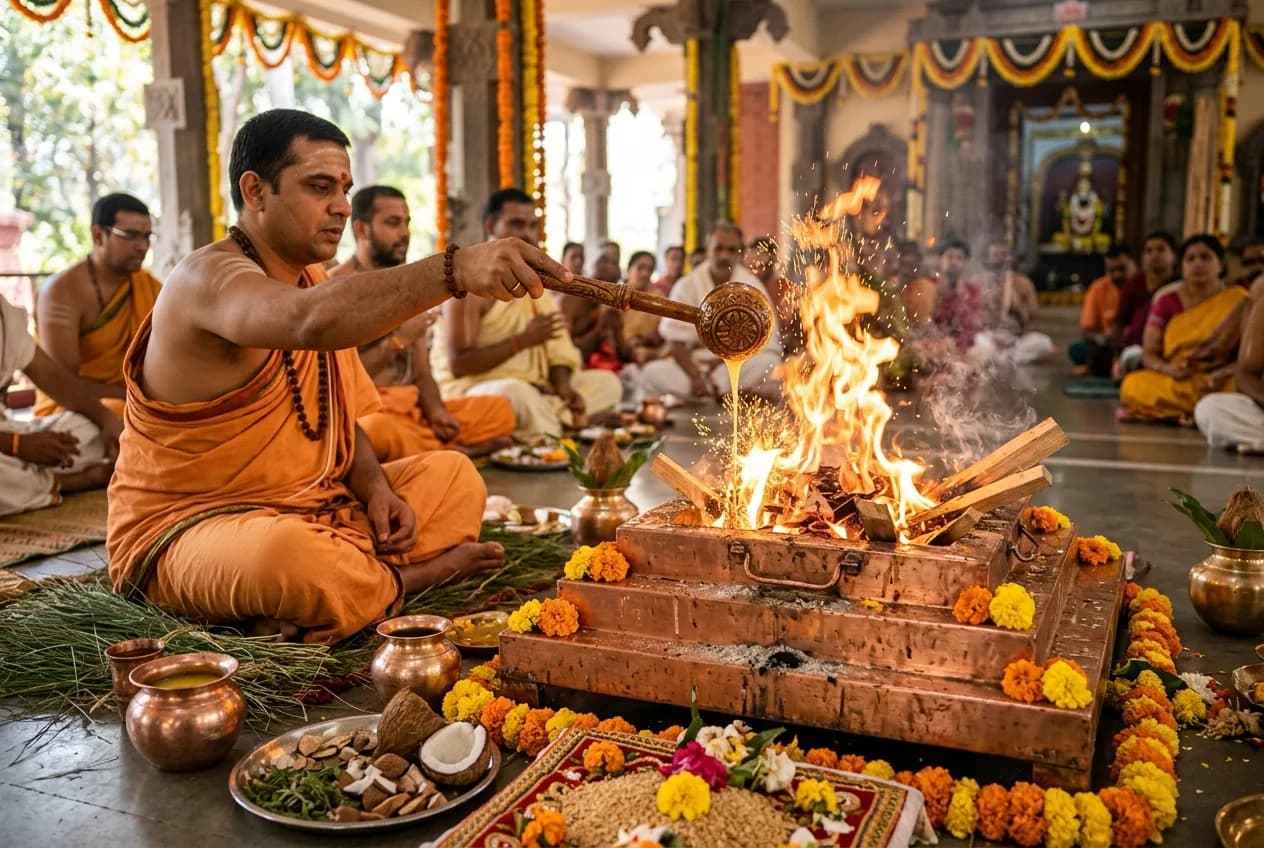
Section 1: Taxonomic Header & Etymology (Nirukta & Vyutpatti)
| Devanagari Forms | यजुर्वेदसंहिता (Compound of यजुस् [yajus] + वेद [veda] + संहिता [saṃhitā]) |
|---|---|
| IAST Transliteration | Yajurveda-Saṃhitā |
| Verbal Root (Dhātu) | Derived from the verbal root √yaj (यज् देवपूजासंगतिकरणदानेषु — yaja deva-pūjā-saṅgati-karaṇa-dāneṣu, class 1, "to worship, commune, harmonize, and offer"). |
| Grammatical Derivation (Vyutpatti) | The morphological compound Yajurveda-Saṃhitā resolves into three structural components: (1) Yajus (यजुस्): In Pāṇinian grammar and Yāska’s Nirukta (7.12), defined as यजुर्यजतेः (Yajur yajateḥ), designating metrically unbound prose formulas (Gadyātmakaḥ yajuḥ) recited by the Adhvaryu priest during the physical arrangement and execution of sacrificial altars (Yajña). (2) Veda (वेद): Sacred unauthored knowledge (Apauruṣeya-jñāna) intuited directly by Vedic seers. (3) Saṃhitā (संहिता): The canonical ordered text collection assembled according to exact phonetic sandhi laws. |
“That sacred formula which is composed in prose (Gadya) and whose divisions are determined purely by procedural and semantic meaning—free from rigid metrical syllable counts—is termed Yajus.”
— Maharṣi Jaimini & SāyaṇācāryaSemantic Evolution & Why “Religion” is an Inadequate Translation
The morphological compound Yajurveda-Saṃhitā unites three foundational operational dimensions in classical Vedic hermeneutics, moving from manual ritual action to contemplative transcendence:
Unlike the metrical stanzas of the Ṛgveda or the sung melodies of the Sāmaveda, Yajus signifies flexible prose liturgical utterances timed precisely with physical movements of manual offering, altar measurement, and ritual invocation.
Primordial unauthored cognition of cosmological laws and sacrificial physics revealed to the purified awareness of ancient Ṛṣis.
The systematic canonical arrangement of mantras and ritual procedures preserved across living recensional branches (Śākhās) for solemn Śrauta rites.
Section 2: Abstract & Philosophical Core
The Yajurveda Saṃhitā is the operational manual of Vedic ritual engineering, sacrificial architecture, and physical consecration. While the Ṛgveda provides contemplative poetry and the Sāmaveda provides musical ecstasy, the Yajurveda governs the precise physical execution (Karma-anuṣṭhāna) of solemn Yajñas (such as the Darśa-Pūrṇamāsa [New and Full Moon sacrifices], Aśvamedha, Vājapeya, and Agnicitya / altar construction).
The defining structural characteristic of the Yajurveda is its division into two distinct recensional streams: Śukla Yajurveda (the White or Pure Recension) and Kṛṣṇa Yajurveda (the Black or Dark Recension). This split reflects an ancient pedagogical and structural divergence in how sacred liturgical formulas and their explanatory ritual commentaries were transmitted across North and South Indian lineages.
Two Distinct Recensional Streams (द्विविध शाखा परम्परा)
Śukla Yajurveda (शुक्ल यजुर्वेद — The White / Pure Recension)
शुक्ल यजुर्वेद (वाजसनेयि शाखा)In this tradition, the pure verse and prose mantras (Mantras) are strictly separated from their ritual procedural explanations (Brāhmaṇa commentary). The liturgical mantras are collected cleanly into the Vājasaneyi Saṃhitā, while the vast expository commentary forms the Śatapatha Brāhmaṇa.
Kṛṣṇa Yajurveda (कृष्ण यजुर्वेद — The Black / Dark Recension)
कृष्ण यजुर्वेद (तैत्तिरीय, काठक, मैत्रायणी)In this tradition, the mantra texts and their ritual commentary (Brāhmaṇa) are interwoven together into a single, combined pedagogical text. The archaic liturgical formulas appear alongside running theological and procedural explanations.
Four Core Contributions of the Yajurveda (चतुर्विध मुख्य योगदान)
The physical construction of brick fire-altars (Vedi and Cayana), measurement of sacred geometry, handling of ritual implements, and precise offering of oblations according to mathematical proportions that anticipated later Śulba Sūtras.
One of the most celebrated litanies in Sanskrit literature (Vājasaneyi Saṃhitā Chapter 16), invoking Lord Rudra across a hundred names in every aspect of nature, society, craft, and existence, laying the foundation for Śaiva theology and Śrī Rudram.
The final 40th chapter of the Śukla Yajurveda Saṃhitā, offering a profound reconciliation between active worldly duty (Karma) and liberating spiritual knowledge (Vidyā), declaring that all changing phenomena are enveloped by the Divine.
Prayers consecrating agriculture, animal husbandry, arithmetic, statecraft, universal peace (Śānti Pāṭha), and societal harmony, establishing mutual reciprocity between human labor and cosmic forces.
Section 3: Primary Scriptural Anchors (Śruti, Smṛti, and Itihāsa)
Salutation to Thy wrath, O Rudra; and salutation to Thine arrow. Salutation also to Thy two arms.
Opening the monumental Śatarudrīya (VS Chapter 16), this verse initiates a sweeping litany that recognizes the fierce, transformative aspect of the Divine (Rudra / Śiva) present not only in peaceful sanctuaries, but in storms, rivers, mountains, thieves, healers, merchants, and all living beings.
All this whatsoever—whatever moves within this moving universe—is enveloped, clothed, and inhabited by the Divine (Īśa). By renouncing egoistic possessiveness (Tyaktena), enjoy life; do not covet another's wealth, for whose is it?
As the opening verse of the Īśā Upaniṣad (and the concluding 40th chapter of the Śukla Yajurveda), this passage bridges sacrificial ritual with non-dual mysticism. Sāyaṇācārya and Ādi Śaṅkarācārya comment that true enjoyment (Bhuñjīthā) of life comes not through grasping exploitation, but through recognizing everything as sacred gift (Tyāga).
Section 4: Structural Architecture & Recensions (Śākhās)
The Yajurveda Saṃhitā is uniquely organized into two canonical streams—Śukla (White) and Kṛṣṇa (Black)—reflecting distinct pedagogical methodologies for preserving ritual mantras and their interpretive theological expositions.
1. Śukla Yajurveda (Vājasaneyi Saṃhitā)
Contains 40 Chapters (Adhyāyas), comprising roughly 1,975 mantras.
Strictly separates liturgical mantras from theological and procedural commentary. The mantras are addressed directly to the deities, with commentary relegated to the Śatapatha Brāhmaṇa.
Primary Surviving Recensions (प्रमुख शाखा विस्तार):
The most widely recited recension of the Śukla Yajurveda, named after sage Madhyandina. Contains 40 Adhyāyas, 303 Anuvākas, and 1,975 Kaṇḍikās.
Preserved across southern lineages with distinctive phonetic accentuation and minor textual variants across its 40 Adhyāyas and 2,086 Kaṇḍikās.
Associated Vedic Corpus (सम्बद्ध वाङ्मय):
2. Kṛṣṇa Yajurveda (Black Yajurveda)
Interweaves verse mantras (Yajus) with prose ritual explanations (Brāhmaṇa) in a conversational, explanatory style.
Preserves the archaic pedagogical style wherein liturgical mantras and their ritual application (Viniyoga), symbolic narratives (Arthavāda), and theological rationale are taught simultaneously.
Primary Surviving Recensions (प्रमुख शाखा विस्तार):
The most prominent living recension of the Kṛṣṇa Yajurveda, named after Sage Tittiri. Comprises 7 Kāṇḍas, 44 Prapāṭhakas, and 651 Anuvākas.
Associated with Sage Kaṭha; famous for housing the sublime Kaṭha Upaniṣad recounting the dialogue between Naciketā and Yama on the secret of immortality.
Contains 4 Kāṇḍas characterized by archaic linguistic forms and housing the Maitrāyaṇīya (Maitrī) Upaniṣad.
A rare surviving recension related to the Kāṭhaka school, preserved in fragmentary palm-leaf manuscripts and epigraphical records.
Associated Vedic Corpus (सम्बद्ध वाङ्मय):
Section 5: Comparative Darśana & Sampradāya Perspectives (Bhāṣya Analysis)
The Yajurveda serves as the prime operational foundation for both Pūrva Mīmāṃsā ritual science and Vedāntic contemplation, unifying procedural precision (Karma) with transcendent knowledge (Jñāna):
1. Mīmāṃsā & Karma-Kāṇḍa Hermeneutics
Maharṣi Jaimini & ŚabarasvāminThe Yajurveda is the foundational text for Mīmāṃsā hermeneutics, establishing precise rules (Vidhi, Niyama, Parisaṅkhyā) for ritual injunctions, timing, and procedural correctness. Every sacrificial act executed by the Adhvaryu priest creates an unseen transcendental potential (Apūrva) that bridges the ritual action with its ultimate fruit. Mīmāṃsā establishes that Vedic prose formulas (Yajus) are not arbitrary human compositions, but infallible verbal injunctions coordinating human action with cosmic law.
2. Vedānta & Saguṇa/Nirguṇa Synthesis
Sage Yājñavalkya & Ādi ŚaṅkarācāryaWhile the ritual portion (Saṃhitā and Brāhmaṇa) governs fire sacrifices and social duties, the concluding chapters and Upaniṣads (Īśā and Bṛhadāraṇyaka) elevate the ritual fire into meditation upon the inner flame of consciousness (Vaiśvānara / Brahman). In the Śukla Yajurveda tradition, Sage Yājñavalkya articulates the Neti Neti method in the Bṛhadāraṇyaka and non-dual equanimity in the Īśāvāsya, proving that outward procedural precision (Karma) is the preparatory crucible for inward liberating knowledge (Jñāna).
Section 6: Verified Academic & Traditional Bibliography
Primary Sanskrit texts cited according to their standard critical editions, supplemented by classical commentaries and twentieth-century Indological scholarship: