
Vyasa Mahabharata (व्यास महाभारतम्)(महाभारतम् (व्यास महाभारतम्))
The monumental Fifth Veda of Indian civilization: an encyclopedic epic chronicling the dynastic struggle of the Bharatas, exploring the tragic collisions, ethical paradoxes, and radical subtlety of Dharma in an imperfect world
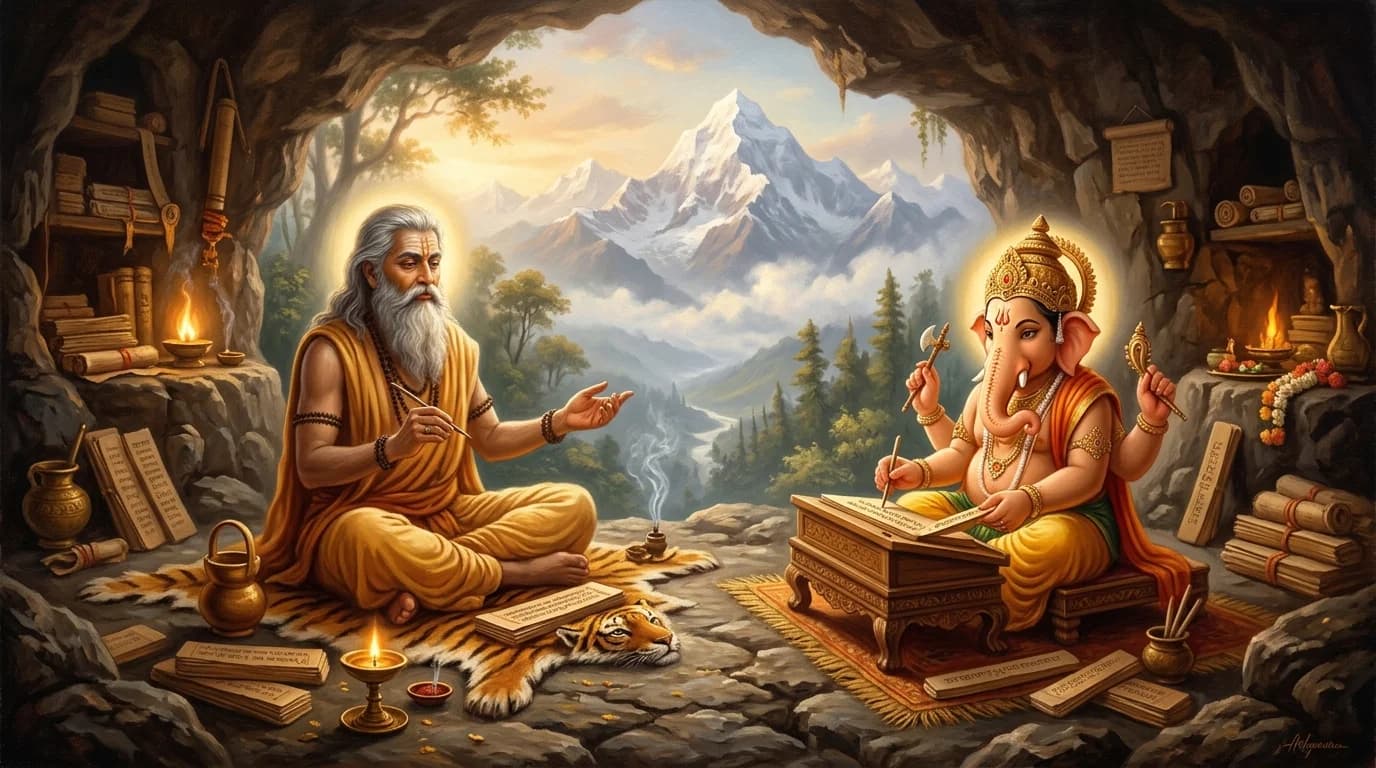
Section 1: Taxonomic Header & Etymology (Nirukta & Vyutpatti)
| Devanagari Forms | महाभारतम् (neuter singular Karmadhāraya / Bahuvrīhi compound: Mahā-bhāratam); प्रातिपदिक: महाभारत (Mahābhārata) |
|---|---|
| IAST Transliteration | Mahābhāratam |
| Verbal Root (Dhātu) | Formed from the prior element mahat ("great, vast, weighty, sublime") and the posterior nominal stem bhārata, derived from the verbal root √bhṛ (भृञ् भरणपोषणयोः — bhṛñ bharaṇapoṣaṇayoḥ, Dhātupāṭha 1.946, "to bear, sustain, nourish, protect"). |
| Grammatical Derivation (Vyutpatti) | Morphologically and grammatically analyzed through classical Pāṇinian sūtras across two stages: (1) Mahā- (महा-): Substituted for mahat as the prior member of a compound via Pāṇini Aṣṭādhyāyī 6.3.46 (ānmahataḥ samānādhikaraṇajātiyayoḥ). (2) Bhārata (भारत): Formed from Bharata (the eponymous sovereign monarch of the Lunar Dynasty, son of Duṣyanta and Śakuntalā) through the patronymic and relational taddhita suffix aṇ (Aṣṭādhyāyī 4.1.83 / 4.2.114), inducing vṛddhi elongation of the initial vowel (Bharata + aṇ → Bhārata). By Aṣṭādhyāyī 4.3.101 (tena proktam) and 4.2.60 (kratūkthādisūtrāntāṭ ṭhak), Bhārata signifies the great chronicle composed concerning the descendants of Bharata. |
“Because of its supreme greatness (mahattvāt—vastness of philosophical scope) and its unmatched weightiness of meaning (bhāravattvāt—gravitas of ethical and ontological truth), it is called Mahābhārata. Whoever comprehends this etymological essence (Nirukta) is liberated from all transgressions.”
— Mahābhārata, Ādi Parva 1.1.208–209 (BORI Critical Edition)“Where there is Dharma (righteous order and cosmic truth), there alone is victory.”
— Mahābhārata, Bhīṣma Parva 62.34 & Udyoga Parva 126.48Semantic Evolution & Why “Religion” is an Inadequate Translation
Classical Sanskrit tradition acknowledges three progressive historical layers of textual expansion within the transmission of the epic:
Derived from √ji ("to conquer"). Declared in the inaugural invocation (Tato jayam udīrayet) and Ādi Parva 1.56.19 (Jayo nāmetihāso'yaṃ śrotavyo vijigīṣuṇā), Jaya represents Vyāsa’s initial composition of roughly 8,800 intricate verses taught directly to his five disciples: Sumantu, Jaimini, Paila, Śuka, and Vaiśampāyana.
The core narrative chronicle of the Bharata dynasty, omitting secondary sub-narratives (Upākhyānas), as attested in Ādi Parva 1.1.61 (Caturviṃśatisāhasrīṃ cakre bhāratasaṃhitām / upākhyānair vinā tāvad bhārataṃ procyate budhaiḥ). Recited by Vaiśampāyana to King Janamejaya at the Sarpasatra sacrifice in Takṣaśilā.
The complete civilizational encyclopedia incorporating philosophical discourses, ethical treatises (Śānti and Anuśāsana Parvas), and classic Upākhyānas (Nala-Damayantī, Sāvitrī-Satyavān, Śakuntalā). Recited by the Sūta bard Ugraśravas Sauti (son of Lomaharṣaṇa) to Sage Śaunaka and the assembled ṛṣis during the twelve-year sacrifice in the forest of Naimiṣāraṇya.
Section 2: Abstract & Philosophical Core
Revered across Indian civilization as the Pañcama Veda (the Fifth Veda) and the Kārṣṇa Veda (the Veda revealed through Kṛṣṇa Dvaipāyana Vyāsa), the Mahābhārata stands as the longest epic poem in world literature—extending approximately eight times the combined length of Homer’s Iliad and Odyssey. While the Vālmīki Rāmāyaṇa depicts the luminous moral ideal (Maryādā) in personal, familial, and political rectitude, the Mahābhārata directly engages the tragic friction, ethical dilemmas, and complex grey zones of Dharma within a conflicted, declining Kaliyuga world.
Where the Rāmāyaṇa demonstrates how a sovereign of unblemished virtue upholds righteousness, the Mahābhārata confronts an acute existential question: How does an earnest person uphold Dharma when every course of action carries severe ethical costs, when venerable elders maintain silence during public atrocities, and when competing moral obligations directly collide?
Through its epic scope, the Mahābhārata functions simultaneously as a national chronicle (Itihāsa), a constitutional treatise on statecraft (Rājadharma), a handbook of crisis ethics (Āpaddharma), and a rigorous inquiry into liberation (Mokṣadharma). Vyāsa avoids didactic reductionism; instead, he places moral principles into high-stakes historical crises where characters must choose between legal formality and substantive justice.
Section 3: Primary Scriptural Anchors (Śruti, Smṛti, and Itihāsa)
Duryodhana is a vast tree made of wrath and envy; Karṇa is its trunk, Śakuni its branches, Duḥśāsana its abundant flowers and fruit, and its root is the unwise King Dhṛtarāṣṭra. Yudhiṣṭhira is a vast tree made of Dharma; Arjuna is its trunk, Bhīmasena its branches, the two sons of Mādrī its flowers and fruit, and its root is Śrī Kṛṣṇa, Brahman, and the knowers of sacred wisdom.
In his celebrated seventeenth-century commentary Bhāratabhāvadīpa, Nīlakaṇṭha Caturdhara demonstrates that these two metaphorical trees (Vṛkṣa-rūpaka) delineate the inner conflict of human consciousness: the tree of Adharma is anchored in Amanīṣā (spiritual blindness and lack of discernment, personified in Dhṛtarāṣṭra), while the tree of Dharma draws its life from Kṛṣṇa (the supreme divine ground) and Brahman (the eternal truth of the Vedas).
Concerning Dharma, Artha, Kāma, and Mokṣa, O noblest of the Bharatas: whatever is found here may be found elsewhere, but whatever is not found here exists nowhere else.
Pronounced by Vaiśampāyana at the commencement of his recitation (1.56.33) and reaffirmed by Ugraśravas Sauti at the close of the epic (18.5.38), this declaration defines the encyclopedic boundaries of the text. Notice the four locatives in the opening hemistich: the epic claims exhaustive authority within the four canonical pursuits of human existence (Caturvarga / Puruṣārtha), asserting that every ethical tension, political motive, psychological drive, and spiritual path known to humanity has been investigated within its narrative.
Dry dialectical logic lacks a conclusive foundation; scriptural texts offer manifold perspectives; there is no solitary sage whose isolated opinion carries sole authority. The essential truth of Dharma is concealed within the depths of the heart; therefore, the path trodden by noble and righteous souls is the true path.
Faced with the life-or-death riddles posed by the Yakṣa (who is Yama / Dharma-rāja in disguise) beside the crane-haunted forest pool, Yudhiṣṭhira delivers this synthesis of Indian epistemology. Bādarāyaṇa cites this principle in the Brahma Sūtras (2.1.11: Tarkāpratiṣṭhānāt) to demonstrate that unassisted rational speculation cannot resolve ultimate ontological realities; one must rely on scriptural insight validated through the lived conduct of the virtuous (Sadācāra).
One should set aside an errant individual for the sake of the family; set aside family partiality for the sake of the village; set aside the village for the sake of the realm; and for the integrity and realization of the immortal Self, one should be willing to abandon the entire earth. ... Where Kṛṣṇa is, there is Dharma; and where Dharma is, there is victory.
In the first verse, Vidura counsels Dhṛtarāṣṭra to restrain Duryodhana rather than sacrificing an entire nation to one prince’s avarice. As Advaita commentators clarify, ātmārthe does not denote petty selfishness, but points to spiritual integrity: what does it benefit a person to gain the whole earth if they compromise the immortal Self? The second verse (the institutional motto of the Supreme Court of India) is repeated at critical junctures by Gāndhārī, Bhīṣma, and Vyāsa.
With upraised arms I cry aloud, yet no one heeds me: from Dharma flow both sustainable prosperity (Artha) and true fulfillment of desire (Kāma)—why then is Dharma not practiced? Never out of desire, nor out of fear, nor out of greed should one abandon Dharma—not even to save one’s physical life; for Dharma is eternal, while pleasure and pain are fleeting; the conscious soul is eternal, while its physical vehicle is transient.
Revered as the Bhārata-Sāvitrī, these two verses represent Maharṣi Vyāsa’s concluding summation after recounting 100,000 verses of dynastic history, statecraft, and war. Human civilization repeatedly falls into ruin because people abandon Dharma to seize immediate power (Artha) and pleasure (Kāma), failing to see that lasting prosperity grows only from righteous roots, and that trading eternal spiritual integrity for temporal advantage is a tragic delusion.
Section 4: Structural Architecture — The 18 Parvas, Harivaṃśa, & The BORI Critical Edition
The Mahābhārata is constructed upon a monumental architectural framework governed by the symbolic number 18 (Aṣṭādaśa-Tattva): 18 major Parvas (Books), 18 chapters of the Bhagavad Gītā, 18 Akṣauhiṇī armies participating in the conflict, and 18 days of combat at Kurukṣetra. The entire corpus encompasses 100 Upa-parvas, supplemented by the Harivaṃśa as its Khila (appendix):
1. The Symbolic Numerology of Eighteen (Aṣṭādaśa-Tattva)
In classical Indian epic architecture, the number eighteen signifies cosmic wholeness and the resolution of karmic cycles: the 18 Parvas of the epic correspond to the 18 chapters of the Gītā, the 18 fighting days of Kurukṣetra, and the 18 major Purāṇas. It denotes the passage of human consciousness through every possible permutation of ethical duty, conflict, and spiritual realization.
2. Architectural Blueprint of the 18 Major Parvas & Harivaṃśa (अष्टादशपर्व एवं हरिवंश परिचय)
| Parva & Sanskrit Title | Adhyāyas (CE / Vulgate) | Central Narrative Arc & Embedded Philosophical Treatises |
|---|---|---|
Ādi Parva आदिपर्व Ādi Parva (The Book of the Beginning) Parva 1 | 225 Adhyāyas (BORI CE) / 234 (Vulgate) | Framing narrations at Naimiṣāraṇya and Takṣaśilā; ancestral origins of the Lunar Dynasty (Śakuntalā, Yayāti, Devayānī, Bhīṣma’s vow); birth and youth of the Pāṇḍavas and Kauravas; the fire of the Lacquer House (Lākṣāgṛha), Draupadī’s Svayaṃvara, establishment of Indraprastha, and the burning of the Khāṇḍava forest. |
Sabhā Parva सभापर्व Sabhā Parva (The Book of the Assembly Hall) Parva 2 | 72 Adhyāyas (BORI CE) / 81 (Vulgate) | Construction of the wondrous assembly palace by Maya Dānava; Nārada’s discourse on constitutional statecraft; the subjugation of Jarāsandha and Yudhiṣṭhira’s Rājasūya sacrifice (Śiśupāla-vadha); Duryodhana’s jealousy; the rigged dice match (Dyūta-parvan), the public disrobing of Draupadī, and the banishment of the Pāṇḍavas. |
Vana (Āraṇyaka) Parva वनपर्व (आरण्यकपर्व) Vana / Āraṇyaka Parva (The Book of the Forest) Parva 3 | 299 Adhyāyas (BORI CE) / 315 (Vulgate) | Twelve years of forest exile; Arjuna’s ascetic penance and acquisition of divine weapons (Kirātārjunīya); visits to sacred pilgrimage sites (Tīrtha-yātrā); discourses by Sage Mārkaṇḍeya; legendary sub-narratives including Nala-Damayantī, Sāvitrī-Satyavān, and Ṛṣyaśṛṅga; concluding with the Yakṣa-Praśna philosophical dialogue. |
Virāṭa Parva विराटपर्व Virāṭa Parva (The Book of Virāṭa) Parva 4 | 67 Adhyāyas (BORI CE) / 72 (Vulgate) | The thirteenth year spent in incognito disguise (Ajñātavāsa) within the court of King Virāṭa of Matsya (Yudhiṣṭhira as Kaṅka, Bhīma as Ballava, Arjuna as Bṛhannalā, Draupadī as Sairandhrī); the slaying of the tyrant Kīcaka; and Arjuna’s defense of the Matsya kingdom against the Kuru cattle-raid (Go-grahaṇa). |
Udyoga Parva उद्योगपर्व Udyoga Parva (The Book of Effort / Preparation) Parva 5 | 197 Adhyāyas (BORI CE) / 199 (Vulgate) | Diplomatic mobilization and war preparations; Śrī Kṛṣṇa’s peace mission to Hastināpura (Bhagavad-yāna); Duryodhana’s rejection of compromise ("not even enough earth to cover the tip of a needle"); Kuntī and Kṛṣṇa meeting Karṇa. Houses two standalone philosophical treatises: the Vidura-Nīti (chs. 33–40) and the Sanatsujātīya (chs. 41–46). |
Bhīṣma Parva भीष्मपर्व Bhīṣma Parva (The Book of Bhīṣma) Parva 6 | 117 Adhyāyas (BORI CE) / 122 (Vulgate) | Vedic cosmography of Jambūdvīpa; Days 1 to 10 of the Kurukṣetra conflict under Grandfather Bhīṣma’s supreme command; Śrī Kṛṣṇa charging toward Bhīṣma with a chariot wheel; Bhīṣma’s fall upon a bed of arrows (Śara-talpa). Contains the complete Śrīmad Bhagavad Gītā (chs. 23–40 / Vulgate 25–42). |
Droṇa Parva द्रोणपर्व Droṇa Parva (The Book of Droṇa) Parva 7 | 173 Adhyāyas (BORI CE) / 202 (Vulgate) | Days 11 to 15 under Ācārya Droṇa’s command; the encirclement and heroic martyrdom of sixteen-year-old Abhimanyu within the Cakravyūha; Arjuna’s vengeance upon Jayadratha; Ghaṭotkaca’s nocturnal battle; Yudhiṣṭhira’s equivocation regarding Aśvatthāmā; and Droṇa laying down his weapons in yogic contemplation. |
Karṇa Parva कर्णपर्व Karṇa Parva (The Book of Karṇa) Parva 8 | 69 Adhyāyas (BORI CE) / 96 (Vulgate) | Days 16 and 17 of the battle under Karṇa’s leadership with King Śalya as his charioteer; Bhīma fulfilling his vow upon Duḥśāsana; Śrī Kṛṣṇa instructing Arjuna on circumstantial ethics versus rigid literalism (the Kauśika ascetic parable); culminating in the fateful duel between Karṇa and Arjuna. |
Śalya Parva शल्यपर्व Śalya Parva (The Book of Śalya) Parva 9 | 64 Adhyāyas (BORI CE) / 65 (Vulgate) | Day 18 of the war under Śalya’s brief command; Balarāma’s holy pilgrimage along the sacred Sarasvatī river (Sārasvata-tīrtha-yātrā); Duryodhana taking refuge beneath the waters of Dvaipāyana lake; and the decisive mace duel (Gadā-yuddha) between Bhīma and Duryodhana. |
Sauptika Parva सौप्तिकपर्व Sauptika Parva (The Book of the Night Raid) Parva 10 | 18 Adhyāyas (BORI CE / Vulgate) | Aśvatthāmā, Kṛpavarmā, and Kṛtavarmā executing a nocturnal assault on the sleeping Pāṇḍava encampment, slaying Dhṛṣṭadyumna, Śikhaṇḍī, and the five young sons of Draupadī; confrontation over the ultimate weapon (Brahmāśiras); Kṛṣṇa’s curse on Aśvatthāmā and the miraculous protection of unborn Parīkṣit. |
Strī Parva स्त्रीपर्व Strī Parva (The Book of the Women) Parva 11 | 27 Adhyāyas (BORI CE / Vulgate) | A profound anti-war elegy: King Dhṛtarāṣṭra, Queen Gāndhārī, Kuntī, and the bereaved women survey the corpse-strewn plain of Kurukṣetra; Gāndhārī’s lamentation and vision of fallen warriors; her sorrowful curse upon the Yādava dynasty; Kuntī revealing the tragic secret of Karṇa’s birth to her surviving sons. |
Śānti Parva शान्तिपर्व Śānti Parva (The Book of Peace) Parva 12 | 353 Adhyāyas (BORI CE) / 365 (Vulgate) | The longest single Parva of the epic (~14,000 verses): Yudhiṣṭhira’s grief and longing for renunciation; Śrī Kṛṣṇa escorting him to the dying Bhīṣma on his bed of arrows. Divided into three encyclopedic treatises: (1) Rājadharma-parvan (statecraft and justice), (2) Āpaddharma-parvan (crisis governance and ethics), and (3) Mokṣadharma-parvan (Sāṃkhya, Yoga, Vedānta, and the Nārāyaṇīya theology). |
Anuśāsana Parva अनुशासनपर्व Anuśāsana Parva (The Book of Instruction) Parva 13 | 154 Adhyāyas (BORI CE) / 168 (Vulgate) | Continuation of Bhīṣma’s final discourses on charity (Dāna-dharma), duties of the orders of life, and universal non-injury (Ahiṃsā); revelation of the Śiva Sahasranāma (ch. 17) and the Viṣṇu Sahasranāma (ch. 135 / Vulgate 149); Bhīṣma voluntarily leaving his mortal frame during the auspicious northern solstice (Uttarāyaṇa). |
Āśvamedhika Parva आश्वमेधिकपर्व Āśvamedhika Parva (The Book of the Horse Sacrifice) Parva 14 | 96 Adhyāyas (BORI CE) / 92 (Vulgate) | Vyāsa and Kṛṣṇa consoling Yudhiṣṭhira; revival of stillborn Parīkṣit by Kṛṣṇa’s truth-declaration; the performance of the grand Aśvamedha sacrifice; the episode of the golden mongoose teaching that humble, selfless charity surpasses lavish royal offerings. Contains the Anugītā (chs. 16–51). |
Āśramavāsika Parva आश्रमवासिकपर्व Āśramavāsika Parva (The Book of the Hermitage) Parva 15 | 47 Adhyāyas (BORI CE) / 39 (Vulgate) | Following fifteen years of peaceful cohabitation under Yudhiṣṭhira’s rule, the aging elders—Dhṛtarāṣṭra, Gāndhārī, Kuntī, Vidura, and Sañjaya—retire to an ascetic forest hermitage beside the Gaṅgā; Vidura’s yogic transference of consciousness into Yudhiṣṭhira; and the elders meeting a serene end in a Himalayan forest fire. |
Mausala Parva मौसलपर्व Mausala Parva (The Book of the Clubs) Parva 16 | 9 Adhyāyas (BORI CE) / 8 (Vulgate) | Thirty-six years after the great war: civil strife and self-destruction of the Yādava clan at Prabhāsa through iron clubs; Balarāma’s yogic departure; Bhagavān Śrī Kṛṣṇa concluding His earthly manifestation upon the arrow of the hunter Jarā; the golden city of Dvārakā swallowed by the ocean. |
Mahāprasthānika Parva महाप्रस्थानिकपर्व Mahāprasthānika Parva (The Book of the Great Journey) Parva 17 | 3 Adhyāyas (BORI CE / Vulgate) | Yudhiṣṭhira crowns young Parīkṣit at Hastināpura; the five Pāṇḍavas and Draupadī renounce worldly power, undertaking the final ascent of the Himālayas accompanied by a faithful stray dog; one by one the travelers fall due to subtle attachments; Yudhiṣṭhira refuses entry into heaven without the loyal hound (revealed as Dharma-rāja). |
Svargārohaṇa Parva स्वर्गारोहणपर्व Svargārohaṇa Parva (The Book of the Ascent to Heaven) Parva 18 | 5 Adhyāyas (BORI CE / Vulgate) | Yudhiṣṭhira undergoes his final moral trial—choosing to stay in suffering realms beside his brothers rather than enjoy heaven alone; the dissolution of the test (Deva-māyā); entry into the transcendent spiritual state; concluding with the Bhārata-Sāvitrī and the spiritual benefits of hearing the epic. |
Harivaṃśa Parva हरिवंशपर्व Harivaṃśa Parva (The Appendix: Lineage of Hari) Khila | 118 Adhyāyas (BORI CE) / ~16,000 Verses (Vulgate) | The indispensable canonical supplement (Khila) to the Mahābhārata, divided into three major sections: Harivaṃśa-parvan (genealogies of the Solar and Lunar lines), Viṣṇu-parvan (the complete life, childhood in Vṛndāvana, exploits in Mathurā, and reign in Dvārakā of Śrī Kṛṣṇa), and Bhaviṣya-parvan (prophetic cosmology and theological hymns). |
3. The BORI Critical Edition (1919–1966): Text-Critical Methodology
Initiated in 1919 under Ramakrishna Gopal Bhandarkar and guided by General Editor Vishnu Sitaram Sukthankar (succeeded by S. K. Belvalkar and P. L. Vaidya), the Bhandarkar Oriental Research Institute in Pune spent 47 years collating 1,259 manuscripts across eight regional scripts (Śāradā, Kashmiri, Nepāli, Maithilī, Bengālī, Devanāgarī, Telugu, Grantha, and Malayālam). Sukthankar’s Prolegomena (1933) established that despite regional divergences, Northern and Southern recensions converge upon an archetypal text of roughly 89,000 verses, providing the definitive scientific foundation for modern Indology.
Section 5: Comparative Darśana, Classical Commentaries (Ṭīkās), & Sampradāya Perspectives
Across a millennium of Indian intellectual history, the Mahābhārata was expounded through authoritative Sanskrit commentaries (Ṭīkās) and interpreted by the primary Vedāntic schools as the supreme canon of ethical and metaphysical reconciliation:
1. The Classical Sanskrit Commentary Tradition (Ṭīkā-Paramparā)
Devabodha (11th c.), Arjunamiśra (15th c.), Sarvajña Nārāyaṇa, Vādirāja Tīrtha (16th c.), and Nīlakaṇṭha Caturdhara (17th c.)Across ten centuries, Indian scholasticism produced monumental Sanskrit commentaries that safeguarded the text’s philosophical depth: (1) Devabodha’s Jñānadīpikā (c. 11th century CE), the oldest surviving commentary, provided concise philological glosses that served as the primary guide for the BORI Critical Edition; (2) Vādirāja Tīrtha’s Lakṣālaṅkāra (16th c., Udupi) offered an exhaustive Dvaita exposition of all eighteen Parvas; and (3) Nīlakaṇṭha Caturdhara’s Bhāratabhāvadīpa (17th c., Varanasi) synthesized Mīmāṃsā ritualism, Nyāya epistemology, Yoga psychology, and Advaita metaphysics, becoming the standard pan-Indian commentary.
2. Advaita Vedānta & Classical Poetics (Ānandavardhana & Śaṅkara)
Ādi Śaṅkarācārya (8th c.), Ānandavardhana (9th c.), Abhinavagupta (10th c.), and NīlakaṇṭhaAdvaita Vedānta accords exceptional authority to the Mahābhārata. Ādi Śaṅkarācārya wrote commentaries on three distinct texts embedded within its books: the Bhagavad Gītā, the Viṣṇu Sahasranāma, and the Sanatsujātīya. In Dhvanyāloka 4.5, Ānandavardhana establishes that the predominant aesthetic and philosophical mood of the entire epic is Śānta-rasa: by depicting the tragic collapse of all earthly dynasties and heroic ambitions, Vyāsa systematically evokes Vairāgya (dispassion) to awaken contemplation of the immortal Ātman and Bhagavān Vāsudeva.
3. Viśiṣṭādvaita Vedānta (Śrī Rāmānuja & Parāśara Bhaṭṭa)
Śrī Rāmānujācārya, Parāśara Bhaṭṭa, Piḷḷai Lokācārya, and Vedānta DeśikaIn Viśiṣṭādvaita, the Mahābhārata is venerated as the premier vehicle of Upabṛṃhaṇa—the essential canonical expansion that clarifies Upaniṣadic truths. Parāśara Bhaṭṭa’s commentary on the Viṣṇu Sahasranāma (Bhagavadguṇadarpaṇa) demonstrates how the 1,000 names reveal the infinite auspicious qualities (Kalyāṇa-guṇas) and supreme accessibility (Saulabhya) of Śrīman Nārāyaṇa, who out of compassion descended as Śrī Kṛṣṇa to serve as the humble charioteer (Pārtha-sārathi) and divine protector of His devotees.
4. Dvaita Vedānta (Śrī Madhvācārya’s Mahābhārata-Tātparya-Nirṇaya)
Śrī Madhvācārya (13th c.), Jayatīrtha, Vādirāja Tīrtha, and Raghavendra TīrthaŚrī Madhvācārya considered the Mahābhārata to be the supreme authority for resolving all philosophical doubts. In his Mahābhārata-tātparya-nirṇaya, he delineates three simultaneous levels of meaning (Bhāratārtha-traya): (1) Historical-Ethical (Itihāsa-artha): the actual battle between righteousness and wickedness; (2) Internal-Psychological (Kṣetra-saṅgrāma): the moral warfare within every human being where the five Pāṇḍavas embody spiritual faculties (Yudhiṣṭhira as Dharma, Bhīma as devotion and vitality, Arjuna as contemplative reflection) contending against egoism and desire; and (3) Supreme Theological (Nārāyaṇa-sarvottamatva): every word and narrative celebrating the unmatched sovereignty of Lord Nārāyaṇa.
Section 6: The Embedded Philosophical Library within the Mahābhārata
The Mahābhārata functions not as a single linear tale, but as an expansive sacred library housing autonomous masterpieces of ethics, metaphysics, statecraft, and devotional mysticism across its books:
1. The Four Gītās (Catur-Gītā) & Contemplative Dialogues
चतुर्गीता विमर्श (Catur-Gītā)While the 700-verse Śrīmad Bhagavad Gītā (Bhīṣma Parva 23–40) is the most celebrated dialogue in world literature, the epic preserves several other profound philosophical Gītās: the Sanatsujātīya (Udyoga Parva 41–46), in which the sage Sanatsujāta instructs Dhṛtarāṣṭra on Self-knowledge and inner immortality; the Anugītā (Āśvamedhika Parva 16–51), where Kṛṣṇa elucidates the nature of sensory detachment to Arjuna after the war; and concise contemplative teachings in the Śānti Parva such as the Utathya Gītā, Vāmadeva Gītā, and the celebrated Piṅgalā Gītā (teaching how renouncing insatiable craving brings peace surpassing cosmic rulership).
2. Vidura-Nīti: The Ethics of Conscience & Statecraft
विदुरनीति (उद्योगपर्व ३३–४०) (Vidura-Nīti)Spoken across an agonizing, sleepless night by the wise counselor Vidura to his agitated brother Dhṛtarāṣṭra, the Vidura-Nīti forms an eight-chapter masterpiece on political prudence, administrative accountability, moral psychology, and human integrity. Vidura outlines the traits of a wise person (Paṇḍita) versus a fool (Mūḍha), warning that power divorced from moral restraint invariably destroys its possessor.
3. The Sāvitrī-Upākhyāna & Dharmavyādha-Upākhyāna: Lived Duty
सावित्री एवं धर्मव्याध उपाख्यान (वनपर्व) (Sāvitrī & Dharmavyādha Upākhyāna)In the Vana Parva, two sub-narratives redefine the nature of spiritual attainment: in the Sāvitrī-Upākhyāna, Sāvitrī engages Lord Yama in a profound philosophical debate on justice, truth, and compassion, persuading Death itself to return her husband Satyavān; while in the Dharmavyādha-Upākhyāna, a meat-seller in Mithilā instructs a haughty forest ascetic that true spiritual liberation is realized not through dramatic mortifications, but through honest, compassionate performance of everyday household duty and devotion to aging parents.
Section 7: Living Praxis — Viṣṇu Sahasranāma & The Ethical Legacy of the Epic
Beyond its historical stature, the Mahābhārata continues to govern the daily devotional life, ethical deliberation, and artistic expressions of Sanātana Dharma:
1. Daily Liturgy of the Viṣṇu Sahasranāma & Śiva Sahasranāma
विष्णुसहस्रनाम एवं शिवसहस्रनाम नित्यपारायणWhen Yudhiṣṭhira asks Bhīṣma these foundational questions, the dying patriarch reveals the thousand names of Viṣṇu (Viśvaṃ viṣṇur vaṣaṭkāro...). Today, the Viṣṇu Sahasranāma and Śiva Sahasranāma (Anuśāsana Parva 17) remain among the most widely chanted devotional texts across all Hindu traditions, recited daily in households, temples, and monastic ashrams for peace, protection, and spiritual focus.
2. Constitutional, Civic & Judicial Compass
न्यायिक आदर्शः — यतो धर्मस्ततो जयःThe motto of the Supreme Court of India—यतो धर्मस्ततो जयः (Yato Dharmas Tato Jayaḥ)—is drawn directly from the Mahābhārata. In the Śānti Parva, Bhīṣma’s instructions on taxation (taking honey from a flower without harming the blossom), judicial fairness, ecological stewardship, and crisis management continue to provide ancient ethical anchors for modern democratic governance.
3. Dramatic, Literary & Performing Arts Transmission
कला, नाटक एवं लोकपरम्परा विस्तारFrom classical Sanskrit drama (Bhāsa’s Ūrubhaṅga and Karṇabhāra; Kālidāsa’s Abhijñānaśākuntalam; Bhāravi’s Kirātārjunīya; Bhaṭṭa Nārāyaṇa’s Veṇīsaṃhāra) to regional vernacular epics (Pampa’s Kannada Vikramārjuna Vijaya, the Telugu Andhra Mahābhāratamu of Nannaya-Tikkana-Yerrapragada, Sarala Dasa’s Odia Mahābhārata, and Villiputturar’s Tamil Mahābhāratam), and living folk theater like Terukkūttu, Kathakaḷi, Yakṣagāna, and Pāṇḍav Līlā, the epic serves as the enduring creative fountainhead of the subcontinent.
Section 8: Verified Academic & Traditional Bibliography
Primary Sanskrit texts cited according to their standard critical editions, supplemented by classical commentaries and twentieth-century Indological scholarship: