
Rigveda Samhita(ऋग्वेद संहिता)
The primordial foundational fountainhead of Indian civilization, cosmological intuitions, contemplative prayers, liturgical poetry, and invocations of cosmic powers
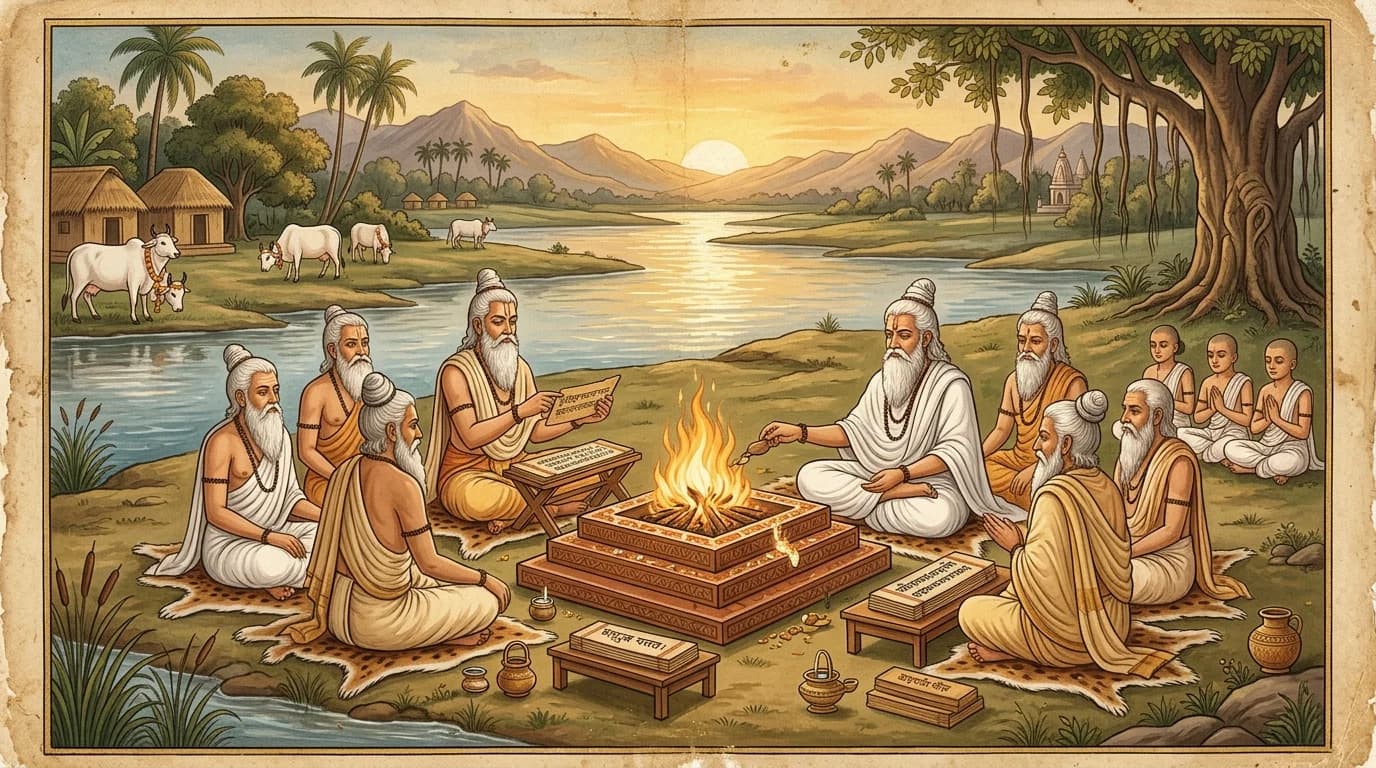
Section 1: Taxonomic Header & Etymology (Nirukta & Vyutpatti)
| Devanagari Forms | ऋग्वेदसंहिता (Compound of ऋच् [ṛc] + वेद [veda] + संहिता [saṃhitā]) |
|---|---|
| IAST Transliteration | Ṛgveda-Saṃhitā |
| Verbal Root (Dhātu) | Derived from three classical linguistic roots: (1) √ṛc (ऋच् स्तुतौ — ṛca stutau, Dhātupāṭha 6.19, "to praise, laud, shine, celebrate in sacred verse"); (2) √vid (विद् ज्ञाने — vida jñāne, class 2, "to know, cognize directly"); and (3) sam + √dhā (to place together in continuous euphonic union). |
| Grammatical Derivation (Vyutpatti) | The compound Ṛgveda-Saṃhitā resolves morphologically through three classical steps: (1) Ṛc (ऋच्) transforms to Ṛg- before voiced consonants via Pāṇini’s Aṣṭādhyāyī 8.2.39 (Jhalāṃ jaśo'nte). In Mīmāṃsā Sūtra 2.1.35, Sage Jaimini defines: "तेषामृग्यत्रार्थवशेन पादव्यवस्था" (Teṣām ṛg yatrārthavaśena pādavyavasthā)—"Among mantras, a Ṛc is that in which division into metrical quarters (Pādas) is governed by the completeness of semantic meaning." (2) Veda (वेद) is formed by attaching the primary suffix ghañ (-a) to the root √vid (vida jñāne), designating unauthored, direct cognitive illumination (Apauruṣeya-jñāna intuited by the seers: "ṛṣir darśanāt" — Yāska’s Nirukta 2.11). (3) Saṃhitā (संहिता) is formed from the preverb sam ("together, harmoniously") + √dhā ("to place, hold") + past passive participle suffix -kta (dadhāter hiḥ, Aṣṭādhyāyī 7.4.42), signifying both the canonical collection and continuous euphonic recitation governed by "paraḥ sannikarṣaḥ saṃhitā" (Aṣṭādhyāyī 1.4.109). |
“That canonical scripture which reveals the suprasensible means (Dharma and Brahma-vidyā) for attaining the highest good and dispelling sorrow—means otherwise inaccessible to mere sensory perception and inference—is the Veda.”
— Sāyaṇācārya’s ṚgvedabhāṣyabhūmikāSemantic Evolution & Why “Religion” is an Inadequate Translation
Far from being a primitive catalog of pastoral chants, the semantic architecture of the Ṛgveda Saṃhitā operates simultaneously as a precise metrical science, an epistemological archive, and a living phonetic continuum:
A luminous stanza structured into metrical quarters (Pādas) wherein poetic rhythm and sacred meaning are indivisible, designed to awaken intuitive perception (Dhī).
Direct experiential cognition of cosmic reality intuited in states of contemplative absorption (Samādhi) by ancient seers, transcending historical human authorship.
The uninterrupted euphonic junction of sound and cosmic vibration, preserved without the drift of a single accent across thousands of years.
Section 2: Abstract & Philosophical Core
The Ṛgveda Saṃhitā stands as the oldest extant monument of Indo-European and Sanskrit literature and the foundational fountainhead (Śruti-mūla) of Sanātana Dharma. Far from being a primitive nature-mythology, the Ṛgveda is a sophisticated poetic and philosophical archive composed in archaic Vedic Sanskrit across seven primary poetic meters (Gāyatrī, Uṣṇih, Anuṣṭubh, Bṛhatī, Paṅkti, Triṣṭubh, and Jagatī).
Its hymns (Sūktas, literally "well-spoken or auspiciously woven utterances") were intuited in states of deep meditative absorption (Dhī / Manīṣā) by Ṛṣis (male seers such as Viśvāmitra, Vasiṣṭha, Vāmadeva, Atri, Bharadvāja, Gṛtsamada, Kaṇva, and Dīrghatamas) and Ṛṣikās (female seers and Brahmavādinīs such as Vāgāmbhṛṇī, Lopāmudrā, Ghoṣā, Apālā, Viśvavarā, Romāśā, and Sūryā Sāvitrī).
Four Foundational Pillars of Rigvedic Thought (चतुर्विध मूल दर्शन)
The universe is not a chaotic accident; it is sustained by Ṛta—the self-regulating law of harmony governing the course of the sun and seasons, the truthfulness of human speech, and the integrity of ritual sacrifice (Yajña).
While the Ṛgveda invokes numerous luminous deities (Devas, from √div, "to shine"—such as Agni the sacred fire of transformation, Indra the sovereign force of illumination that shatters obstruction [Vṛtra], Varuṇa the guardian of moral law, Savitṛ the vivifying solar intelligence, and Uṣas the dawn of awakening), it explicitly proclaims that all these names and forms are multifaceted expressions of One Ultimate Reality (Ekaṃ sad viprā bahudhā vadanti — Ṛgveda 1.164.46).
Poetic speech (Vāk) is revered not as a human convention, but as the cosmic energy connecting human consciousness in the heart (Hṛd) with the transcendent Truth (Parame vyoman).
In its tenth Maṇḍala (Nāsadīya Sūkta, Hiraṇyagarbha Sūkta, Puruṣa Sūkta), the Ṛgveda pioneers rigorous metaphysical inquiry into the origin of existence prior to space, time, being (Sat), and non-being (Asat), laying the direct foundation for the Upaniṣads and Vedānta.
Section 3: Primary Scriptural Anchors (Śruti, Smṛti, and Itihāsa)
I adore Agni, the guiding priest placed at the forefront of the sacred sacrifice, the luminous deity who officiates in season, the invoker (Hotṛ), and the supreme bestower of treasures.
As the opening mantra of the entire Vedic canon, this verse establishes the grammar of Vedic spirituality. In Yāska’s Nirukta (7.14) and Sāyaṇācārya’s Bhāṣya, Agni is derived from agra-ṇī ("the leader who stands at the forefront") and aṅga-nayana ("he who carries offerings as his own limbs"). On the external ritual plane (Adhiyajña), Agni is the consecrated altar-fire that transforms material oblations into subtle fragrance reaching the cosmos; on the internal contemplative plane (Adhyātma), Agni is Vāc (speech) and the awakened flame of aspiration (Tapas and Jñāna) placed at the forefront of consciousness (purohitam).
They call It Indra, Mitra, Varuṇa, and Agni; and It is the heavenly, noble-winged Garutmān. That which is One Reality (Ekaṃ Sat), the illumined sages speak of in manifold ways—calling It Agni, Yama, and Mātariśvan.
This mantra is the foundational axiom of Indian philosophical pluralism. Notice the grammatical precision: Sat ("Being / Existence / Reality") is in the neuter singular (Ekaṃ Sat), indicating the unconditioned Absolute prior to gender or limitation, while the names (Indra, Mitra, Varuṇa, Agni) are masculine functional manifestations of its cosmic powers. Rather than asserting that all views are arbitrary, Dīrghatamas declares that the wise (Viprāḥ) behold the same indivisible Sat through diverse functional and devotional lenses.
We meditate upon that supreme, adorable spiritual effulgence (Bhargas) of the divine vivifier Savitṛ; may He illumine and inspire our intellects.
Acclaimed in the Upaniṣads (Bṛhadāraṇyaka 5.14, Chāndogya 3.12) as the quintessence of the Vedas (Gāyatrī vā idaṃ sarvaṃ bhūtaṃ yad idaṃ kiṃ ca), this mantra is remarkable for two features: first, it asks for no material wealth, victory over enemies, or private boon—it prays solely for the awakening of Dhī (discriminative wisdom); second, it uses the collective pronoun naḥ ("our intellects"), making the pursuit of enlightenment a shared, universal human aspiration. In his Vedārthaprakāśa, Sāyaṇācārya interprets Savitṛ both as the solar deity and as Paramātman (the indwelling Supreme Brahman), deriving bhargaḥ from √bhrasj ("that effulgence which roasts away Avidyā and Pāpa").
Then there was neither non-existence (Asat) nor empirical existence (Sat); there was no realm of matter, nor the sky beyond it. What covered all? Where? In whose shelter? Was there unfathomable, abyssal cosmic water? Death was not then, nor was there immortality; there was no distinguishing sign of night or day. That One (Tad Ekam) breathed windlessly by Its own intrinsic power (Svadhayā); other than That, there was nothing whatsoever beyond. Whence this manifold creation has arisen—whether It fashioned it or did not—He who is the Witness-Overseer (Adhyakṣa) of this universe in the highest heaven of consciousness, He verily knows; or perhaps even He knows not!
Celebrated worldwide as the pinnacle of ancient philosophical cosmology, the Nāsadīya Sūkta anticipates Advaita Vedānta (Tad Ekam breathing windlessly with its inherent power Svadhā / Māyā) and Sāṃkhya cosmology. In his commentary, Sāyaṇācārya explains that Asat (pure void) is denied because reality cannot spring from nothing, while Sat (manifest empirical differentiation of name and form) had not yet unfolded; only the unconditioned Absolute (Tad Ekam) existed in pure self-luminosity (ānīd avātam).
Walk together in harmony, speak together in concord, and let your minds apprehend truth in unity—just as the ancient cosmic powers, in unanimity, partake of their sacred share. Harmonious be your counsel, united be your assembly (Samiti), unified be your minds and shared your awareness. United be your noble resolve (Ākūti), united be your hearts, and harmonious be your minds, so that all of you may flourish together in noble solidarity.
It is deeply significant that the entire Ṛgveda Saṃhitā—which opens with the invocation of Agni (1.1.1)—closes its final hymn (10.191) with this call to social, intellectual, and spiritual solidarity (Saṃjñāna). Ādi Śaṅkarācārya and Sāyaṇācārya cite these verses as the Vedic foundation for collective deliberation (Samiti), civic harmony, and the shared pursuit of Brahma-vidyā.
Section 4: Structural Architecture, Recensions (Śākhās), and Associated Vedic Corpus
The Ṛgveda Saṃhitā is preserved through two parallel indexing frameworks recorded in the Anukramaṇī indices of Kātyāyana and Śaunaka, securing both its liturgical-historical structure and its recitational pedagogy.
1. Dual Classification Systems: Daśatayī (Maṇḍala) & Aṣṭaka
The Maṇḍala System (दशतयी — Daśatayī)
Divides the canon into 10 Maṇḍalas (Books/Cycles), containing 85 Anuvākas (Sub-sections), 1,028 Sūktas (1,017 main hymns + 11 Vālakhilya hymns in Maṇḍala 8, Sūktas 49–59), and 10,552 Mantras (comprising approximately 153,826 words and 432,000 syllables—matching the exact astronomical number of syllables noted in the Śatapatha Brāhmaṇa 10.4.2.23).
The Aṣṭaka System (अष्टक — Pedagogical Division)
Divides the exact same corpus into 8 Aṣṭakas of equal length for systematic oral mastery, each containing 8 Adhyāyas (64 Adhyāyas total), further subdivided into 2,024 Vargas (stanza-groups of typically 5 mantras each).
2. Internal Architecture of the Ten Maṇḍalas (दशतयी रचनाक्रम)
| Maṇḍala Group | Books | Primary Seer Lineages (Ṛṣi-Gotra) | Structural & Thematic Characteristics |
|---|---|---|---|
1. Early Archon Collection | Maṇḍala 1 (191 Sūktas) | 15 diverse lineages (Śatarcins—Madhucchandas, Medhātithi, Gotama, Kutsa, Parāśara, Dīrghatamas, Agastya). | Organized in small family clusters; contains both liturgical invocations and profound philosophical riddles (Asya Vāmasya Sūkta 1.164). |
2. The Six "Family Books" (Gotra-Maṇḍalas) | Maṇḍalas 2 to 7 (429 Sūktas total) | M.2: Gṛtsamada (Bhārgava) M.3: Viśvāmitra M.4: Vāmadeva (Gautama) M.5: Atri M.6: Bharadvāja (Āṅgirasa) M.7: Vasiṣṭha | The oldest core of the Ṛgveda. Strictly ordered inside each Maṇḍala: hymns to Agni first, Indra second, followed by other deities (Viśvedevās, Maruts, Uṣas, Savitṛ, Varuṇa), arranged in descending order of hymn length. |
3. Pragātha & Kaṇva Collection | Maṇḍala 8 (103 Sūktas: 92 + 11 Vālakhilya) | Kaṇva and Āṅgirasa lineages. | Distinguished by strophic Pragātha meters designed for melodic Sāman chanting; includes the 11 Vālakhilya hymns. |
4. Pavamāna Soma Collection | Maṇḍala 9 (114 Sūktas) | Diverse seers across all lineages. | Dedicated exclusively to Pavamāna Soma—the purifying stream of sacred ambrosia and contemplative ecstasy (Indor dhārā). |
5. Cosmological & Philosophical Synthesis | Maṇḍala 10 (191 Sūktas — matching Maṇḍala 1) | Parameṣṭhin, Nārāyaṇa, Vāgāmbhṛṇī, Sūryā Sāvitrī, Viśvakarman, Bṛhaspati, Saṃvanana. | Contains the great cosmological hymns (Nāsadīya 10.129, Puruṣa 10.90, Hiraṇyagarbha 10.121, Vāk/Devī 10.125), dialogue hymns (Saṃvāda-sūktas), wedding liturgy (10.85), and social concord (10.191). |
3. Recensions (Śākhās) and the Fourfold Rigvedic Corpus
Patañjali’s Mahābhāṣya (Paspaśāhnika: "Ekaviṃśatidhā bāhvṛcyam") records that the Ṛgveda once possessed 21 recensions (Śākhās), of which five were principal according to Śaunaka’s Caraṇavyūha: Śākala, Bāṣkala, Āśvalāyana, Śāṅkhāyana, and Māṇḍūkeya. Today, the complete Saṃhitā text survives in the Śākala Śākhā (alongside the Khila-sūktas such as the Śrī Sūkta preserved from the Bāṣkala tradition), while the liturgical manuals of Āśvalāyana and Śāṅkhāyana remain in active living practice across India.
Ṛgveda Saṃhitā (Śākala recension, 1,028 Sūktas, 10,552 Mantras).
Aitareya Brāhmaṇa (40 Adhyāyas / 8 Pañcikās, edited by Mahīdāsa Aitareya) and Kauṣītaki (or Śāṅkhāyana) Brāhmaṇa (30 Adhyāyas).
Aitareya Āraṇyaka and Kauṣītaki (Śāṅkhāyana) Āraṇyaka.
Aitareya Upaniṣad (comprising Aitareya Āraṇyaka 2.4–6, home to the Mahāvākya: "प्रज्ञानं ब्रह्म" — Prajñānam Brahma) and Kauṣītaki Brāhmaṇa Upaniṣad (alongside 8 minor Rigvedic Upaniṣads such as Nādabindu, Ātmabodha, Nirvāṇa, and Mudgala).
Āśvalāyana and Śāṅkhāyana Śrauta & Gṛhya Sūtras; Vāsiṣṭha Dharmasūtra.
Section 5: Comparative Darśana & Sampradāya Perspectives (Bhāṣya Analysis)
Across the historical horizon of Indian intellectual history, the hymns of the Ṛgveda Saṃhitā have been interpreted through distinct hermeneutical lenses, ranging from ritual liturgy to profound Vedāntic non-dualism:
1. Yāska’s Nirukta (Etymology & Multi-Tiered Hermeneutics)
Sage Yāska (c. 7th–6th Century BCE)In the Nirukta (7.1–4, 13.9)—the oldest extant treatise on Vedic semantics and etymology—Sage Yāska refutes the skeptic Kautsa (who claimed Vedic mantras were obscure or meaningless, "Anarthakā hi mantrāḥ") and establishes that every Ṛgvedic mantra operates simultaneously across three planes of reference: (1) Adhiyajña (अधियज्ञ — Liturgical Plane): Application of the mantra within external ritual performance (Yajña); (2) Adhidaivata (अधिदैवत — Cosmological/Natural Plane): Understanding the deities (Agni, Vāyu/Indra, Āditya) as the luminous macrocosmic forces governing Earth (Pṛthivī-sthāna), Atmosphere (Antarikṣa-sthāna), and Heaven (Dyusthāna); (3) Adhyātma (अध्यात्म — Inner Spiritual/Psychological Plane): Understanding the deities as faculties of consciousness and vital energy within the human microcosm, culminating in the Ātman (Mahābhāgya-vāda: all deities are limbs of the One Mahān Ātmā, Nirukta 7.4).
2. Pūrva Mīmāṃsā & Advaita Vedānta
Jaimini, Śabarasvāmin, Ādi Śaṅkara, Vidyāraṇya & SāyaṇācāryaBoth Mīmāṃsā and Vedānta uphold the doctrine of Apauruṣeyatva: the Ṛgveda is not the personal composition of fallible human authors; rather, at the dawn of every cosmic cycle (Kalpa), the eternal phonetic and semantic archetypes of the Veda are intuited verbatim by the purified minds of the Ṛṣis. In his monumental commentary Vedārthaprakāśa—composed in 14th-century Vijayanagara under Bukka Rāya I and guided by Vidyāraṇya, building upon earlier commentators such as Skandasvāmin (7th c. CE, Gujarat), Nārāyaṇa, Udgītha, and Veṅkaṭamādhava (10th–11th c. CE, Kerala)—Sāyaṇācārya provides a comprehensive word-by-word grammatical (Pāṇinian), etymological (Yāskīya), liturgical, and philosophical synthesis, demonstrating how the Karma-kāṇḍa (Saṃhitā and Brāhmaṇa) purifies the mind to enter the Jñāna-kāṇḍa (Upaniṣads).
3. Dvaita Vedānta (Śrī Madhvācārya)
Śrī Madhvācārya (Ānandatīrtha) & Jayatīrtha (13th–14th Century CE)Rejecting the view that the Saṃhitā is merely ritualistic (Karma-para), Śrī Madhvācārya demonstrates that the entire Ṛgveda is directly Brahma-para (revealing the Supreme Reality). Drawing upon the Mahābhārata (Śānti Parva: "trayorthāḥ sarvavedeṣu"), Madhva formulates a three-level semantic rule for every Vedic name (Agni, Indra, Varuṇa, Mitra): (1) Adhidevata-artha: Refers to the specific cosmic deity presiding over fire, rain, or solar light; (2) Adhyātma-artha: Refers to the conscious faculty within the embodied Jīva; (3) Parama-mukhya-vṛtti (Supreme Primary Sense): Because every Sanskrit root signifies an infinite perfection (e.g., Agni = he who leads all beings and is foremost; Indra = idi paramaiśvarye, he who possesses supreme sovereignty), every Vedic name finds its ultimate, unconditioned etymological fulfillment (Mahāyoga) in the Supreme Lord Viṣṇu / Nārāyaṇa alone (citing Ṛgveda 1.164.46 and Bṛhaddevatā).
4. Vyākaraṇa & Śabda-Advaita (Grammar Philosophy)
Sage Patañjali & Bhartṛhari (c. 5th Century CE)Meditating on Ṛgveda 1.164.45 and the Devī Sūkta (10.125), the grammatical philosopher Bhartṛhari articulated the four subtle levels of Śabda-Brahman (Consciousness as Sacred Word): (1) Parā Vāk (परा वाक्): Unmanifest, transcendent Consciousness identical with Brahman; (2) Paśyantī (पश्यन्ती): The intuitive, indivisible flash of seeing-meaning prior to sequential words; (3) Madhyamā (मध्यमा): Internal mental speech structured with syntax and thought; (4) Vaikharī (वैखरी): Audible, articulated human speech uttered through breath and vocal organs.
Section 6: Acoustic Preservation & Oral Transmission Systems (Vikṛti-Pāṭhas)
Recognized by UNESCO (2003) as a Masterpiece of the Oral and Intangible Heritage of Humanity, the transmission of the Ṛgveda Saṃhitā across more than three thousand years without the alteration of a single syllable or tonal accent is an unmatched achievement of human linguistics and cognitive science. While manuscripts written on palm leaf or birch bark decay within a few centuries in India’s monsoon climate, the Vedic sages engineered an error-correcting acoustic architecture grounded in the Ṛgveda Prātiśākhya of Śaunaka and the Pāṇinīya Śikṣā.
1. Threefold Pitch Accentuation (Svara-Vyavasthā)
Every syllable of the Ṛgveda is governed by precise musical-phonetic pitch accents: Udātta (raised/unmarked pitch), Anudātta (low pitch, marked with a horizontal bar underneath), Svarita (falling-rising circumflex pitch, marked with a vertical stroke above), and Pracaya. A shift in accent changes grammatical compounding and meaning (illustrated by the classic Indra-śatru example in Pāṇinīya Śikṣā 52).
2. Three Primary Modes of Recitation (Prakṛti-Pāṭhas)
Continuous recitation with full euphonic Sandhi rules intact.
Every compound and Sandhi junction is dissolved into its isolated morphological base words (Padas), locking down the exact lexical inventory of all 10,552 mantras.
Stepping pairs of words forward (1-2, 2-3, 3-4...), simultaneously verifying both isolated words and their Sandhi junctions.
3. Eight Complex Permutations (Aṣṭa-Vikṛti-Pāṭhas)
To make accidental drift mathematically impossible, Vedic Ghanapāṭhins master eight algorithmic forward-and-backward braided recitations: Jaṭā, Mālā, Śikhā, Rekhā, Dhvaja, Daṇḍa, Ratha, and Ghana.
Jaṭā-pāṭha Pattern
Ghana-pāṭha Pattern (The Crown Permutation)
Because each word is woven forward and backward with its neighbors under strict Sandhi and tonal rules, any lapse of memory in one sequence is immediately exposed by cross-checking against the Pada and Ghana patterns.
Section 7: Living Praxis — Rigvedic Continuity in Daily Sādhanā & Liturgy
Far from being a museum artifact, the Ṛgveda Saṃhitā remains the living breath of daily spiritual practice, temple liturgy, and life-cycle ceremonies across India today:
1. Daily Sandhyāvandana & Gāyatrī Upāsanā
नित्य सन्ध्यावन्दन एवं गायत्री उपासनाEvery day at dawn (Prātaḥ-sandhyā), noon (Mādhyāhnika), and dusk (Sāyaṃ-sandhyā), millions of practitioners recite the Ṛgvedic Savitṛ Gāyatrī Mantra (3.62.10), the Āpo Hi Ṣṭhā purifying water-hymn (10.9.1–3), the Dadhikrāvan mantra (4.39.6), and the Sūryopasthāna hymns (1.50).
2. Temple Abhiṣeka & Ṣoḍaśopacāra Pūjā (Puruṣa Sūkta & Śrī Sūkta)
षोडशोपचार पूजा · पुरुष सूक्त एवं श्री सूक्तIn both domestic Pañcāyatana Pūjā and grand temple consecrations across North and South India, each of the 16 ritual offerings (Ṣoḍaśopacāra—invocation, seat, foot-washing, sacred bath, garment, sandalwood, flowers, incense, lamp, and food offering) is accompanied verbatim by the 16 mantras of the Ṛgvedic Puruṣa Sūkta (10.90.1–16), alongside the Śrī Sūkta (Ṛgveda Khila 5.87) invoking Goddess Mahālakṣmī.
3. Healing & Fearlessness (Mahāmṛtyuñjaya Mantra — Ṛgveda 7.59.12)
महामृत्युञ्जय मन्त्र (त्र्यम्बकं यजामहे)Revealed to Sage Vasiṣṭha, this single Ṛgvedic mantra remains one of the most widely chanted prayers for healing, inner peace, and liberation from the fear of mortality.
4. Sacred Life-Cycle Rites (Vivāha & Saṃskāras)
विवाह एवं गृह्य संस्कारThe core liturgy of the Hindu wedding ceremony (Vivāha Saṃskāra—including Pāṇigrahaṇa [clasping of hands: "Gṛbhṇāmi te saubhagatvāya hastam", 10.85.36] and the Saptapadī vows) is drawn directly from the Sūryā-Sāvitrī Vivāha Sūkta of Ṛgveda Maṇḍala 10, Sūkta 85.
Section 8: Verified Academic & Traditional Bibliography
Primary Sanskrit texts cited according to their standard critical editions, supplemented by classical commentaries and twentieth-century Indological scholarship: