
Brahman(ब्रह्मन्)
The supreme ultimate reality, infinite cosmic consciousness, and ground of being
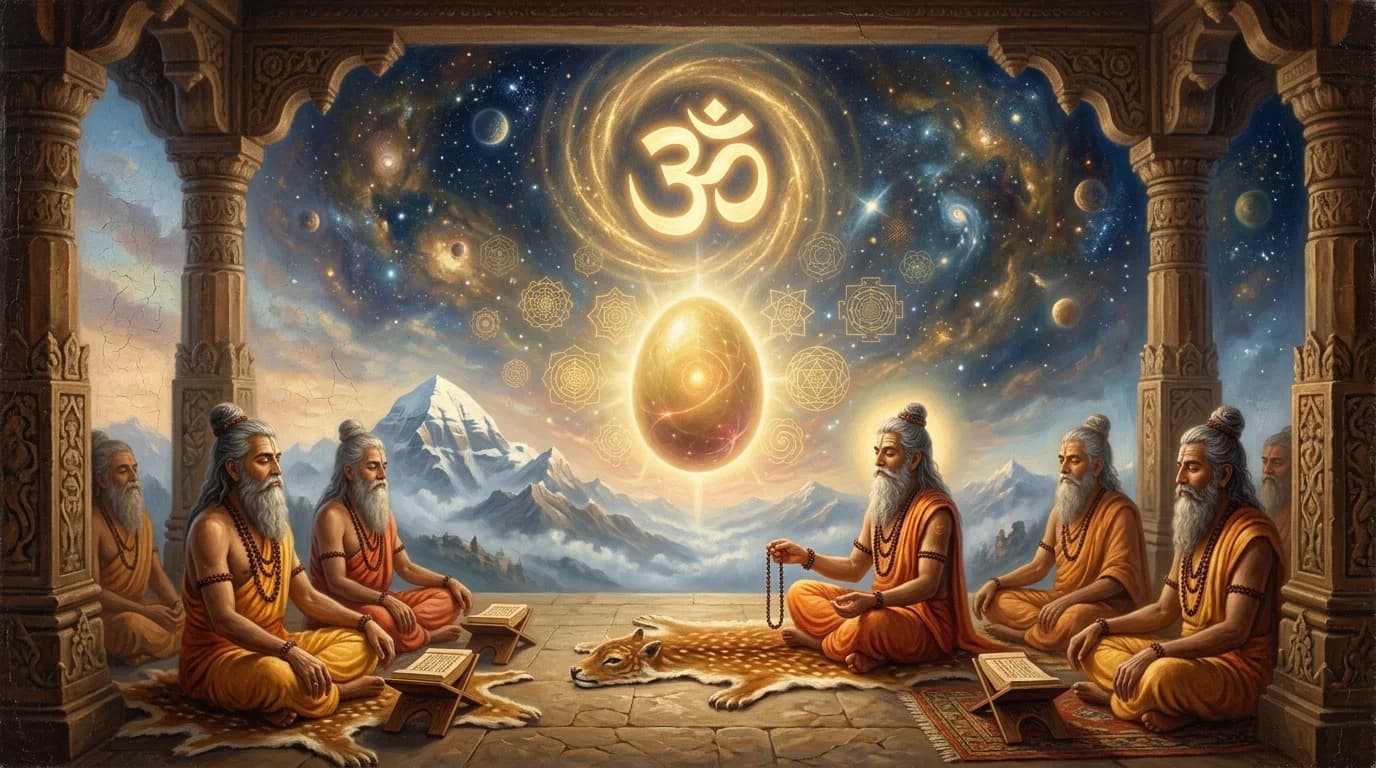
Section 1: Taxonomic Header & Etymology (Nirukta & Vyutpatti)
| Devanagari Forms | ब्रह्मन् (Sanskrit neuter n-stem: bráhman; nominative singular: ब्रह्म, brahma / ब्रह्मा, brahmā for the masculine creator deity Brahmā) |
|---|---|
| IAST Transliteration | Brahman (neuter absolute reality) vs. Brahmā (masculine personal creator deity of the Trimūrti) |
| Verbal Root (Dhātu) | Derived from the Sanskrit root √bṛh (बृह्) or √bṛṃh (बृंह्), cataloged in Pāṇini’s Dhātupāṭha under class 1 (bṛhi vṛddhau, "to grow, swell, expand, burst forth with infinite energy"). In Yāska’s Nirukta (1.8) and traditional etymological lexicons (Amarakośa), Brahman is defined as that which expands boundlessly and causes all things to grow: |
| Grammatical Derivation (Vyutpatti) | Formed by attaching the primary suffix -man (manin) to the root √bṛh / √bṛṃh (bṛher manin), producing the neuter nominal stem bráhman (signifying boundless expansion, prayer, sacred utterance, and ontological reality). Pāṇinian phonology explains the aspiration shift and nasal assimilation characteristic of the Vedic nominal class. |
“Because it is infinitely vast (bṛhat) and because it causes all things to expand and be nourished (bṛṃhaṇa), that Supreme Reality is designated as Brahman.”
— Yāska’s Nirukta 1.8 and Amarakośa traditionsSemantic Evolution: From Sacred Utterance to Ultimate Absolute
Across the historical strata of Sanskrit literature, the term bráhman underwent a profound semantic expansion:
In the Ṛgveda, bráhman denoted sacred speech, liturgical hymns, or mystical poetic utterances that possessed transformative power, lifting human awareness toward the divine.
In the sacrificial ritual texts, bráhman came to signify the mystical binding energy underlying the sacrificial rites, holding the cosmos together.
In the Upaniṣads, Brahman was elevated to supreme metaphysical status—the immutable, boundless reality from which the universe originates, by which it is sustained, and into which it ultimately dissolves.
Section 2: Abstract & Philosophical Core
Within Sanātana Dharma, Brahman is the absolute, non-dual reality that constitutes the foundation, material cause (Upādāna-kāraṇa), and efficient cause (Nimitta-kāraṇa) of the entire universe. It is neither a localized deity sitting in a celestial realm nor an inanimate physical substance; rather, it is infinite, self-luminous consciousness (Sat-Cit-Ānanda) that simultaneously transcends the cosmos (Transcendent / Nirguṇa) and immanently pervades every atom of creation (Immanent / Saguṇa).
The central epistemological insight of the Upaniṣads is the radical identity of Ātman (the innermost subjective witness consciousness) and Brahman (the supreme objective cosmic ground): Ayam Ātmā Brahma ("This innermost Self is Brahman") and Tat Tvam Asi ("That Thou Art").
When human beings view reality through the lens of fragmentation (Bheda-buddhi), they perceive a pluralistic universe of separate objects, births, and deaths. When the mind is purified through moral discipline (Dharma), selflessness (Karma Yoga), and contemplative inquiry (Jñāna Yoga), it recognizes that all names and forms (Nāma-rūpa) are transient ripples on the infinite ocean of Brahman.
Section 3: Primary Scriptural Anchors (Śruti & Upaniṣads)
Om. Brahman is Truth (Satya), Consciousness (Jñāna), and Infinity (Ananta). He who knows that Brahman is lodged within the secret cave of the heart and in the supreme space of consciousness—he fulfills all his desires simultaneously in union with the all-knowing Brahman.
This triad (Satyam, Jñānam, Anantam) is foundational across all Vedāntic schools. Ādi Śaṅkarācārya explains in his Bhāṣya that these three terms are not adjectives describing Brahman as if it had properties; rather, they are defining terms (Svarūpa-lakṣaṇa) that point to its unconditioned nature: Satya distinguishes Brahman from unreal illusions; Jñāna distinguishes it from inert matter (Jaḍa); and Ananta distinguishes it from finite objects.
This immortal Brahman alone is before, Brahman is behind, Brahman is to the right and to the left. It stretches below and above; this entire universe is verily the supreme Brahman alone.
This verse establishes radical immanence (Sarvātmakatva). Just as waves, foam, and bubbles are nothing other than water, every object, person, and cosmic force in the universe is an expression of Brahman.
This Self is Brahman, existing everywhere, shining in all things.
In the Madhuvidyā ("Doctrine of Honey/Mutual Interdependence"), sage Yājñavalkya reveals that every aspect of the cosmos—earth, water, fire, wind, sun, consciousness—is reciprocal nectar for all beings, because the identical, immortal Brahman resides as the inner ruler within all.
It is not attained by speech, nor by the mind, nor by the eye. How can It be comprehended except by one who says, 'It is'?
Kaṭha Upaniṣad teaches that while Brahman cannot be objectified by empirical senses or intellectual cognition, It is self-evident as pure existence itself (Asti). In Kena Upaniṣad 1.5, this is corroborated: "Yadvācānabhyuditaṃ yena vāgabhyudyate / tadeva brahma tvaṃ viddhi nedaṃ yadidamupāsate" ("That which cannot be expressed by speech, but by which speech is expressed—know That alone to be Brahman, not this which people worship here").
Section 4: The Twofold Aspect of Brahman: Nirguṇa vs. Saguṇa
A vital distinction in Vedāntic metaphysics (particularly Advaita) is the twofold presentation of Brahman:
| Dimension | Sanskrit Term | Ontological Status | Description & Epistemic Approach |
|---|---|---|---|
1. Transcendent Absolute | निर्गुण ब्रह्म / परब्रह्म Nirguṇa / Para Brahman | Pure Unconditioned Reality | Without attributes, form, gender, or change (Nirviśeṣa). Known only through direct intuitive realization (Aparokṣānubhūti). |
2. Immanent Creator & Lord | सगुण ब्रह्म / अपरब्रह्म / ईश्वर Saguṇa / Apara Brahman / Īśvara | Phenomenal Ground with Attributes | The supreme architect, ruler, and efficient cause of the universe (Īśvara). Worshiped through devotion (Bhakti) and meditation (Upāsanā). |
Without attributes, form, gender, or change (Nirviśeṣa). Known only through direct intuitive realization (Aparokṣānubhūti).
The supreme architect, ruler, and efficient cause of the universe (Īśvara). Worshiped through devotion (Bhakti) and meditation (Upāsanā).
Section 5: Comparative Darśana & Sampradāya Perspectives (Bhāṣya Analysis)
The three foundational Vedāntic Darśanas interpret the nature of Brahman and Its relationship with the individual soul (Jīva) and material creation (Jagat) through rigorous Bhāṣya exegesis of the Prasthānatrayī:
1. Advaita Vedānta
Ādi ŚaṅkarācāryaCore Tenet: Non-dualism (Advaita). Brahman alone is ultimately real (Satyam), while the phenomenal world of multiplicity is an apparent superimposition (Vivarta) driven by Māyā or Avidyā. In realization, the individual Ātman and Brahman are recognized as identical (Ahaṃ Brahmāsmi).
2. Viśiṣṭādvaita Vedānta
Śrī RāmānujācāryaCore Tenet: Qualified Non-dualism (Viśiṣṭādvaita). Brahman is identified explicitly with Śrīman Nārāyaṇa, possessing infinite auspicious attributes (Kalyāṇa-guṇas). The universe of sentient souls (Cit) and insentient matter (Acit) forms the real, organic body (Śarīra) of Brahman.
3. Dvaita Vedānta
Śrī MadhvācāryaCore Tenet: Radical Dualism (Dvaita). Brahman (Viṣṇu) is completely distinct from individual souls (Jīvas) and matter (Prakṛti). Liberation (Mokṣa) is the eternal realization of the soul's loving, dependent relationship with Lord Viṣṇu.
Section 6: Verified Academic & Traditional Bibliography
Primary Sanskrit texts cited according to their standard critical editions, supplemented by classical commentaries and twentieth-century Indological scholarship: