
Valmiki Ramayana (वाल्मीकि रामायणम्)(वाल्मीकि रामायणम्)
The foundational Ādi-Kāvya narrating the life of Maryādā Puruṣottama Śrī Rāma, demonstrating the living application of Dharma through human relationships, filial duty, statecraft, and fidelity
Section 1: Taxonomic Header & Etymology (Nirukta & Vyutpatti)
| Devanagari Forms | वाल्मीकिरामायणम् (Neuter singular compound: Vālmīki-Rāmāyaṇam; Nominative: Vālmīki-Rāmāyaṇam) |
|---|---|
| IAST Transliteration | Vālmīki-Rāmāyaṇam |
| Verbal Root (Dhātu) | Derived from the verbal root √ram (रमु क्रीडायाम् — ramu krīḍāyām, Pāṇinian Dhātupāṭha 1.906, "to delight, rejoice, sport, find serene rest") combined with the primary suffix ghañ (Pāṇini Aṣṭādhyāyī 3.3.18 / 3.3.113), joined to ayana from √iṇ (इण् गतौ — iṇ gatau, class 2, "to go, move, walk, attain") with the neuter suffix lyuṭ (-ana, Aṣṭādhyāyī 3.3.115). |
| Grammatical Derivation (Vyutpatti) | Classical Sanskrit exegesis derives the compound Vālmīki-Rāmāyaṇam through rigorous Pāṇinian morphology: (1) Rāma (राम): Derived from √ram in two complementary senses: (a) Locative Contemplative Sense (Adhikaraṇe ghañ): "Ramante yogino'nante nityānande cidātmani / iti rāma-padenāsau paraṃ brahmābhidhīyate" (Padma Purāṇa & Rāmapūrvatāpanīya Upaniṣad)—"That infinite, eternally blissful Consciousness (Cidātman) in Whom the yogis rejoice in meditative absorption is designated by the word Rāma." (b) Causative Active Sense (Kartari ghañ from ramayati): "Rāmayati sarvān lokān saundarya-śīla-guṇaiḥ iti rāmaḥ"—"He who delights all worlds through His moral beauty, compassion, and noble character is Rāma." (2) Ayana (अयन): Formed from √iṇ + lyuṭ, signifying "sacred path, journey, course of conduct, shelter, or abode." (3) Rāmāyaṇa (Natva Phonetic Rule): When Rāma and ayana combine (Rāma + ayana), the dental nasal n (न) of ayana undergoes cerebralization (ṇatva) to retroflex ṇ (ण) following the r in the prior member via Pāṇini Aṣṭādhyāyī 8.4.2 (aṭ-kupv-āṅ-num-vyavāye'pi) and 8.4.3 (pūrvapadāt saṃjñāyām agah), yielding Rāmāyaṇam: "The Sacred Journey, Way of Life, and Abode of Śrī Rāma." |
“Narrative of past events accompanied by instruction in the four human ends of life—Dharma, Artha, Kama, and Moksha—is designated as Itihasa.”
— Classical Definition of Itihāsa (Amarkośa & Purāṇic Lexicography)Semantic Evolution & Why “Religion” is an Inadequate Translation
In Bāla Kāṇḍa 4.7, Maharṣi Vālmīki articulates three distinct internal titles for his own work, revealing its multifaceted thematic dimensions:
The sacred journey and moral exemplar of Śrī Rāma, showing how an individual maintains unblemished righteousness, filial duty, and fidelity in royal prosperity and deep forest exile.
Vālmīki explicitly titles the epic after Devī Sītā, honoring her moral sovereignty, unbroken courage in the Aśokavana, intellectual independence, and boundless maternal compassion.
The cosmic and geopolitical dimension of the narrative: the defeat of Rāvaṇa (grandson of Pulastya), demonstrating that tyrannical force divorced from Dharma inevitably collapses.
Section 2: Abstract & Philosophical Core
Why does Sanātana Dharma place an epic narrative alongside abstract metaphysical treatises? Classical Sanskrit poetics (Mammaṭa's Kāvyaprakāśa 1.2 and Abhinavagupta's Locana) explains that scriptures instruct humanity through three distinct pedagogical voices: (1) Prabhu-sammita (प्रभुसम्मित — Like a Sovereign Master), such as the Vedas and legal codes, commanding through direct injunction ("Speak the truth; practice Dharma"); (2) Suḥṛt-sammita (सुहृत्सम्मित — Like a Wise Friend), such as the Purāṇas and historical chronicles, advising through cautionary examples and historical consequences; and (3) Kāntā-sammita (कान्तासम्मित — Like a Beloved Companion), such as elevated Kāvya, which moves the heart through aesthetic beauty (Rasa) and empathy, inspiring the listener to embrace righteousness spontaneously from within.
The Vālmīki Rāmāyaṇa represents the supreme masterpiece of this transformative pedagogical art. While the Upaniṣads inquire into the transcendent Absolute and the Dharmaśāstras codify ethical rules, the Rāmāyaṇa reveals Vigrahavān Dharmaḥ—Dharma embodied in a living human person (Maryādā Puruṣottama Śrī Rāma) navigating the joys, heartbreaks, exiles, and moral dilemmas of earthly existence.
Unlike speculative treatises, the epic tests virtue in relational crucibles: between father and son (Daśaratha and Rāma), mother and step-son (Kausalyā, Sumitrā, Kaikeyī), brothers who refuse to covet a throne (Rāma, Bharata, Lakṣmaṇa, Śatrughna), husband and wife (Rāma and Sītā), and friends across boundaries of species, culture, and status (Rāma's embrace of Guha the forest chieftain, Śabarī the ascetic woman, Jaṭāyu the vulture-king, Sugrīva, Hanumān, and Vibhīṣaṇa).
Four Foundational Insights of the Ādi-Kāvya (चतुर्विध मूल दर्शन)
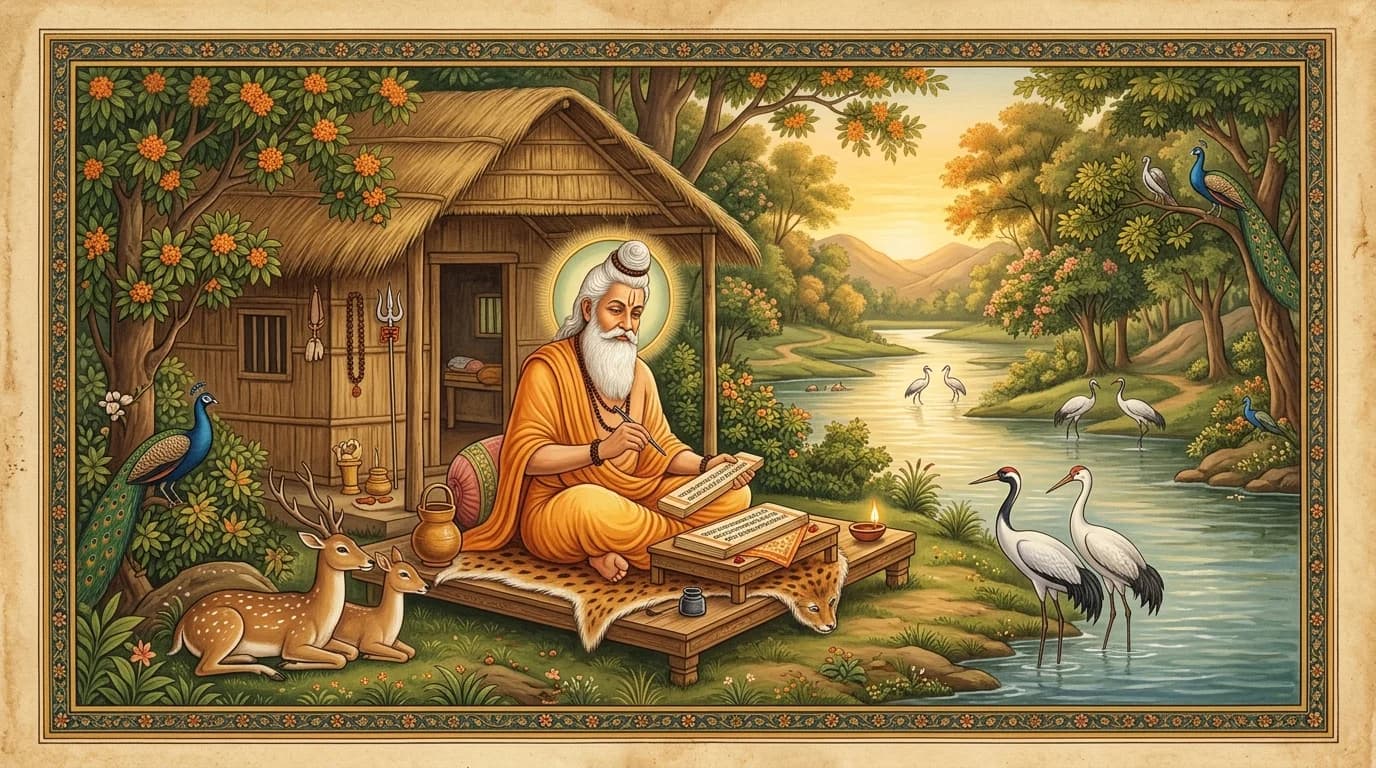
The epic begins not on a battlefield or royal court, but in a forest when Maharṣi Vālmīki witnesses a hunter shoot down a Krauñca crane and hears the grieving cry of its widowed mate. Out of selfless empathy (Kāruṇya), Vālmīki's sorrow (Śoka) spontaneously crystallizes into rhythmic Anuṣṭubh meter (Śloka). In the Indian tradition, all authentic literature is born from compassion for the suffering of sentient beings.
Dharma is never an abstract theory in the epic; it is lived across concrete relational crucibles. Brothers refuse royal inheritance out of love for each other, rulers honor promises at the cost of life, and social barriers dissolve in unconditional spiritual fellowship with forest chieftains, birds, and ascetics.
Devī Sītā stands as the unwavering moral compass of the epic. She insists on sharing fourteen years of wilderness exile out of love, confronts the tyrant Rāvaṇa in the Aśokavana with only a blade of grass (Tṛṇam antarataḥ kṛtvā) between them, and protects the very Rākṣasī guards who tormented her after victory.
The epic sets up a stark civilizational contrast between Rāvaṇa—possessing Vedic scholarship, ascetic power (Tapas), and golden wealth, yet enslaved to predatory desire (Kāma)—and Śrī Rāma, whose martial strength is voluntarily governed by Satya (truthfulness), Karuṇā (compassion), and Maryādā (ethical bounds).
Section 3: Primary Scriptural Anchors (Śruti, Smṛti, and Itihāsa)
O hunter, never may you attain peaceful standing for endless years to come, because from this mated pair of Krauñca birds you have struck down one while it was absorbed in love!
In the Dhvanyāloka (1.5: "Kāvyasyātmā sa evārthas tathā cādikaveḥ purā / krauñca-dvandva-viyogotthaḥ śokaḥ ślokatvam āgataḥ"), the 9th-century literary philosopher Ānandavardhana cites this verse as the foundational archetype of Rasa-dhvani (aesthetic suggestion), where personal grief (Śoka) is transmuted by the poet's contemplative vision into universal aesthetic compassion (Karuṇa-rasa). Furthermore, classical commentators (Govindarāja in Bhūṣaṇa and Maheśvara Tīrtha in Tattvadīpikā) demonstrate how these exact Sanskrit syllables simultaneously form an auspicious Maṅgalācaraṇa (benediction to Lord Viṣṇu) via Śleṣa (double-entendre): resolving mā-niṣāda as "O Abode/Consort of Mā [Goddess Mahālakṣmī], may You attain eternal renown (tvam agamaḥ pratiṣṭhāṃ śāśvatīḥ samāḥ), for from the pair of demon-tyrants [Rāvaṇa and Mandodarī], You struck down the one blinded by lust (kāma-mohitam)!"
Who indeed in this world today is virtuous and heroic, a knower of Dharma, grateful, truthful in speech, and firm in his vows? Who is endowed with stainless character, devoted to the welfare of all living beings, wise, capable, and uniquely delightful to behold? Who is self-possessed, has conquered anger, is radiant, free from envy, and before whose righteous wrath in battle even the gods tremble?
Vālmīki asks Sage Nārada not about a mythical figure in a distant paradise, but asmin sāmprataṃ loke—"in this world right now." Nārada replies that these sixteen virtues—comparable to the sixteen digits (Ṣoḍaśa-kalā) of the full moon—are united in Ikṣvāku-vaṃśa-prabhavo Rāmo nāma janaiḥ śrutaḥ (1.8). Commentators highlight Kṛtajñaḥ (gratitude) right alongside Dharmajñaḥ: as Govindarāja notes, Rāma remembers a single small act of help forever, yet never recalls a hundred offenses committed against Himself (kṛtam ekam upakāraṃ jānāti, nāpakāra-śatam).
Truth alone is the Sovereign of the world; upon Truth does Dharma ever rest. All things have Truth as their root; there is no state higher than Truth. Charity, sacrifices, oblations, austerities practiced, and the Vedas themselves are founded upon Truth; therefore, one must be supremely devoted to Truth.
At Citrakūṭa, when the royal counselor Jābāli adopts a pragmatic materialist (Lokāyata) argument to persuade Rāma to break his vow and return to rule Ayodhyā—arguing that Daśaratha is dead and promises to the dead are mere words—Rāma delivers this constitutional defense of moral integrity. If a ruler abandons Satya for political expediency, the entire trust holding society together collapses (Ayodhyā 109.9: "Kṣatra-bandhur ahaṃ... dharma-veṣeṇa pāpaṃ na kartum utsahe"—"I refuse to commit unrighteousness wearing the cloak of Dharma").
Rāma is Dharma incarnate in living form; He is noble, and His valor is unfailingly wedded to truth. He is the sovereign of the entire world, even as Indra is of the gods.
Classical Sanskrit rhetoric celebrates Pratipakṣa-praśaṃsā—praise uttered not by a court flatterer, but involuntarily by an adversary who has experienced the hero's character firsthand. This immortal definition (Rāmo vigrahavān dharmaḥ) is spoken by the Rākṣasa Mārīca to Rāvaṇa in an urgent attempt to dissuade Rāvaṇa from abducting Sītā, warning that challenging Dharma incarnate guarantees ruin.
To anyone who approaches Me for refuge even once and implores, "I am Yours," I grant sanctuary and fearlessness from all beings—this is My solemn vow. (6.18.33) ... Compassion must be extended by a noble soul toward even those who have done wrong; for who in this world is completely free from error? (6.113.45)
These two verses form the ethical summit of the Yuddha Kāṇḍa. When Vibhīṣaṇa forsakes Rāvaṇa's unjust court and arrives at Rāma's camp, Sugrīva warns that he may be an enemy spy; Rāma replies with 6.18.33, declaring that he would grant sanctuary even to Rāvaṇa himself if he sought refuge. Second, immediately after Rāvaṇa falls in battle, Hanumān enters the Aśokavana and asks Sītā's permission to punish the cruel Rākṣasī guards who had tormented her for ten months. Devī Sītā immediately stays Hanumān's hand with 6.113.45 (kāryaṃ karuṇam āryeṇa na kaścin nāparādhyati), shielding her former captors with unconditional forgiveness.
Section 4: Structural Architecture — The Seven Kāṇḍas, Gāyatrī-Sampuṭa, & Textual Recensions
The architecture of the Vālmīki Rāmāyaṇa harmonizes acoustic geometry, geographical breadth, and narrative pacing into a unified epic structure:
1. The 24,000-Verse Gāyatrī Architecture (Caturviṃśatisāhasrī Saṃhitā)
In Bāla Kāṇḍa 4.2 ("Caturviṃśatsahasrāṇi ślokānām uktavān ṛṣiḥ"), Maharṣi Vālmīki structures the epic into exactly 24,000 Ślokas, corresponding directly to the 24 sacred syllables of the Vedic Savitṛ Gāyatrī Mantra (Ṛgveda 3.62.10: Tat savitur vareṇyaṃ bhargo devasya dhīmahi | dhiyo yo naḥ pracodayāt ||). In traditional manuscripts and commentaries (such as Govindarāja's Bhūṣaṇa), the first verse of every 1,000-verse interval (Sahasra-ślokī) begins sequentially with one of the 24 syllables of the Gāyatrī Mantra (starting with त in Tapas-svādhyāya-niratam, 1.1.1), rendering the entire epic an acoustic expansion (Upabṛṃhaṇa) of the Gāyatrī Mantra.
2. The Seven-Book Narrative & Ethical Blueprint (सप्तकाण्ड संरचना एवं दार्शनिक तत्त्व)
The epic unfolds across seven books (Sapta-Kāṇḍa), each situated in a distinct geographical landscape and dedicated to specific ethical dimensions:
| Kāṇḍa (Book) & Sanskrit Title | Approximate Sargas | Geographic Locus & Narrative Arc | Central Philosophical & Ethical Theme |
|---|---|---|---|
Bāla Kāṇḍa बालकाण्डम् Bāla Kāṇḍam (Book of Youth) | 77 / 76 Sargas | Ayodhyā, Siddhāśrama, & Mithilā Birth of Rāma and His brothers; apprenticeship under Sage Viśvāmitra; protection of the Yajña; redemption of Ahalyā; breaking of Śiva's bow and marriage to Sītā. | Brahmavidyā & Preparation: Uniting martial valor (Kṣātra-tejas) with spiritual humility (Brahma-tejas) under a Guru; redemptive grace (Ahalyā-uddhāra). |
Ayodhyā Kāṇḍa अयोध्याकाण्डम् Ayodhyā Kāṇḍam (Book of Ayodhyā) | 119 / 111 Sargas | Ayodhyā to Citrakūṭa Eve of coronation turned into 14-year exile via Kaikeyī's boons; Rāma's serene acceptance; Sītā and Lakṣmaṇa's devotion; Daśaratha's grief; Bharata-milāpa and installation of the Pādukās at Nandigrāma. | Samatva, Satya, & Tyāga: Unchanged radiance of face when offered a crown or exile; Bharata ruling as a trustee-ascetic rather than usurping a throne. |
Araṇya Kāṇḍa अरण्यकाण्डम् Araṇya Kāṇḍam (Book of the Forest) | 75 / 71 Sargas | Daṇḍakāraṇya & Pañcavaṭī Sanctuary to forest sages; discourse with Sītā on non-provocation vs. protective duty; Śūrpaṇakhā's mutilation; the Golden Deer (Mārīca); abduction of Sītā; Jaṭāyu's heroic sacrifice; meeting Śabarī. | Dharma-Sūkṣmatā & Bhakti: The subtlety of non-violence vs. defense of the vulnerable; Jaṭāyu's supreme sacrifice (Mokṣa bestowed by Rāma); Śabarī's pure devotion transcending social birth. |
Kiṣkindhā Kāṇḍa किष्किन्धाकाण्डम् Kiṣkindhā Kāṇḍam (Book of Kiṣkindhā) | 67 / 66 Sargas | Ṛṣyamūka, Kiṣkindhā, & Southern Ocean Meeting Hanumān; sacred fire-alliance (Agni-sākṣika-sakhya) with Sugrīva; restraint of Vālin; coronation of Tārā/Sugrīva; dispatch of search parties; Sampāti's guidance and awakening of Hanumān's latent strength. | Mitra-Dharma & Ātma-Bala: Steadfastness in friendship; accountability to moral law; awakening forgotten inner potential (Jāmbavān reminding Hanumān of his infinite capacity). |
Sundara Kāṇḍa सुन्दरकाण्डम् Sundara Kāṇḍam (Book of Beauty) | 68 / 66 Sargas | Laṅkā & Aśokavana Hanumān's leap across the ocean (overcoming Maināka, Surasā, and Siṃhikā); discovery of Sītā in the Aśokavana; Sītā's fearless rebuke of Rāvaṇa; presentation of Rāma's signet ring (Cūḍāmaṇi exchange); burning of Laṅkā's fortifications. | Hope, Resilience, & Grace: Why is it called Sundara ("Beautiful")? Because here the separated soul (Sītā) and the Supreme Lord (Rāma) are united by the selfless spiritual messenger (Ācārya / Prāṇa — Hanumān). |
Yuddha Kāṇḍa युद्धकाण्डम् Yuddha Kāṇḍam (Book of the War / Laṅkā Kāṇḍa) | 128 / 116 Sargas | Seashore, Setubandha, Laṅkā, & Ayodhyā Sanctuary to Vibhīṣaṇa (Abhaya-dāna); building of the Ocean Bridge; the great war (Kumbhakarṇa, Indrajit, Sañjīvanī herb, Āditya-hṛdaya, fall of Rāvaṇa); Sītā's Agni-parīkṣā; return in the Puṣpaka and Paṭṭābhiṣeka (Rāmarājya). | Dharma-Yuddha & Śaraṇāgati: Victory of moral order over egoic tyranny (Rāvaṇa); dignity even toward fallen foes (Rāma's words to Vibhīṣaṇa at Rāvaṇa's funeral: "Maraṇāntāni vairāṇi"—"Enmities end with death; he is as much my brother as yours," 6.109.25). |
Uttara Kāṇḍa उत्तरकाण्डम् Uttara Kāṇḍam (Epilogue / Later Book) | 111 / 100 Sargas | Laṅkā's Pre-history, Ayodhyā, & Hermitage Origins of the Rākṣasas and Hanumān's childhood; tragedy of public rumor and Sītā's shelter in Vālmīki's hermitage; birth of Kuśa and Lava and their recitation of the Rāmāyaṇa; Sītā's final return into Mother Earth (Bhū-praveśa). | Tragic Sublimity & Transcendence: The agonizing tension between a constitutional monarch's public sacrifice (Rājadharma) and personal heartbreak; Sītā's ultimate vindication and return to her sacred origin. |
3. The Three Manuscript Recensions & The Baroda Critical Edition
Between 1951 and 1975, Sanskrit philologists led by G. H. Bhatt and U. P. Shah at the Oriental Institute, M. S. University of Baroda (Vadodara), collated nearly 2,000 manuscripts across India and Nepal to publish the definitive seven-volume Critical Edition of the Vālmīki Rāmāyaṇa. Philological analysis established two major recensions (Northern and Southern), subdivided into three regional streams:
The Southern Recension
दाक्षिणात्य पाठCharacterized by high grammatical regularity, uniform inclusion of the Gāyatrī-Sampuṭa, and preserved by the great medieval commentators (Varadarāja, Govindarāja, and Nāgojī Bhaṭṭa). Formed the primary baseline for the Critical Edition.
The North-Western Recension
उदीच्य पाठCritically edited by Vishva Bandhu at the Vishveshvaranand Vedic Research Institute (VVRI, Hoshiarpur). Contains distinctive variant readings and preserved ancient textual sequences in Northwestern India.
The North-Eastern Recension
प्राच्य पाठPreserved in ancient Newari palm-leaf manuscripts (including the oldest dated manuscript of 1020 CE). First introduced to European scholarship in Paris and Turin by Gaspare Gorresio (1843–1867).
Section 5: Comparative Darśana & Sampradāya Perspectives (Bhāṣya Analysis)
Across three millennia of classical Indian exegesis, the Vālmīki Rāmāyaṇa has been studied not merely as a sacred narrative, but as an authoritative Śāstra interpreted through more than thirty Sanskrit commentaries (Ṭīkās) and the foundational Darśanas of Vedānta:
1. Classical Sanskrit Commentarial Tradition (Rāmāyaṇa-Ṭīkās)
Udāli Varadarāja (12th c.), Govindarāja (15th c.), Nāgojī Bhaṭṭa (18th c.), Maheśvara Tīrtha, Śivasahāya, Mādhava YogīTraditional Indian scholarship studied every grammatical inflection, Mīmāṃsā legal rule, and moral dilemma of Vālmīki's text through more than thirty classical Sanskrit commentaries (Ṭīkās). Foremost among these are: (1) Vivekatilaka of Udāli Varadarāja (12th–13th century CE), the oldest surviving complete Sanskrit commentary; (2) Rāmāyaṇa-Bhūṣaṇa of Govindarāja (15th–16th century CE, Tirupati/Kāñcī), a monumental seven-volume commentary interpreting every verse through Pāṇinian grammar and Viśiṣṭādvaita theology; (3) Rāmāyaṇa-Tilaka of Nāgojī Bhaṭṭa / Rāmavarman (18th century CE, Varanasi), celebrated for grammatical precision and Advaitic insights; and (4) Amṛtakataka of Mādhava Yogī, interpreting the epic rigorously through Upaniṣadic Advaita.
2. Advaita Vedānta
Ādi Śaṅkarācārya, Mādhava Yogī (Amṛtakataka), Adhyātma Rāmāyaṇa traditionAdvaita Vedānta interprets the Rāmāyaṇa across both planes of reality (Dvirūpa-brahma): (1) On the Pāramārthika / Adhyātma Plane: Rāma is Tāraka-brahma—Pure, Self-Luminous Consciousness (Parātpara-brahma) abiding in Ayodhyā (the human body of nine gates). Sītā is Mūla-prakṛti / Cit-śakti; Lakṣmaṇa is the awakened Jīva serving the Self with vigilance; Rāvaṇa is the Daśendriya-abhimānī Ahaṃkāra (ten-headed ego identifying with the ten senses) abducting peace of mind; and Hanumān is Prāṇa / Mahat-tattva (the purified intellect and breath) leaping across the ocean of delusion (Moha) to reunite soul with Self. (2) On the Vyāvahārika Plane: By voluntarily acting within human limits ("Ātmānaṃ mānuṣaṃ manye"), the Supreme Brahman models how an individual must uphold Dharma with complete inner detachment (Jīvanmukti).
3. Viśiṣṭādvaita / Śrīvaiṣṇava Sampradāya
Śrī Rāmānujācārya, Periyavāccān Piḷḷai (Taniślokī), Vedānta Deśika (Abhayapradānasāra), GovindarājaIn the Śrīvaiṣṇava tradition, the Vālmīki Rāmāyaṇa is revered specifically as the Śaraṇāgati-Veda (the Canonical Scripture of Self-Surrender). While the Vedas reveal the Lord's transcendent majesty (Paratva), the Rāmāyaṇa reveals His Saulabhya (supreme accessibility) and Suśīlya (graciousness by which the Infinite mingles as an equal with forest-dwellers, birds, and monkeys). Every Kāṇḍa demonstrates Prapatti (surrender): Bharata's surrender to the Pādukās, the forest sages surrendering to Rāma, Sugrīva's surrender in friendship, and Vibhīṣaṇa's surrender at the seashore. Crucially, Viśiṣṭādvaita highlights Devī Sītā as Puruṣakāra-bhūtā Mahālakṣmī—the compassionate Divine Mother who mediates between the flawed human soul and the justice of the Lord, ensuring that no soul is ever beyond redemption.
4. Dvaita Vedānta
Śrī Madhvācārya (Mahābhārata-Tātparya-Nirṇaya / Saṅgraha-Rāmāyaṇa)Opening his Brahma-sūtra-bhāṣya and Tātparya-nirṇaya by citing the Mūla-Rāmāyaṇa, Śrī Madhvācārya establishes that Lord Rāma is the full, unconditioned manifestation (Pūrṇāvatāra) of Śrīman Nārāyaṇa, eternally free from human limitation or ignorance. Whenever Rāma appears to grieve or ask questions in the epic, it is purely Loka-śikṣaṇārtha (pedagogical demonstration to instruct humanity in Dharma) and to honor the terms of Brahmā's boons. Furthermore, Dvaita metaphysics places special emphasis on Hanumān as the incarnation of Mukhya-Prāṇa (Vāyu-deva, the cosmic mediator of life-breath and Jīva-ottama), whose unswerving service in the Sundara and Yuddha Kāṇḍas represents the zenith of Tattvajñāna and Bhakti.
Section 6: Constitutional Governance & Moral Dilemmas — Rājadharma & Dharma-Saṅkaṭa
The Vālmīki Rāmāyaṇa presents an enduring benchmark of political philosophy while refusing to flatten human life into simplistic moral formulas. Through constitutional discourses and complex ethical crises, it explores how power must be disciplined by duty:
1. The Constitutional Blueprint of Rāmarājya (The Kaccit-Sarga)
कच्चित्-सर्गः · राजधर्म-संविधानम् (Kaccit-Sargaḥ (Ayodhyā Kāṇḍa 100 / Critical Edition 94))When Bharata visits Citrakūṭa, Rāma greets him with more than seventy penetrating constitutional questions, known as the Kaccit-Sarga ("I trust that..."), outlining the benchmark of righteous governance (Rāmarājya):
2. The Restraint of Vālin: Jurisdictional Justice vs. Concealment
वालि-निग्रह एवं अधिकार-विमर्श (Vāli-Nigraha & Adhikāra-Vimarśa (Kiṣkindhā Kāṇḍa 17–18))In Kiṣkindhā Kāṇḍa 17, Vālmīki provides Vālin with an eloquent Sarga to question Rāma directly on striking from concealment. In Chapter 18, Rāma presents a legal justification based on sovereign jurisdiction (Bhūmiḥ sabhārata), the sacred duty of protecting an allied refugee (Sugrīva), and enforcing the moral law against Vālin's usurpation of his living brother's wife (Rumā). Classical commentators observe that Vālim acknowledges the justice of Rāma's judgment before passing, entrusting his son Aṅgada to Rāma's care.
3. Public Office vs. Personal Heart: Sītā's Moral Sovereignty
राजधर्म-व्यक्तिगत-हृदय-सङ्घर्षः (Rājadharma & Sītā's Spiritual Sovereignty (Uttara Kāṇḍa 96–97))In the Uttara Kāṇḍa, Vālmīki dramatizes the tragic tension when a constitutional monarch's obligation to remain beyond public reproach clashes with his personal knowledge of his wife's spotlessness. The epic gives the final moral word to Maharṣi Vālmīki and Devī Sītā herself in the royal assembly (Uttara Kāṇḍa 96–97), where Sītā's dignified return to Mother Earth (Mādhavī Devī) stands as an immortal assertion of feminine spiritual sovereignty, refusing to compromise her sacred integrity.
Section 7: Living Praxis — Sundarakāṇḍa Pārāyaṇa & The Global Ramayana Continuum
For three millennia, the Vālmīki Rāmāyaṇa has functioned not as a closed historical relic, but as an active liturgical discipline and a civilizational continuum spanning regional India and Southeast Asia:
1. Sundarakāṇḍa Pārāyaṇa & Āditya-Hṛdaya Stotra
सुन्दरकाण्ड पारायण एवं आदित्यहृदय स्तोत्रAcross India, the Sundara Kāṇḍa (68 Sargas) is recited in its entirety or across 7-day / 9-day Navāha-pārāyaṇa cycles. Uniquely, it contains no battlefield violence; it is a contemplative pilgrimage of mindfulness and humility, showing how the soul crosses the ocean of obstacles to rediscover inner peace (Sītā). Similarly, Sage Agastya's instruction to Rāma on the battlefield—the Āditya-Hṛdaya Stotra (Yuddha Kāṇḍa 105)—is chanted daily across traditions to cultivate mental focus, dispel exhaustion, and dissolve self-doubt.
2. Classical Sanskrit Literature Continuum
संस्कृत महाकाव्य एवं नाटक परम्पराVālmīki's narrative directly inspired the greatest classical Sanskrit masterpieces: Kālidāsa's Raghuvaṃśa (celebrating the solar dynasty's ideals), Bhāsa's Pratimānāṭaka and Abhiṣekanāṭaka, Bhaṭṭi's grammatical epic Rāvaṇavadha (Bhaṭṭikāvya), and Bhavabhūti's psychological dramas Mahāvīracarita and Uttararāmacarita.
3. The Great Vernacular Classics of South India
दाक्षिणात्य भाषासु रामकथा विस्तारःEvery linguistic culture of the South reimagined Vālmīki: Kampan's 12th-century Tamil masterwork Irāmāvatāram (Kamba Rāmāyaṇam); Ranganātha's Telugu Ranganātha Rāmāyaṇamu and Viswanatha Satyanarayana's Śrīmadrāmāyaṇa Kalpavṛkṣamu; Thunchaththu Ezhuthachan's Malayalam Adhyātma Rāmāyaṇam Kilippāṭṭu; and Narahari's Torave Rāmāyaṇa and Kuvempu's modern epic Śrī Rāmāyaṇa Darśanam in Kannada.
4. North, East, & West Indian Literary Heritage
उत्तर-पूर्व-पश्चिम प्रान्तीय राम-साहित्यGosvāmī Tulasīdāsa's 16th-century Awadhi Śrī Rāmacaritamānasa became the primary cultural scripture of North India; Mādhava Kandali's 14th-century Assamese Saptakāṇḍa Rāmāyaṇa; Krittibas Ojha's 15th-century Bengali Śrīrāma Pāñcālī; Balarāma Dāsa's 15th-century Odia Jagamohana Rāmāyaṇa; and Sant Eknāth's 16th-century Marathi Bhāvārtha Rāmāyaṇa.
5. The Pan-Asian Cultural Continuum
वैश्विक रामकथा एवं आग्नेय-एशिया परम्पराVālmīki's epic traveled across maritime trade routes into Southeast Asia: the 9th-century Old Javanese Kakawin Rāmāyaṇa (Indonesia), the stone reliefs carved across Prambanan; the Khmer Reamker carved along the galleries of Angkor Wat (Cambodia); the Thai national epic Ramakien; and the Lao Phra Lak Phra Lam.
Section 8: Verified Academic & Traditional Bibliography
Primary Sanskrit texts cited according to their standard critical editions, supplemented by classical commentaries and twentieth-century Indological scholarship: