
Srimad Bhagavad Gita (श्रीमद्भगवद्गीता)(श्रीमद्भगवद्गीता)
The Smṛti-Prasthāna of Vedānta: a battlefield dialogue synthesizing Non-Dual Metaphysics, Sāṃkhya Cosmology, Niṣkāma Karma, and Bhakti-Prapatti
Section 1: Taxonomic Header & Etymology (Nirukta & Vyutpatti)
| Devanagari Forms | श्रीमद्भगवद्गीता (Feminine singular compound: Śrīmad-Bhagavad-Gītā; Nominative: Śrīmad-Bhagavad-Gītā; locative plural in colophons: Śrīmad-Bhagavad-Gītāsu) |
|---|---|
| IAST Transliteration | Śrīmad-Bhagavad-Gītā |
| Verbal Root (Dhātu) | Derived from the verbal root √gai (गै शब्दे — gai śabde, Dhātupāṭha 1.965, "to sing, chant, articulate in melodic rhythm, proclaim in verse") with the past passive participial suffix -kta (Pāṇini Aṣṭādhyāyī 6.4.66: ghu-mā-sthā-gā-pā-jahāti-sāṃ hali), yielding gītā in the feminine singular to agree with the elided noun Upaniṣad (Bhagavatā gītā upaniṣad). |
| Grammatical Derivation (Vyutpatti) | The title constitutes a Karmadhāraya-compound embedded in a Tatpuruṣa: (1) Śrīmat (श्रीमत् → श्रीमद्- via sandhi): Formed from Śrī (radiant divine grace, sovereign majesty, and transcendental illumination) + possessive suffix matup (Pāṇini Aṣṭādhyāyī 5.2.94), signifying "supremely resplendent with eternal wisdom and beauty." (2) Bhagavat (भगवत् → भगवद्-): Derived from Bhaga + matup (with m → v via Aṣṭādhyāyī 8.2.9: mād upadhāyāś ca mator vo'yavādibhyaḥ). In classical Purāṇic and Vedāntic lexicography (Viṣṇu Purāṇa 6.5.74, cited by Ādi Śaṅkarācārya and Rāmānujācārya), Bhaga denotes the six infinite divine perfections (Ṣaḍ-aiśvarya) possessed in fullness by the Supreme Lord: Aiśvarya (unconditioned cosmic sovereignty), Vīrya (inexhaustible spiritual potency and valor), Yaśas (stainless renown), Śrī (all-sustaining beauty and abundance), Jñāna (omniscient, self-luminous consciousness), and Vairāgya (complete non-attachment and transcendence). (3) Gītā (गीता): Feminine participle agreeing with Upaniṣad, denoting the sacred song sung directly by the Supreme Lord Himself. |
“Thus, in the Upanishads of the glorious Bhagavad Gita, the science of the Absolute (Brahma-vidya), the scripture of practical integration (Yoga-shastra), and the dialogue between Shri Krishna and Arjuna...”
— Canonical Chapter Colophon (Saṅkalpa-puṣpikā)Semantic Evolution & Why “Religion” is an Inadequate Translation
Traditional Vedāntic exegesis establishes that the Gītā does not treat knowledge, action, and devotion as fragmented or contradictory paths, but orchestrates their organic synthesis across three linguistic and theological dimensions:
Signifies that the text is imbued with divine auspiciousness, supreme aesthetic beauty, and salvific grace, communicating the deepest truths of existence without formal austerity.
Identifies the speaker as the Supreme Being possessing unconditioned sovereignty (Aiśvarya), potency (Vīrya), renown (Yaśas), splendor (Śrī), omniscience (Jñāna), and transcendence (Vairāgya).
Designates the text as an Upaniṣad sung directly by Bhagavān, drawing the nourishing nectar of the entire Vedic revelation for active engagement in the world.
Section 2: Abstract & Philosophical Core
Within the Prasthānatrayī (the three canonical foundations of Vedānta), the Śrīmad Bhagavad Gītā occupies the position of the Smṛti-prasthāna. Embedded within the Bhīṣma Parva (Chapters 23–40) of Maharṣi Kṛṣṇa Dvaipāyana Vyāsa's Mahābhārata, it bridges the contemplative heights of the Upaniṣads (Śruti-prasthāna) and the systematic aphorisms of the Brahma Sūtras (Nyāya-prasthāna). Traditional verses in the Gītā-dhyāna compare the Upaniṣads to cows, Śrī Kṛṣṇa to the divine cowherd, Arjuna to the calf, and the Gītā to the nectar-like milk drawn for the nourishment of all humanity.
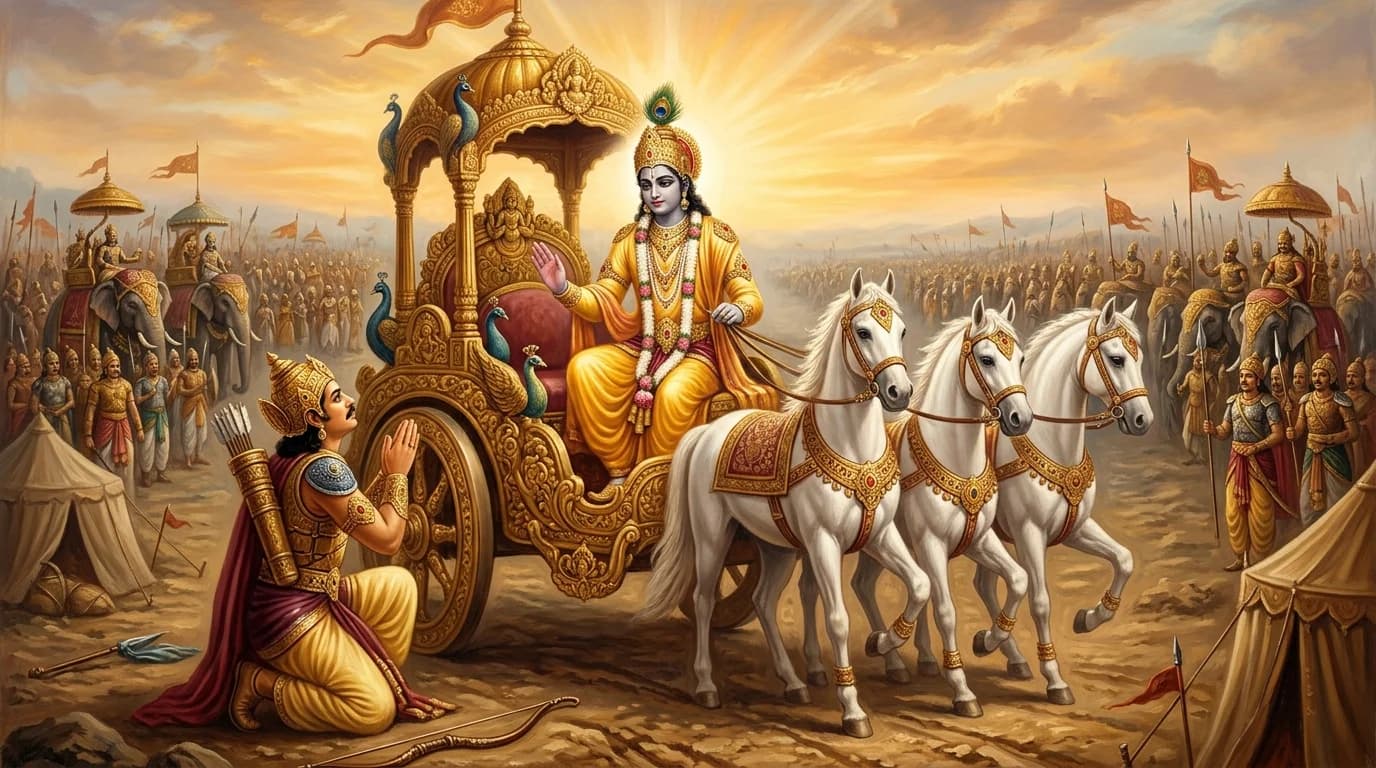
Unlike philosophical treatises composed in quiet forest hermitages, the Bhagavad Gītā opens in the center of an acute moral and existential crisis (Arjuna-viṣāda) between two arrayed armies at Kurukṣetra. Confronted with the tragic necessity of fighting a defensive war against his own elders, teachers, and kinsmen who have allied with unrighteousness (Adharma), the hero Arjuna is overwhelmed by grief (Śoka) and moral confusion (Moha / Dharma-sammūḍha-cetāḥ). Dropping his bow Gāṇḍīva, he surrenders as a disciple (Śiṣyas te'haṃ śādhi māṃ tvāṃ prapannam — 2.7) and asks what constitutes the true ultimate good (Śreyas).
To resolve Arjuna's paralysis, Bhagavān Śrī Kṛṣṇa executes one of the most comprehensive philosophical syntheses in world history. Rather than demanding withdrawal from the world into forest asceticism, the Gītā harmonizes four major streams of Indian thought that had previously been viewed as competing paths.
The Fourfold Philosophical Synthesis of the Bhagavad Gītā (चतुर्विध दार्शनिक समन्वय)
Affirms the absolute indestructibility of the indwelling conscious Self (Ātman / Dehī) and the all-pervasive presence of Brahman across every stratum of cosmic manifestation. Physical death touches only the transient bodily sheath (Deha), leaving the unborn, eternal witness untouched.
Establishes the analytical distinction between the conscious Knower of the Field (Kṣetrajña / Puruṣa) and the mutable Field of psychophysical matter (Kṣetra / Prakṛti) driven by the interplay of the three Guṇas (Sattva, Rajas, and Tamas). The Self is recognized as actionless witness (Akartā).
Transforms external ritual sacrifice into inward moral discipline: performing one's contextual duty (Svadharma) with consummate skill (Kauśala) and equanimity (Samatva), relinquishing all selfish claim over results (Niṣkāma Karma) to sustain universal order and social welfare (Lokasaṅgraha).
Reveals intimate communion with the Supreme Person (Puruṣottama), who transcends both mutable matter and immutable witness. Devotional adoration culminates in wholehearted self-surrender (Śaraṇāgati / Prapatti) to divine grace, neutralizing karmic fear and existential sorrow.
“All the Upanishads are the cows, the milker is Krishna the cowherd boy, Partha (Arjuna) is the calf, the wise are the drinkers, and the milk is the great nectar of the Gita.”
— Gītā-Dhyānam 4Section 3: Primary Scriptural Anchors (Śruti, Smṛti, and Itihāsa)
Of the unreal (Asat) there is no enduring being; of the Real (Sat) there is no non-being. The ultimate truth of both has been perceived by the seers of Reality. Just as a person casts off worn-out garments and puts on new ones, so the embodied Self (Dehī) casts off worn-out physical bodies and enters new ones.
In his Bhagavad-gītā-bhāṣya, Ādi Śaṅkarācārya identifies Verse 2.11 (Aśocyān anvaśocas tvam...) as the exact starting point (Śāstrārambha) of philosophical instruction. He explains that grief (Śoka) and delusion (Moha) cannot be eradicated through conventional worldly means or moral appeals, but yield solely to direct ontological discrimination between the immutable Conscious Self (Sat / Dehin) and the transient, perishable body (Asat / Deha). Verses 2.22–23 establish that the Self cannot be cleft by weapons, burnt by fire, moistened by water, or dried by wind; It remains eternal, all-pervading, unshakeable, and ancient.
Your rightful sphere of jurisdiction extends exclusively to the performance of action, never to its fruits. Let not the fruits of action be your motive, nor let your attachment be to inaction. Established in Yoga, perform your actions, abandoning possessive attachment, O Dhananjaya, remaining balanced in success and failure; this evenness of mind is called Yoga. Endowed with equanimous wisdom, one casts off right here both good and bad deeds; therefore, dedicate yourself to Yoga; Yoga is artistry and skill in action.
Classical commentators emphasize the delicate fourfold balance articulated in 2.47: human moral jurisdiction (Adhikāra) belongs solely to conscientious execution (Karmaṇi), never to external results (Phaleṣu). Craving for outcomes (Karma-phala-hetu) binds the psyche to anxiety, yet retreating into escapist inertia (Akarma) violates cosmic duty. Rāmānujācārya observes that Samatva (poised indifference to personal gain or loss) dissolves karmic residue, while Yogaḥ karmasu kauśalam defines Yoga as the specific skill by which action, which naturally causes bondage, is transformed into an instrument of spiritual liberation.
Whenever righteousness declines, O Bharata, and unrighteousness surges aggressively, at that time I manifest Myself. For the protection of the virtuous, for the destruction of wicked wrongdoers, and for the firm re-establishment of cosmic righteousness, I manifest age after age. One who truly comprehends the divine nature of My birth and action does not enter rebirth upon leaving the body, but attains Me, O Arjuna.
The Avatāra doctrine represents a foundational cornerstone of classical Vaiṣṇava and Vedāntic theology. Unlike ordinary transmigrating souls whose embodiment is compelled by past karmic impressions (Prārabdha Karma), the Divine descent is voluntary, sovereign, and motivated purely by compassionate cosmic restoration. Śaṅkarācārya explains that the Lord appears through His own illusive potency (Māyā / Yoga-māyā) as if embodied, remaining eternally pure, conscious, and liberated. Madhvācārya underscores that realizing the transcendent (Divya) character of the Lord's activities dissolves worldly delusion and grants direct liberation.
There are two orders of beings in this world: the Perishable (Kṣara) and the Imperishable (Akṣara). The Perishable encompasses all embodied forms, while the unshifting witness is proclaimed as the Imperishable. But distinct from both is the Supreme Person, designated as the Paramātman—the inexhaustible Lord who, entering the three worlds, sustains them all. Because I transcend the Perishable and surpass even the Imperishable, I am celebrated in the world and in the Vedas as Puruṣottama (the Supreme Person).
Chapter 15 forms the ontological zenith of the Gītā's metaphysics. It articulates a three-tiered taxonomy: (1) Kṣara Puruṣa denotes the constantly changing material universe and psychophysical bodies; (2) Akṣara Puruṣa designates the immutable, unmanifest causal ground or transcendent witness consciousness (Kūṭastha); (3) Puruṣottama represents the Supreme Independent Lord who pervades and sustains the cosmos while transcending both cosmic manifestation and its unmanifest state. This passage is cited centrally across Advaita, Viśiṣṭādvaita, and Dvaita schools to demonstrate the supremacy of the Ultimate Reality over material nature.
Fix your mind on Me, be devoted to Me, worship Me, and bow down to Me. You shall surely come to Me; this is My solemn promise to you, for you are dearly beloved of Me. Abandoning all reliance on formal religious rites and secondary dharmas, take refuge in Me alone as your sole shelter. I will deliver you from all sins and bonds of sorrow; do not grieve!
Known as the Carama Śloka (the ultimate concluding verse), 18.66 resolves the foundational crisis that initiated the dialogue in 2.11. The opening distress (Aśocyān anvaśocas tvam — "You grieve for that which ought not to be grieved") meets its definitive resolution in Śrī Kṛṣṇa's compassionate pledge: Mā śucaḥ ("Do not grieve"). In Viśiṣṭādvaita, this verse represents the pinnacle doctrine of Prapatti / Śaraṇāgati, where the seeker surrenders egoic agency, acknowledging Bhagavān as both the exclusive means (Upāya) and the ultimate goal (Upeya). In Advaita, Sarva-dharmān parityajya signifies the renunciation of all superimpositions of agency, merging the purified intellect into non-dual identity with Brahman.
Section 4: Structural Architecture — The 18-Chapter Ṣaṭka Triad & Mahāvākya Synthesis
In classical Indian hermeneutics, codified by Yāmunācārya in the Gītārthasaṅgraha, Madhusūdana Sarasvatī in the Gūḍhārthadīpikā, and Śrīdhara Svāmī in the Subodhinī, the 18 chapters of the Bhagavad Gītā form an intentional Threefold Hexad (Ṣaṭka-traya). Madhusūdana Sarasvatī directly correlates these three hexads with the three constituent words of the Vedic Mahāvākya "Tat Tvam Asi" (That Thou Art), demonstrating that the scripture is a complete pedagogical journey from individual self-analysis to cosmic contemplation and non-dual realization:
The 18-Chapter Ṣaṭka Triad & Mahāvākya Synthesis (षट्कत्रय एवं तत्त्वमसि समन्वय)
The 700 verses of the Bhagavad Gītā are structured into three distinct sets of six chapters (Ṣaṭkas), progressing organically through self-inquiry, divine contemplation, and holistic synthesis:
| Hexad (Ṣaṭka) & Focus | Chapters & Ślokas | Primary Thematic Focus | Key Philosophical & Practical Doctrines |
|---|---|---|---|
1. Prathama-Ṣaṭka प्रथम-षट्क (कर्म एवं आत्म-षट्क) Prathama-Ṣaṭka (Karma & Ātma-Ṣaṭka) Tvam-padārtha (Inquiry into the Individual Self) | Adhyāyas 1 to 6 279 Ślokas | Karma Yoga, Dhyāna Yoga, and Dispassionate Discernment of the Embodied Self | Ch. 1: Arjuna-Viṣāda (existential crisis). Ch. 2: Sāṃkhya-Yoga (immortality of Ātman, Niṣkāma Karma, the Sthitaprajña sage). Ch. 3: Karma-Yoga (Yajña wheel, Lokasaṅgraha). Ch. 4: Jñāna-Karma-Sannyāsa (Avatāra doctrine, sacrifice of knowledge). Ch. 5: Karma-Sannyāsa (harmony of renunciation and selfless engagement). Ch. 6: Ātma-Saṃyama / Dhyāna-Yoga (meditation, mastery of mind through Abhyāsa and Vairāgya). |
2. Madhyama-Ṣaṭka मध्यम-षट्क (भक्ति एवं ईश्वर-षट्क) Madhyama-Ṣaṭka (Bhakti & Īśvara-Ṣaṭka) Tat-padārtha (Nature of the Supreme Divine) | Adhyāyas 7 to 12 209 Ślokas | Bhakti Yoga, Cosmic Sovereignty, Divine Glories, and the Universal Theophany | Ch. 7: Jñāna-Vijñāna (higher Parā and lower Aparā Prakṛti; four classes of devotees). Ch. 8: Akṣara-Brahma (contemplation at life's transition, solar and lunar paths). Ch. 9: Rāja-Vidyā-Rāja-Guhya (panentheism, Patraṃ puṣpaṃ offering, divine assurance of Yogakṣema). Ch. 10: Vibhūti-Yoga (cosmic splendors of the Divine, Catuḥ-ślokī Gītā 10.8–11). Ch. 11: Viśvarūpa-Darśana (theophany of the Universal Cosmic Form). Ch. 12: Bhakti-Yoga (harmony of Saguṇa and Nirguṇa meditation; 35 virtues of the beloved devotee). |
3. Antima-Ṣaṭka अन्तिम-षट्क (ज्ञान एवं समन्वय-षट्क) Antima-Ṣaṭka (Jñāna & Samanvaya-Ṣaṭka) Asi-padārtha (Ontological Synthesis & Identity) | Adhyāyas 13 to 18 212 Ślokas | Jñāna Yoga, Guṇa-Viveka, The Inverted World Tree, and Grand Soteriological Culmination | Ch. 13: Kṣetra-Kṣetrajña-Vibhāga (the Field, the Knower, and 20 virtues of true Jñāna). Ch. 14: Guṇatraya-Vibhāga (dynamics of Sattva, Rajas, Tamas; the Guṇātīta sage). Ch. 15: Puruṣottama-Yoga (the inverted cosmic Aśvattha tree; Kṣara, Akṣara, and Puruṣottama). Ch. 16: Daivāsura-Sampad-Vibhāga (taxonomy of 26 divine vs. destructive qualities). Ch. 17: Śraddhātraya-Vibhāga (threefold modes of faith, food, austerity, and charity). Ch. 18: Mokṣa-Sannyāsa-Yoga (grand synthesis of Tyāga, Sannyāsa, five factors of action, Svadharma, and Carama Śloka surrender). |
Section 5: Comparative Darśana & Sampradāya Perspectives (Bhāṣya Analysis)
Because the Śrīmad Bhagavad Gītā is revered by all Vedāntic and Tantric schools as the direct spoken word of Bhagavān (Bhagavad-vākya), India’s greatest philosophical masters composed monumental commentaries (Bhāṣyas) to demonstrate how its verses establish their respective metaphysical visions:
1. Advaita Vedānta (अद्वैत वेदान्त)
Ādi Śaṅkarācārya, Ānandagiri, Śrīdhara Svāmī, & Madhusūdana SarasvatīĀdi Śaṅkarācārya establishes that the ultimate purpose of the Gītā is the complete termination of transmigratory suffering (Saṃsāra-nivṛtti) through steadfast abidance in non-dual Self-knowledge (Ātma-jñāna-niṣṭhā). Because an ego agitated by desires cannot grasp subtle non-dual truth, the text prescribes a rigorous two-stage soteriology: first, the seeker undertakes Karma Yoga (discharging contextual duties without craving for rewards, dedicating work to Īśvara), which produces mental purification (Citta-śuddhi); second, the purified intellect enters contemplation, realizing that the individual conscious witness (Kṣetrajña) and the Supreme Reality (Paramātman) are indivisibly one (13.2). Madhusūdana Sarasvatī in his Gūḍhārthadīpikā expands this framework, demonstrating that pure Bhakti is both the most efficacious purifier of the heart and the spontaneous experiential blossom of non-dual realization.
2. Viśiṣṭādvaita Vedānta (विशिष्टाद्वैत वेदान्त)
Yāmunācārya, Śrī Rāmānujācārya, & Vedānta DeśikaFollowing the 32-verse blueprint of Yāmunācārya's Gītārthasaṅgraha, Rāmānujācārya reveals the Bhagavad Gītā as the preeminent scripture of loving devotion (Bhakti Yoga) and unconditional surrender (Prapatti / Śaraṇāgati) directed toward Bhagavān Śrīman Nārāyaṇa (incarnate as Śrī Kṛṣṇa). Rāmānuja rejects the view that action is discarded when knowledge arrives. Instead, purified Karma Yoga (infused with knowledge of the soul's eternal nature) directly leads to Ātmāvalokana (vision of the individual soul as distinct from material prakṛti). Realizing itself as an eternal dependent attribute (Prakāra) and servant (Śeṣa) of the Divine, the soul blossoms into unceasing meditative love (Bhakti Yoga). For seekers unable to sustain continuous contemplation, Chapter 18.66 offers the direct sovereign path of Prapatti—casting oneself entirely upon the mercy of the Lord, who guarantees liberation.
3. Dvaita Vedānta (द्वैत वेदान्त)
Śrī Madhvācārya & Śrī JayatīrthaŚrī Madhvācārya stresses that the Gītā never counsels abandonment of action in the physical world (Karma-tyāga). Rather, it demands the total abandonment of selfish reward (Phala-tyāga) and the false conceit that the individual soul acts independently (Kartṛtva-abhimāna-tyāga). Because all finite beings and insentient nature are eternally dependent upon the Supreme Independent Lord (Svatantra-Īśvara), every prescribed duty performed with devotion constitutes sacred worship (Viṣṇu-pūjā). Madhvācārya highlights Chapter 15 as the heart of scripture: the eternal ontological distinction between the finite changing soul (Kṣara), the immutable ground (Akṣara), and the Supreme Lord (Puruṣottama). Liberation is attained when intense study and deep devotion (Sneha-pūrva-bhakti) invoke the saving grace (Prasāda) of Śrī Kṛṣṇa.
4. Non-Dual Kashmir Śaivism (काश्मीर-शैवदर्शनम्)
Ācārya AbhinavaguptaCommenting on the ancient Kashmiri Recension of the Gītā (which preserves 745 verses), Ācārya Abhinavagupta presents a profound Tantric and non-dual Śaiva hermeneutic. For Abhinavagupta, Kurukṣetra is not merely an external plain in northern India; it is the human body and mind (Deva-kṣetra), where the illuminating forces of pure consciousness (the Pāṇḍavas) struggle against contracted mental tendencies, sensory cravings, and divisive ignorance (the Kauravas). Liberation requires neither passive quietism nor fleeing societal duties. When the awakened yogi recognizes that all sensory movements and external actions are radiant expressions (Śaktis) of Supreme Universal Consciousness (Parameśvara / Śiva), every act becomes an effortless internal offering (Antar-yāga), transmuting daily life into uninterrupted spiritual ecstasy.
5. Jñāneśvarī & Vaiṣṇava Bhakti Traditions (वारकरी, शुद्धाद्वैत एवं गौड़ीय)
Sant Jñāneśvara, Śrī Vallabhācārya, Viśvanātha Cakravartī, & Baladeva VidyābhūṣaṇaBeyond formal Sanskrit scholastic commentaries, vernacular and devotional traditions celebrate the Gītā as the supreme revelation of divine sweetness (Mādhūrya) and universal accessibility. In his 13th-century Marathi masterwork Jñāneśvarī, Sant Jñāneśvara describes the Gītā as the maternal heart of the Vedas, where dry metaphysical analysis melts into warm loving experience. Similarly, the Gauḍīya and Vallabha traditions interpret the dialogue through the lens of pure unmotivated love (Ahaitukī Prema-Bhakti). Verse 9.26 reveals that the Infinite Lord does not measure offerings by gold or ritual complexity, but hungers solely for the loving intention of the devotee's heart.
Section 6: Ethical & Psychological Architecture — Svadharma, Guṇa-Viveka, & Daivī-Sampad
The Bhagavad Gītā offers an extraordinarily refined psychological and ethical framework for human flourishing in the midst of complex worldly duties. It addresses mental decline, authentic vocation, and the cultivation of 26 virtues essential for inner liberation:
1. The Psychology of Mental Breakdown & Self-Mastery (The Eightfold Decline)
काम-क्रोध-सम्मोह-विवेक-विनाश क्रम (Kāma-Krodha-Sammoha-Viveka-Vināśa Krama)In Verses 2.62–63, Śrī Kṛṣṇa outlines with scientific precision the eight-link psychological chain that leads to inner ruin: brooding on sense objects (Dhyāyataḥ viṣayān) → attachment (Saṅga) → craving (Kāma) → frustrated anger (Krodha) → cognitive delusion (Sammoha) → loss of ethical memory (Smṛti-vibhrama) → collapse of discriminative intellect (Buddhi-nāśa) → spiritual ruin (Praṇaśyati). Conversely, Verses 6.5–6 and 6.35 reveal the methodology of mastery: the mind can be transformed into one's greatest ally through steady daily practice (Abhyāsa) and dispassionate non-reactivity (Vairāgya).
2. Svadharma & Svabhāva: The Ethics of Authentic Vocation
स्वधर्म एवं स्वभाव-नियत कर्म (Svadharma & Svabhāva-Niyata Karma)The Gītā warns against imitating roles unaligned with one's innate constitutional tendencies (Paradharma). Rather than imposing uniform external demands, Chapter 3.35 and 18.45–48 teach that each individual achieves spiritual excellence by performing work harmonious with their innate psycho-physical temperament (Svabhāva-niyataṃ karma). Worshipping the pervasive Divine through the sincere offering of one's professional and ethical responsibilities (Svakarmaṇā tam abhyarcya siddhiṃ vindati mānavaḥ — 18.46) sanctifies ordinary work into contemplative practice.
3. The 26 Virtues of the Divine Heritage (Daivī-Sampad)
षड्विंशति दैवी सम्पद् लक्षण (Ṣaḍviṃśati Daivī-Sampad Lakṣaṇa)In Chapter 16 (Verses 1–3), the Gītā codifies 26 noble psychological attributes (Daivī-Sampad) that purify consciousness and lead directly to liberation (Daivī sampad vimokṣāya), contrasting them with demonic tendencies (Āsurī-Sampad) rooted in arrogance, wrath, and exploitation:
Section 7: Living Praxis — How the Bhagavad Gītā is Lived & Recited Today
Across traditional households, contemplative monastic centers (Āśramas), and modern professional domains, the Bhagavad Gītā is not preserved as an antique artifact, but actively practiced through daily recitation cycles, annual festivals, and practical ethical compasses:
1. Nitya-Pārāyaṇa & The Contemplative Recitation Cycle
नित्य-पारायण एवं मङ्गल-स्तोत्रPractitioners chant one chapter each morning, completing the 18 chapters over an 18-day cycle, or meditate upon the Saptī-ślokī (7 key verses) or Catuḥ-ślokī Gītā (10.8–11). Recitation is traditionally preceded by the Gītā-dhyānam and concluded with the Gītā-māhātmya, infusing daily life with meditative discipline and linguistic sanctity.
2. Gītā Jayantī: The Annual Festival of Revealed Wisdom
गीता जयन्ती (मार्गशीर्ष-शुक्ल-एकादशी)Observed annually on Mārgaśīrṣa Śukla Ekādaśī (Mokṣadā Ekādaśī), Gītā Jayantī commemorates the day Bhagavān Śrī Kṛṣṇa spoke the Gītā to Arjuna. Communities organize full 700-verse recitations (Sampūrṇa Gītā-pārāyaṇa), philosophical assemblies (Śāstrārtha), and extensive food distribution (Anna-dāna), celebrating the eternal relevance of righteous duty.
3. Ethical Decision-Making Framework for Modern Crisis
आधुनिक जीवन-व्यवहारे गीता-मार्गदर्शनम्In leadership, medicine, governance, and familial life, the Gītā provides a three-stage decision-making methodology: (1) step out of reactive grief and partisan emotionalism into the centered clarity of the conscious Witness (Sākṣī-bhāva); (2) discern what action sustains universal harmony and social welfare (Lokasaṅgraha); and (3) execute that action wholeheartedly with skill and equanimity (Samatva), free from paralyzing dread of applause or blame.
Section 8: Verified Academic & Traditional Bibliography
Primary Sanskrit texts cited according to their standard critical editions, supplemented by classical commentaries and twentieth-century Indological scholarship: