
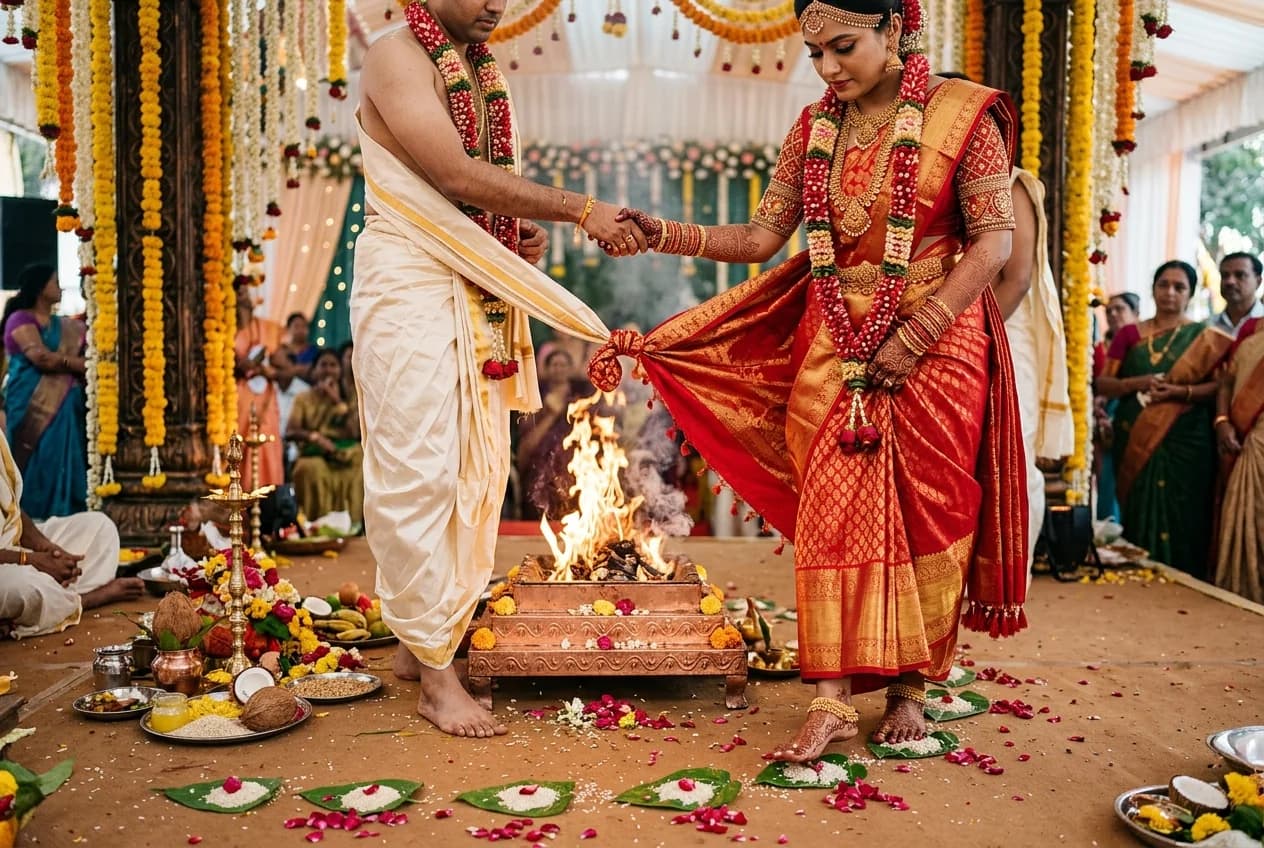
Overview: What is it?
In Sanatan Dharma, marriage (Vivaha) is neither a legal contract nor a mere romantic union; it is a profound spiritual sacrament (Samskara) uniting two souls and their ancestral lineages in mutual pursuit of Dharma (righteous living), Artha (economic sustainability), Kama (wholesome emotional fulfillment), and Moksha (spiritual liberation).
Meaning and Significance
In Sanatan Dharma, no tradition exists solely as an empty outer mechanical ritual. Each custom reflects a harmonious synthesis of spiritual metaphysics, cultural continuity, and inner psychological balance:
Conducted before Agni as the divine witness, the couple vows to walk the householder path (Grihastha Ashrama)—the societal bedrock that sustains students, ascetics, and ancestors alike.
The wedding brings together families, crafts, musicians, and regional communities in colorful celebrations spanning several days of music, feasting, and ritual art.
The Saptapadi (Seven Steps taken together) establishes an explicit shared ethical contract covering nourishment, health, prosperity, happiness, children, longevity, and unbroken lifelong friendship.
Historical and Scriptural Context
गृभ्णामि ते सौभगत्वाय हस्तं मया पत्या जरदष्टिर्यथासः ।
“I take your hand for mutual good fortune, that you may reach old age together with me as your partner, gifted by the divine powers to guide our household.”
“Codifies the foundational rites of Panigrahana (handclasp), Laja Homa (parched grain offering), and Saptapadi (the seven steps).”
How It Is Practiced
Preparation & Readiness
- 1Auspicious Lagna and Muhurat calculated by Vedic astronomical calendar.
- 2Pre-wedding ceremonies including Haldi/Ubtan purification and Mehendi.
- 3Setting up the Mandap with four pillars symbolizing parents, ancestors, and virtues.
Core Observance Sequence
- 1Vara-Agamana & Kanyadana: Welcoming the groom and the emotional entrustment of the bride with blessings.
- 2Panigrahana: Holding hands over the sacred fire while promising loyalty, patience, and companionship.
- 3Laja Homa: Offering puffed rice into the fire with prayers for family prosperity and health.
- 4Agni Pradakshina: Walking around the sacred fire together, sealing the sacred partnership.
- 5Saptapadi: Taking seven conscious steps together while reciting the seven sacred oaths.
- 6Sindoor & Mangalsutra: Inwardly acknowledging marital sanctity through sacred vermilion and necklace.
- 7Ashmarohana & Arundhati Darshana: Viewing the steady pole star (Dhruva) and Arundhati-Vasishtha twin stars as ideals of steadfast devotion.
Wedding rituals feature rich regional color and diverse family customs across India. The shastric core (Panigrahana, Agni Pradakshina, and Saptapadi) is celebrated everywhere.
Regional and Traditional Variations
Sanatan traditions accommodate geographical diversity, regional language idioms, and family customs without losing their unifying essence:
Northern Traditions
Includes Baraat procession, Varmala exchange, Saat Phere around the fire, and Vidai blessings.
Southern Traditions
Features early morning Muhurtam, Mangalsutra (Thali) tying accompanied by loud Ketti Melam drumming, and Oonjal (swing ceremony).
Eastern Traditions
In Bengal, marked by Saat Paake Ghaura (carrying bride on wooden seat around groom), Shubho Drishti, and blowing of Shankha.
Western Traditions
In Gujarat and Maharashtra, features Antarpat cloth partition, Hastamelap, and playful family post-wedding games.
Note: Through all regional colors, the seventh step of Saptapadi culminates in the declaration: "Sakha Saptapada Bhava" — "Having walked seven steps together, you have become my eternal friend."
Frequently Asked Questions
What are the Seven Steps (Saptapadi)?
They are seven shared vows for: 1. Wholesome food & nourishment, 2. Physical and mental vitality, 3. Wealth and righteous resources, 4. Joy and spiritual harmony, 5. Virtuous offspring, 6. Seasonal longevity & health, 7. Lifelong friendship and spiritual unity.
Why is fire (Agni) the primary witness in Hindu marriage?
Agni is incorruptible, radiant, and all-pervading. Vows uttered before Agni are considered binding before the cosmic order (Rta).
Related Traditions & Observances
Primary Sources & Canonical Citations
- Rigveda Samhita, Mandala 10 (Surya Vivaha Sukta)
- Ashvalayana Grihya Sutra, Adhyaya 1
- Apastamba Grihya Sutra