
Havan and Yajna: The Sacred Fire & Cosmic Reciprocity
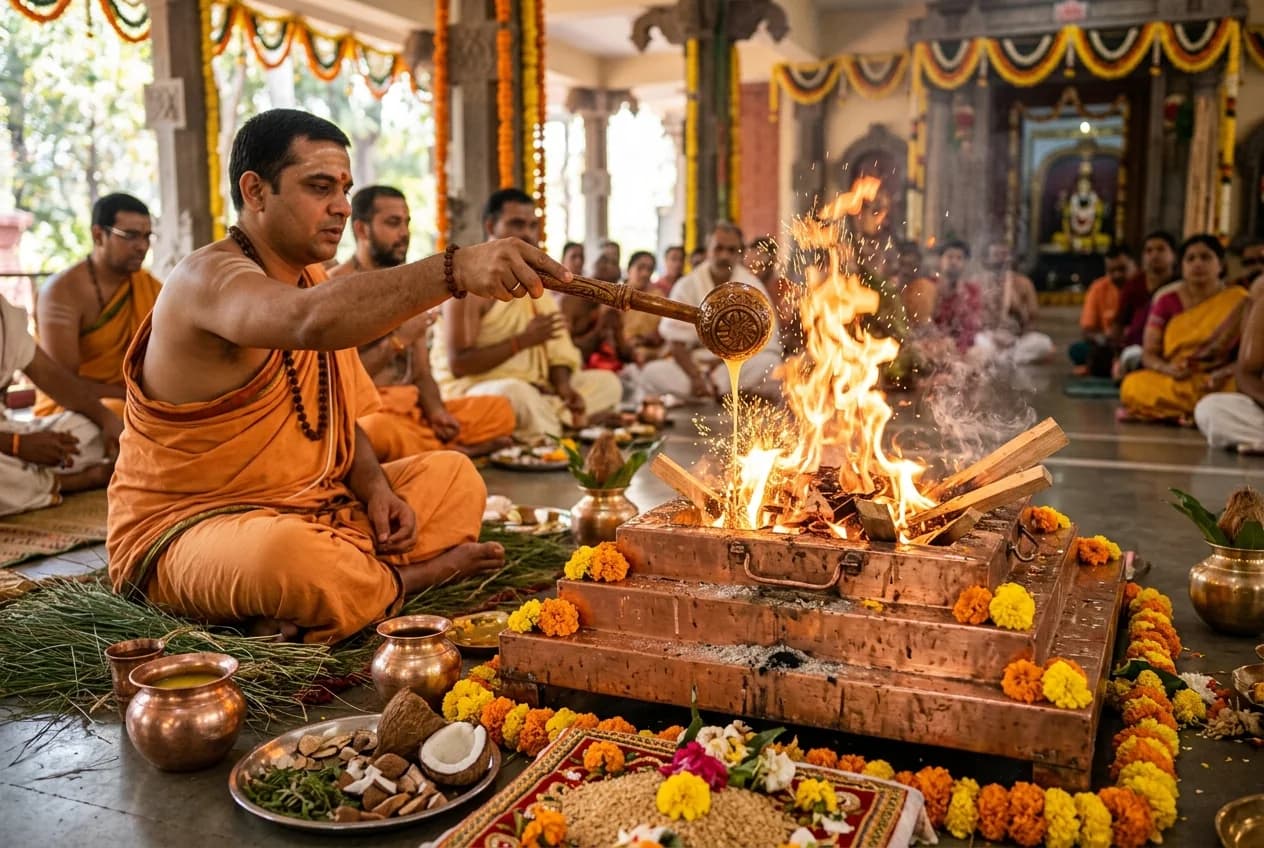
At the center of the Vedic worldview stands Yajna (यज्ञ)—the cosmic principle of sacred reciprocity, selfless offering, and interdependent ecological harmony. Derived from the Sanskrit verbal root यज् (Yaj), signifying Devapujana (veneration of the divine), Sangatikarana (communal and cosmic unification), and Dana (generous giving), Yajna finds its tangible ritual expression in Homa (होम) or Havan (हवन): the consecrated offering of clarified butter (Ajya), medicinal woods (Samidha), and botanical grains (Havis) into the sacred fire (Agni) accompanied by Vedic mantras. Far from being a transactional plea for material favor, the sacred fire ritual operates as a thermodynamic and contemplative bridge connecting the individual household (Griha) with the solar-atmospheric cycle (Adhidaiva) and the indwelling Witness-Consciousness (Adhyatma).
What Is It?
1. Terminological Precision & Sacred Apparatus (Yajna-Ayudha & Dravya)
While often used interchangeably in everyday parlance, classical Sanskrit texts maintain subtle distinctions among the core terms:
• यज्ञ (Yajña): The overarching spiritual, ethical, and liturgical institution of selfless sacrifice—encompassing both external fire rites (Karma-Yajna) and internal contemplative disciplines (Jnana-Yajna and Prana-Agnihotra).
• होम / हवन (Homa / Havana): Derived from the root हु (Hu — "to pour into fire, to offer"), referring specifically to the act of casting consecrated oblations (Ahuti) into the consecrated fire altar (Kunda or Sthandila).
• अग्निहोत्र (Agnihotra): The foundational twice-daily Vedic fire oblation performed precisely at the solar transitions of sunrise and sunset.
Classical Shulba Sutras and Grihya Sutras specify six primary ritual elements required for an authentic domestic or communal Havan:
| Sanskrit Term | Ritual Element | Material & Geometric Specification | Liturgical & Scientific Function |
|---|---|---|---|
| १. हवन कुण्ड / स्थण्डिल (Havana Kuṇḍa / Sthaṇḍila) | The Sacred Fire Altar | A stepped pyramid receptacle of copper, brick, or sanctified earth/sand (Sthandila) with three concentric tiers (Mekhala). | Concentrates thermal convection, maximizes oxygen flow for clean combustion, and bounds the sacred cosmos (Vedi). |
| २. समिधा (Samidhā) | Consecrated Fuel Twigs | Dry, bark-intact twigs cut to one span (Pradesha, approx. 9–12 inches) from sacred trees: Palasha, Ashvattha (Peepal), Audumbara, Shami, Bilva, or Amra (Mango). | Sustains a smokeless, high-temperature ember bed rich in natural cellulose and aromatic volatile oils. |
| ३. आज्यम् / गोघृतम् (Ājyam / Go-ghṛtam) | Purified Cow's Ghee | Pure clarified butter from indigenous cow's milk, melted and sanctified over fire using two Darbha blades (Utpavana). | Acts as a high-energy lipid catalyst accelerating the volatilization and dispersion of botanical compounds. |
| ४. हविष्य / साकल्य (Haviṣya / Sākalya) | Oblation Grains & Botanicals | Unbroken barley (Yava), black sesame (Tila), rice (Vrihi), raw sugar (Sharkara), dried coconut (Shriphala), and aromatic herbs (Guggulu, Giloy, Nagakeshara, Jatamansi). | Releases phyto-aerosols, antimicrobial vapors, and subtle fragrance (Sugandhi) into the surrounding atmosphere. |
| ५. स्रुक् एवं स्रुव (Sruk & Sruva) | Sacrificial Ladles | Long-handled wooden spoons carved from Palasha, Khadira, or Vikankata wood (or copper), shaped with a spouted bowl. | Enables measured, graceful pouring of liquid ghee (Dhara) directly into the central flame without hand contact. |
| ६. प्रणीता एवं प्रोक्षणी पात्र (Praṇītā & Prokṣaṇī Pātra) | Witness & Consecration Vessels | Two small copper or wooden water bowls placed North of the fire altar, covered with Darbha grass. | Pranita houses Varuna (Lord of Cosmic Moral Order) as the silent witness of the rite; Prokshani holds water for sprinkling purification. |
2. Classical Typology & Temporal Timing
Classical ritual traditions classify fire ceremonies into three distinct operational categories based on their purpose and frequency:
Performed daily at dawn and dusk in the household fire (Garhapatya or Aupasana Agni) to maintain ecological and spiritual equilibrium.
Performed at every major life milestone (Shodasha Samskaras such as Namakarana, Upanayana, and Vivaha), on New and Full Moon days (Darsha-Purnamasa), and during seasonal harvests (Agrayana — offering the first fruits of the harvest to Agni).
Specialized Homas such as Ganapati Homa, Navagraha Homa, Mrityunjaya Homa, Rudra Homa, and Chandi Homa performed for collective peace (Rashtra-Shanti), health, and household harmony (Vastu-Shanti).
What Does It Mean?
1. Verified Shastric & Upanishadic Foundations
A. Yajna as the Cosmic Axis and Supreme Action (Rigveda 1.164.35; Shatapatha Brahmana 1.7.1.5)
In the philosophical hymn of Dirghatamas in the Rigveda (1.164.35) and throughout the Shatapatha Brahmana, Yajna is defined not as an arbitrary human custom, but as the generative axis around which the cosmos revolves:
B. The Wheel of Cosmic Reciprocity — Parasparam Bhavayantah (Bhagavad Gita 3.10–11)
In the third chapter of the Bhagavad Gita (Karma Yoga), Sri Krishna elevates the Vedic fire sacrifice into a universal law of ecological and social interdependence:
C. The Atmospheric & Ecological Cycle of the Oblation (Manusmriti 3.76)
Both the Bhagavad Gita (3.14 — Yajnad bhavati parjanyah) and the Manusmriti (3.76) articulate the physical and subtle transformation of matter offered into the sacred fire:
D. Non-Dual Interiorization of the Fire Sacrifice (Bhagavad Gita 4.24)
In Advaita Vedanta, the external ritual of the Havan culminates in the realization that the offerer, the oblation, the fire, and the act of offering are all manifestations of a single indivisible Consciousness (Brahman):
2. Philosophical, Psychological & Environmental Hermeneutics
Beyond the external liturgical acts, Vedic and Vedantic thinkers interpret the dynamics of Havan as an integrated psychological, thermodynamic, and ethical transformation:
Every single oblation cast into the Havan Kunda is accompanied by two sacred utterances: स्वाहा (Svāhā), derived by Nirukta etymologists from Su + Āha ("well and truthfully spoken") or Sva + Āhā ("offering one's own self/essence"), spoken precisely as the offering enters the flame; and immediately after the offering leaves the hand, the Yajamana (sacrificer) declares: "इदमग्नये इदं न मम (Idam Agnaye, Idaṃ Na Mama) — This belongs to Agni; this is no longer mine." Psychologically, repeating Idaṃ Na Mama dozens or hundreds of times trains the mind to relinquish possessive egoism (Mamatva) and anxiety over results, embodying the essence of Nishkama Karma.
Unlike ordinary disposal by burning, a Havan utilizes a stepped inverted-pyramid copper or earthen Kunda designed to maintain high core temperatures with clean oxygen draw. When cow's ghee (Go-ghrita), cellulose-rich woods, camphor, and medicinal botanicals (Havan Samagri) contact the ember bed, they do not merely char; their volatile essential oils, terpenes, and phenolic compounds sublimate into fine bio-aerosols that disperse into the ambient air (Vayu-shuddhi).
Fire is the only element among the five Mahabhutas that cannot be polluted and always rises upward (Urdhva-jvalana). Sitting before the sacred fire serves as a visual meditation on transmuting coarse material tendencies into subtle luminous energy (Tejas and Ojas).
How Is It Practiced?
1. Canonical Liturgical Sequence (अग्निमुखम् / Agnimukham)
While elaborate Vedic sacrifices require specialized priests (Ritviks), the classical domestic Grihya Homa or Smarta Havan follows a structured seven-stage sequence (अग्निमुखम् / Agnimukham):
2. Regional & Lineage Variations Across Bharat
| Region | Traditional Nomenclature | Distinctive Custom (Lokachara / Kulachara) |
|---|---|---|
| North & Central India (UP, Bihar, Delhi, Haryana, Punjab, Rajasthan, MP) | हवन (Havan) / यज्ञ (Yajna) / अग्निहोत्र (Agnihotra) | Performed using a stepped copper Havan Kunda, mango or Palasha wood, and aromatic 36-herb Havan Samagri; widely practiced in domestic morning rituals, Navaratri Ashtami/Navami Havan, and community Mahayajnas. |
| Tamil Nadu, Andhra Pradesh, Telangana & Karnataka | होमम् (Homam) / अग्निमुखम् (Agnimukham) | Follows strict Apastamba, Bodhayana, or Ashvalayana Agnimukham protocols; brick or earthen Kundas are bordered with Kolam rice flour patterns and Darbha grass (Paristarana); features specialized Ganapati Homam, Sudarshana Homam, and Chandi Homam. |
| Maharashtra, Goa & Konkan | होम (Homa) / दैनन्दिन अग्निहोत्र (Nitya Agnihotra) | Preserves both ancient Shrauta fire lineages and the widespread domestic Sunrise-Sunset Agnihotra (offering two pinches of unbroken brown rice smeared with cow's ghee into a miniature copper pyramid pot of cow-dung embers exactly at sunrise and sunset). |
| Bengal, Odisha & Assam | होम (Homa) / यज्ञ (Jajna) | Integral to Durga Puja (Sandhi Puja and Maha Ashtami/Navami Homa) and Kali Puja; includes offering बेलपत्र (Bilva leaves) soaked in pure ghee (108 or 1,008 leaves) into the sacred fire alongside Uludhwani and conch blowing. |
| Himalayan Devabhumi (Uttarakhand, Himachal Pradesh & Jammu-Kashmir) | हवन (Havan) / धूनी पूजन (Dhuni Pujana) | Incorporates high-altitude Himalayan botanicals (Deodar cedar wood, Bhojpatra, Jatamansi, Guggulu, and wild sesame); among Kashmiri Pandits, the elaborate Yajna utilizes a consecrated earthen pot (Kangri/Kunda) and prolonged Svaha-kara with curd, ghee, and barley. |
Primary Scriptural Corpus & Academic References
- 1.Rigveda Samhita: Mandala 1, Sukta 1 (Agni Sukta); Mandala 1, Sukta 164, Rik 35 (Ayam Yajno Bhuvanasya Nabhih — Yajna as the cosmic axis); Mandala 10, Sukta 90 (Purusha Sukta — cosmogony through cosmic sacrifice).
- 2.Yajurveda (Vajasaneyi Samhita & Taittiriya Samhita): Vajasaneyi Samhita 17.79 (Sapta Te Agne Samidhah — canonical Purnahuti mantra) and Adhyaya 36.17 (Shanti Patha — ecological peace invocation).
- 3.Shatapatha Brahmana: Kanda 1, Adhyaya 7, Brahmana 1, Kandika 5 (Yajno Vai Shreshthatamam Karma); Kanda 2, Adhyaya 2–3 (theology and ritual mechanics of Agnihotra and Agnyadhana).
- 4.Srimad Bhagavad Gita: Adhyaya 3 (Karma Yoga), Verses 9–16 (the cosmic wheel of Yajna-chakra and mutual nourishment Parasparam Bhavayantah); Adhyaya 4 (Jnana-Karma-Sannyasa Yoga), Verses 24–33 (twelve forms of interiorized Yajna and Brahmarpanam).
- 5.Manusmriti: Adhyaya 3, Verse 76 (Agnau Prastahutih Samyak — the solar-hydrological cycle of fire oblations).
- 6.Grihya Sutra Corpus: Ashvalayana Grihya Sutra 1.1–3; Paraskara Grihya Sutra 1.1–2; Apastamba Grihya Sutra 1.1–2 (canonical procedural rules for Sthandila preparation, Agni-pratishtha, Ajya-samskara, and Purnahuti).
- 7.Kane, Pandurang Vaman (1941): History of Dharmaśāstra (Ancient and Mediaeval Religious and Civil Law in India), Vol. II, Part I, Chapter VI ("Gṛhya Fires and Daily Homa") & Part II ("Śrauta Rituals"), pp. 206–215, 976–1008, Bhandarkar Oriental Research Institute, Pune.
- 8.Staal, Frits (1983): Agni: The Vedic Ritual of the Fire Altar (2 Vols.), Motilal Banarsidass / Asian Humanities Press (monumental Indological documentation of Vedic Agni-karya, altar geometry, and liturgical continuity).