
Overview: What is it?
A visit to an Indian temple is designed as an inward pilgrimage. The ancient temple is not a social hall; it is an architectural representation of the cosmic human being (Vastu Purusha), where the innermost sanctum (Garbhagriha) represents the deepest cave of the human heart. Approaching the sanctum for Darshan involves a systematic quieting of sensory desires.
Meaning and Significance
In Sanatan Dharma, no tradition exists solely as an empty outer mechanical ritual. Each custom reflects a harmonious synthesis of spiritual metaphysics, cultural continuity, and inner psychological balance:
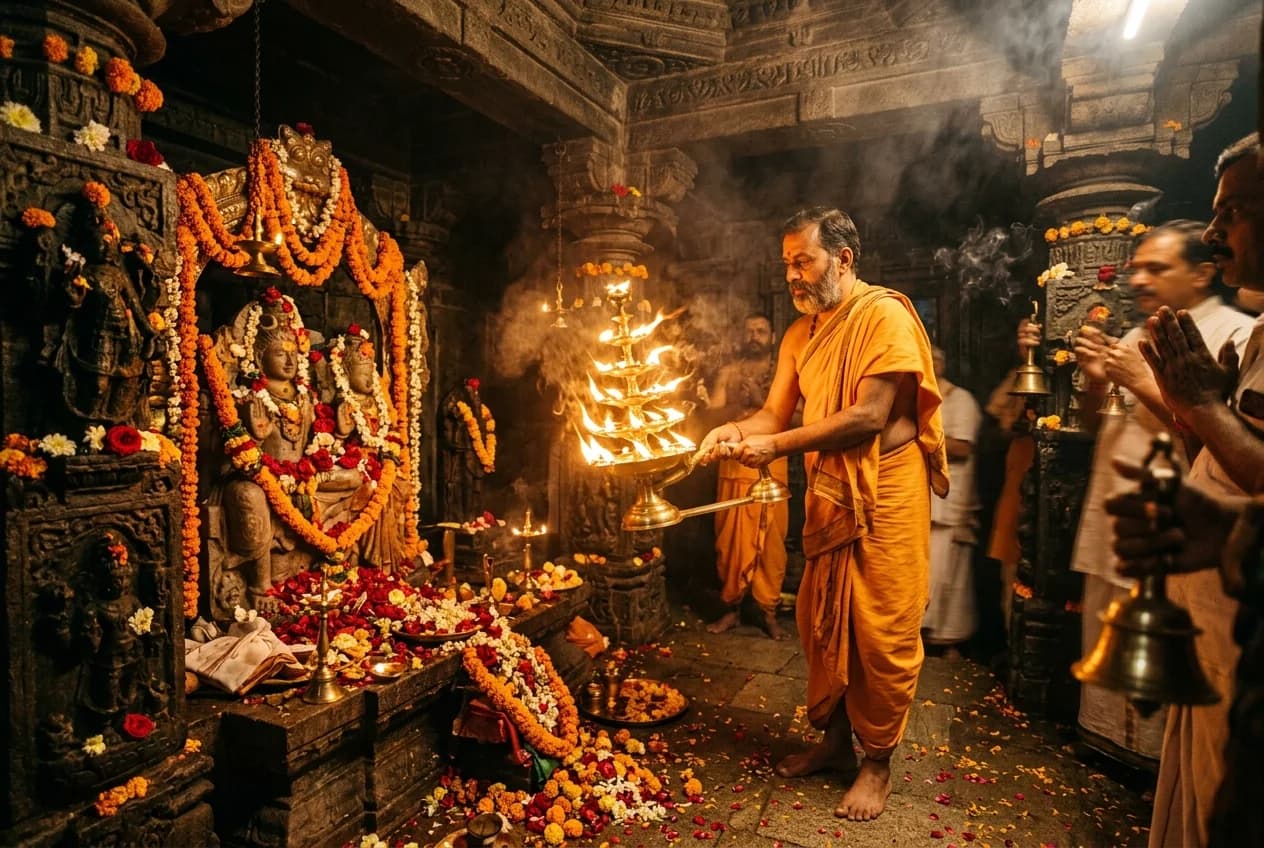
Darshan literally means "seeing"—not merely looking at a stone form, but entering into reciprocal vision where the deity beholds the seeker and the seeker experiences their own pure divine reflection. Aarti (circling illuminated lamps) represents the joy of light illuminating truth.
Temples historically served as community universities, classical concert stages, grain storehouses, and architectural landmarks preserving stone masonry and liturgical sciences.
Walking clockwise (Pradakshina) around the sanctum centers one's wandering attention around a steady, unchanging core, reminding the seeker that God is the true center around which worldly life revolves.
Historical and Scriptural Context
“The Garbhagriha is the seat of supreme stillness. The murti consecrated through Prana Pratishtha radiates divine grace to all who gaze with faith.”
“Circumambulating the consecrated deity once frees the mind from trivial anxieties, for one aligns one's body with cosmic rotational harmony.”
How It Is Practiced
Preparation & Readiness
- 1Bathe and dress in modest, clean traditional attire.
- 2Remove footwear outside the temple complex.
- 3Wash hands and feet at the temple water reservoir or tap.
Core Observance Sequence
- 1Bow respectfully at the outer entrance (Gopuram / Dhvaja Stambha).
- 2Ring the brass bell (Ghanta) gently upon entering to focus mind away from idle chatter.
- 3Approach the inner shrine quietly without pushing or shouting.
- 4Engage in silent Darshan with palms joined (Anjali Mudra).
- 5Observe the Aarti: cupping hands over the consecrated warmth and touching them to eyes and forehead.
- 6Perform clockwise circumambulations (Pradakshina), typically 1, 3, or more times.
- 7Receive sanctified Charanamrita and Prasad in the right hand supported by the left.
- 8Sit quietly in the temple courtyard for a few moments to absorb the tranquil atmosphere.
Temple customs adhere strictly to regional Agamas (Shaiva, Vaishnava, Shakta) and local temple trusts. Always respect local signage and priest instructions.
Regional and Traditional Variations
Sanatan traditions accommodate geographical diversity, regional language idioms, and family customs without losing their unifying essence:
Northern Traditions
Devotees often directly touch the Shiva Linga with water and bilva leaves in temples like Kashi Vishwanath, accompanied by devotional chanting of "Har Har Mahadev".
Southern Traditions
Strict Agamic rules require male devotees to remove upper shirts in many Kerala and Tamil Nadu temples; devotees do not touch the sanctum murti directly.
Eastern Traditions
In Jagannath Puri and Kamakhya, unique regional seva schedules, mahaprasad distributions, and seasonal vestments reflect deep emotional intimacy.
Western Traditions
In Shirdi, Pandharpur, and Dwarka, thousands perform Padayatra (walking pilgrimages) singing Abhangas and bhajans.
Note: While ritual forms differ by region and sampradaya, the spiritual purpose remains unified: inner purification through divine remembrance.
Frequently Asked Questions
Why do we circumambulate clockwise?
Clockwise movement keeps the consecrated deity constantly on one's right side (Dakshina). In Indian culture, the right side represents auspiciousness and active righteousness.
What is the significance of cupping hands over the Aarti flame?
The flame has been waved in adoration before the deity and carries symbolic divine grace. Touching the warmth to one's eyes asks for spiritual vision and inner clarity.
Related Traditions & Observances
Primary Sources & Canonical Citations
- Kamika Agama, Archana Vidhi
- Skanda Purana, Kashi Khanda
- Vastu Vidya by Sage Bhoja