
Lighting the Diya: The Sacred Flame of Knowledge
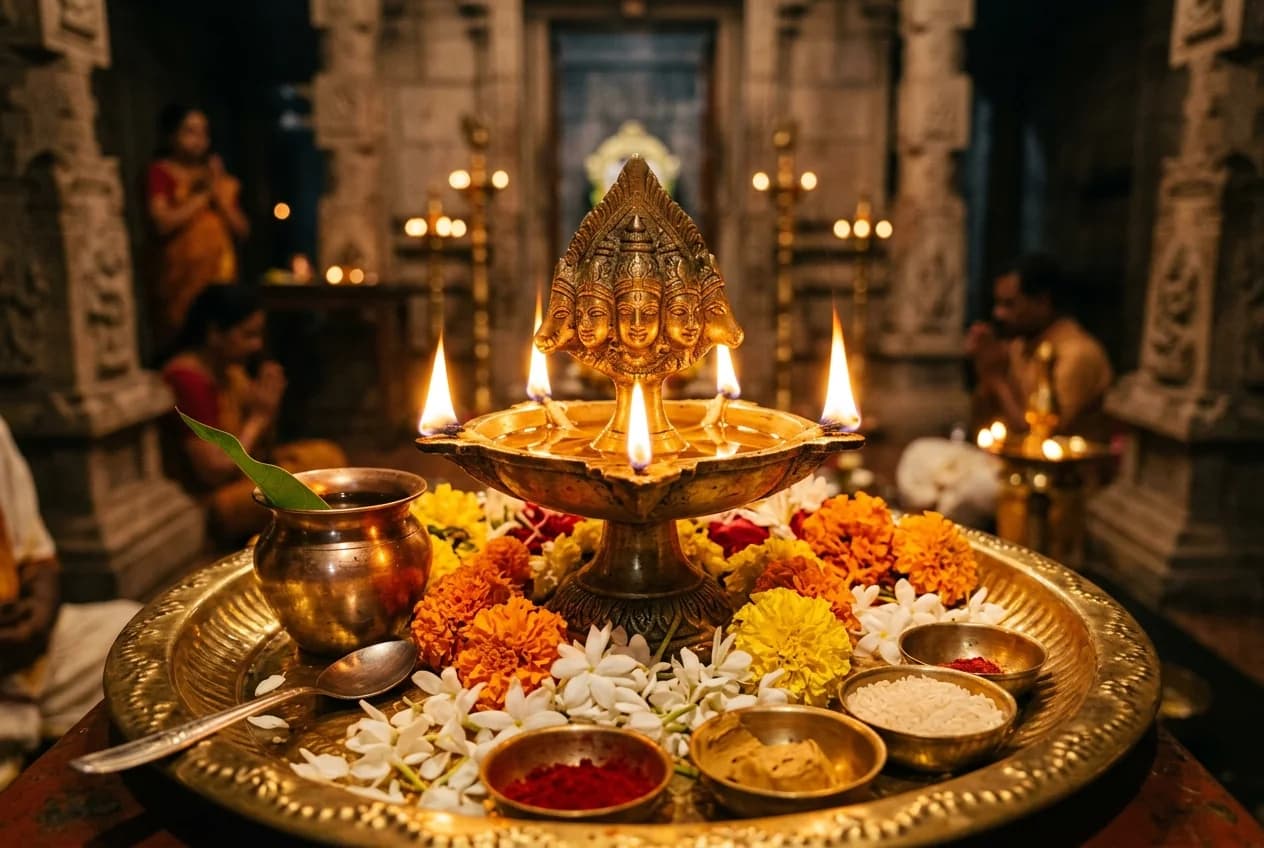
In the ritual and philosophical universe of Sanatan Dharma, Deepa Prajwalana (दीप प्रज्वलन)—the kindling of a sacred oil or ghee lamp—is the foundational threshold of all sacred action. No domestic liturgy (Grihya Puja), temple rite (Agama Puja), life-cycle sacrament (Samskara), or auspicious cultural assembly commences without first invoking light. Far from being a merely decorative or ambient custom, lighting the Diya (Sanskrit: Dīpa or Dīpaka) functions simultaneously as a miniature Vedic fire altar (गार्हपत्य अग्नि / Garhapatya Agni) within the household, an epistemological symbol of self-luminous consciousness (Chit-Shakti) dispelling metaphysical ignorance (Avidya), and a tangible daily discipline aligning human awareness with the solar transitions of dawn and dusk (Sandhya).
What Is It?
1. Phenomenological Definition & Ritual Anatomy
At its material core, Deepa Prajwalana is the deliberate offering of sustained luminosity before a consecrated altar (Puja Peetha), threshold, or sacred plant (Tulasi Vrindavana) through the combustion of purified plant oil or clarified butter (Ghrita) drawn upward through a twisted cotton fiber wick.
Classical ritual manuals (Paddhatis) and Agamas analyze the Diya as a composite sacred instrument consisting of four interdependent elements:
| Sanskrit Term | Component | Material Specification | Ritual Function |
|---|---|---|---|
| पात्र (Pātra) | The Vessel / Reservoir | Unfired or fired terracotta (Mrinmaya), brass (Pittala), bronze (Kamsya), silver, or Panchaloha (five-metal alloy). | Contains the fuel and grounds the flame onto the terrestrial plane (Prithvi Tattva). |
| स्नेह / घृत (Sneha / Ghṛta) | The Fuel Medium | Cow's ghee (Go-Ghrita), sesame oil (Tila Taila), mustard oil, or coconut oil. | Provides continuous sustenance (Prana) to the flame through capillary action. |
| वर्तिका (Vartikā) | The Wick | Hand-spun raw cotton (Karpasa), lotus stem fiber (Kamala Nala), or sacred Darbha fiber. | Serves as the conduit linking the liquid fuel to the point of ignition. |
| ज्योति / शिखा (Jyoti / Śikhā) | The Flame | The upward-burning luminous tip. | Represents Agni Tattva (the element of fire/light) and the visible presence of the Divine (Pratyaksha Devata). |
2. Temporal Timing (Kala-Nirnaya)
Within the framework of Nitya Karma (daily observances), the Diya is traditionally kindled during the two primary twilight junctions (उभय सन्ध्या / Ubhaya Sandhya):
Kindled during or immediately following Brahma Muhurta and morning ablutions (Snana), welcoming the solar light of consciousness into the home.
Kindled at the critical transition (गोधूलि बेला / Godhuli Bela) when solar light recedes and nocturnal darkness (Tamas) begins to descend. In traditional households, artificial lights are switched on only after the evening Sandhya Deepa has been offered at the domestic altar and the Tulasi courtyard.
During liturgical periods such as Navaratri, Kartika Masa, or major Yajnas, a continuous lamp is maintained day and night as an unbroken vigil of spiritual mindfulness (Sadhana).
What Does It Mean?
1. Verified Shastric & Upanishadic Foundations
A. Continuity of the Vedic Domestic Fire (Garhapatya Agni)
In the historical evolution from Vedic Shrauta and Grihya sacrifices to Puranic and Agamic domestic worship (Puja), the household Diya directly inherits the theological role of Agni as the domestic priest (Purohita) and divine witness (Sakshi). The opening verse of the Rigveda (1.1.1) establishes Agni as the mediator between the human and cosmic realms:
Because Agni is regarded as Sarva-Devata-Mukha ("the mouth and portal of all deities"), kindling the Diya establishes a sanctified channel of presence before any specific deity (Ishta Devata) is invoked.
B. Epistemological Light: The Pavamana Mantra (Brihadaranyaka Upanishad 1.3.28)
The quintessential philosophical foundation of lighting the lamp is articulated in the Abhyaroha (ascension prayer) of the Brihadaranyaka Upanishad (1.3.28):
In his classical commentary (Bhashya) on this verse, Adi Shankaracharya explains that Tamas (darkness) is not merely the physical absence of photons, but Ajnana (metaphysical ignorance of one's true nature), which is synonymous with spiritual death (Mrityu). Conversely, Jyoti (light) is Vidya—luminous, self-revealing knowledge of the imperishable Self (Atman). Lighting the physical lamp is thus an enacted Sankalpa (resolve) to awaken internal discernment (Viveka).
C. Latent Divinity and Self-Effulgence (Svetasvatara Upanishad & Bhagavad Gita)
The Svetasvatara Upanishad (1.15) uses the exact mechanics of sesame oil and fire to illustrate how the Supreme Consciousness (Brahman) pervades the individual psyche:
Furthermore, the Bhagavad Gita (14.11 & 14.18) links luminosity (Prakasha) and upward movement (Urdhvagati) directly to the predominance of Sattva Guna (purity, harmony, and cognitive clarity).
2. Philosophical & Psychological Hermeneutics
In Advaita Vedanta and Agamic symbolism, the four physical components of the Diya map directly onto the microcosm of human existence:
Molded from earth and minerals, finite in form, yet capable of housing the sacred flame.
In Sanskrit, the word स्नेह (Sneha) carries a dual meaning: both "oil/fat" and "love/attachment." When our worldly attachments and karmic tendencies (Vasanas) are surrendered as fuel to the fire of spiritual inquiry, they are transmuted into radiance.
Immersed in the oil of worldly experience, the ego-wick must be purified and consumed gently so that higher consciousness may shine without smoke.
Regardless of how you tilt a lamp, the flame always points upward (Urdhva-Mukha). This serves as a psychological reminder for the seeker (Sadhaka) that true wisdom always aspires upward toward liberation (Moksha), never downward toward inertia (Tamas).
How Is It Practiced?
1. Canonical Liturgical Sequence
While family customs (Kulachara) vary in complexity, traditional Puja Paddhatis prescribe a six-step sequence for daily Deepa Prajwalana:
2. Regional & Lineage Variations Across Bharat
| Region | Traditional Vessel & Form | Distinctive Custom (Lokachara / Kulachara) |
|---|---|---|
| North & Central India (UP, Bihar, Rajasthan, MP, Delhi) | Terracotta Mitti ka Diya and brass Akhanda Deepa. | Known as Sandhya Batti or Diya-Batti. In the sacred month of Kartika, lamps are offered daily in the courtyard (Akasha Deepa) and floated on sacred rivers (Deepa Dana). |
| Maharashtra & Konkan | Tall brass समई (Samai) with multiple wick spouts and small ghee निरंजन (Niranjan). | Every evening at dusk, children and elders gather before the household shrine to chant the bilingual Sanskrit-Marathi Shubham Karoti Kalyanam and Divya Divya Dipotkar liturgy. |
| Tamil Nadu & Karnataka | कुत्तुविलक्कु (Kuthuvilakku) and कामाक्षी दीप (Kamakshi Vilakku) depicting Goddess Lakshmi/Kamakshi. | Lit with five wicks (Pancha-Mukha) representing the five Pranas and five elements (Pancha Bhutas). Only four wicks are lit during routine Puja, or all five during auspicious festivals like Karthigai Deepam. |
| Kerala | Bronze निलविलक्कु (Nilavilakku) standing on the floor. | Lit with an odd number of wicks (1, 3, 5, or 7) using pure sesame or coconut oil. After lighting, family members chant Nama Japa (Rama Nama or Narayana Nama) seated around the lamp at dusk. |
| Bengal, Odisha & Assam | Brass प्रदीप (Pradip) or multi-tiered पञ्चप्रदीप (Pancha-Pradip). | At twilight (Sandhya-Ahnik), the matriarch carries the lit Sandhya Pradip accompanied by the blowing of the conch shell (Shankha Dhwani) and Uludhwani (auspicious ululation) to the Tulsi Mancha. |
Primary Scriptural Corpus & Academic References
- 1.Rigveda Samhita: Mandala 1, Sukta 1, Rik 1 (Agni Sukta — foundational theology of Agni as domestic Purohita and cosmic mediator).
- 2.Brihadaranyaka Upanishad: Adhyaya 1, Brahmana 3, Mantra 28 (Pavamana Abhyaroha — Tamaso Ma Jyotirgamaya), with the Bhashya of Adi Shankaracharya.
- 3.Svetasvatara Upanishad: Adhyaya 1, Mantra 15 (Tileshu Tailam — analogy of latent oil in sesame seeds and fire in wood).
- 4.Srimad Bhagavad Gita: Adhyaya 14 (Gunatraya Vibhaga Yoga), Verses 11 and 18 (association of Prakasha and upward tendency with Sattva Guna); Adhyaya 10, Verse 11 (Jnanadipena Bhasvata — the shining lamp of knowledge destroying darkness born of ignorance).
- 5.Skanda Purana & Padma Purana (Kartika Mahatmya): Prescriptions on Deepa Dana (the merit of offering lamps in temples, riverbanks, and sacred thresholds) and the Shubham Karoti invocation.
- 6.Agni Purana: Chapters on Deva-Puja-Vidhi and Deepa-Dana-Mahatmya (regulations on pure fuels, wick counts, and prohibitions against extinguishing sacred fire with breath).
- 7.Kane, Pandurang Vaman (1941–1974): History of Dharmaśāstra (Ancient and Mediaeval Religious and Civil Law in India), Vol. II, Part I & II (sections on Ahnika, Sandhya, and Deva-Puja), Bhandarkar Oriental Research Institute, Pune.
- 8.Bühnemann, Gudrun (1988): Pūjā: A Study in Smārta Ritual, Publications of the De Nobili Research Library, University of Vienna (detailed philological analysis of the 16 Upacharas, including Deepa-Darshana and Deepa-Pujana).