
Northern Himalayan & Riverine Traditions: Seismic Mountain Architecture, Sacred Riverfront Ghats, and Artisanal Textile Lineagesउत्तरापथ एवं हिमालय-गङ्गा सांस्कृतिक परंपरा: काठ-कुणी स्थापत्य, तीर्थ घाट एवं वस्त्र शिल्प
From the Interlocking Timber-Stone Mechanics of Himalayan Kath Kuni and Koti Banal to the Hydro-Ritual Cosmology of Kashi's Ghats and the Guild Mastery of Chikankari, Kani Pashmina, and Phulkari
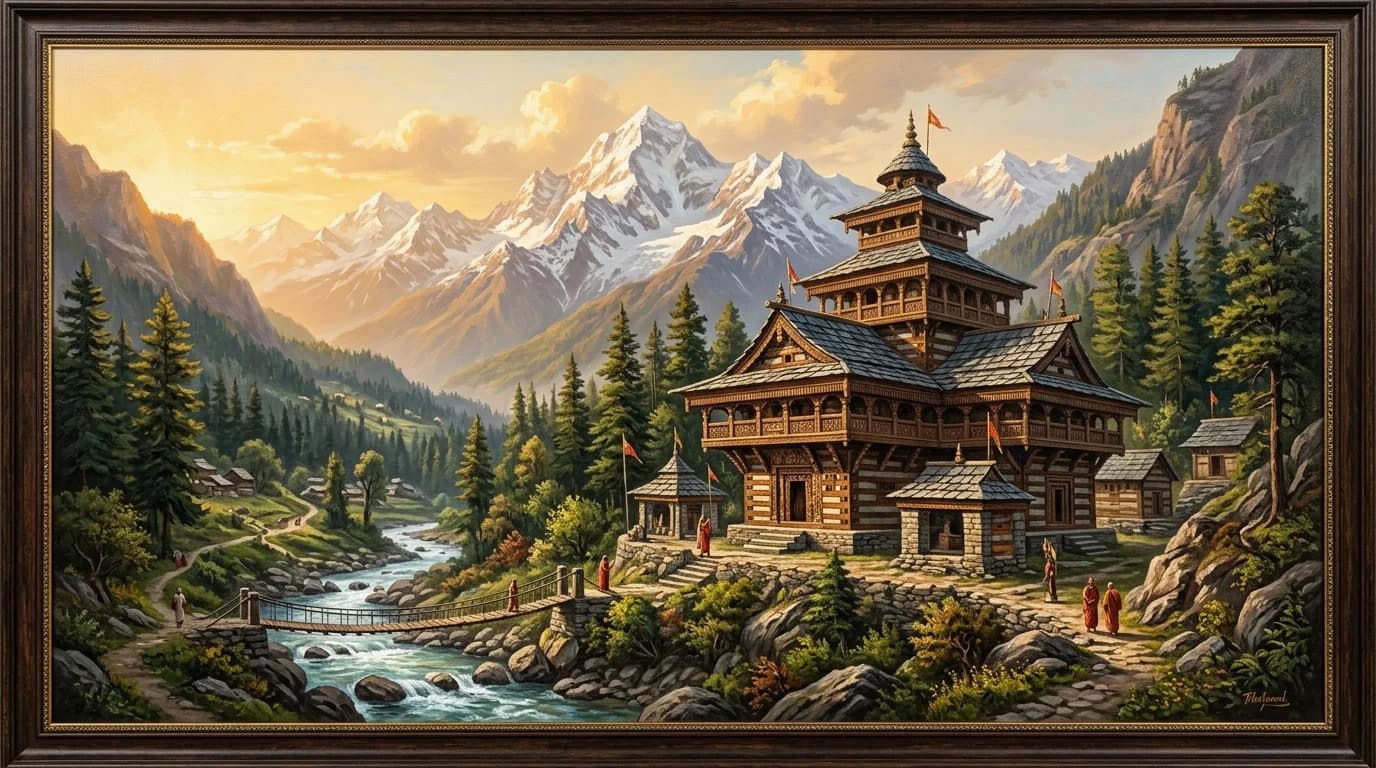
“In the northern direction stands the Lord of Mountains named Himālaya, ensouled by divinity; plunging into both the eastern and western oceans, he stands as the very measuring-rod (Mānadaṇḍa) of the Earth.”
— Kālidāsa, Kumārasambhava (1.1), 5th Century CEThe cultural geography of Northern India (Uttarāpatha and Āryāvarta) is governed by a single civilizational continuum: the tectonic uplift of the Himavat (Himalayas) and the perennial descent of snow-fed glacial rivers into the Sapta-Sindhu and Gaṅgā–Yamunā alluvial plains. Far from being a passive backdrop, this extreme topographical gradient—falling from 7,000-meter seismic peaks to monsoon-swollen river basins—produced highly specialized material sciences, architectural typologies, and liturgical rhythms. In the high mountain valleys of Himachal Pradesh, Uttarakhand, and Kashmir, indigenous builders engineered mortarless, energy-dissipating timber-and-stone towers (Kath Kuni, Koti Banal, and Dhajji-Dewari) capable of surviving Magnitude 8+ earthquakes. Along the riverbanks of Haridwar, Prayagraj, and Varanasi, hydraulic engineers sank deep well-foundations into shifting silt to construct monumental stepped Ghāṭs that transform seasonal flood mechanics into sacred amphitheaters of daily solar and fire worship (Sandhyā Āratī). Simultaneously, across the courts and villages of Kashmir, Punjab, Himachal, and Awadh, hereditary artisan guilds codified mathematical weaves and needlework traditions—from Talim-coded Kani Pashmina and reverse-darned Phulkari to the 32-stitch Chikankari repertoire of Lucknow. This codex examines the structural physics, textual liturgy, and material alchemy uniting the mountain sanctuaries and riverine plains of the North.
1. The Himavat–Gaṅgā Continuum: Sacred Geography in Text & Ecology
In Vedic and Puranic cosmography, the Himalayas and the Indo-Gangetic river system constitute an indivisible hydrological and spiritual organism. The Nadīstuti Sūkta of the Ṛgveda (10.75.5) maps the sacred fluvial landscape from east to west—invoking the Gaṅgā, Yamunā, Sarasvatī, Śutudrī (Sutlej), Paruṣṇī (Ravi), Asiknī (Chenab), Marudvṛdhā, Vitastā (Jhelum), and Ārjīkīyā (Beas).
Later regional Māhātmyas—most notably the Kedāra Khaṇḍa and Kāśī Khaṇḍa of the Skanda Purāṇa, alongside the sixth-to-seventh-century Nīlamata Purāṇa of Kashmir—establish the theological principle of Tīrtha (from the root tṛ-, "to cross over"), a geographical ford where the terrestrial plane intersects with transcendent consciousness.
The Architecture of the Five Confluences (Pañca Prayāga)
Before entering the plains at Gaṅgādvāra (Haridwar), the headwaters of the Gaṅgā model a sacred dendritic network across Garhwal (Kedārabhūmi), marked by five sanctified river confluences (Pañca Prayāga) descending along the Alaknandā gorge:
1. Viṣṇuprayāga
1,372 mConfluence of the Alaknandā (rising from the Satopanth glacier above Badrinath) and the Dhaulīgaṅgā.
2. Nandaprayāga
870 mConfluence of the Alaknandā and the Nandākinī descending from the Nanda Devi sanctuary.
3. Karṇaprayāga
788 mConfluence of the Alaknandā and the Piṇḍar river.
4. Rudraprayāga
610 mConfluence of the Alaknandā and the Mandākinī descending from the Kedarnath massif.
5. Devaprayāga
472 mThe supreme Himalayan confluence where the turbulent, silt-laden Bhāgīrathī (emerging from Gaumukh) unites with the calmer Alaknandā to officially take the name Gaṅgā.
This vertical ecology created a permanent seasonal circulation of scholars, ascetics, artisans, and pilgrims along the Uttarāpatha trade and pilgrimage arteries—linking the wooden temple sanctums of Chamba, Kullu, and Uttarkashi directly to the sandstone and brick metropolises of Mathura, Ayodhya, Lucknow (Lakṣmaṇapurī), and Kāśī.
2. Seismic Vernacular Engineering: Kath Kuni, Koti Banal, and Himalayan Nagara
The Western and Central Himalayas lie along the Main Central Thrust (MCT) and Main Boundary Thrust (MBT), placing the region in Seismic Zone V—one of the most tectonically volatile zones on Earth, evidenced by the 1905 Kangra (Mw 7.8) and 1991 Uttarkashi (Mw 6.8) earthquakes. Over a thousand years ago, indigenous Himalayan master-builders (Thāvis and Mistries) solved the problem of high-intensity seismic shear not through rigid reinforcement, but through controlled ductility and friction damping.
2.1 Structural Mechanics of Kath Kuni (Himachal Pradesh) & Koti Banal (Uttarakhand)
Etymologically derived from the Sanskrit Kāṣṭha-Koṇī (काष्ठ = timber + कोण = corner/angle), Kath Kuni in Himachal Pradesh (Shimla, Kullu, Mandi, and Kinnaur valleys) and its sister tradition Koti Banal in the Yamuna–Bhagirathi valleys of Uttarakhand (radiocarbon-dated at Rajgarhi to 880 ± 90 CE) employ an interlocking composite wall system constructed entirely without lime or cement mortar:
Load-bearing walls (typically 45 to 60 cm thick) are built by laying alternating horizontal courses of long, squared Deodar (Cedrus deodara—prized for its rot-resistant essential oils and tensile elasticity) beams and dressed flat stone slabs (granite, gneiss, or slate).
Every timber course consists of two parallel Deodar beams running along the inner and outer faces of the wall, separated by an internal cavity (Choli). At intervals of 1.0 to 1.5 meters, these twin beams are pinned together by transverse wooden dovetail keys or dowels called Kadil (or Maānwi), preventing lateral buckling.
The hollow Choli cavity between the twin beams and stones is packed with loose dry stone rubble (Gitti). This unbonded core provides both high thermal insulation against sub-zero Himalayan winters and internal frictional damping.
At the four corners of the building, perpendicular timber beams overlap in halved notches and are locked vertically with hardwood pegs, creating a three-dimensional structural cage (Pinjrā).
Why Kath Kuni Survives Earthquakes That Destroy Concrete
When severe seismic ground-motion strikes a rigid unreinforced masonry or poorly detailed concrete building, stress concentrates at mortar joints, causing brittle fracture and catastrophic collapse. In a Kath Kuni tower—even five-to-seven-story citadel temples like the Bhimakali Temple at Sarahan, Chehni Kothi in Banjar (45 meters tall originally), or the four-story dwellings of Koti Banal—the absence of rigid mortar allows adjacent stone and Deodar courses to slide microscopically against one another. Seismic kinetic energy is dissipated harmlessly through hysteretic friction across thousands of wood-to-stone interfaces, while the high tensile strength of the continuous Deodar belts prevents the corners from separating.
2.2 Vertical Bioclimatic Zoning of the Mountain Dwelling
A traditional Kath Kuni or Koti Banal house is vertically stratified to harvest passive solar and metabolic heat:
Ground Level (Obra / Giani)
Constructed with a higher ratio of thick stone masonry and minimal small openings to house livestock (Gau-śālā). The metabolic body heat of cattle rises naturally through the timber floorboards to warm the living quarters above.
Intermediate Level (Bhor / Kothar)
Windowless or low-fenestration granary chambers lined with seasoned Deodar chests to store indigenous millets (Kodra, Jhangora), buckwheat (Ogla/Phaphra), amaranth (Chaulai), and pulses safe from moisture and rodents.
Upper Level (Bāsa / Dalan)
Cantilevered outward beyond the stone tower footprint using projecting wooden corbels, encircled by a wrap-around sun-gallery (Verandah / Dalan) with intricately carved Jālī screens facing south to capture low-angle winter sunlight.
Roof Crown (Chhappar / Pajja)
Pitched wooden trusses covered with heavy, overlapping hand-split slate slabs (Pajja) weighing several tons. This deadweight pre-stresses the dry-stone walls vertically, increasing frictional shear resistance during lateral earthquakes while shedding heavy winter snowpack.
3. Tīrtha-Stambha & Ghāṭ Hydro-Architecture: The Sacred Riverfronts
As the Himalayan waters enter the plains at Haridwar and curve northward at Varanasi (Kāśī), sacred architecture shifts from seismic mountain towers to monumental hydraulic earthworks: the Ghāṭ (Sanskrit Ghaṭṭa—a stepped landing stage linking city and river).
3.1 The Geotechnical Genius of Kāśī’s Uttaravāhinī Crescent
At Varanasi, the Gaṅgā—which otherwise flows southeast toward the Bay of Bengal—encounters a subsurface geological ridge of Kankar (calcareous nodular limestone) and sweeps dramatically from south to north (Uttaravāhinī) in an unbroken crescent spanning 6.8 kilometers across 84 contiguous Ghāṭs, from the confluence of the Assi river in the south to the confluence of the Varaṇā river at Ādi Keśava Ghāṭ in the north (giving the city its ancient name: Varaṇā + Assi = Vārāṇasī).
Building monumental sandstone palaces, temples, and steps along the concave outer bank of a major alluvial river posed an extraordinary hydraulic challenge: every monsoon, the Gaṅgā rises between 10 and 15 meters vertically, subjecting the western bank to immense hydrodynamic velocity, vortex scouring, and pore-water pressure as the floodwaters recede. Between the seventeenth and nineteenth centuries—spearheaded by royal patrons including Rani Ahilyabai Holkar of Indore, the Maratha Peshwas, Mahadji Scindia, the Bhonsles of Nagpur, and the Maharajas of Banaras—architects perfected a resilient foundation system:
1. Sunken Well-Foundations (Kūpa-Stambha)
Instead of shallow strip footings, masons excavated deep shafts through the river silt down to the hard Kankar stratum, lining them with circular brick-and-stone cylinders bound by iron cramps and resting on massive rings of seasoned Sal wood (Shorea robusta), which becomes harder and virtually petrified when permanently submerged under water without oxygen.
2. Octagonal Bastions (Burj) & Stepped Aprons
The vertical palace facades are buttressed by projecting octagonal stone towers (Burj) and deep subterranean piers that deflect the river's erosive thalweg current away from the bank.
3. Submersible Shrine Niche Geometry (Marhi)
Small, heavily weighted stone Marhi shrines and Chhatrīs are built directly onto the lower tiers of the Ghāṭs with streamlined pyramidal roofs and small doorways designed to be completely submerged for two months every monsoon and emerge unscathed when the river recedes in Śarad Ṛtu.
3.2 Textual Liturgy of the Riverfront: Pañcatīrthī & Sandhyā Āratī
In twelfth-century Gāhaḍavāla Varanasi, the jurist Bhaṭṭa Lakṣmīdhara compiled the Tīrthavivecanakāṇḍa of his monumental digest Kṛtyakalpataru (c. 1110–1150 CE), followed by the Kāśī Khaṇḍa of the Skanda Purāṇa (13th–14th century CE) and Vācaspati Miśra’s Tīrthacintāmaṇi. These texts codify the sacred micro-geography of the riverfront around the Pañcatīrthī Yātrā—five supreme hydro-spiritual nodes corresponding to the subtle anatomy of the divine body:
1. Assī Ghāṭ (Assī-saṅgama)
Node 1 of 5The southern threshold.
2. Daśāśvamedha Ghāṭ
Node 2 of 5The ritual heart, where Brahmā performed ten horse sacrifices (Daśa-Aśvamedha) to prepare the city for Śiva’s return.
3. Maṇikarṇikā Ghāṭ (Cakrapuṣkariṇī)
Node 3 of 5The cosmic navel and Mahāśmaśāna (Great Cremation Ground), where Viṣṇu dug the primordial lotus tank with his Sudarśana Cakra and where Śiva whispers the Tāraka Mantra into the ear of the departing soul, granting instantaneous Mokṣa.
4. Pañcagaṅgā Ghāṭ
Node 4 of 5The confluence of five visible and subtle streams (Kiraṇā, Dhūtapāpā, Gaṅgā, Yamunā, Sarasvatī), historic seat of Rāmānanda and Kabīr.
5. Ādi Keśava Ghāṭ (Varaṇā-saṅgama)
Node 5 of 5The northern crown where Viṣṇu first set foot in Kāśī.
Every evening at twilight (Sandhyā-kāla)—most famously at Har-ki-Pauri (Brahmakuṇḍa) in Haridwar and Daśāśvamedha and Assī Ghāṭs in Varanasi—the riverfront becomes the stage for the Gaṅgā Sandhyā Āratī. This ceremony is a strict Agamic and Vedic invocation of the Pañca Mahābhūtas (Five Great Elements):
Initial Ācamana and offering of the river's own sacred water back to the river in a copper Arghya-pātra.
Offering of fragrant terrestrial flowers (Puṣpa) and sandalwood paste (Gandha).
Primordial acoustic resonance of blown sea-conches (Śaṅkha-nāda) and rhythmic bronze bells (Ghaṇṭā) establishing Nāda Brahma.
Rhythmic waving of white yak-tail whisks (Cāmara) and peacock-feather fans (Mayūra-piccha).
Clockwise circumambulation (Āvartana) of multi-tiered brass Nāga-dīpas (cobra-hooded lamps holding 51 or 108 ghee-soaked cotton wicks) and blazing camphor censers (Karpūra-dīpa), whose fiery reflections on the dark river current visually unite Agni and Soma.
4. Comparative Matrix of Northern Regional Sub-Traditions
| Northern Zone | Signature Architectural Typology | Master Textile & Needlework Lineage | Core Living Ritual & Custom | Primary Textual / Historical Anchor |
|---|---|---|---|---|
| Himachal Valley (Kullu, Shimla, Kinnaur, Chamba) | Kath Kuni (Kāṣṭha-Koṇī) dry-stone & Deodar timber-laced seismic towers; Pent-roof & Pagoda wooden temples (Hidimba, Lakshana Devi). | Kullu & Kinnauri Pattu: Handwoven sheep-wool shawls with geometric Tapru Borders encoding the 5 Buddhist/Vedic elemental colors; Chamba Rumal double-sided Dorukha silk embroidery. | Kullu Dussehra & Dev-Paramparā: Procession of hundreds of village Devtā palanquins (Rathas) with Narsingha horns; winter solstice bonfires. | Vāstu-Śāstra timber canons; 7th-c. Meruvarman inscriptions at Bharmour. |
| Garhwal & Kumaon (Uttarakhand / Kedārabhūmi) | Koti Banal multi-story seismic timber-stone architecture; Himalayan Nāgara stone clusters with wooden Chhatrī caps (Kedarnath, Jageshwar, Katarmal). | Bhotiya Wool Weaves (Thulma, Chutka blankets spun on drop-spindles Takli) using wild Himalayan nettle (Bicchū-būṭī) and barberry bark dyes. | Aipan threshold/altar art (wet red ochre Geru ground painted with white rice-paste Bishwar geometric Yantras); Jāgar spirit-invocation ballads. | Skanda Purāṇa (Kedāra & Mānas Khaṇḍa); Katyuri & Chand dynastic epigraphs. |
| Kashmir Valley (Śāradā-Pīṭha) | Taq (timber-laced brick masonry) & Dhajji-Dewari (timber patchwork frame); pyramidal multi-tiered birch-bark/cedar roofs & Karkota stone temples (Martand). | Kani Pashmina & Sozni: 12–15 micron Changthangi Pashm woven with eyeless wooden Kani bobbins via cryptographic Talim notation. | Herath (Mahāśivarātri) Vaṭuka Bhairava walnut-soaked clay pot worship; Khir Bhawani spring devotion. | Nīlamata Purāṇa (6th–7th c.); Kalhaṇa’s Rājataraṅgiṇī (1148 CE). |
| Punjab Plains (Sapta-Sindhu / Pañcanada) | Nanakshahi brick fortifications, Bāolī stepwells, and composite Pietra Dura / frescoed sacred Darbārs & Havelīs. | Phulkari & Bāgh: Geometric reverse-side darning stitch in untwisted Pat floss silk on handspun Khaddar (Chope, Suber, Vari-da-Bagh). | Lohri winter solstice (Makara Saṅkrānti eve) communal Agni circumambulation with sesame (Til), jaggery, and Rewari. | Ṛgveda fluvial hymns; Sufi & Gurmat poetic canons. |
| Awadh & Central Gangetic (Ayodhya, Lucknow, Prayagraj) | Awadhi Nawabi & Lakhori Brick Architecture: Self-supporting parabolic vaults without iron/wood beams (Bara Imambara, Rumi Darwaza) bound with Urad-dāl, lime, and Surkhī mortar. | Lucknow Chikankari: 32-stitch white-on-white muslin needlework (Bakhiyā, Murrī, Phandā, Tepchī, and needle-teased Jālī latticework); Zardozi metallic embroidery. | Gaṅgā-Jamunī Tehzeeb courtly etiquette (Ādāb), Charaṇa-Sparśa elder reverence, and Prayagraj Kumbha / Māgha Melā Kalpavāsa. | Vālmīki’s Rāmāyaṇa; Abdul Halim Sharar’s Guzashtā Lakhnaū. |
| Kāśī & Purvanchal (Varanasi, Sarnath, Mirzapur) | Uttaravāhinī Riverfront Ghāṭs on sunken Sal-wood well foundations; spire-clustered Śikhara-Śekharī Nāgara stone temples (Kashi Vishwanath, Kardameshwar). | Banarasi Kimkhwāb & Kaḍhuā Brocade: Pit-loom mulberry silk woven with extra-weft gold/silver Kalābattū Zari (Jāl, Mīnākārī, Tanchoi). | Daily pre-dawn Pañcakrośī / Antargr̥hī Yātrā, Sūrya Arghya, Gaṅgā Sandhyā Āratī, and Dev Dīpāvalī (Kārtika Pūrṇimā). | Skanda Purāṇa (Kāśī Khaṇḍa); Lakṣmīdhara’s Kṛtyakalpataru. |
5. The Guild Science of Northern Textiles: Pashmina, Phulkari, and Chikankari
Northern India’s textile heritage bridges high-altitude pastoral ecology with courtly urban mathematics. Three distinct regional traditions illustrate how material constraints and mathematical notation govern Northern craft guilds.
5.1 Kashmiri Kani Pashmina & The Cryptographic Talim
Kashmir ValleyTrue Kashmiri Pashmina is woven from the ultra-fine winter undercoat (Pashm) combed each spring from the Changthangi goat (Capra hircus laniger), pastured by nomadic Changpa herders at altitudes above 4,200 meters in Ladakh. With a fiber diameter of 12 to 15 microns (one-sixth the thickness of a human hair), raw Pashm cannot withstand the mechanical tension of industrial power-looms.
Women artisans manually separate coarse guard hairs from the soft down, dust the fibers with rice flour to absorb excess lanolin without stripping tensile strength, and spin the gossamer yarn on a traditional wooden spinning wheel (Yender).
In a Kani Jamawar shawl, no shuttle passes across the full width of the loom. Instead, weavers interlock up to 150 small, eyeless wooden bobbins called Kanis (carved from forest Poshu or Kail wood) across individual warp threads—identical in tapestry mechanics to French Gobelin weaving, yet executed on microscopic threads. To guide this complexity, the pattern designer (Naqqāsh) draws the floral Būtā (paisley/cypress) motif and translates it by another specialist (Tarah-Guru) into the Talim—a specialized cryptographic shorthand script of symbols and numbers that specifies exactly how many warp threads of each color must be wrapped on every single pick. Seated at the loom, the master weaver chants the Talim code aloud in a rhythmic cadence while his apprentices throw the corresponding Kanis, requiring 6 to 24 months to complete a single shawl.
5.2 Awadhi Chikankari: The 32-Stitch Architecture of Light and Shadow
Awadh / LucknowWhile popularized under Mughal Empress Nur Jahan and perfected under the eighteenth- and nineteenth-century Nawabs of Awadh in Lucknow, fine flowered muslin embroidery traces its Indian ancestry to the Puṣpa-paṭṭa ("flowered cloth") recorded by Megasthenes (4th century BCE) and the white-on-white embroidered bodices described in Bāṇabhaṭṭa’s seventh-century Harṣacarita.
Lucknow Chikankari operates through a four-guild division of labor: the weaver/cutter, the wooden block printer (Chhāpīgar) who stamps fugitive patterns using washable indigo, Geru (red ochre), and gum Arabic, the female embroiderer (Kārīgar), and the specialized river-launderer (Dhobī). Its technical genius lies in its 32 canonical stitches, which manipulate the passage of light through sheer cotton (Malmal or Tanzeb) via three distinct structural mechanisms:
Including Tepchī (a long running stitch used for outlining and base-filling), Zanjīrā (micro-chain stitch), and Bakhiyā (the signature Shadow-Work stitch, where a dense herringbone cross-stitch is worked on the reverse side of the sheer muslin so that only a luminous, pearl-like shadow of the thread glows through the front while the front surface remains outlined by minute seed-dots).
Including Murrī (a rice-grain-shaped diagonal satin knot worked over a base of Tepchī at the center of jasmine flowers) and Phandā (a spherical millet-seed knot wrapped multiple times around the needle tip to create tactile three-dimensional relief).
Unlike European cutwork (where fabric threads are snipped away with scissors), in a true Chikankari Jālī (Madrāsī Jālī, ikhjarī Jālī, Bulbul-Chashm ["nightingale's eye"]), not a single warp or weft thread is ever cut. Instead, the artisan uses a thick needle to gently push adjacent warp and weft threads apart, binding them under tension with microscopic buttonhole stitches from the back to open a permanent geometric window in the cloth.
5.3 Punjabi Phulkari & Bāgh: Maternal Thread-Counting Geometry
Punjab PlainsIn the agrarian plains of Punjab, Phulkari ("flower-work") and Bāgh ("garden"—where the embroidery covers every square millimeter of the base cloth so the ground fabric becomes completely invisible) were never produced for commercial sale. They were sacred maternal heirlooms embroidered by mothers and grandmothers over decades—commencing on the day a daughter or granddaughter was born—to wrap her during her wedding circumambulation.
Technically, Phulkari is a triumph of mental spatial geometry:
Coarse, durable hand-spun and hand-woven cotton (Khaddar), dyed deep madder-crimson, indigo, or earth-brown using natural Majeeth and pomegranate rind, is paired with radiant, untwisted floss silk thread (Pat) imported historically from Kashmir, Afghanistan, and Bengal and dyed in golden yellow, magenta, and forest green.
In authentic traditional Phulkari, no pattern is ever drawn or stamped on the cloth. Working exclusively from the back (reverse) side of the Khaddar, the woman counts individual warp and weft threads by eye, executing long and short darning stitches separated on the reverse by a tiny 1-millimeter pick. Because Pat silk is completely untwisted, the long floats on the front surface catch the sunlight like liquid gold.
In the Chope (embroidered by the maternal grandmother Nānī to wrap the bride after her ritual bath), a double-running stitch (Holbein stitch) renders the geometric triangles identical on both the front and reverse sides, symbolizing purity free of duplicity; in the Vari-da-Bāgh (gifted by the groom's mother), golden-orange concentric diamond lattices cover the entire field—save for a single small, deliberate asymmetry (Nazar-būṭī) stitched in black or blue in one corner to acknowledge that perfection belongs solely to the Divine.
6. Primary & Secondary Bibliography
Primary Sanskrit & Vernacular Texts
- 1.Skanda Purāṇa (Kāśī Khaṇḍa & Kedāra Khaṇḍa). Śrī-Skāndamahāpurāṇam (7 vols.). Edited by Nag Sharan Singh. Delhi: Nag Publishers, 1982–1986; English translation by G. V. Tagare (Ancient Indian Tradition and Mythology Series, Vols. 50–51 & 58–61). Delhi: Motilal Banarsidass, 1993–1996.
- 2.Nīlamata Purāṇa. The Nīlamata Purāṇa: A Critical Edition and English Translation (2 vols.). Edited and translated by Ved Kumari. Srinagar: J & K Academy of Art, Culture and Languages, 1968–1973.
- 3.Bhaṭṭa Lakṣmīdhara. Kṛtyakalpataru: Vol. VIII, Tīrthavivecanakāṇḍa. Critically edited by K. V. Rangaswami Aiyangar. Gaekwad’s Oriental Series, No. 98. Baroda: Oriental Institute, 1942.
- 4.Vācaspati Miśra. Tīrthacintāmaṇi. Edited by Kamalakrishna Smrititirtha. Bibliotheca Indica, Work No. 195. Calcutta: Asiatic Society of Bengal, 1912.
- 5.Kalhaṇa. Kalhaṇa’s Rājataraṅgiṇī: A Chronicle of the Kings of Kaśmīr (3 vols.). Sanskrit text with critical notes and English translation by M. Aurel Stein. Westminster: Archibald Constable, 1892–1900 (Reprint Delhi: Motilal Banarsidass, 1989).
- 6.Sharar, Abdul Halim. Guzashtā Lakhnaū: Mashriqī Tamaddun kā Ākhirī Namūnā. Translated and edited by E. S. Harcourt and Fakhir Hussain as Lucknow: The Last Phase of an Oriental Culture. London: Paul Elek / Oxford University Press, 1975.
Modern Architectural, Indological & Material-Science Scholarship
- 7.Dave, Bharat, Jay Thakkar, & Mansi Shah. Prathaa: Kath-Khuni Architecture of Himachal Pradesh. Ahmedabad: SID Research Cell, CEPT University, 2013.
- 8.Eck, Diana L.. Banāras: City of Light. New York: Alfred A. Knopf / Columbia University Press, 1982; and India: A Sacred Geography. New York: Harmony Books, 2012.
- 9.Gutschow, Niels. Benares: The Sacred Landscape of Vārāṇasī. Stuttgart & London: Edition Axel Menges, 2006.
- 10.Handa, O. C.. Temple Architecture of the Western Himalaya: Wooden Temples. New Delhi: Indus Publishing Company, 2001.
- 11.Maskiell, Michelle. "Consuming Kashmir: Shawls and Empires, 1500–2000." Journal of World History 13, no. 1 (2002): 27–65; and Frank Ames, The Kashmir Shawl and Its Indo-French Influence. Woodbridge: Antique Collectors' Club, 1997.
- 12.Rautela, Piyoosh. "Traditional Wooden Architecture of Uttarakhand (Koti Banal) and Its Seismic Resilience." Current Science / Disaster Management and Mitigation Centre (DMMC), Government of Uttarakhand, Dehradun, 2008–2015.
- 13.Wilkinson-Weber, Clare M.. Embroidering Lives: Women's Work and Skill in the Lucknow Embroidery Industry. Albany: State University of New York Press, 1999.