
Hindustani & Carnatic Classical Traditions: The Science of Nada Brahma, Ragas, and Microtonal Shrutisनादब्रह्म एवं राग-ताल व्यवस्था
From Samavedic Liturgical Chants and Bharata's Twenty-Two Microtonal Shrutis to the Chronobiology of Raga Time Theory and Cyclical Tala Mathematics
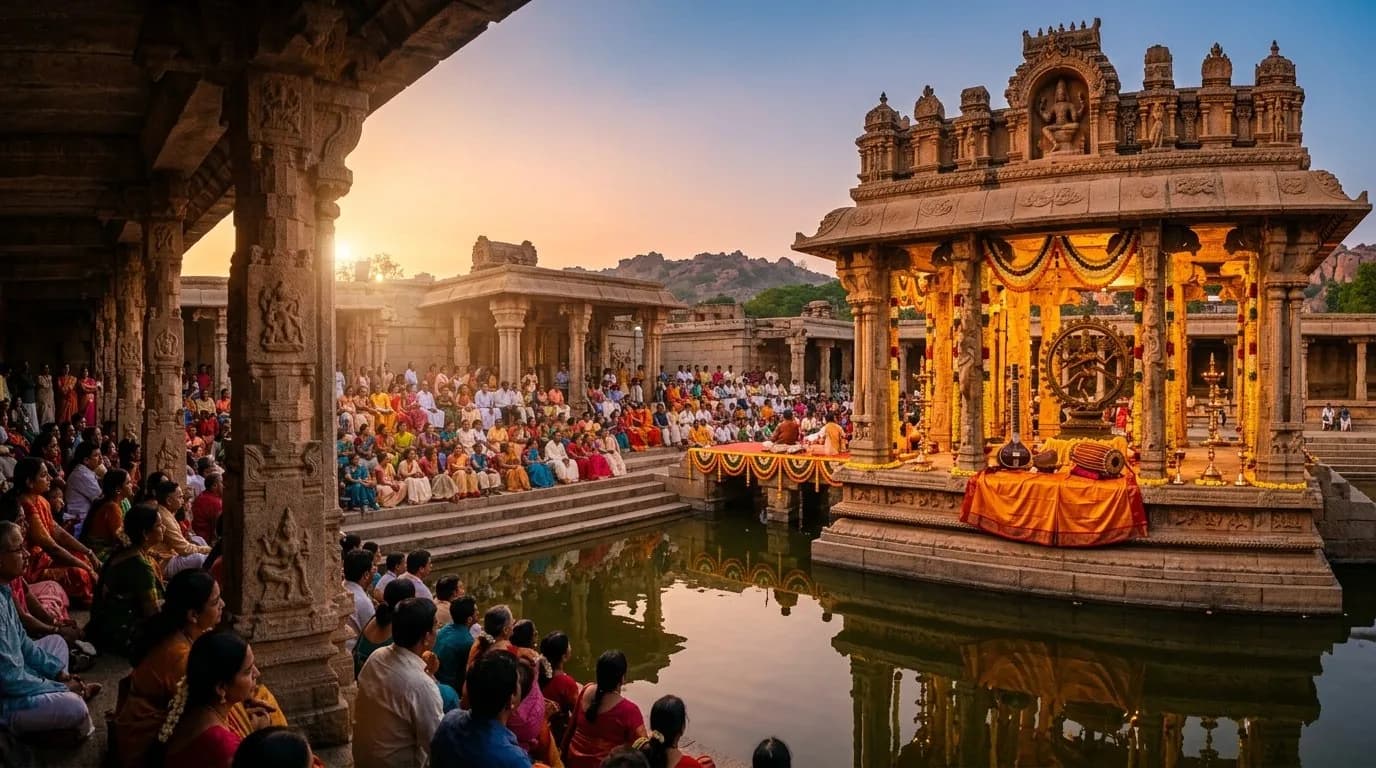
“We worship that Nāda Brahma—the divine reality as sound—which is the consciousness immanent in all beings, manifested as the universe itself, blissful and non-dual.”
— Śārṅgadeva, Saṅgīta Ratnākara (1.3.2), 13th Century CEIndian classical music (Śāstrīya Saṅgīta) is neither an entertainment medium nor a system of vertical polyphonic harmony. It is an acoustic soteriology—a rigorous discipline of consciousness grounded in the Vedic premise that the phenomenal universe is a manifestation of primordial vibration (Nāda Brahma). Across three millennia of unbroken oral and textual transmission, this tradition developed a sophisticated science of microtonal intonation (Śruti), melodic architecture (Rāga), and cyclical temporal mathematics (Tāla). While sharing common roots in the Sāmaveda and the classical treatises of Bharata Muni, Mataṅga, and Śārṅgadeva, the tradition crystallized after the fourteenth century into two distinct yet complementary streams: Hindustani (Uttarādi) in the North and Carnatic (Dakṣiṇādi) in the South. This codex examines the physiological generation of sound, the experimental derivation of the twenty-two Śrutis, the structural divergence of the Thāṭ and Melakarta taxonomies, the chronobiology of the Rāga-Samaya cycle, and the metaphysics of rhythmic resolution.
1. Samavedic Foundations & The Metaphysics of Nāda
In the Vedic worldview, acoustic reality precedes material form. The Chāndogya Upaniṣad (1.1.1–2) identifies the syllable Om (Udgītha) as the quintessence (Rasa) of all cosmic existence, while the Sāmaveda establishes the liturgical template for setting poetic meters (Ṛk) to precise tonal melodies (Sāman).
Early Sāmagāna (chanting of the Sāmaveda) evolved from a three-note recitation nuclei (Udātta, Anudātta, Svarita) into a descending heptatonic scale known in the Nāradīya Śikṣā (1st century BCE – 2nd century CE) as:
- 1Kruṣṭa (कृष्ट)often equated with Madhyama or Pañcama in specific recensions
- 2Prathama (प्रथम)Madhyama / Ma
- 3Dvitīya (द्वितीय)Gāndhāra / Ga
- 4Tṛtīya (तृतीय)Ṛṣabha / Re
- 5Caturtha (चतुर्थ)Ṣaḍja / Sa
- 6Mandra (मन्द्र)Dhaivata / Dha
- 7Atisvārya (अतिस्वाय्र्य)Niṣāda / Ni
“That which is Prathama for the Sāma chanters is the Madhyama note of the flute.”
The Nāradīya Śikṣā (1.5.1–2) explicitly maps these liturgical tones onto the seven secular notes (Svaras) of the flute (Veṇu) and lute (Vīṇā), bridging Vedic ritual and classical art music (यः सामगानां प्रथमः स वेणोर्मध्यमः स्वरः — “That which is Prathama for the Sāma chanters is the Madhyamanote of the flute”).
Ahata and Anāhata Nāda
Later musicological and yogic treatises—most notably Mataṅga’s Bṛhaddeśī (c. 6th–8th century CE) and Śārṅgadeva’s Saṅgīta Ratnākara (13th century CE)—synthesized Sāṃkhya cosmology, Tantra, and Śaiva metaphysics to classify sound into two ontological categories:
Anāhata Nāda (Unstruck Sound)
The subtle, uncaused, self-existent vibration of pure consciousness (Ākāśa), audible only to advanced contemplatives in deep Samādhi when sensory fluctuations cease. Because it lacks aesthetic variety (Rañjakatva), it serves purely for liberation (Mukti).
Ahata Nāda (Struck Sound)
Manifest acoustic vibration generated by physical friction or impact. Within the human body (Gātra-vīṇā), Śārṅgadeva explains the physiological alchemy of Nāda through the etymology of the word itself (Saṅgīta Ratnākara 1.3.6):
The syllable Na signifies vital breath (Prāṇa Vāyu), and Da signifies cosmic/digestive fire (Agni). When the self (Ātman) desires expression, it stirs the mental faculties, which strike the bodily fire (Agni) at the navel center (Brahmagranthi). This fire stimulates the vital breath (Prāṇa), which rises steadily through the navel, heart (Hṛdaya), throat (Kaṇṭha), cerebral vault (Mūrdhā), and oral cavity (Āsya) to manifest as articulated musical pitch across three octaves (Sthānas: Mandra, Madhya, and Tāra). Ahata Nāda, therefore, bestows both worldly aesthetic rapture (Bhukti) and spiritual liberation (Mukti).
2. The Acoustic Mathematics of the 22 Śrutis
Unlike Western equal temperament—which artificially divides the octave into twelve equal semitones (¹²√2 ≈ 1.05946) so instruments can modulate freely across keys—Indian classical music is anchored on an immutable tonic drone (Ṣaḍja / Sa) and operates through pure, natural-harmonic microtonal intervals called Śrutis (śrūyate iti śrutiḥ— “that which is distinctly heard”).
Bharata’s Catuḥ-Sāraṇā (Two-Vīṇā Experiment)
In Chapter 28 of the Nāṭya Śāstra (c. 200 BCE – 200 CE), Bharata Muni demonstrates empirically that an octave (Saptaka) contains exactly twenty-two distinct microtonal positions. To prove this, he prescribes the Sāraṇā Catuṣṭayī experiment using two identical arched harps or lutes of identical string length, gauge, and tension:
By lowering the Pañcama (fifth) of the Cala Vīṇā by the smallest perceptible auditory interval—called the Pramāṇa Śruti (corresponding acoustically to the syntonic comma of 81:80, or approximately 21.51 cents)—the ancient theorists transitioned from the Ṣaḍja-grāma (where Pa sits at the 17th Śruti, a pure fifth of 3:2) to the Madhyama-grāma (where Pa sits at the 16th Śruti, a grave fifth of 40:27). Through four successive microtonal reductions across both instruments, all 22 Śrutis were mapped before the strings aligned with the adjacent notes of the fixed reference Vīṇā.
The Classical Distribution of Śrutis Across the Seven Svaras
While the 22 Śrutis form the underlying microtonal continuum, seven primary resting stations are selected to serve as Svaras (notes that possess self-luminosity and aesthetic resonance: svato rañjayati śrotrapracittaṁ sa svara ucyate). Their traditional distribution follows the canonical verse (Saṅgīta Ratnākara 1.3.25):
| Svara (Full Name) | Solfège Symbol | Śruti Allocation | Cumulative Śruti Position (Modern/Medieval) | Acoustic Ratio (Just Intonation Equivalent) |
|---|---|---|---|---|
| Ṣaḍja | Sa | 4 Śrutis | 4th (or 1st in modern tonic start) | 1:1 (0 cents) |
| Ṛṣabha | Re / Ri | 3 Śrutis | 7th | 16:15, 10:9, 9:8 |
| Gāndhāra | Ga | 2 Śrutis | 9th | 6:5, 5:4, 81:64 |
| Madhyama | Ma | 4 Śrutis | 13th | 4:3, 27:20, 45:32 |
| Pañcama | Pa | 4 Śrutis | 17th | 3:2 (701.96 cents) |
| Dhaivata | Dha | 3 Śrutis | 20th | 8:5, 5:3, 27:16 |
| Niṣāda | Ni | 2 Śrutis | 22nd | 16:9, 9:5, 15:8 |
In live performance, a musician does not play all 22 Śrutis chromatically in a single piece. Rather, each Rāga selects a specific microtonal shade (Śruti-sthāna) of a Svara. For instance, the Komala Gāndhāra in Rāga Darbārī Kānaḍā (Ati-komala, heavily oscillated toward Ṛṣabha) occupies a distinctly lower microtonal locus than the Komala Gāndhāra of Rāga Kāfī or Bhīmpalāsī.
3. Historical Divergence & Structural Taxonomies: Hindustani vs. Carnatic
Up to the thirteenth century CE, Indian musicological texts describe a unified pan-Indian theoretical framework (Grāma-Mūrchanā-Jāti-Rāga). Śārṅgadeva, writing at the Yadava court of Devagiri in Maharashtra, synthesized both Northern and Southern regional practices in his Saṅgīta Ratnākara.
The formal bifurcation into Hindustani (Uttarādi) and Carnatic (Dakṣiṇādi) traditions occurred between the fourteenth and sixteenth centuries due to distinct socio-political and cultural trajectories:
In North India
Cross-fertilization between indigenous Sanskritic traditions (Dhrupad, temple Havelī Saṅgīta) and Persianate court aesthetics (Qawwālī, Maqām modal sensibilities) under the Delhi Sultanate and Mughal courts shifted performance emphasis toward expansive, unhurried microtonal exploration (Ālāp), vocal timbre cultivation (Ākār), and the crystallizing of the Khayāl idiom.
In South India
Shielded initially by the Vijayanagara Empire and later nurtured at the Nayaka and Maratha courts of Thanjavur, the Carnatic tradition preserved a tighter structural continuity with ancient Śāstric treatises, channeling its creative energy into complex devotional compositions (Kṛtis) and mathematically rigorous Rāga-Tāla permutations.
Comparative Taxonomy: The 72 Melakarta vs. The 10 Thāṭ Systems
Both systems abandoned the medieval Rāga-Rāgiṇī-Putra (family tree) classification in favor of rational parent-scale (Janaka-Janya or Thāṭ-Rāga) frameworks:
| Structural Parameter | Carnatic System (Dakṣiṇādi) | Hindustani System (Uttarādi) |
|---|---|---|
| Primary Classification | 72 Melakarta System (codified by Venkaṭamakhin in Caturdaṇḍī Prakāśikā, 1660 CE; standardized by Govindācārya in Saṅgraha Cūḍāmaṇi, 18th c.) | 10 Thāṭ System (codified by Pandit Vishnu Narayan Bhatkhande in Hindustānī Saṅgīta Paddhati, early 20th c., adapting Southern Mela logic) |
| Mathematical Basis | Combinatorial matrix of 2 Madhyamas (Śuddha & Prati) × 6 Pūrvāṅga combinations (Re-Ga) × 6 Uttarāṅga combinations (Dha-Ni) = 72 Sampūrṇa (7-note) scales. | Empirical grouping of prevailing Northern Rāgas into 10 parent heptatonic scales: Bilāval, Kalyāṇ, Khamāj, Bhairav, Pūrvī, Mārvā, Kāfī, Āsāvarī, Bhairavī, Toḍī. |
| Mnemonic Encoding | Kaṭapayādi Saṅkhyā: Every Melakarta name encodes its exact mathematical serial number (1–72) in its first two Sanskrit syllables (e.g., Dhī-ra-śaṅkarābharaṇam → 9 and 2 → 29). | Named directly after the flagship Rāga representing that scale cluster (Āśraya Rāga). |
| Śuddha (Natural) Scale | Kanakāṅgī (Mela #1): The lowest possible chromatic intervals (equivalent to Sa, Komal Re, Shuddha Re as Ga, Ma, Pa, Komal Dha, Shuddha Dha as Ni). | Bilāval Thāṭ: Equivalent to the Western Major / Ionian scale (Carnatic Dhīraśaṅkarābharaṇam, Mela #29). |
| Pitch vs. Ornament | Gamaka-integrated Svara: A note is rarely held as a flat, unornamented tone; its identity is inseparable from its specific oscillatory curve (Daśavidha Gamaka). | Sthāyī Svara + Meend: Extended dwelling on steady, resonant tonal centers (Nyāsa Svaras) connected by slow, continuous microtonal glides (Mīṇḍ). |
4. Kāla-Tattva: The Chronobiology of Rāga Time Theory
A defining hallmark of Hindustani classical music (and historically attested in early texts like Nārada’s Saṅgīta Makaranda, c. 11th century CE) is Rāga-Samaya-Cakra—the law that each Rāga achieves maximum psychophysical and aesthetic potency (Rakti) during a specific three-hour watch (Prahara) of the 24-hour solar cycle or during a specific season (Ṛtu).
Rather than superstitious convention, Bhatkhande demonstrated that the Samaya (time) cycle operates on three strict acoustic and structural laws aligned with human circadian rhythms:
1. The Three Note-Groups (Svara-Vargas) Across Sunrise and Sunset
The 12-hour half-day (repeated symmetrically from 4:00 AM to 4:00 PM and 4:00 PM to 4:00 AM) is divided into three four-hour acoustic zones:
Zone I (4:00–7:00 AM & 4:00–7:00 PM) — Sandhiprakāśa Rāgas (Twilight Rāgas)
4:00–7:00 AM & 4:00–7:00 PMCharacterized by Komala Re and Komala (or Śuddha) Dha, combined with Śuddha Ga and Śuddha Ni.
Zone II (7:00–10:00 AM & 7:00–10:00 PM) — Śuddha Re, Ga, Dha Rāgas
7:00–10:00 AM & 7:00–10:00 PMAs daylight or evening settles, the flattened notes resolve upward into natural (Śuddha) intervals, creating bright, expansive architectures (e.g., Bilāval, Alaiyā Bilāval, and Deśkār in the morning; Yaman, Bihāg, and Khamāj in the evening).
Zone III (10:00 AM–4:00 PM & 10:00 PM–4:00 AM) — Komala Ga and Komala Ni Rāgas
10:00 AM–4:00 PM & 10:00 PM–4:00 AMDuring midday zenith and deep midnight, the third and seventh degrees flatten (Komala Ga and Komala Ni), turning the mood inward and contemplative (e.g., Āsāvarī, Jaunpurī, Bhīmpalāsī, and Multānī from late morning to afternoon; Bāgeśrī, Mālkauṁs, and Darbārī Kānaḍā around midnight).
2. Madhyama as the Adhvadarśaka Svara (The Time-Indicator Note)
The fourth scale degree (Madhyama / Ma) acts as the pivot of the solar cycle. Śuddha Ma (the perfect fourth) dominates morning, midday, and post-midnight Rāgas. As afternoon shifts toward sunset (Sandhyā), Tīvra Ma (the augmented fourth) enters—first alongside Śuddha Ma in late-afternoon Rāgas like Multānī, and then commanding evening Rāgas (Mārvā, Pūrvī, Yaman, Śuddha Kalyāṇ) before yielding back to Śuddha Ma around midnight (Bihāg, Bāgeśrī, Mālkauṁs).
3. Pūrvāṅga vs. Uttarāṅga Vādī Dominance
The octave is split into two tetrachords: the lower Pūrvāṅga (Sa, Re, Ga, Ma) and the upper Uttarāṅga (Pa, Dha, Ni, Ṡa).
Pūrvāṅga-vādī Rāgas (12:00 PM – 12:00 AM)
Pūrvāṅga-vādī Rāgas (whose king-note or Vādī lies in the lower tetrachord) are performed between 12:00 PM (Noon) and 12:00 AM (Midnight), where melodic gravity pulls toward the lower register.
Uttarāṅga-vādī Rāgas (12:00 AM – 12:00 PM)
Uttarāṅga-vādī Rāgas (whose Vādī lies in the upper tetrachord) are performed between 12:00 AM (Midnight) and 12:00 PM (Noon), ascending toward the upper tonic (Ṡa) as day breaks.
(In addition to diurnal cycles, seasonal Rāgas transcend hourly restrictions during their appointed season—such as the Malhār family during the monsoon Varṣā Ṛtu, Basant and Bahār during spring Vasanta Ṛtu, and Hindol during the vernal swing festival).
5. Tāla Aesthetics & The Mathematics of Cyclical Time
As Śārṅgadeva declares, Śruti is the mother of music and Laya (tempo/rhythm) is its father (श्रुतिर्माता लयः पिता). While Western classical meter organizes time linearly across bar lines toward a final cadence, Indian Tāla conceives time cosmologically as a wheel (Āvartana—a self-contained cycle of beats or Mātrās/Akṣaras).
Every rhythmic cycle begins and resolves on the Sam(literally “equilibrium” or “togetherness”)—the first beat of the cycle where melodic improvisation and percussive permutation converge in a moment of cathartic release.
The Tāla Daśa Prāṇas (Ten Vital Breaths of Rhythm)
Classical treatises codify rhythm through ten analytical dimensions (Daśa Prāṇas):
Structural Comparison: Sūlādi Sapta Tāla vs. Hindustani Thekā
Carnatic Sūlādi Sapta Tālas
Anchored by the Mridangam, Ghatam, Kanjira, and Morsing, the Carnatic system uses 7 core Tālas (Dhruva, Maṭya, Rūpaka, Jhampa, Triputa, Aṭa, Eka). Because each contains a variable Laghu component that can take any of the 5 Jātis (3, 4, 5, 7, or 9 beats), the system generates 7 × 5 = 35 foundational Tālas (extending to 175 when subdivided across the 5 Gatis/Nadai).
Hindustani Thekā System
Anchored by the Tabla and Pakhawaj, Hindustani rhythm identifies a Tāla not merely by its beat count and subdivisions (Vibhāgs), but by its acoustic Thekā—a canonical sequence of mnemonic drum syllables (Bols such as Dhā, Dhin, Tā, Tiṭa, Kit-tak). Thus, Jhoomrā (14 beats), Dhamār (14 beats), Āḍā Cautāl (14 beats), and Dīpcaṇḍī (14 beats) share the exact same length of 14 Mātrās, yet possess completely distinct structural subdivisions, Tālī-Khālī architectures, and sonic Thekās.
6. Compositional Genres, Manodharma, & Living Lineages
Indian classical performance balances two complementary poles: Kalpita / Nibaddha Saṅgīta (pre-composed, metrically bound works) and Manodharma / Anibaddha Saṅgīta (spontaneous, rule-governed creative improvisation generated in real time).
Hindustani Classical Genres & Gharānās
1. Dhrupad (ध्रुपद):
The oldest living vocal and instrumental (Rudra Vīṇā, Surbahār) form in North India, descending directly from the medieval Prabandha tradition and patronized by Raja Man Singh Tomar of Gwalior (1486–1516 CE) and Swami Haridas. A Dhrupad performance begins with an expansive, unaccompanied, unmetered Nom-Tom Ālāp across three tempos (Vilambita, Madhya, Druta), probing every microtonal nuance of the Rāga, followed by a majestic composition in four sections (Sthāyī, Antarā, Sañcārī, Ābhoga) accompanied by the barrel-shaped Pakhawaj in Cautāl (12 beats) or Sūltāl (10 beats). Major lineages include the Dagarvāṇī (renowned for subtle microtonal Śruti work and Gamak), Darbhanga, Bettiah, and Talwandi traditions.
2. Khayāl (ख़याल):
Meaning "imagination" or "contemplation," Khayāl rose to prominence between the fifteenth and eighteenth centuries (associated with Sultan Husain Sharqi of Jaunpur and Sadarang–Adarang at the court of Muhammad Shah Rangila). Performed in a two-part structure—a slow, meditative Baḍā Khayāl (Vilambita) followed by a brisk Choṭā Khayāl (Druta)—it synthesizes the structural grandeur of Dhrupad with ornate vocal runs (Tāns), rhythmic interplay (Bol-bāṇṭ), and expressive flexibility. It is transmitted through hereditary pedagogical lineages called Gharānās:
Emphasizing open-throated projection, structural clarity, Behlāvā, and straight Sapāṭ Tāns.
Deeply rooted in Dhrupad-Dhamār aesthetics, featuring Nom-Tom Ālāp before the Khayāl and vigorous rhythmic Bol-bāṇṭ.
Prioritizes supreme microtonal intonation (Svara-sādhanā), slow architectural Badhat (note-by-note unfolding), and poignant emotional resonance (Karuṇā).
Celebrated for complex, rare compound Rāgas (Jod-Rāgas) and intricate, breath-defying Vakra (oblique) Tān patterns locked to the Sam.
Known for dazzling velocity, Tappā-inspired ornamentation, and emotional versatility.
Carnatic Classical Genres & The Trinity
1. The Compositional Architecture (Varnam, Kṛti, Padam, Tillānā)
Varṇam: The pedagogical and concert cornerstone that encapsulates the complete Rāga-bhāva and Svara trajectories of a Rāga, opening every traditional recital.
Kṛti (कृति): The pinnacle of Carnatic compositional art, structured into three movements: Pallavi (thematic statement), Anupallavi (secondary development in the upper register), and Caraṇam (concluding stanza), enriched with Saṅgatis (progressive melodic variations on a single lyric phrase) and Ciṭṭasvaras.
2. The Carnatic Pioneers & The Tiruvarur Trinity
Purandara Dāsa (1484–1564 CE): Revered as the Pitāmaha (Grandfather) of Carnatic music; he codified the foundational pedagogical syllabus (Sarali Varisai, Janta Varisai, Alaṅkāras in Māyāmāḻavagauḻa Mela #15, and Gītams) still taught to every student today.
Tyāgarāja (1767–1847 CE), Muttusvāmi Dīkṣitar (1775–1835 CE), and Śyāma Śāstrī (1762–1827 CE): Born contemporaneously in Tiruvarur (Tamil Nadu), the Trinity elevated the Kṛti to unmatched heights. Tyāgarāja composed primarily in emotive Telugu addressed to Lord Rāma, introducing dynamic Saṅgati tiers; Dīkṣitar composed contemplative, slow-tempo Sanskrit masterpieces infused with Advaita Vedānta, Tantric Śrīvidyā symbolism, and Dhrupad-like Vīṇā gamakas; Śyāma Śāstrī excelled in intricate rhythmic Svarajatis and Kṛtis in praise of Goddess Kāmākṣī, particularly in Miśra Cāpu (7 beats).
3. Rāgam-Tānam-Pallavi (RTP):
The supreme test of Manodharma Saṅgīta in a Carnatic concert, comprising an expansive unpulsed Rāga Ālāpana, a rhythmic-melodic pulse exposition (Tānam), and a single-line Pallavi subjected to Tri-kāla (doubling and quadrupling speed while keeping the Tāla constant), Niraval (melodic improvisation preserving lyric syllabic positions), and Rāgamālikā Kalpanā Svaras (extemporaneous solfège garlands weaving across multiple Rāgas).
7. Primary & Secondary Bibliography
Primary Sanskrit & Vernacular Texts
- [1]Bharata Muni. Nāṭyaśāstra, with the commentary Abhinavabhāratī of Abhinavagupta. Edited by M. Ramakrishna Kavi (4 vols.). Gaekwad’s Oriental Series, Baroda: Oriental Institute, 1926–1964 (Chapters 28–33).
- [2]Nārada. Nāradīya Śikṣā, with the commentary Śikṣāvivaraṇa of Bhaṭṭa Śobhākara. Edited by Pandit Satyavrata Samasrami. Calcutta, 1890.
- [3]Mataṅga Muni. Bṛhaddeśī. Edited and translated with critical notes by Prem Lata Sharma and Anil Bihari Beohar (2 vols.). Kalāmūlaśāstra Series, New Delhi: Indira Gandhi National Centre for the Arts (IGNCA) & Motilal Banarsidass, 1992–1994.
- [4]Śārṅgadeva. Saṅgīta-Ratnākara, with the commentaries Kalānidhi of Kallinātha and Sudhākara of Siṁhabhūpāla. Critically edited and translated by R. K. Shringy and Prem Lata Sharma (2 vols.). Delhi: Motilal Banarsidass, 1978–1989.
- [5]Venkaṭamakhin. Caturdaṇḍīprakāśikā. Edited with critical introduction and translation by R. Sathyanarayana (2 vols.). Kalāmūlaśāstra Series, New Delhi: IGNCA, 2002–2006.
- [6]Bhatkhande, Vishnu Narayan. Hindustānī Saṅgīta-Paddhati: Kramik Pustak Mālikā (6 vols.) & Lakṣya-Saṅgīta. Hathras: Sangeet Karyalaya, 1910–1932.
Modern Academic & Musicological Scholarship
- [7]Lath, Mukund. A Study of Dattilam: A Treatise on the Sacred Music of Ancient India. New Delhi: Impex India / IGNCA, 1978.
- [8]Rowell, Lewis. Music and Musical Thought in Early India. Chicago Studies in Ethnomusicology. Chicago: University of Chicago Press, 1992.
- [9]Sambamoorthy, P.. South Indian Music (6 vols.). Chennai: The Indian Music Publishing House, 1963–1969.
- [10]Te Nijenhuis, Emmie. Musicological Literature (A History of Indian Literature, Vol. VI, Fasc. 1). Wiesbaden: Otto Harrassowitz, 1977.
- [11]Vatsyayan, Kapila. Bharata: The Nāṭyaśāstra. New Delhi: Sahitya Akademi, 1996.
- [12]Widdess, Richard. The Rāgas of Early Indian Music: Modes, Melodies, and Musical Notations from the Gupta Period to c. 1250. Oxford Monographs on Music. Oxford: Clarendon Press, 1995.