
Eastern Terracotta & Odissi Poetry: Kalinga Monumental Temples, Bishnupur Burnt-Clay Shrines, Jamdani Muslins, and Odissi Sculptural Aestheticsप्राच्य भारत स्थापत्य एवं काव्य परंपरा: कलिंग देवालय, विष्णुपुर टेराकोटा एवं ओडिशी कला
From the Rekha and Piḍha Deuls of Bhubaneswar and Konark to the Carved Laterite and Clay Temples of Bengal, Air-Woven Jamdani Muslins, and the Fluid Tribhangi Sculptures of Odissi
“Three vertical offsets (Rathas), the triple curving profiles of the Rekhā, two terraced tiers of the Piḍha roof culminating in the crowning Āmalaka and Kalasa disk—thus is the sacred Kalinga temple adorned in cosmic harmony.”
— Śilpa Prakāśa (Palm-leaf Architectural Treatise of Orissa), Verses 1.45–48Across the eastern littoral of the Indian subcontinent—spanning the ancient kingdoms of Kaliṅga, Utkala, Oḍra, Vanga, Puṇḍra, and Mithilā (modern Odisha, West Bengal, Bihar, and parts of Bangladesh)—civilizational expression was shaped by the monsoon deltas of the Mahānadī, Brāhmaṇī, Suvarṇarekhā, Ganges, and Brahmaputra rivers. Unlike the granites of the South or the sandstones of Central India, the alluvial clay and laterite soils of the East catalyzed two unique material architectures: the towering stone sanctums and sculptural poetry of the Kalinga architectural order in Odisha, and the intricately carved burnt-clay terracotta temples of Bengal (most notably in Bishnupur). Simultaneously, the literary and musical genius of Jayadeva’s Gītagovinda, the mystical acoustic songs of the Bauls, and the fine-thread mathematics of Jamdani muslin weaving sustained an unbroken cultural continuum bridging courtly Sanskrit aesthetics with vernacular folk devotion. This codex examines the engineering of Kalinga temples, the technical manuals of the Śilpa Prakāśa, the terracotta symbolism of Bengal, the kinetic geometry of Odissi sculpture, and the textile mastery of eastern looms.
1. Kalinga Architecture & The Śilpa Prakāśa Canon
The architecture of Odisha represents one of the most rigorously codified regional styles in Indian art history, classified across indigenous palm-leaf Sanskrit manuscripts such as the Śilpa Prakāśa (composed by Rāmacandra Mahāpātra Kauḷācāra, likely between the 9th and 12th centuries CE) and the Bhuvanapradīpa into three structural orders (Rekhā Deul, Piḍha Deul, and Khakhara Deul).
1.1 The Tripartite Elevation of the Kalinga Temple
Unlike the Dravidian style with its towering flat-topped Gopurams, a mature Kalinga temple complex (such as the Lingaraja and Rajarani temples in Bhubaneswar, the Jagannath Temple in Puri, and the Sun Temple at Konark) consists of two or four interconnected halls along an axial east-west line:
1. Deul / Vimāna (Sanctum Sanctorum)
Tier 1 of 3Crowned by a curvilinear shikhara (Rekha Deul), which rises vertically before curving gently inward near the apex to form a neck (Grīvā) capped by a massive ribbed stone disk called the Āmalaka and a vase finial (Kalasa).
2. Jagamohana (Assembly Hall)
Tier 2 of 3Fronting the sanctum, roofed by a stepped pyramidal stack of horizontal tiered cornices (Piḍhas), creating a visual silhouette resembling a mountain slope (Meru).
3. Bhogamaṇḍapa & Nāṭamaṇḍapa
Tier 3 of 3Later subsidiary halls added for communal prasadam dining and temple dance (Mahārī performances).
1.2 Geometrical and Yantra Planning in the Śilpa Prakāśa
The Śilpa Prakāśa details the esoteric and architectural foundation of the temple through Yantra geometry. Every temple is laid out using the Square-Circle Principle (Vāstupuruṣamaṇḍala), wherein the ground plan is divided into 64 or 81 squares. However, Kalinga architects introduced distinctive vertical offsets (Rathas):
Triratha (3 vertical offsets per side), Pañcaratha (5 offsets), Saptaratha (7 offsets), and Navaratha (9 offsets).
These vertical offsets create deep chiaroscuro shadow lines along the temple exterior, visually breaking the monolithic masonry wall into soaring vertical rays (Pāgas) that lead the eye upward to the heavens.
Nāyakī Figures & Maithuna Auspiciousness
Furthermore, the Śilpa Prakāśa outlines the ritual carving of Nāyakīs (celestial female figures embodying structural and cosmic energies) and erotic couples (Maithuna) into the wall niches—not as mere ornamentation, but as symbolic representations of Mithuna (the non-dual union of Puruṣa and Prakṛti, consciousness and energy), ensuring the structural integrity and auspiciousness of the building.
2. The Sun Temple at Konark (c. 1250 CE): Stone Chariot of the Cosmos
Built by the Eastern Ganga monarch King Narasimhadeva I (r. 1238–1264 CE) on the sandy shores of the Bay of Bengal, the Sun Temple at Konark (Kōṇāditya) is the supreme masterpiece of Kalinga architecture—conceived as a colossal cosmic chariot (Ratha) of the Sun God (Sūrya), hauling light across the firmament.
2.1 The Architectural Program
1. The 24 Stone Wheels
The massive stone plinth of the temple is carved with 24 monolithic wheels (3 meters in diameter), each exquisitely detailed with 8 major spokes and 8 minor spokes, carved medallions, and aquatic motifs. Far from being mere decoration, these 24 wheels are precision astronomical sundials: the shadow cast by the central hub pin across the carved bead-rims measures time down to the exact prahara (3-hour watch) and minute of the day.
2. The Seven Horses
Pulled across the stone earth by seven rearing stone horses (symbolizing the seven days of the week and the seven colors of the solar spectrum), the entire complex was originally engineered with a towering 60-meter-high Rekhā Deul over the sanctum (which collapsed in the 19th century due to foundation subsidence on unstable sand) and an intact, towering Jagamohana pyramid.
3. Chlorite Sculptures & Magnetic Crown
The doorways and major iconographic niches are carved from green chlorite stone (a metamorphic rock capable of holding razor-sharp microscopic detail). Historically, travelers recorded that a massive loadstone placed at the summit of the main tower acted as a magnetic anchor, stabilizing the iron-clamped masonry and deflecting passing Portuguese merchant ships off the coast.
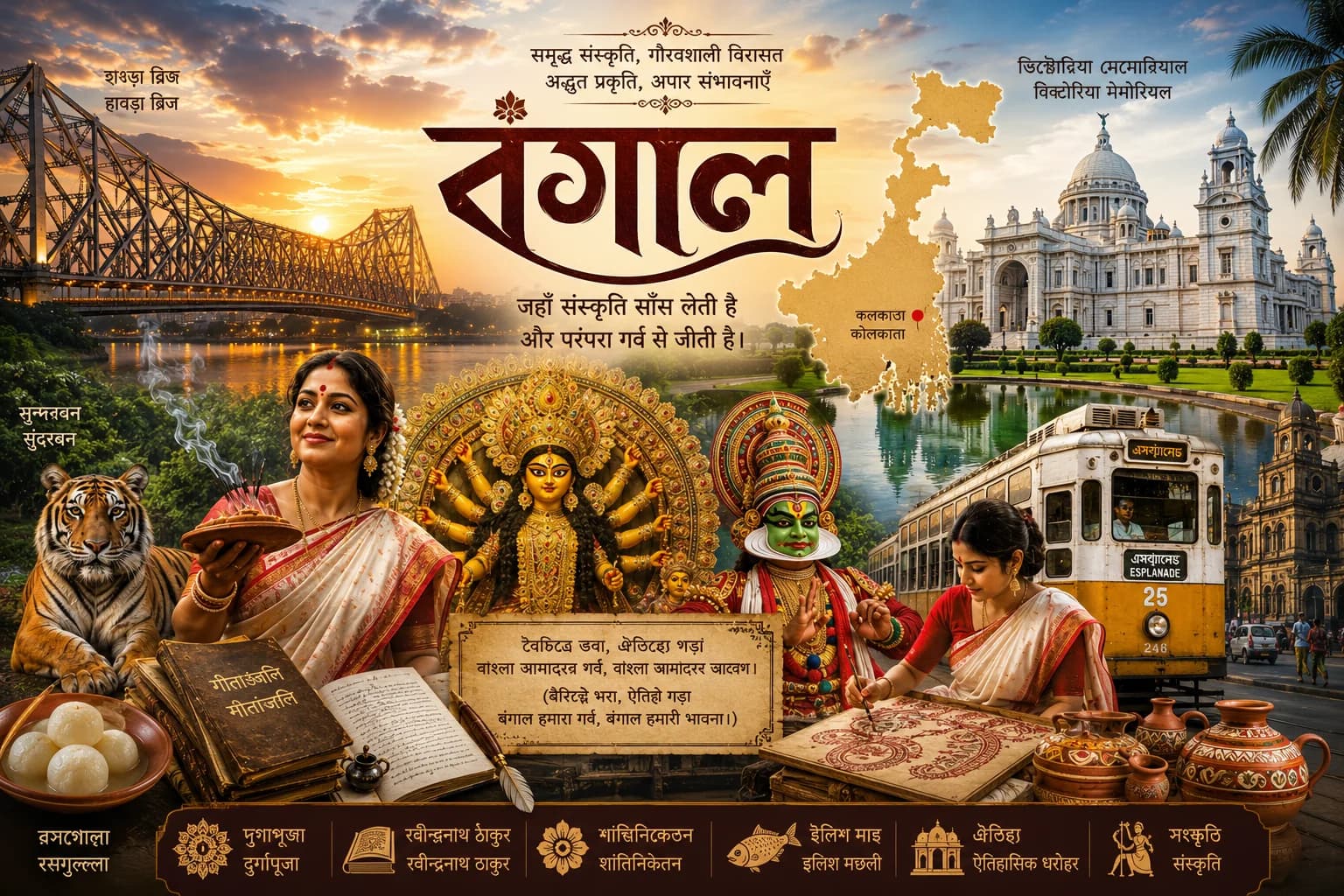
3. Terracotta Temples of Bengal: Bishnupur’s Burnt-Clay Epics
While Odisha mastered monumental stone architecture, the deltaic plains of Bengal (Gauda, Vanga, and Radha) possessed virtually zero structural stone. To construct enduring shrines for the rising tide of Gauḍīya Vaiṣṇavism under the Malla kings of Bishnupur (17th–18th centuries CE)—most notably Raghunath Singh, Bir Singha, and Durjana Singh Malla—local master potters and masons transformed ordinary river clay into monumental architectural sculpture.
3.1 The Terracotta Construction System
Fine, plastic river silt collected from the Damodar and Kangsabati riverbeds is kneaded with rice husk, straw, and sand, shaped in wooden or carved stone molds, and sun-dried.
Unlike modern high-fired bricks, these terracotta plaques were fired in traditional low-to-medium-temperature reduction kilns using cow dung and wood fuel, yielding rich reddish-brown, burnt-umber, and charcoal-grey hues.
The temple walls are constructed of thin, hard-baked bricks decorated with thousands of interlocking narrative terracotta tiles (Tera-koṭā). These panels depict episodes from the Rāmāyaṇa, Mahābhārata, Bhāgavata Purāṇa, the pastoral sports of Krishna (Kṛṣṇa-līlā), royal hunting scenes, European merchants sailing on river barges, and daily village life.
3.2 Architectural Styles of Bengal Terracotta Temples
The Bishnupur school developed four distinct roof typologies inspired by indigenous Bengali bamboo-and-thatch hut architecture (Chālā-ghar):
Eka-ratna
A single tower (Ratna) rising above a curved-cornice (Chāḷā) brick shrine (e.g., Madangopal Temple, 1665 CE).
Pāñca-ratna
Five towers resting on a square sanctum with a curved cornice (e.g., the magnificent Shyamrai Temple, 1643 CE, featuring exquisite wall plaques depicting Krishna lifting Govardhan hill and Radha-Krishna in the kadamba groves).
Jor-Bangla
Two traditional thatched-hut structures joined side-by-side, sharing a single roof with a central turret, completely covered in relief tiles (e.g., Keshta Raya / Kestorai Temple, 1655 CE).
Rasmancha
A massive pyramidal stepped tower surrounded by arched Bengali galleries, built in 1600 CE by King Hambir Malla to enshrine all the town's divine images together during the annual Rās festival.
4. Odissi Sculptural Aesthetics: Tribhaṅgi, Mahārīs, and the Gītagovinda
In the temple sculpture and classical dance of Odisha, the human body is treated as a flexed, fluid instrument of spiritual ecstasy.
4.1 The Tribhaṅgi Posture and Sculptural Kinematics
In the temples of Bhubaneswar (Mukteshvara, Rajarani, Lingaraja) and Konark, stone is carved to look elastic. The dominant bodily posture is Tribhaṅgi (the "thrice-bent" S-curve), where the body’s weight shifts onto one leg, causing the torso to deflect at three distinct anatomical joints:
1. Grīvā-bhaṅga
Deflection 1The neck tilts gracefully to one side.
2. Kati-bhaṅga
Deflection 2The chest and waist deflect in the opposite direction.
3. Jānu-bhaṅga
Deflection 3The knee bends inward.
This sculptural grammar was mirrored in living reality by the Mahārīs—devotional temple dancers dedicated to Lord Jagannath at Puri—and the Gotipuas (young boys trained in feminine attire). Their movements, codified later in the nineteenth-century treatise Abhinaya Candrikā, formed the direct kinetic foundation of modern Odissi classical dance, characterized by deep Chauka stances, fluid torso undulations (Bhaṅgis), and sharp eye-glances (Dṛṣṭi).
4.2 Jayadeva’s Gītagovinda: The Liturgical Soul of Orissa
Composed in the twelfth century by the court poet Jayadeva at Kenduli (near Puri), the Gītagovinda is a Sanskrit lyrical masterpiece divided into 12 cantos (Sargas) and 24 songs (Aṣṭapadīs). It traces the emotional and spiritual topography of Viraha (pain of separation) and Saṁyoga (ecstatic union) between Rādhā and Kṛṣṇa.
The Liturgical Soul & Bhakti Theology of Utkala
Puri Jagannath MandirSung daily within the sanctum of the Jagannath Temple by hereditary singers (Devadāsīs and Mahārīs), the Gītagovinda established the theological paradigm that the human soul (Jīvātmā / Gopī) achieves liberation not through cold asceticism, but through passionate, total surrender (Bhakti) to the Divine Beloved.
5. Comparative Matrix of Eastern Regional Art, Architecture & Textiles
| Eastern Sub-Region | Architectural & Monumental Typology | Master Textile & Weaving Lineage | Core Living Festival & Ritual | Primary Textual & Historical Anchor |
|---|---|---|---|---|
| Odisha (Utkala / Kaliṅga) | Kalinga Stone Architecture: Rekha Deul & Piḍha Deul dry-stone granite/sandstone temples (Konark Sun Temple, Lingaraja). | Bomkai (Sonepuri) & Khandua Patta: Tie-dyed Bandha silk sarees woven with temple-border motifs and Gītagovinda Sanskrit verses. | Jagannath Ratha Yatra: Chariot pulling of the three deities; Mahāprasadam community feast from earthen pots. | Śilpa Prakāśa, Bhuvanapradīpa; Jayadeva’s Gītagovinda (12th c.). |
| West Bengal (Bishnupur & Radha) | Terracotta Temples: Carved burnt-clay plaque shrines (Pāñca-ratna and Jor-Bangla styles of Bishnupur). | Baluchari & Swarnachari Silk: Jacquard-woven mulberry silk sarees depicting scenes from the Mahābhārata and Rāmāyaṇa along the Pallar. | Durga Puja (UNESCO Intangible Cultural Heritage): Elaborate community Pāndals, Dhunuchi Naach, and Sindoor Khela. | Malla dynastic chronicles; Caryāpada mystic Buddhist songs (8th–12th c.). |
| Bengal Delta / Bangladesh (Dhaka & Tangail) | Sultanate Brick Mosques & Zamindari Terracotta (Gaur, Paharpur Somapura Mahavihara). | Dhakai Jamdani Muslin: Translucent unbleached cotton hand-woven with supplementary geometric/floral weft motifs without mechanical draw-looms. | Pahela Baishakh (Bengali New Year): Halkhata (new ledger books), Mangal Shobhajatra mask processions. | Kautilya’s Arthaśāstra (praise of Vanga muslin); Mughal imperial farmans. |
| Mithila / Bihar (Tirhut) | Madhubani (Mithila) Domestic Wall Art: Natural-pigment floor and wall paintings (Bhitti-citra). | Tussar Silk (Bhagalpur Kosa): Wild forest silkworm cocoons woven into textured golden fabrics and hand-painted with Madhubani motifs. | Chhath Puja: Rigorous four-day solar worship standing waist-deep in river/pond waters offering Thekua prasad at sunset and sunrise. | Śatapatha Brāhmaṇa (Videha migration of Gautama Rāhūgaṇa); Rāmāyaṇa. |
| Assam & Brahmaputra Valley | Ahom Brick Masonry & Wooden Satra Monasteries: Rang Ghar amphitheater and Namghar prayer halls. | Muga, Eri & Pat Silk: Golden wild Muga silk (Antheraea assamensis) woven with floral Gamosa borders. | Bihu (Rongali, Kongali, Bhogali): Spring agricultural fertility dance, drum (Pung) rhythms, and harvest feasts. | Ahom Buranjis (chronicles); Śrīmanta Śaṅkaradeva’s Borgeets. |
6. Eastern Textile Mastery: Jamdani, Baluchari, and Bomkai
6.1 Dhakai Jamdani: The "Air-Woven" Muslin of Bengal
Dhaka & Bengal DeltaReferred to in ancient Sanskrit texts as Sūkṣma-vastra ("subtle cloth") and in Mughal chronicles as Jamdani (from Persian Jam [flower] + Dani [vase]), authentic Jamdani weaving developed along the banks of the Shitalakshya River near Dhaka (now Bangladesh and West Bengal).
Spun from indigenous short-staple cotton (Phuti) that grew exclusively along the Brahmaputra riverbanks, master spinners produced yarn counts exceeding 300 to 400 fine counts, where a twenty-meter saree could be squeezed inside a hollow bamboo internode or passed through a signet ring.
Jamdani is not printed or embroidered. It is figured muslin created on a pit-loom by two weavers working simultaneously with a primary shuttle for the sheer ground fabric and dozens of tiny wooden spools (Tīllīs) carrying thicker, un-degummed cotton or gold thread. Without any mechanical draw-loom or computer jacquard, the weavers count warp threads by eye and insert floral motifs (Panna Hazar [thousand emeralds], Tercha, Bel-patra [bilva leaf], Kalka) directly into the wet shed during weaving so that the patterns float like pale moonbeams suspended in mist against the transparent ground.
6.2 Baluchari & Swarnachari Silk Storytelling
Murshidabad & BishnupurOriginating in the village of Baluchar (Murshidabad district) and later shifted to Bishnupur, Baluchari silk sarees are woven on jacquard looms where the entire body and the broad shoulder panel (Pallu) are covered in narrative figural brocade. Using dyed mulberry silk warp and contrasting colored weft, Baluchari weaves depict scenes from the royal courts of the Nawabs of Bengal, European officers smoking hookahs on verandas, and majestic episodes from the Mahābhārata—such as Arjuna holding the bow or Krishna preaching the Bhagavad Gītā to a kneeling Arjuna on the battlefield of Kurukshetra.
6.3 Odishon Bomkai and Khandua Patta
Odisha (Sonepur & Coastal)In western and coastal Odisha, the Bomkai (Sonepuri) and Khandua Patta weave traditions combine tie-dyed warp/weft (Bandha) with supplementary weft extractions. Woven in silk or mercerized cotton, a traditional Bomkai saree features iconic regional motifs: the Padma (lotus), Kanta (fish bone), Kala-phula (flower of the dark river), and the Rasa-kumbha (temple-spire water pot), embodying the sacred topography of the Eastern littoral.
7. Primary & Secondary Bibliography
Primary Sanskrit, Bengali & Odia Texts
- 1.Rāmacandra Mahāpātra Kauḷācāra. Śilpa Prakāśa: Sanskrit Text with Translation and Notes. Translated and annotated by Alice Boner and Śāδāśiva Rath Śarmā. Leiden: E. J. Brill, 1966.
- 2.Jayadeva. Gītagovinda of Jayadeva. Critically edited by Narayan Ram Acharya. Mumbai: Nirnayasagar Press, 1950; translated by Barbara Stoler Miller, Love Song of the Dark Lord: Jayadeva’s Gītagovinda. New York: Columbia University Press, 1977.
- 3.Caryāpada. The Mystic Songs of Carya: A Study of the Oldest Bengali Poems. Translated and edited by Manindra Mohan Bose. Calcutta: University of Calcutta, 1928 (reprint 1983).
- 4.Śrīmanta Śaṅkaradeva. Borgeeta & Aṅkiyā Nāṭ. Guwahati: Publication Board Assam, 1978.
Modern Art-Historical, Architectural & Textile Scholarship
- 5.Bandopadhyay, Biswamoy. The Terracotta Temples of West Bengal. New Delhi: Aryan Books International, 2007.
- 6.Boner, Alice. Principles of Composition in Hindu Sculpture: Cave Temple Period. Leiden: E. J. Brill, 1962.
- 7.Eschmann, Annchrit, Hermann Kulke, and Gaya Charan Tripathi (Eds.). The Cult of Jagannath and the Regional Tradition of Orissa. New Delhi: Manohar, 1978.
- 8.Ghosh, Ajit. "The Terracotta Art of Bengal." Rupam, no. 27–28 (1926): 84–92.
- 9.Mahapatra, K. N.. Khiching Temples and Other Archaeological Monuments of Mayurbhanj. Bhubaneswar: Orissa Sahitya Akademi, 1980.
- 10.Mohanty, Bijan. Ikat Textiles of Orissa. Ahmedabad: Calico Museum of Textiles, 1984.
- 11.Ray, Amita. Villages, Towns and Secular Buildings in Ancient India (c. 150 BC - c. 350 AD). Calcutta: Firma K. L. Mukhopadhyay, 1964; and Art of Bengal: 1st–12th Century A.D. Calcutta: N. K. Gossain, 1987.
- 12.Taher, Momtazur Rahman. Jamdani. Dhaka: The University Press Limited, 1999.
- 13.Donaldson, Thomas E.. Hindu Temple Art of Orissa (3 vols.). Studies in South Asian Culture, Vols. XII:1–3. Leiden: E. J. Brill, 1985–1987.