
Upanayana: The Rite of Sacred Initiation and Second Birth
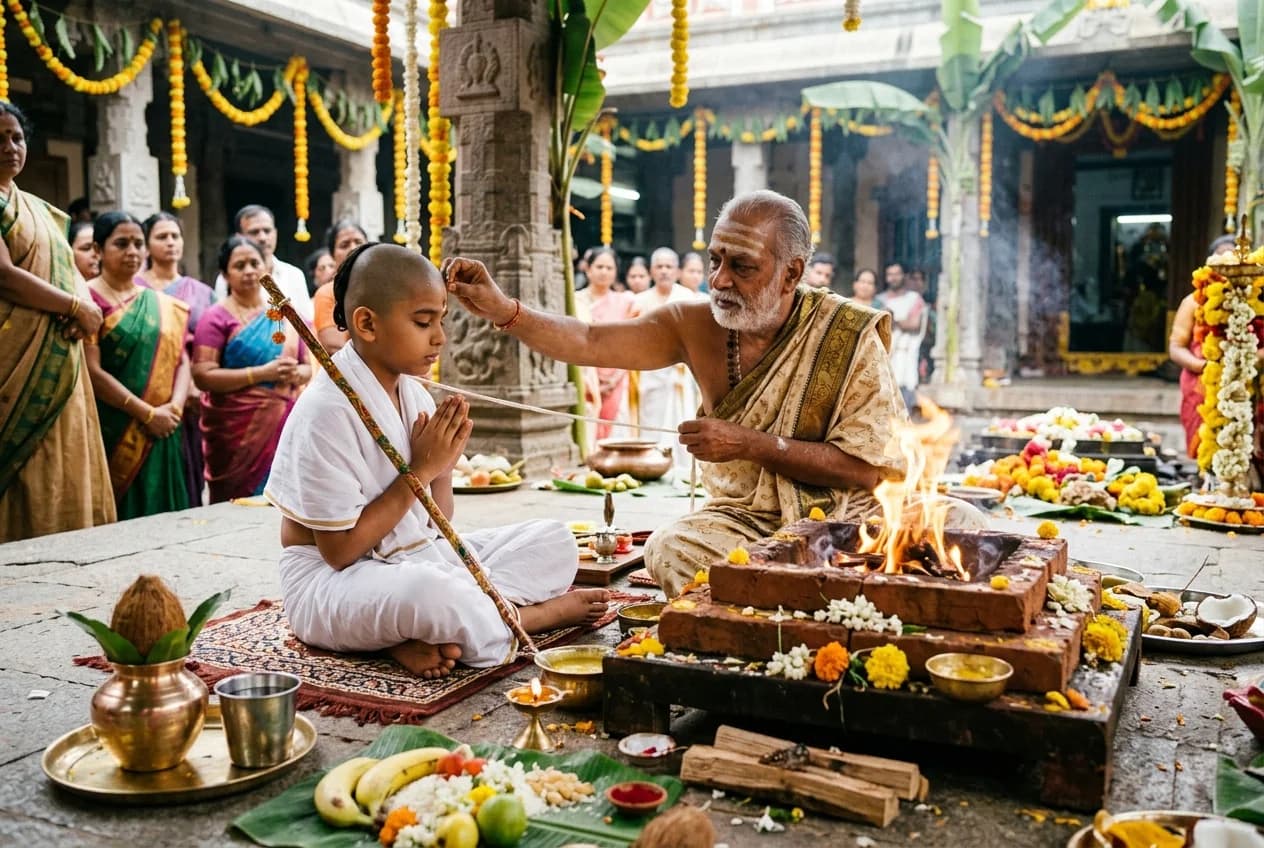
Within the classical architecture of the Shodasha Samskaras (the sixteen sacred life-cycle rites of Sanatan Dharma), Upanayana (उपनयन) stands as the pivotal threshold marking the transition from childhood into conscious spiritual and intellectual citizenship (Brahmacharya Ashrama). Etymologically derived from the prefix उप (Upa — "near") and the verbal root नी (Nī — "to lead" or "eye/vision"), Upanayana carries a dual classical significance: first, the ceremonial leading of the young seeker near the spiritual preceptor (Acharya) for Vedic instruction; and second, the opening of the "inner eye of wisdom" (Jnana-chakshu) by which one perceives subtle ethical and cosmic realities unseen by physical sight. Through the investiture of the sacred thread (Yajnopavita) and the confidential transmission of the Savitri-Gayatri Mantra (Brahmopadesha), the initiate undergoes a symbolic second birth (द्विजत्व / Dvijatva)—awakening to lifelong responsibility toward knowledge, ethical self-restraint, and cosmic reciprocity.
What Is It?
1. Phenomenological Definition & Sacred Insignia (Chihna)
In the Grihya Sutras (domestic ritual manuals), Upanayana is not merely the bestowal of a cotton cord, but a comprehensive educational and spiritual consecration. By accepting five distinct ritual insignia, the initiate (Vatu or Brahmachari) assumes a disciplined lifestyle dedicated to learning (Svadhyaya), simplicity, and mindfulness.
| Sanskrit Term | Sacred Insignia | Material Specification | Pedagogical & Spiritual Function |
|---|---|---|---|
| १. यज्ञोपवीतम् / ब्रह्मसूत्रम् (Yajñopavītam / Brahmasūtram) | The Sacred Thread | Three hand-spun raw cotton strands (Tantu), each folded thrice (nine sub-threads), tied with a sacred knot (Brahmagranthi). | Worn diagonally from the left shoulder to the right hip (Upaviti); signifies consecration for Vedic study, Sandhya, and cosmic obligations (Rinas). |
| २. मौञ्जी मेखला (Mauñjī Mekhalā) | The Sacred Waist Girdle | A triple-plaited cord woven from sacred Munja grass (Saccharum munja), Kusha, or bowstring hemp (Murva). | Encircles the navel center; symbolizes moral girding, pranic containment, and readiness for disciplined service. |
| ३. दण्डः (Daṇḍaḥ) | The Consecrated Staff | A straight wooden staff of Palasha (Butea monosperma), Bilva, Nyagrodha (banyan), or Udumbara wood, cut to crown, forehead, or nose height. | Represents spinal and moral uprightness, vigilance over the mind and speech (Vak-danda, Mano-danda), and a traveller on the path of truth. |
| ४. अजिनम् / उत्तरीयम् (Ajinam / Uttarīyam) | The Sacred Upper Mantle | Historically a small emblem of naturally shed blackbuck or deer skin (Krishnajina) attached to the thread, paired with an unstitched cotton upper cloth. | Evokes the heritage of forest-academy Rishis (Aranyaka tradition), humility, and spiritual austerity (Tapas). |
| ५. भिक्षापात्रम् (Bhikṣāpātram) | The Alms Vessel | A clean vessel of brass, copper, or gourd carried during the ceremonial Bhikshacharanam. | Eliminates egoic pride of wealth or birth by training the student to receive sustenance gratefully as sacred alms (Bhiksha). |
2. Classical Timing, Solar Alignment & Historical Scope
Classical Jyotisha and Dharmashastra authorities prescribe strict astronomical windows, psychological developmental thresholds, and historical lineage parameters for formal initiation:
Classical Jyotisha and Dharmashastra texts prescribe performing Upanayana during Uttarayana (the six-month northern course of the Sun from Makara Sankranti to Karka Sankranti, particularly in the spring months of Chaitra, Vaishakha, and Jyeshtha), when solar luminosity is ascending.
The Ashvalayana Grihya Sutra (1.19.1–6) and Manusmriti (2.36–38) recommend initiation between the 8th and 12th years of childhood—corresponding in developmental psychology to the maturation of abstract reasoning, phonological memory, and self-regulation—though grace periods extend up to ages 16, 22, and 24.
While later medieval social customs restricted formal Upanayana primarily to male lineages, early Dharmasutra literature preserves clear historical memory of female Vedic initiation. The Harita Dharmasutra (quoted in Madhava's Parashara-Madhaviya and Kamalakara Bhatta's Nirnayasindhu) and the Gobhila Grihya Sutra (2.1.19) explicitly describe Brahmavadinis—women who underwent Upanayana, wore the Yajnopavita, kindled the sacred Vedic fire, and studied the Vedas alongside male peers—distinguishing them from Sadyovadhus, for whom the rite was performed symbolically prior to marriage.
What Does It Mean?
1. Verified Shastric & Upanishadic Foundations
A. The Cosmic Pedagogy of Spiritual Gestation (Atharvaveda 11.5.3)
The earliest and most exalted scriptural hymn dedicated to educational initiation is the Brahmachari Sukta of the Atharvaveda (11.5). Verse 3 portrays the teacher-student bond not as an institutional contract, but as a sacred spiritual gestation:
B. The Sacred Investiture Mantra (Paraskara Grihya Sutra 2.2.11; Brahmopanishad)
When the sacred thread (Yajnopavita) is placed over the initiate's left shoulder, the Acharya and assembly chant the canonical Vedic consecration formula affirming that sacred duty (Yajna) has accompanied cosmic creation from its very origin:
C. The Union of Hearts Between Preceptor and Seeker (Ashvalayana Grihya Sutra 1.21.7)
During the climax of the initiation before the Gayatri is whispered, the Acharya reaches over the student's right shoulder to touch the student's heart (Hridaya-sparsha), reciting a profound mantra of pedagogical and spiritual alignment:
D. The Definition of Dvijatva — The Second Birth (Manusmriti 2.169–170; Apastamba Dharmasutra 1.1.1)
Classical Smritis clarify that while physical birth (Jaiva-janma) from biological parents brings the body into the world, the second birth (ब्रह्मजन्म / Brahmajanma) through Upanayana awakens the individual to eternal spiritual truth:
2. Philosophical & Psychological Hermeneutics
Beyond its ritual gestures, Upanayana encapsulates deep psychological transitions and metaphysical commitments central to the Sanatan worldview:
The sacred thread is spun from three primary cotton cords (Tantu) united by a single transcendent knot (ब्रह्मग्रन्थि / Brahmagranthi). Resting directly across the heart chakra, these three strands remind the initiate of: 1) The Three Cosmic Debts (Rina-traya) — Deva-rina (debt to cosmic forces of nature), Rishi-rina (debt to the sages and teachers of knowledge), and Pitri-rina (debt to parents, ancestors, and generational continuity); 2) The Three Gunas & Three States — harmonizing Sattva, Rajas, and Tamas across waking (Jagrat), dream (Svapna), and deep sleep (Sushupti) to realize the fourth witness state (Turiya — the Brahmagranthi); and 3) Integration of Human Faculties — aligning Jnana-shakti (clarity of knowledge), Iccha-shakti (purity of intention), and Kriya-shakti (righteous action).
The Taittiriya Aranyaka (2.1) defines three modes of positioning the thread during sacred action: 1) उपवीती (Upavītī) — worn over the left shoulder and under the right arm, used for all auspicious divine worship (Deva-karya) and daily Sandhya; 2) निवीती (Nivītī) — worn straight down from the neck like a garland, used when honoring human sages (Rishi-tarpana) and during specific secular duties; and 3) प्राचीनावीती (Prācīnāvītī) — shifted over the right shoulder and under the left arm, used exclusively during ancestral rites (Pitri-karya and Shraddha).
Even princes and children of affluent families were required during Upanayana to approach elders with a begging bowl and utter भवति भिक्षां देहि (Bhavati Bhikṣāṃ Dehi)—"O revered mother, please grant me alms." Psychologically, this dissolves arrogance of lineage or wealth on the very first day of education, establishing that knowledge can only be received in a vessel of humility (Vinaya).
How Is It Practiced?
1. Canonical Liturgical Sequence
Across the Rig, Yajus, and Sama Grihya Sutras, the classical ceremony unfolds through seven structured stages, progressing from detachment from early childhood to active initiation into scriptural discipleship:
2. Regional & Lineage Variations Across Bharat
| Region | Traditional Nomenclature | Distinctive Custom (Lokachara / Kulachara) |
|---|---|---|
| North India & Mithila (UP, Bihar, MP, Rajasthan, Delhi) | उपनयन (Upanayana) / जनेऊ (Janeu) / यज्ञोपवीत (Yajnopavita) | In Mithila and Awadh, women sing traditional Upanayana Sohar and Barua folk songs; includes a dramatic mock pilgrimage to Kashi (Kashi-Yatra), where the maternal uncle (Mama) persuades the newly initiated student to return home and eventually embrace Grihastha Dharma. |
| Maharashtra, Goa & Konkan | मुंज (Munja) / व्रतबन्ध (Vratabandha) | Named directly after the Munja grass girdle; features Matribhojana (where young peers and the initiate dine with the mother around a silver plate), the Antarpat (sacred cloth barrier dropped at the auspicious Muhurta for Gayatri initiation), and the joyous Kashi-Yatra procession. |
| Tamil Nadu, Andhra Pradesh, Telangana & Karnataka | उपनयनम् (Upanayanam) / पूणूल (Poonal) / ब्रह्मोपदेशम् (Brahmopadesham) | Seated on the father's lap beneath a white silk cloth, the child receives Brahmopadesham whispered into the right ear; includes Kumara Bhojanam, Yajnopavita Dharanam with three strands (one strand for Brahmacharis), and the next morning's Khanda-snanam and Samidadhanam. |
| Kashmir | मेखला (Mekhala) / यज्ञोपवीत (Yagnopavit) | Among Kashmiri Pandits, the elaborate two-day rite includes Devagone, ritual bathing near sacred river waters, wearing the traditional Kharav (wooden sandals) and Yaenovol (sacred thread), and offerings to Goddess Sharika and Agni. |
| Pan-Indian Annual Renewal | श्रावणी उपाकर्म (Shravani Upakarma) / आवणि अविट्टम् (Avani Avittam) | Every year on Shravana Purnima, all initiates gather to perform atonement (Prayashchitta), offer homage to the Vedic Rishis (Kandarshi Tarpana), replace their worn Yajnopavita with a newly consecrated thread, and recommit to Svadhyaya (scriptural study). |
Primary Scriptural Corpus & Academic References
- 1.Atharvaveda Samhita (Shaunaka Recension): Kanda 11, Sukta 5 (Brahmachari Sukta — foundational Vedic hymn celebrating the cosmic and spiritual rebirth of the initiated student).
- 2.Shatapatha Brahmana (Shukla Yajurveda): Kanda 11, Adhyaya 5, Brahmana 4 (the earliest complete ritual liturgy of Upanayana, Savitri transmission, and Samidadhana).
- 3.Taittiriya Aranyaka (Krishna Yajurveda): Prapathaka 2, Anuvaka 1 (scriptural injunction on Upaviti, Niviti, and Prachinaviti orientations of the Yajnopavita).
- 4.Grihya Sutra Corpus: Ashvalayana Grihya Sutra 1.19–22; Paraskara Grihya Sutra 2.2–5; Apastamba Grihya Sutra 4.10–11; Gobhila Grihya Sutra 2.10 (canonical procedural manuals for Mekhala, Danda, Hridaya-sparsha, Brahmopadesha, and Bhikshacharanam).
- 5.Apastamba Dharmasutra & Manusmriti: Apastamba Dharmasutra 1.1.1.1–36 and Manusmriti 2.36–69, 2.144–172 (philosophical definitions of Dvijatva, Brahmajanma, and the reverence due to the Acharya and Savitri).
- 6.Harita Dharmasutra (cited in Smritichandrika & Parashara-Madhaviya): Classical categorization of women into Brahmavadinis (invested with the Yajnopavita and studying the Vedas) and Sadyovadhus.
- 7.Kane, Pandurang Vaman (1941): History of Dharmaśāstra (Ancient and Mediaeval Religious and Civil Law in India), Vol. II, Part I, Chapter VII ("Upanayana"), pp. 268–311, Bhandarkar Oriental Research Institute, Pune.
- 8.Pandey, Rajbali (1969): Hindu Saṃskāras: Socio-Religious Study of the Hindu Sacraments, Chapter VIII ("The Upanayana Saṃskāra"), pp. 111–145, Motilal Banarsidass, Delhi.