
Vijayadashami (Dussehra)
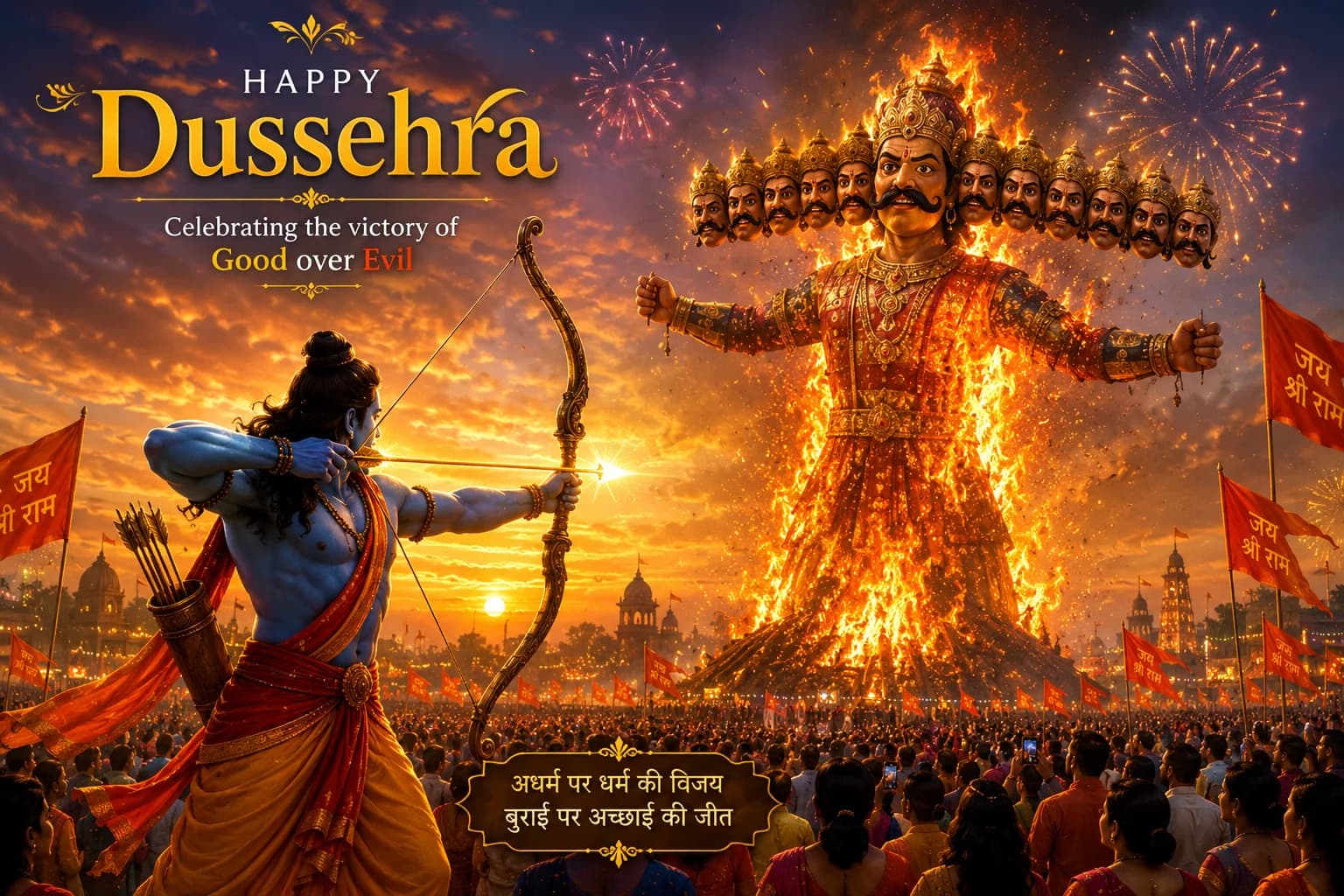
Vijayadashami (Dussehra) celebrates the victory of Lord Rama over Ravana and Goddess Durga over Mahishasura, symbolizing the triumph of Good over Evil.
 Dashami (10th Lunar Tithi)
Lexical, Linguistic & Historical Contextऐतिहासिक समीक्षा
In classical Nibandha literature (such as the Kalamadhava and Brahma Purana), the term Dashahara originally designated Jyeshtha Shukla Dashami (Ganga Dussehra, commemorating the descent of Ganga destroying ten categories of sin as enumerated in the Skanda Purana, Kashi Khanda). Over the medieval period, through the widespread pan-Indian synthesis of the Ramalila tradition and royal Navaratra rites, Dashahara (Dussehra) became synonymous in North and Central India with Ashvina Shukla Vijayadashami.
०१. Nirukta & Etymological Exegesisनिरुक्तम् एवं व्युत्पत्तिः
Traditional Sanskrit hermeneutic breakdown of sacred nomenclature, Paninian verbal roots (dhātu), and theological derivations:
Derived from Vi-ji (to conquer or triumph completely) + Daśamī (the tenth lunar digit/tithi). Literally: 'The Tenth Lunar Day of Supreme Victory.'
Compound of Daśa (ten) + Harā (that which destroys, removes, or severs; from verbal root hṛ). Denotes both the slaying of the ten-headed Daśagrīva (Ravana) and the eradication of the ten cardinal sins (Daśa-pāpa-harā).
Named after the unconquered form of Adi Parashakti (Aparājitā), who is ritually invoked in the northeast (Īśāna) direction during the Aparāhṇa period prior to embarking on dharmic endeavors.
Compound of Āyudha (weapons, instruments, implements of craft) + Pūjā (consecration). The sacralization of the instruments of Svadharma and livelihood.
०२. Astronomical Ephemeris & Dharma-Śāstra Rulesखगोलीय निर्णयः एवं सिद्धान्तः
Unlike standard solar or lunar observances governed strictly by the Udaya Tithi (the lunar tithi prevailing at local sunrise), the canonical timing of Vijayadashami is determined by the intersection of the tenth lunar tithi (Dashami), the late-afternoon solar division (Aparahna Kala—the 4th of the 5 equal parts of daytime), and the lunar mansion of Shravana Nakshatra.
Primary Aparahna & Shravana Nakshatra Override Rule
Dharmasindhu of Kashinatha Upadhyaya & Nirnayasindhu of Kamalakara Bhatta (Pariccheda II)Ashvina Shukla Dashami must prevail during the Aparahna period. If Dashami spans across two consecutive days during Aparahna, or falls slightly short on one of the days, the day on which Dashami coincides with Shravana Nakshatra is mandatorily selected for Vijayadashami.
Vijaya Muhurta & Sadhe-Tin Svayam-Siddha Muhurta
Muhurta Chintamani & NirnayasindhuA daytime span of 30 Ghatis is divided into 15 Muhurtas (approx. 48 minutes each); the 11th Muhurta of the day is Vijaya Muhurta. Along with Chaitra Shukla Pratipada, Akshaya Tritiya, and Kartika Shukla Pratipada, Vijayadashami constitutes one of the three-and-a-half self-auspicious days (Svayam-Siddha Muhurtas) requiring no additional astrological rectification for Vidyarambha, Simollanghana, or dharmic enterprises.
०३. Scriptural Foundations & Puranic Hermeneuticsशास्त्रीय प्रमाणानि एवं परम्पराः
When the buffalo-demon Mahishasura usurped the sovereignty of the three worlds (Trailokya), the combined fiery effulgence (Tejas) of Brahma, Vishnu, Shiva, and all Devas coalesced into the transcendent form of Chandika / Mahalakshmi (Durga). Equipped with the weapons of each deity, Devi waged a cosmic war spanning nine nights (Navaratra). At the juncture (Sandhi Kala) of Ashtami and Navami, She manifested as Chamunda and finally decapitated Mahishasura, restoring cosmic order (Rta) celebrated on Dashami.
During the final phase of the Lanka war, Bhagwan Rama received the solar initiation of the Aditya Hridaya Stotra from Maharshi Agastya (Yuddha Kanda, Sarga 105). In the Puranic-Shakta synthesis recorded in the Kalika Purana and Devi Bhagavata, Sage Narada advised Rama to observe the nine-day Sharadiya Navaratra Vrata. Because autumn falls within Dakshinayana, Rama performed Akala Bodhana (unseasonable awakening of Goddess Ambika on Shashthi), invoked Her grace at the Ashtami-Navami Sandhi, discharged the Brahmastra to vanquish Ravana, and marched victoriously on Vijayadashami.
On Ashvina Shukla Dashami, completing their 13th year of incognito exile (Ajnatavasa) in Matsya, Arjuna circumambulated the sacred Shami tree, invoked Devi Aparajita, retrieved his Gandiva bow, and routed the Kaurava army. Furthermore, in Kalidasa's Raghuvamsha (Sarga 5), when Kautsa requested 140 million gold coins for Guru-Dakshina from King Raghu, Lord Kubera rained celestial gold upon the Shami and Ashmantaka (Apta) groves outside Ayodhya on the eve of Vijayadashami—originating the tradition of exchanging Apta leaves as symbolic gold (Suvarna).
०४. Philosophical & Ayurvedic Tattvaतात्त्विक विमर्शः एवं आयुर्वेद विज्ञानम्
Adhyātmik Significance
आध्यात्मिक तात्पर्यम् · Inner MetaphysicsIn Advaita Vedanta and Yoga psychology, the ten heads of Dashagriva (Ravana) represent the externalized tyranny of the ten Indriyas (five Jnanendriyas: Shrotra, Tvak, Chakshu, Rasana, Ghrana; and five Karmendriyas: Vak, Pani, Pada, Payu, Upastha) governed by Ahankara (ego). Cutting off the heads repeatedly fails until the arrow of Viveka (discrimination) pierces the navel/heart center of ego-identification. Furthermore, while the nine nights of Navaratri systematically purify Tamas (Mahakali), Rajas (Mahalakshmi), and Sattva (Mahasarasvati), the tenth day—Vijayadashami—marks the ascent into the Gunatita / Turiya state of spiritual sovereignty.
Ayurvedic Ṛtu-Sandhi
ऋतुसन्धि विज्ञानम् · Seasonal Bio-HarmonyAccording to Charaka Samhita (Sutrasthana, Adhyaya 6) and Ashtanga Hridaya (Sutrasthana, Adhyaya 3), Ashvina marks the critical Ritu-Sandhi between Varsha (monsoon) and Sharad (autumn). Pitta Dosha accumulated during the humid monsoon undergoes acute aggravation (Prakopa) under the sharp autumn sun.
Dietary & Fasting Science
उपवास विज्ञानम् · Metabolic & Sattvic AharaThe preceding nine-day Navaratra regimen of Langhana (controlled fasting and grain restriction) clears metabolic Ama and pacifies Pitta. On Vijayadashami, sprouting barley shoots (Jayanti—rich in chlorophyll and cooling enzymes), sweet milk preparations, and Pitta-pacifying sattvic dishes gently re-establish digestive homeostasis (Jatharagni) without triggering inflammatory Pitta spikes.
०५. Canonical Anuṣṭhāna Vidhi & Liturgical Orderपूजा क्रमः एवं मन्त्र विधानम्
Prescribed Canonical Samagrī (पूजोपकरणानि):
Navaratra Kalasha Visarjana & Jayanti Dharana
कलश विसर्जन एवं जयन्ती धारणPerform the concluding Uttara Puja of the Navaratra Ghata (sacred pot). Reverently harvest the golden-green sprouted barley shoots (Jayanti) grown across the nine nights, offer them to Devi, and place them upon the head or behind the ear for longevity and auspiciousness.
Aparajita Devi Pujana
अपराजिता देवी पूजनIn the northeast (Ishana) corner of the home courtyard or temple, draw an eight-petaled lotus (Ashtadala Padma) with rice flour. Invoke Goddess Aparajita in the center, flanked by Jaya on the right and Vijaya on the left. Offer Shodashopachara Puja and tie the yellow Aparajita protective cord on the wrist.
Shami Vriksha Pujana
शमी वृक्ष पूजनProceed toward the northeast direction and worship the sacred Shami tree (or Ashmantaka/Apta tree) with Akshata, flowers, betel nut, and lamp. Circumambulate the tree and accept its leaves as sacred blessings of resilience and dharmic victory.
Ayudha, Shastra & Vidya Pujana
आयुध, शस्त्र एवं विद्या पूजनCleanse and consecrate all instruments of knowledge, craft, technology, agriculture, and defense—books, manuscripts, computers, musical instruments, tools, and vehicles—anointing them with sandalwood, turmeric-vermilion, and marigold flowers to dedicate one's daily profession as sacred Yajna.
Simollanghana & Vidyarambham
सीमोल्लंघन एवं विद्यारम्भSymbolically cross the northeastern boundary of the locality (Simollanghana) to mark the transcending of inner and outer limitations after Chaturmas, and initiate children into sacred learning (Vidyarambham) by inscribing 'Om Harih Shri Ganapataye Namah' in raw rice.
Vrat Pāraṇ Canonical Rule (पारण निर्णयः)
For devotees observing the full nine-day Navaratra Vrata, canonical Parana (breaking of the fast) is performed on Dashami after completing the Navaratra Kalasha Visarjana and Aparajita Puja, partaking of the consecrated Prasad and sprouted barley (Jayanti) blessings.
०६. Regional Living Traditions & Ethnographyक्षेत्रीय परम्पराः एवं लोकसंस्कृतिः
Culmination of multi-day Ramlila dramatic enactments based on Tulsidas's Ramcharitmanas (most notably the 31-day UNESCO-recognized Ramnagar Ramlila in Kashi). Concludes at dusk with Ravana Dahana—the burning of towering effigies of Ravana, Kumbhakarna, and Meghanada symbolizing the incineration of ego.
Begins with Darpana Visarjana (witnessing the reflection of Devi's feet in a mirror bowl). Married women perform Devi Barana and Sindur Khela (anointing the Goddess and one another with sacred vermilion), followed by river immersion (Bhasana), fraternal embrace (Kolakuli), and Shubho Bijoya greetings.
Marked by Sarasvati Pujana, Shastra Pujana, doorway marigold torans, and afternoon Simollanghana where families exchange Apta tree leaves (Bauhinia racemosa) as symbolic gold with the blessing: 'Sona ghya, sonyasarkha raha' (Accept this gold and remain pure like gold).
In Mysuru, celebrated as the royal state festival continuing the 15th-century Vijayanagara Empire liturgy, culminating in the Jamboo Savari procession of Goddess Chamundeshwari in a golden Ambari. In Kerala and Tamil Nadu, toddlers are initiated into letters during Vidyarambham (Ezhuthiniruthu), concluding the 9-day Bommai Golu display.
Starts on Vijayadashami and continues for 7 days. Over 200 village deities (Grama Devatas) are carried in palanquins (Rathas) to Dhalpur Maidan to honor Bhagwan Raghunath Ji. No effigies are burned; concludes with Lanka Dahana (symbolic burning of dry grass by the Beas River).
A 75-day festival from Shravana Amavasya to Ashvina Shukla Trayodashi centered on Maa Danteshwari (tutelary Shakti Peetha deity of Bastar), featuring indigenous Maria and Saora tribal artisans pulling massive two-tiered wooden chariots crafted from Sal timber.
०७. Critical Bibliography & Textual Witnessesग्रन्थसूची एवं प्रमाणग्रन्थाः
Primary Sanskrit Texts (मूलसंस्कृतग्रन्थाः)
- Vālmīki Rāmāyaṇa — Yuddha Kāṇḍa, Sargas 105–111 (Critical Edition, Oriental Institute, Vadodara, ed. G.H. Bhatt & U.P. Shah, 1960–1975).
- Mahābhārata — Virāṭa Parva (Go-haraṇa Parva), Adhyāyas 40–45 (Critical Edition, Bhandarkar Oriental Research Institute, Pune, ed. V.S. Sukthankar, 1936).
- Mārkaṇḍeya Purāṇa (Devī Māhātmya / Durgā Saptaśatī) — Adhyāyas 2–4 & 11 (Gita Press, Gorakhpur / Venkateshwar Press, Mumbai).
- Devī Bhāgavata Purāṇa — Skandha 3 (Adhyāyas 26–30) & Skandha 5 (Adhyāyas 2–18).
- Kālikā Purāṇa — Adhyāyas 60–62 (Akāla Bodhana, Navapatrikā & Daśamī Visarjana Vidhi, Chowkhamba Sanskrit Series, Varanasi).
- Nirṇayasindhu of Kamalākara Bhaṭṭa (1612 CE) — Pariccheda II, Āśvina-śukla-daśamī-nirṇayaḥ (Nirnaya Sagar Press, Mumbai).
- Dharmasindhu of Kāśīnātha Upādhyāya (1790 CE) — Pariccheda II, Navarātra-vijayādaśamī-prakaraṇam (Chaukhamba Bharati Academy, Varanasi).
- Raghuvaṃśa Mahākāvya of Kālidāsa — Sarga V, Verses 1–35 (With Sañjīvinī commentary of Mallinātha).
Secondary Indological Scholarship (शोधग्रन्थाः)
- Kane, Pandurang Vaman. History of Dharmaśāstra (Ancient and Mediaeval Religious and Civil Law), Vol. V, Part I, Chapter IX: 'Durgotsava and Vijayādaśamī,' pp. 188–194. BORI, Pune, 1958.
- Coburn, Thomas B. Encountering the Goddess: A Translation of the Devī-Māhātmya and a Study of Its Interpretation. SUNY Press, 1991.
- Stein, Burton. Vijayanagara (The New Cambridge History of India, Vol. I.2 — Analysis of Mahānavamī / Vijayādaśamī Sovereignty Rites). Cambridge University Press, 1989.
- Simmons, Caleb, Moumita Sen, and Hillary Rodrigues (eds.). Nine Nights of the Goddess: The Navarātri Festival in South Asia. SUNY Press, 2018.
Frequently Asked Questions
How is the observance date of Vijayadashami (Dussehra) determined?
In Vedic astronomical calculations, Vijayadashami (Dussehra) is observed on Dashami (10th Lunar Tithi). Because Hindu calendar days begin with local sunrise (Surya Udaya), exact puja timings (Muhurta) depend on when the auspicious Tithi prevails in your specific geographical location.
Are there fasting (Vrat) guidelines associated with this festival?
Fasting practices vary across families and sampradayas. Common observances range from Phalahar (consuming fruits and milk), fasting until twilight pradosh kaal, to a complete waterless vigil (nirjala). Seekers observe according to personal health and lineage traditions.
What is the core spiritual significance behind this celebration?
Vijayadashami (Dussehra) celebrates the victory of Lord Rama over Ravana and Goddess Durga over Mahishasura, symbolizing the triumph of Good over Evil. Celebrating this holy day fosters familial gratitude, charitable sharing (Danam), and attunement with cosmic solar and lunar cycles.
How do regional customs differ across India?
Sanatan Dharma embraces rich regional diversity. While core Vedic mantras and reverence for the divine remain universal, local celebrations reflect distinct linguistic hymns, traditional culinary offerings, and cultural expressions.
Related Festivals & Observances
Ahoi Ashtami
Ahoi Ashtami is a traditional fast observed by mothers on Kartik Krishna Ashtami for the longevity, health, and well-being of their children.
Akshaya Tritiya (Akha Teej)
Akshaya Tritiya is an auspicious day of eternal, imperishable merit ('Akshaya'), marking the descent of River Ganga to Earth, birth of Lord Parashurama, and Kubera receiving divine wealth.
Bathukamma Floral Festival
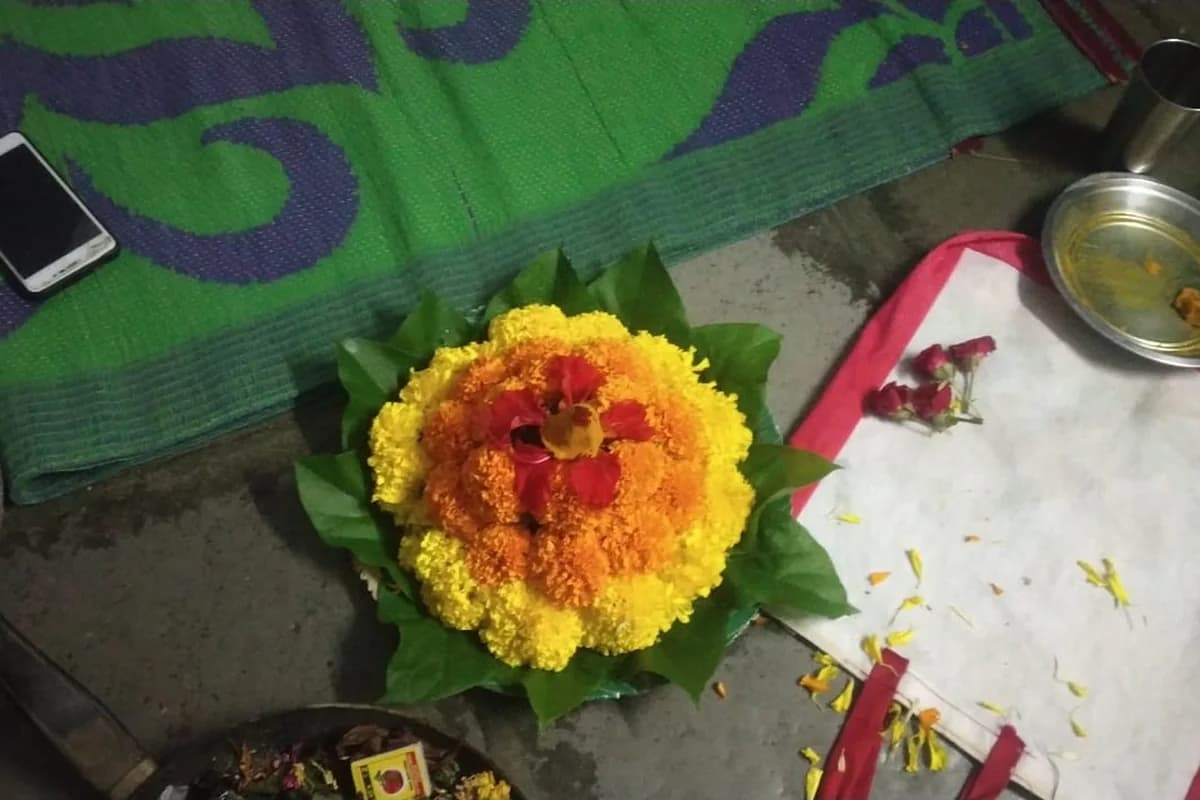
Bathukamma is Telangana's iconic 9-day floral festival celebrated by women during Sharad Navratri, worshiping Goddess Maha Gauri with concentric mounds of seasonal wildflowers.