
Threshold Geometry: Kolam, Rangoli & Alpana — The Mathematical, Ecological, and Metaphysical Science of Sacred Floor Diagramsद्वार देहली कला: कोलम, रंगवल्ली एवं अल्पना का गणितीय और आध्यात्मिक विज्ञान
From the Dhulichitra Canons of the Manasollasa and the Ecology of Bhuta Yajna to Eulerian Graph Topology, Context-Free Array Grammars, and Regional Threshold Lineages
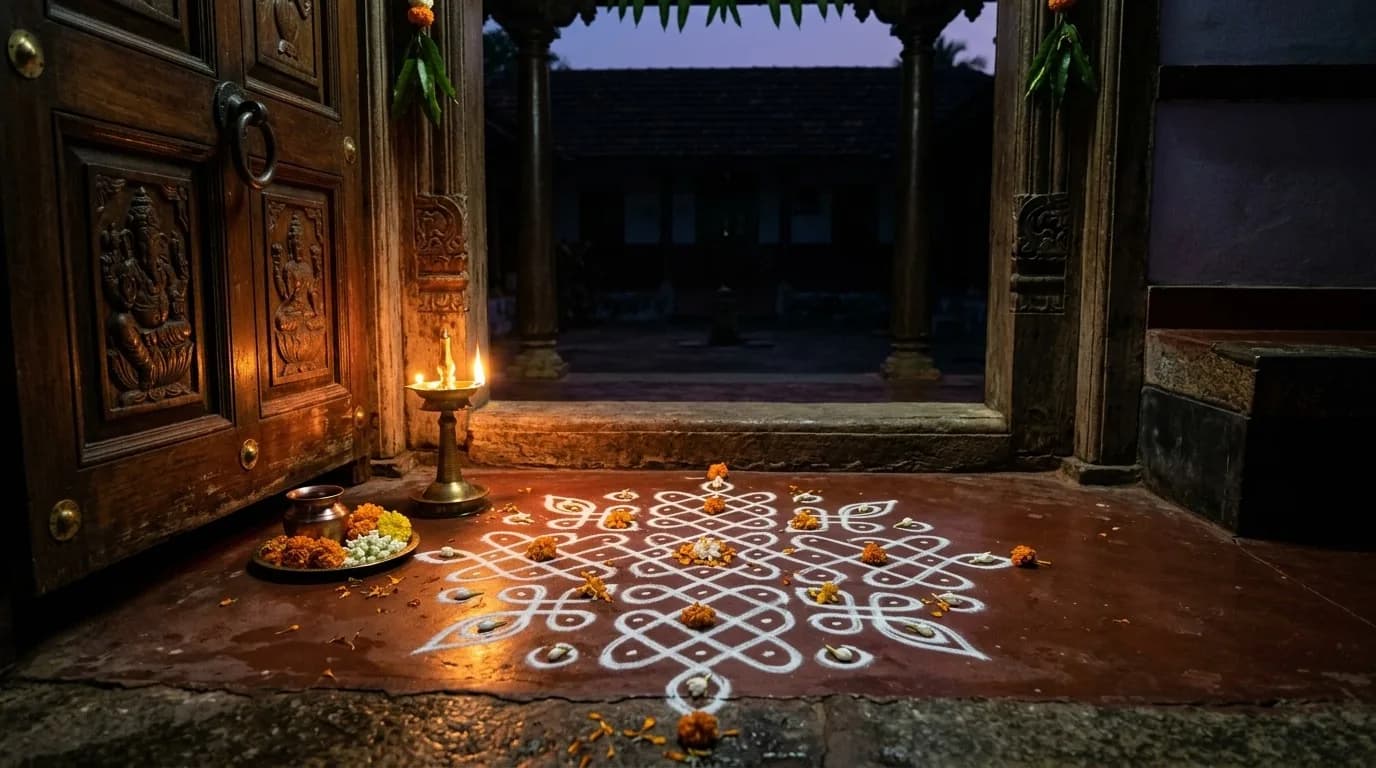
“Upon a surface whitened with lime or upon smoothly prepared level earth, when a sacred diagram is drawn using pulverized mineral and grain powders of diverse hues, the masters call it Dhūlicitra (Powder-Painting) or Raṅgavallī.”
— King Someśvara III, Mānasollāsa (Abhilaṣitārthacintāmaṇi, Vimśati 3, Adhyāya 1), 1129 CEAcross the Indian subcontinent, the architectural threshold (Dehalī in Sanskrit, Vāsal in Tamil) is neither a neutral structural joint nor mere real estate separating private property from the public street. It is a liminal cosmological membrane—the exact boundary where the ordered sanctum of the household (Gṛha) meets the unmanifest chaos of the outer world. Every morning during Brahma-muhūrta (the pre-dawn watch before sunrise), millions of Indian women consecrate this boundary by sweeping, washing, and inscribing intricate geometric diagrams directly onto the earth using dry rice flour, fermented rice paste, quartz powder, or natural mineral pigments. Known regionally as Kōlam (Tamil Nadu), Muggu (Andhra Pradesh & Telangana), Raṅgavallī / Raṅgolī (Maharashtra, Gujarat & Karnataka), Ālpanā (Bengal), Aripana (Mithila/Bihar), Aipan (Uttarakhand), Mandanā (Rajasthan), and Chaukpūrṇā (Uttar Pradesh), this daily discipline integrates four advanced civilizational sciences: Shastric art theory (Dhūlicitra), ecological reciprocity (Bhūta Yajña), computational topology (Eulerian circuits and Lindenmayer fractal systems), and cognitive somatic meditation. This codex examines the textual foundations, ecological biochemistry, formal mathematical grammar, and regional diversity of India’s living threshold arts.
1. Etymological & Shastric Foundations: From Vaidika Vedī to Dhūlicitra
वैदिकवेदीतः धूलिचित्रपर्यन्तम् शास्त्रीयमूलम्The practice of sanctifying level earth through geometric inscription originates in the Śulbasūtras (c. 800–500 BCE)—the ritual geometry manuals of the Kalpasūtras authored by Baudhāyana, Āpastamba, Kātyāyana, and Mānava. To perform a Vedic sacrifice, the ritual ground had to be leveled, purified with water, and measured with stretched cords (Śulba / Rajju) into precise geometric altars (Vedī and Citi)—squares, circles of equal area, isosceles trapeziums, and falcon-shaped (Śyenaciti) fractal matrices—affirming that cosmic order (Ṛta) is invited into human space through mathematical symmetry.
Codification in the 64 Classical Arts (Catuḥṣaṣṭi Kalā)
- 1. Vātsyāyana’s Kāmasūtra (1.3.16) (c. 3rd century CE):
तण्डुलकुसुमवलीविकाराः(Taṇḍula-kusuma-valī-vikārāḥ) — Lists Taṇḍula-kusuma-valī-vikārāḥ as the art of creating intricate geometric and floral offerings on the floor and temple thresholds using whole or ground rice grains (Taṇḍula) and multicolored blossoms (Kusuma). - 2. Bāṇabhaṭṭa & Bhavabhūti (Harṣacarita, Kādambarī & Uttararāmacarita (7th–8th c. CE)):
आलेपन एवं रंगवल्ली परंपरा(Ālepana & Raṅgavallī Paramparā) — Describe royal palace courtyards, inner bridal chambers, and festival pavilions adorned with auspicious Ālepana and Raṅgavallī creepers inscribed with wet sandalwood paste, saffron water, and ground rice flour. - 3. King Someśvara III & Śrīkumāra (Mānasollāsa (1129 CE) & Śilparatna (16th c. CE)):
धूलिचित्रं रसचित्रं च(Dhūlicitra & Rasacitra) — Classify floor diagrams as Dhūlicitra ("powder-painting") and Rasacitra ("liquid-paste painting"). King Someśvara III emphasizes that unlike wall murals (Bhitticitra) designed for permanent narrative contemplation, Dhūlicitra is Kṣaṇika (deliberately ephemeral)—created swiftly with the bare fingers to capture immediate auspicious resonance and erased by the passing steps of the day, modeling the non-attachment (Aparigraha) at the heart of Hindu metaphysics.
The Metaphysics of the Dehalī (Threshold)
In Vāstu Śāstra and Puranic theology, the doorway threshold (Dehalī) is governed by the cosmic paradox of Lord Narasiṁha—who slew Hiraṇyakaśipu neither inside the house nor outside, neither by day nor by night, neither on earth nor in the sky, but directly upon the Dehalī at twilight (Sandhyā). Consequently, the threshold is a zone of heightened spiritual potency guarded by the Dvārapālas, where Lakṣmī (auspiciousness, harmony, abundance) enters the home and Alakṣmī / Jyeṣṭhā (entropy, discord, scarcity) must be barred from crossing.
2. Ecological Dharma: Gomaya Microbiology & Bhūta Yajña
गोमय सूक्ष्मजैविकी एवं भूतयज्ञस्य पर्यावरणधर्मःA traditional threshold ritual proceeds in two strict biochemical and ethical stages before daybreak, uniting domestic hygiene with universal ecological stewardship.
Stage I: Preparing the Canvas with Gomaya-Jala
Stage 2.1Before a single white line is drawn, the householder sweeps the dust away from the entrance and sprinkles water mixed with fresh cow dung (Gomaya) or red ochre clay (Geru / செம்மண்). Far from being an arbitrary rustic habit, this preparation fulfills three material and environmental functions:
In unplastered earthen courtyards, the colloidal lignins and humic acids in Gomaya bind loose soil dust into a smooth, crack-resistant crust upon drying, providing a dark olive-brown or terracotta-red matte background against which white rice flour achieves maximum visual contrast.
Fresh indigenous bovine Gomaya contains beneficial bacteriophages, Bacillus subtilis, and volatile phenolic compounds that suppress pathogenic soil bacteria at the exact point where bare feet cross from the street into the home.
Stage II: Bhūta Yajña (The Daily Ecological Oblation)
Stage 2.2In the Śatapatha Brāhmaṇa (11.5.6.1) and the Manusmṛti (3.68–72), every householder (Gṛhastha) is bound to perform the Pañca Mahāyajñas (Five Great Daily Sacrifices) to repay the karmic debt incurred by daily living—specifically to compensate for the unintentional harm caused to microscopic and small creatures by the five domestic "slaughter-places" (Pañca Sūnā: the hearth Cullī, the grinding stone Peṣaṇī, the broom Upaskara, the mortar Udūkhala, and the water-pot Kumbhī).
The fifth of these daily sacrifices is Bhūta Yajña (Baliharaṇa)—the offering of food to birds, insects, ants, and earth-dwelling organisms before the family consumes its own meal. By mandate, traditional daily Kōlam, Muggu, and Raṅgolī are drawn using unrefined raw rice flour (Taṇḍula-piṣṭa / Arisi Māvu) or coarse grain meal rather than synthetic marble dust or chemical dyes.
As the sun warms the courtyard, colonies of ants, beetles, squirrels, and sparrows gather along the geometric lines to feed. By noon, the sacred diagram has been partially eaten away by living creatures and dispersed by the breeze—completing a daily cycle in which geometry serves directly as ecological nourishment.
3. Computational Ethnomathematics: Graph Theory, L-Systems, and Symmetry Groups
गणनाप्रधानं नृगणितम्: आलेखसिद्धान्तः, एल-प्रणाली एवं साम्यसमूहाःIn the late twentieth century, mathematicians and theoretical computer scientists—pioneered by Gift Siromoney, Rani Siromoney, and Kamala Krithivasan (Madras Christian College, 1974) and expanded by Marcia Ascher and Przemyslaw Prusinkiewicz—demonstrated that the traditional Pulli Kōlam and Sikku (Kambi) Kōlam lineages of South India encode sophisticated concepts in discrete mathematics, planar graph theory, formal picture languages, and fractal recursion.
3.1 The Coordinate Lattice (Pulli) & Combinatorial State Space
புள்ளி அணி மற்றும் சேர்ப்பியல் நிலைவெளிA Pulli Kōlam begins with a discrete two-dimensional array of dots (Pullis) placed at uniform intervals using the thumb and index finger. Three primary lattice geometries govern the repertoire:
A Cartesian grid containing N² dots aligned along perpendicular axes.
Where odd or even rows increase to a central maximum M and taper symmetrically.
Used for six-pointed star (Ṣaṭkoṇa) and lotus (Padma) Yantras.
Around each individual dot in an orthogonal grid, a curved line segment (Kambi) can perform one of only a finite number of local topological maneuvers (passing between two adjacent dots, looping around a single dot by 90°, 180°, or 270°, or enclosing an isolated dot). As proven by physicist Yanagisawa & Nagata (2007) using transfer-matrix encodings, even a modest 5 × 5 dot grid generates millions of valid closed Kōlam configurations, yet traditional practitioners instantaneously filter this vast combinatorial space to select only those graphs possessing global point-group symmetry (typically dihedral group D₄ with 4 reflection axes and 4-fold rotational symmetry, or cyclic group C₄) and unicursal connectivity.
3.2 Eulerian Circuits & Gaussian Knot Projections in Sikku Kōlam
ஒற்றைக் கம்பி சிக்கல் கோலம் மற்றும் ஆயிலர் சுற்றுகள்In the prized Ekakambi Sikku Kōlam ("Single-Strand Braided Kōlam"), the practitioner must weave a single continuous closed line around an entire array of N dots such that:
- Criterion 1: Every dot in the lattice is enclosed within exactly one quadrilateral loop cell;
- Criterion 2: The line never touches a dot and never retraces an existing segment;
- Criterion 3: Every intersection is a transverse double-point crossing;
- Criterion 4: The entire figure begins and ends at the exact same point without lifting the hand.
Planar Graph Regularity & 1-Component Knot Projection (c = 1)
Mathematically, if the self-intersections of the Kambi line are treated as vertices V and the connecting arc segments around the Pulli dots are treated as edges E, the resulting structure is a 4-regular planar graph (deg(v) = 4 ∀ v ∈ V). By Euler’s Theorem, every 4-regular connected graph possesses an Eulerian circuit, guaranteeing that it can be traced completely in one stroke. However, not every Eulerian path through a 4-regular graph yields a smooth Sikku Kōlam: if the artist makes a sharp 90° turn at a crossing instead of continuing straight through the transverse intersection, the single loop fractures into multiple disconnected components. Thus, the artist is solving in real time the Gauss-code / medial-graph single-component link problem from knot theory—selecting the exact distribution of smoothings vs. crossings that keeps the entire link connected as a 1-component knot projection (c = 1).
3.3 Context-Free Array Grammars & Lindenmayer Fractals (L-Systems)
சூழல்-சாரா அணி இலக்கணம் மற்றும் எல்-அமைப்பு பின்னங்கள்In patterns such as the Anklet of Krishna (Kṛṣṇa-salangai) or the Serpent Kōlam (Pāmpu Kōlam), a small base motif grows recursively to cover any size courtyard (3 × 3 → 7 × 7 → 15 × 15 → [2ᵏ - 1] × [2ᵏ - 1]).
DOL-System Kolam Fractal Grammar Specification
Siromoney et al. proved that these expandable Kōlams are generated by Context-Free Array Grammars and deterministic DOL-Systems (Lindenmayer Systems)—the exact mathematical formalism used in modern computer graphics to model biological plant growth and space-filling fractals. At iteration n = 1, 2, 3, …, this simple substitution rule automatically generates the exact traditional braided Kōlam family with Hausdorff fractal dimension approaching D = ln 4 / ln(2 + √2) ≈ 1.128.
4. Comparative Matrix of Regional Threshold & Floor Art Traditions across India
भारतस्य प्रादेशिक देहलीकलानाम् तुलनात्मकमूल्याङ्कनम्| Regional Tradition & Geography | Etymology & Meaning | Primary Material Medium & Ground Preparation | Dominant Structural & Visual Grammar | Key Ritual & Seasonal Occasions |
|---|---|---|---|---|
Kōlam கோலம்(Tamil Nadu) | Tamil Kōlam: "Beauty, form, cosmic order, harmonious play." | Dry coarse rice flour (Paccai Arisi Māvu) or wet rice paste (Mākkōlam) on Gomaya-washed earth. | Pulli (dot grid) with Sikku/Kambi (Eulerian single-line loops) & Padi/Kodu (tessellated parallel lines). | Daily Brahma-muhūrta dawn; month-long Mārgaḻi solar transition & Pongal harvest. |
Muggu / Muggulu ముగ్గు(Andhra Pradesh & Telangana) | Telugu Muggu: "Pattern, auspicious threshold diagram." | White calcium/quartz powder (Muggu-pindi) & rice flour accented with turmeric (Pasupu) and vermilion (Kumkuma). | Chukkala Muggu (dot-matrix loops) & Ratham Muggu (chained chariot diagrams connecting house to house down the street). | Daily dawn; Sankranti (Bhogi, Makara Sankranti, Kanuma) featuring Gobbemma cow-dung balls in the center. |
Ālpanā আলপনা(West Bengal & Assam) | Sanskrit Ālepana (आलेपन): "To anoint, coat, or smear with liquid paste." | Liquid emulsion of soaked raw Atap rice ground into white paste (Piṭhāli), applied with a cotton wick held between fingers. | Freehand curvilinear, non-grid botanical and cosmic motifs: Lakshmi’s footprints (Lakṣmī-pāda), Dhāner Śīṣ (paddy sheaves), owl, fish, lotus. | Kojāgarī Lakṣmī Pūjā, Pauṣa Parbon harvest, Subho Bibāho weddings, and Shantiniketan Nandalal Bose revivals. |
Aripana अरिपन(Mithila / Bihar) | Derived from Sanskrit Ālepana via Maithili vernacular. | Wet white rice paste (Pithar) applied strictly with the ring and middle fingers (Anāmikā) accented with Sindūr dots. | Tantric & Vedic Yantra-mandalas: Aṣṭadala Kamala (8-petaled lotus), Daśapāta, Sarvatobhadra, and Ṣaṭkoṇa triangles. | Upanayana (sacred thread), Kojāgarā, Tulsī Pūjā, and four-stage Vivāha altars. |
Aipan ऐपण(Kumaon & Garhwal, Uttarakhand) | Kumaoni adaptation of Sanskrit Ālepana. | Deep terracotta-red ochre (Geru) base coat over which stark white rice paste (Bishwar) is drawn with the final three fingers. | High-contrast geometric Peeth / Chauki Yantras: Sarasvatī Peeth, Śiva-pīṭha, Navagraha, and linear Vasudhārā vertical drips. | Makar Sankranti, Harela agricultural festival, Janmāṣṭamī, and Nāmakaraṇa rites. |
Raṅgolī & Saathiya रांगोळी / साथिया(Maharashtra & Gujarat) | Sanskrit Raṅgavallī (रंगवल्ली): "A creeping vine of vibrant colors." | Dry pulverized white quartz (Śirola / Chiroḍī) filled with mineral pigments, Haldi-Kumkum, and flower petals. | Thipkyāñcī Raṅgolī (dot-grid), Saṁskāra Bhāratī (five-finger rhythmic spirals), and Gujarati Saathiya (Svastika solar emblems). | Dīpāvalī (5 days from Vasubaras to Bhāūbīj), Guḍhī Pāḍavā, and Navarātri. |
Mandanā मांडणा(Rajasthan & Malwa) | Root Maṇḍ-: "To adorn, sanctify, and protect." | Mud-and-Gomaya red floor (Rātī) painted with white lime-chalk solution (Khaḍiyā) using a crushed date-palm twig brush (Kūñcī). | Architectural geometric lattices (Jālī), Chauk, Pagliyā (divine footprints), stepwells (Bāvaḍī), and peacocks. | Holī, Dīpāvalī, Gangaur, and seasonal solar solstices. |
Jhoti Chita & Muruja ଝୋଟି ଚିତା / ମୁରୁଜ(Odisha) | Odia Jhoti / Chita (wet paste) & Muruja (dry five-color powders). | Liquid rice paste (Pithau) flicked or drawn on walls/floors; dry Muruja powders around the Tulasī Chaura. | Concentric Padma (lotus) wheels, elephants, conch shells, and rows of tiny Māṇabasa Lakshmi footprints entering the granary. | Mārgasīrṣa Gurubāra (Thursdays of Mārgasīrṣa month dedicated to Goddess Mahālakṣmī) & Kārtika month Muruja. |
Pūkkōlam & Kalamezhuthu പൂക്കളം / കളമെഴുത്ത്(Kerala) | Malayalam Pū (Flower) + Kōlam; Kalam (sacred floor diagram). | Pūkkōlam: 10 concentric rings of fresh blossoms (Thumba, marigold, hibiscus). Kalamezhuthu: 5 natural mineral/botanical powders (Pañcavarṇa). | Pūkkōlam: 10-day expanding solar Maṇḍala. Kalamezhuthu: Monumental 3D-relief icons of Bhadrakālī, Ayyappan, or Nāgas erased with coconut palm fronds during trance dance. | Ōṇam (Atham to Thiruvonam 10-day cycle) and Kalamezhuthu Pāṭṭu temple rituals. |
5. Somatic Ergonomics & Cognitive Neuroscience of Morning Practice
प्रभातक्रियायोगः: कायिकीय संतुलनम् एवं स्नायुविज्ञानात्मक ध्यानम्Beyond its mathematical and ecological dimensions, the daily execution of threshold geometry functions as an embodied Kriyā-Yoga integrating posture, breath, and bilateral visual-spatial cognition:
1. Biomechanical Posture (Utkaṭāsana & Forward Flexion)
Pillar 1Traditionally, a practitioner never sits flat on the ground while drawing a large threshold diagram. Instead, she bends from the hip joints (Uttānāsana variation) or moves in a dynamic deep squat (Mālāsana / Utkaṭāsana) while walking backward or sideways around the expanding perimeter of the Kōlam.
Executed every morning on an empty stomach during Brahma-muhūrta, this sustained inversion and pelvic flexion stimulates abdominal visceral circulation (Samāna and Apāna Vāyu), mobilizes the lumbar spine, and warms the joints at daybreak.
2. Fine-Motor Tactile Control (Mudrā-Pravāha)
Pillar 2Dispensing dry rice flour or quartz powder without a brush or stencil requires subtle neuromuscular modulation between the thumb (Aṅguṣṭha) and index/middle fingers (Tarjanī / Madhyamā). To draw a line of uniform millimeter thickness, the fingers must rub against one another at a constant micro-oscillatory frequency synchronized with the speed of the moving arm—a somatic mudra analogous to playing a stringed instrument.
Cultivates bilateral hand-eye coordination, proprioception, and steady motor control, awakening neural pathways in the motor homunculus before dawn.
3. Working-Memory & Spatial Executive Function
Pillar 3When executing a 15 × 15 or 21 × 21 Sikku Kōlam from memory, the practitioner holds a global symmetric blueprint in spatial working memory while executing local right-over-left and left-over-right crossing inversions across four rotated quadrants (90°, 180°, 270°).
Neurocognitive studies of geometric floor-art practitioners demonstrate heightened activation of the parietal visuo-spatial cortex and prefrontal executive networks, inducing a state of focused, non-verbal Dhāraṇā (one-pointed mental absorption) before the household duties of the day begin.
6. Primary & Secondary Bibliography
सन्दर्भग्रन्थसूची: शास्त्रीयग्रन्थाः एवं आधुनिक शोधपत्राणिPrimary Sanskrit & Classical Vernacular Texts
- [1]
Someśvara III. Mānasollāsa (Abhilaṣitārthacintāmaṇi), Vol. II (Vimśati 3, Chapter 1: Citra-lakṣaṇam / Dhūlicitra). Edited by G. K. Shrigondekar. Gaekwad’s Oriental Series, No. 84. Baroda: Oriental Institute, 1939.
- [2]
Vātsyāyana. The Kāmasūtra of Śrī Vātsyāyana Muni, with the commentary Jayamaṅgalā of Yaśodhara. Edited by Pandit Durgaprasad. Mumbai: Nirnayasagar Press, 1900 (Book 1, Chapter 3: Enumeration of the 64 Kalās).
- [3]
Śrīkumāra. Śilparatna (Uttarabhāga, Chapter 46). Edited by K. Sambasiva Sastri. Trivandrum Sanskrit Series, No. 98. Trivandrum: Government Press, 1929.
- [4]
Baudhāyana, Āpastamba, Kātyāyana, & Mānava. The Śulbasūtras: Text, Translation and Commentary. Edited and translated by S. N. Sen and A. K. Bag. New Delhi: Indian National Science Academy (INSA), 1983.
- [5]
Manusmṛti. Manu’s Code of Law: A Critical Edition and Translation of the Mānava-Dharmaśāstra. Edited and translated by Patrick Olivelle. New York: Oxford University Press, 2005 (Chapter 3, Verses 68–72 on Pañca Sūnā and Pañca Mahāyajña).
- [6]
Tagore, Abanindranath. Bāṅglār Brata (The Ritual Vows and Alpanas of Bengal). Visva-Bharati, Calcutta, 1919 (English translation of the Alpana chapters published in Journal of the Indian Society of Oriental Art).
Modern Mathematical, Computer-Science & Anthropological Scholarship
- [7]
Ascher, Marcia. Mathematics Elsewhere: An Exploration of Ideas Across Cultures (Chapter 6: "Symmetric Strip Decorations & The Kolam Tradition"). Princeton: Princeton University Press, 2002.
- [8]
Archambault, Gopika. "Kalamezhuthu: Ritual Floor Drawings of Kerala." Marg 45, no. 3 (1994): 45–60.
- [9]
Huyler, Stephen P. Painted Prayers: Women’s Art in Village India. New York: Rizzoli International Publications, 1994.
- [10]
Nagarajan, Vijaya Rettakudi. Feeding a Thousand Souls: Women, Ritual, and Ecology in India—An Exploration of the Kolam. New York: Oxford University Press, 2018.
- [11]
Prusinkiewicz, Przemyslaw, & Aristid Lindenmayer. The Algorithmic Beauty of Plants (Section on L-System Kolam Generation). New York: Springer-Verlag, 1990.
- [12]
Siromoney, Gift, Rani Siromoney, & Kamala Krithivasan. "Picture Languages with Array Rewriting Rules" & "Array Grammars and Kolam." Information and Control 22, no. 5 (1973): 447–470; Computer Graphics and Image Processing 3, no. 1 (1974): 63–82.
- [13]
Yanagisawa, Kiwamu, & Shojiro Nagata. "Fundamental Study on Design System of Kolam Pattern." Forma (Society for Science on Form, Japan) 22, no. 1 (2007): 31–46.