
The Eight Classical Dance Forms: Natya Shastra, Abhinaya, and the Metaphysics of Embodied Movementअष्ट शास्त्रीय नृत्य परंपरा एवं नाट्य शास्त्र
From Bharata Muni's Fifth Veda and Nandikeshvara's Abhinaya Darpana to the Kinetic Grammar of Nritta, Nritya, and Natya Across Eight Living Lineages
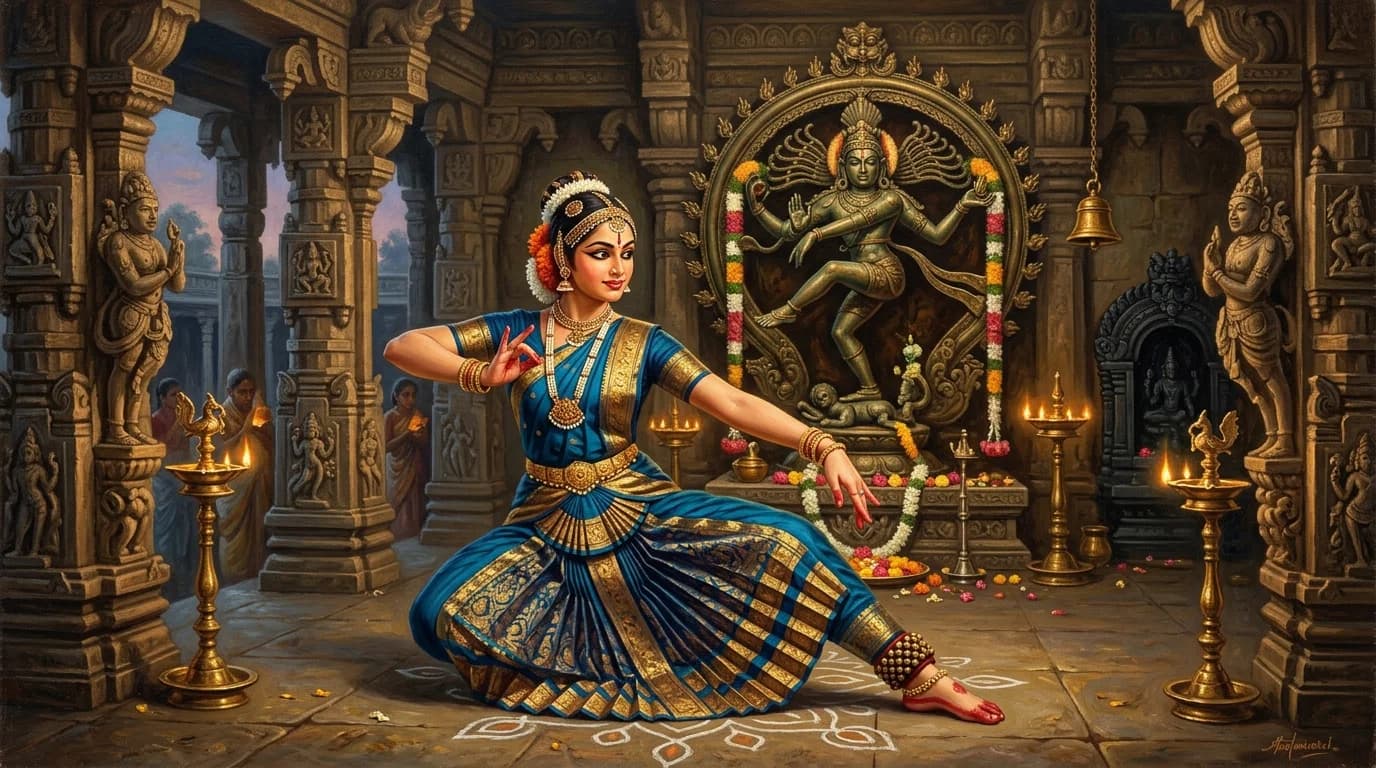
“Where the hand goes, the glance follows; where the glance goes, the mind follows; where the mind goes, the inner emotive state (Bhāva) is awakened; and where Bhāva abides, aesthetic realization (Rasa) arises.”
— Nandikeśvara, Abhinaya Darpaṇa (Verse 37)In the Indian civilizational worldview, classical dance (Śāstrīya Nṛtya) is not secular choreography designed for ocular spectacle, nor is it an individualistic expression of the performer's biography. It is a rigorous somatic Yajña (sacrificial offering of the body in space and time) wherein the human frame functions as a calibrated yantra to invoke, embody, and transmit universal states of consciousness (Rasa). Anchored in Bharata Muni’s Nāṭya Śāstra (c. 200 BCE – 200 CE) and Nandikeśvara’s Abhinaya Darpaṇa, the tradition operates through a constant dialogue between Mārgī (the trans-regional, canonical sacred grammar) and Deśī (regional kinetic idioms rooted in local temple architectures, vernacular poetry, and ecological rhythms). This codex examines the Vedic genesis of Nāṭya, the structural triad of Nṛtta–Nṛtya–Nāṭya, the fourfold semiotic channels of Abhinaya, the aesthetic alchemy of Navarasa, and the anatomical and philosophical distinctiveness of the eight canonical classical lineages: Bharatanatyam, Kathak, Kathakali, Odissi, Kuchipudi, Manipuri, Mohiniyattam, and Sattriya.
1. The Origin of the Nāṭyaveda & The Metaphysics of Movement
The first chapter of the Nāṭya Śāstra (Nāṭyotpatti Adhyāya) situates the birth of dramatic and kinetic art at the transition between the Kṛta Yuga (Golden Age) and the Tretā Yuga, when humanity became susceptible to sensory fragmentation, desire (Kāma), and greed (Lobha). Because the four canonical Vedas were restricted by ritual injunctions, the gods approached Brahmā to request a fifth Veda (Pañcama Veda) accessible to all four social orders (Sarvavarṇika)—an auditory and visual discipline (Dr̥śyaṁ Śravyaṁ ca) that would instruct through aesthetic delight.
Brahmā entered yogic contemplation and extracted the four essential building blocks from the four Vedas to fashion the Nāṭyaveda (Nāṭya Śāstra 1.17):
- 1Pāṭhya (पाठ्य) — Recitative Text & ProsodyVeda: Ṛgveda
- 2Gīta (गीत) — Melodic & Tonal ArchitectureVeda: Sāmaveda
- 3Abhinaya (अभिनय) — Ritual Gesture & Corporeal ActionVeda: Yajurveda
- 4Rasa (रस) — Emotional & Psychophysical EssenceVeda: Atharvaveda
Because of this fourfold Vedic synthesis, the fifth-century dramatist Kālidāsa famously defined classical dance in Mālavikāgnimitram (1.4) as कान्तं क्रतुं चाक्षुषम् (Kāntaṁ kratuṁ cākṣuṣam)—a "pleasing visual Vedic sacrifice (Kratu/Yajña)." In this ritual, the stage (Raṅgabhūmi) is consecrated as a sacred Maṇḍala, the dancer's discipline (Sādhanā) serves as the oblation, and the dissolution of ego in both performer and spectator yields a state akin to Brahmānanda (the bliss of absolute realization).
Tāṇḍava and Lāsya: The Cosmic Polarity
Tāṇḍava (ताण्डव) — The Axial Cosmic Power
In Chapter 4 of the Nāṭya Śāstra (Tāṇḍava Lakṣaṇam), after Bharata stages the first celestial performances (Amṛtamanthana and Tripuradāha) before Lord Śiva on Mount Kailāsa, Śiva instructs his attendant Taṇḍu Muni to impart the vigorous, axial, cosmic dance vocabulary known as Tāṇḍava, built upon 108 synchronized kinetic units called Karaṇas.
Lāsya (लास्य) — The Fluid Lyric Grace
Simultaneously, Goddess Pārvatī imparts Lāsya—the lyrical, fluid, and grace-laden kinetic energy that binds emotional relationships and sustains creation.
Crucially, Tāṇḍava and Lāsya are not gender binaries restricting male and female performers; rather, they are complementary dynamic principles (Śiva–Śakti or Puruṣa–Prakṛti) present in varying ratios within every classical dance tradition.
2. The Tripartite Architecture: Nṛtta, Nṛtya, and Nāṭya
By the medieval period—explicitly articulated in Dhanañjaya’s tenth-century treatise Daśarūpaka (1.8–14) and Nandikeśvara’s Abhinaya Darpaṇa (Verses 14–16)—the performative spectrum was classified into three interdependent structural strata:
1. Nṛtta (नृत्त) — Pure Architectural & Rhythmic Geometry
Nṛtta is pure abstract movement governed by Tāla (cyclic meter) and Laya (tempo). Far from being mere calisthenics, Nṛtta translates the sacred geometry of temple architecture (Śilpa Śāstra) into the living body. Its building blocks include:
- Sthānakas & Maṇḍalas (स्थानक एवं मण्डल): Static and dynamic weight-bearing stances establishing the vertical median line (Brahmasūtra).
- Cārīs (चारी): Earth-bound (Bhaumī) and aerial (Ākāśikī) movements of a single leg or both legs.
- Karaṇas (करण): The 108 canonical combinations of Sthānaka (stance), Cārī (leg movement), and Nṛtta Hasta (hand gesture) in dynamic transition (हस्तपादसमायोगो नृत्तस्य करणं भवेत्, Nāṭya Śāstra 4.30).
- Aṅgahāras (अङ्गहार): Garlands of 6 to 9 Karaṇas woven into seamless rhythmic phrases.
2. Nṛtya (नृत्य) — Interpretive Poetic & Emotional Embodiment
Nṛtya unites rhythm with semantic expression (Padārthābhinaya and Vākyārthābhinaya). Here, the dancer uses codified hand gestures (Hasta Mudrās), ocular patterns (Dṛṣṭi Bhedas), and subtle facial micro-expressions (Upāṅga) to unpack the literal and metaphysical layers of devotional poetry (Padams, Aṣṭapadīs, Kṛtis, Thumrīs). Through Sañcārī Bhāva (improvisational elaboration), a single line of poetry may be interpreted in a dozen distinct theological and psychological ways while the rhythm continues underneath.
3. Nāṭya (नाट्य) — Total Dramatic & Archetypal Transfiguration
Nāṭya encompasses the complete dramatic presentation anchored in a mythic or historical narrative (Itivṛtta), wherein the performer assumes specific character roles (Pātra) utilizing speech, song, costume, and total psychophysical identification to evoke a dominant Rasa.
3. Caturvidha Abhinaya & The Science of Navarasa
The Sanskrit term Abhinaya derives from the prefix abhi- ("toward" or "fully") and the verbal root nī- ("to lead" or "to carry"): that which carries the inner meaning of the poetic work directly into the consciousness of the Sahṛdaya (the attuned, empathetic viewer). Bharata Muni (Nāṭya Śāstra 8.8–9) divides Abhinaya into four distinct semiotic channels (Caturvidha Abhinaya):
1. Āṅgika Abhinaya (आङ्गिक अभिनय)
Corporeal & Kinetic SemioticsThe articulation of the physical body, classified into three anatomical tiers:
The Lexicon of Hasta Mudrās: In the Abhinaya Darpaṇa, Nandikeśvara codifies 28 Asaṁyuta Hastas (single-hand gestures beginning with Patāka, Tripatāka, Ardhapatāka, Kartarīmukha, Mayūra, Ardhacandra) and 24 Saṁyuta Hastas (double-hand gestures beginning with Añjali, Kapota, Karkaṭa, Svastika), alongside Deva Hastas (icons of deities), Daśāvatāra Hastas, and Bāndhava Hastas (kinship signs).
2. Vācika Abhinaya (वाचिक अभिनय)
Sonic, Lyrical & Prosodic ExpressionThe auditory matrix comprising chanted Sanskrit Ślokas, regional poetic compositions, tonal modulation (Kāku), and percussive mnemonic syllables (Sollukaṭṭu, Bols, Ukkuṭa).
3. Āhārya Abhinaya (आहार्य अभिनय)
Visual, Textile & Iconographic AdornmentThe external transformation of the body through sacred unstitched drapes, temple jewelry (Talaisāmānam, Oddiyāṇam, Tahīyā), architectural crowns (Kirīṭa), and mineral facial pigmentation (most elaborate in Kathakali’s Chutti and color-coded archetypes).
4. Sāttvika Abhinaya (सात्त्विक अभिनय)
Internal Psychophysical TransmutationThe highest and most demanding dimension of Abhinaya. Rooted in Sattva (pure contemplative absorption), it manifests as eight involuntary physiological states (Aṣṭa Sāttvika Bhāvas) that cannot be mechanically faked without internal empathy: Stambha (stupefaction/immobility), Sveda (perspiration), Romāñca (horripilation), Svarabheda (faltering voice), Vepathu (trembling), Vaivarṇya (change of color/pallor), Aśru (tears), and Pralaya (syncope/dissolution of consciousness).
The Alchemy of Navarasa
In Chapter 6 of the Nāṭya Śāstra, Bharata formulates his foundational Rasa Sūtra:
“The realization of Rasa arises from the conjunction of Vibhāvas (determinants/causes of emotion), Anubhāvas (consequents/visible physical expressions), and Vyabhicāri Bhāvas (33 transient emotional states).”
— Bharata Muni, Nāṭya Śāstra (Chapter 6)Just as diverse spices, herbs, and jaggery combine in cooking to produce a unified culinary flavor (Ṣāḍava Rasa) that transcends the individual ingredients, the synthesis of these dramatic elements awakens the latent permanent emotional archetypes (Sthāyī Bhāvas) within the viewer into the universal aesthetic rapture of the Nine Rasas (Navarasa)— culminating in Śānta Rasa (tranquil realization), which the eleventh-century Kashmiri polymath Abhinavagupta demonstrated in his Abhinavabhāratī to be the primordial ground from which all eight dynamic Rasas emerge and into which they ultimately dissolve.
4. Comparative Matrix of the Eight Classical Lineages
While the Sangeet Natak Akademi recognizes eight canonical classical dance forms (Aṣṭa Śāstrīya Nṛtya), each represents a complete regional civilization with its own postural physics, textual canon, and musical ecosystem:
| Classical Form & Region | Foundational Stance & Kinetic Axis | Primary Textual & Devotional Lineage | Musical System & Core Instruments | Signature Repertoire Architecture |
|---|---|---|---|---|
| Bharatanatyam Tamil Nadu | Araimandi (Ardhamaṇḍalī): Deep diamond-shaped half-squat; triangulated geometric lines along the Brahmasūtra. | Nāṭya Śāstra, Abhinaya Darpaṇa; Śaiva Siddhānta, Vaiṣṇava Bhakti (Āḻvārs, Nāyanmārs); Tanjore Quartet Mārgam. | Carnatic Classical; Mridangam, Nattuvangam (cymbals), Veena, Flute, Violin. | Alārippu → Jatisvaram → Śabdam → Varṇam → Padam/Jāvali → Tillānā → Śloka. |
| Kathak Uttar Pradesh, Rajasthan | Samapāda / Thāṭ: Erect vertical axis; weight shifts enabling high-velocity pirouettes (Chakkars) and flat-footed Tatkar. | Nāṭya Śāstra; Braj Vaiṣṇava Rāsalīlā (Aṣṭachāp poets) & Indo-Persian courtly aesthetics (Lucknow, Jaipur, Banaras Gharānās). | Hindustani Classical; Tabla, Pakhawaj, Sarangi, Harmonium, Ghungroo (100–200 ankle bells). | Vandana → Thāṭ → Āmad → Tukḍā/Paran → Gat Nikās/Gat Bhāva → Tarānā → Tatkar. |
| Kathakali Kerala | Kalāśam / Maṇḍala: Wide rectangular squat with weight resting on the outer lateral edges of the feet. | Nāṭya Śāstra, Hastalakṣaṇadīpikā; Kūṭiyāṭṭam Sanskrit theatre & Kalaripayattu martial arts; Āṭṭakkathā epics. | Sopāna-Carnatic Hybrid; Chenda, Maddalam, Chengila (gong), Ilathalam (cymbals), Conch. | All-night Keli → Arangu Keli → Thodayam → Purappāḍu → Melappadam → Āṭṭakkathā → Dhanāśī. |
| Odissi Odisha | Chauka (symmetrical square stance of Lord Jagannath) & Tribhaṅgi (thrice-bent S-curve deflecting at neck, torso, and knee). | Nāṭya Śāstra (Oḍra-Māgadhī), Abhinaya Candrikā (Maheshwara Mahapatra); Jagannath Mahārī & Gotipua traditions. | Odissi Sangita (hybrid Rāga system); Mardala (barrel drum), Bansuri, Manjira, Sitar/Violin. | Maṅgalācaraṇa → Baṭu Nṛtya (Sthāyī) → Pallavi → Abhinaya (Gītagovinda) → Mokṣa. |
| Kuchipudi Andhra Pradesh | Ardhamaṇḍalī with mercurial weight transfers, spring-like leaps, and buoyant torso tilts. | Nāṭya Śāstra, Abhinaya Darpaṇa; Siddhendra Yogi’s 15th-c. Bhāgavata Mela / Yakṣagāna (Bhāmākalāpam). | Carnatic Classical; Mridangam, Nattuvangam, Violin, Flute, Veena. | pūrvāṅga Ranga Pūjā → Praveśa Daruvu → Śabdam → Kalāpam → Tarangam (on brass plate). |
| Manipuri Manipur | Chāli / Pāreng: Softly flexed knees with continuous figure-eight (Nāgabandha) curvilinear flow; zero sharp angles. | Govinda Saṅgīta Līlā Vilāsa (Rajarshi Bhagyachandra); synthesis of ancient Lai Haraoba (Maibi) & Gauḍīya Vaiṣṇavism. | Manipuri Classical / Nat Sankirtana; Pung (drum), Pena (bowed lute), Flute, Kartāl (cymbals). | Lai Haraoba, Rāsa Līlā (Vasanta, Kunja, Mahā, Nitya Rās), Pung Cholom & Kartāl Cholom. |
| Mohiniyattam Kerala | Araimandi + Āndolika: Gentle circular and figure-eight swaying of the upper torso without abrupt jerks (Atibhaṅga). | Nāṭya Śāstra, Balarāma Bharatam (Karthika Thirunal), Hastalakṣaṇadīpikā; Travancore court of Swathi Thirunal. | Sopāna Saṅgītam & Carnatic; Idakka (pitch-bending hourglass drum), Mridangam, Veena, Kuzhal. | Cholkettu → Jatisvaram → Varṇam → Padam → Śloka → Saptam → Jīva. |
| Sattriya Assam | Orā (Purush & Prakriti stances) grounded in Māti-Ākharā (64 earth-exercises blending dance, yoga, and acrobatics). | Nāṭya Śāstra, Śrīhastamuktāvalī (Śubhaṅkara); 15th-c. Ekaśaraṇa Nāma Dharma of Mahāpuruṣa Śrīmanta Śaṅkaradeva. | Borgeet Rāga-Tāla System; Khol (asymmetric clay drum), Bortāl (large brass cymbals), Flute. | Gāyan-Bāyan → Sūtradhārī → Gosāī Praveśar Nāc → Gopī Praveśar Nāc → Jhumurā → Aṅkiyā Nāṭ. |
5. Anatomical & Philosophical Analysis of the Eight Lineages
Each of the eight recognized traditions articulates an independent somatic architecture and philosophical sadhana, synthesizing scriptural orthodoxy (Shastric Margi) with regional socio-spiritual ecstasy (Deshi Bhakti).
5.1 Bharatanatyam: Geometric Fire and Agamic Architecture
Tamil NaduEvolving from Sadir Āṭṭam (Dāsī Āṭṭam)—the ritual temple art sustained for centuries by hereditary Devadāsīs under Chola, Pandya, Nayaka, and Maratha patronage—Bharatanatyam is conceived as a Taijasa (fire-element) dance. Its kinetic architecture is built upon the Araimandi (Ardhamaṇḍalī), in which the heels join, the feet turn outward at 180°, and the knees bend deeply to form an inverted equilateral triangle in the lower body, while the outstretched arms form a second triangle with the torso.
Direct sculptural proof of its antiquity survives in stone: all 108 Karaṇas of Chapter 4 of the Nāṭya Śāstra are carved with accompanying Sanskrit verses in the four Gopurams of the Chidambaram Nataraja Temple (12th–13th century CE), while 81 Karaṇas sculpted by Raja Raja Chola I himself adorn the upper sanctum corridor of the Brihadeeswara Temple in Thanjavur (1010 CE). In the early nineteenth century, the Tanjore Quartet (Chinnayya, Ponnayya, Sivanandam, and Vadivelu) codified the modern concert Mārgam ("spiritual path"), designed specifically to mirror the pilgrim's physical walk through a Dravidian temple:
5.2 Kathak: The Vertical Axis, the Pirouette, and Poetic Storytelling
Uttar Pradesh, RajasthanDeriving its name from the Vedic and epic Kathākāras (कथां करोति इति कथकः — "he who narrates a sacred story with gesture and song," attested in the Mahābhārata [Ādi Parva 206.2–4]), Kathak is unique among Indian classical dances in preserving an unbroken Samapāda (upright vertical spinal axis) with minimal knee flexion. This verticality allows for rapid shifts of center-of-gravity, culminating in lightning-fast Chakkars (pirouettes on the heel) that freeze instantly into a sculpted Thāṭ posture precisely on the Sam (first beat of the Tāla cycle).
Kathak’s dual historical heritage—nurtured simultaneously in the Vaishnava Rāsalīlā temples of Braj and Varanasi and the imperial Mughal and Awadhi courts—produced a rich synthesis of devotional Bhakti (Kṛṣṇa-līlā, Śiva-vandana) and courtly Darbārī refinement (Āmad, Salāmī, Gat Nikās). Wearing up to 200 brass bells (Ghungroo) strapped to each ankle, the Kathak artist acts as a live percussionist, able to isolate and sound a single bell out of two hundred (Ek-ghunghrū-kī-āwāz) during Tatkar footwork.
5.3 Kathakali: Total Mythic Transfiguration and Ocular Dramaturgy
KeralaEmerging in Kerala during the sixteenth and seventeenth centuries through the synthesis of Kūṭiyāṭṭam (India's 2,000-year-old living Sanskrit temple theatre) and Kalaripayattu (ancient martial science), Kathakali is an all-night dance-drama (Āṭṭakkathā) staged by the light of a single giant brass oil lamp (Kalivilakku). Because Kathakali dancers remain completely silent—leaving the vocal narration of Sanskritized Malayalam verses (Ślokas and Padams) to two onstage vocalists (Ponnāni and Śiṅkiṭi)—their corporeal and facial vocabulary reaches unmatched intensity.
Trained from childhood through arduous monsoon oil-massages (Uzhichil) that remodel musculoskeletal flexibility, the performer adopts a wide rectangular stance with the weight balanced on the outer lateral edges of the feet. Hand gestures follow the regional treatise Hastalakṣaṇadīpikā, whose 24 root Mudrās combine permutationally into a complete sign-language grammar capable of declining nouns and conjugating verbs. Facial expression (Mukhabhinaya) relies on rigorous exercises for the eyeballs (Nayanābhinaya), eyebrows, and cheek muscles, framed by cosmological Vesham (make-up and costume archetypes):
5.4 Odissi: Temple Sculpture Awakened into Lyric Motion
OdishaDirectly descending from the Oḍra-Māgadhī Pravṛtti cited by Bharata Muni in the Nāṭya Śāstra (14.36) and visually attested in the second-century BCE Rani Gumpha cave reliefs at Udayagiri, Odissi evolved through two intertwined ritual streams in Odisha: the Mahārīs (sanctum Devadāsīs dedicated to Lord Jagannath at Puri, who performed inside the Nāṭamandira and during the pahada bedtime ritual) and the Gotipuas (young boys dressed as women who brought Vaishnavite dance into public courtyards from the 16th century onward).
Codified in Maheshwara Mahapatra’s fifteenth-century Sanskrit treatise Abhinaya Candrikā, Odissi’s kinetic grammar rests on the dialectic of two postures: 1. Chauka (चौक): A grounded, symmetrical four-square stance with the feet separated and arms forming a right-angled frame, embodying the cosmic stability of Lord Jagannath (Puruṣa); 2. Tribhaṅgi (त्रिभङ्गी): The signature thrice-bent posture in which the body deflects across the vertical axis at three points—the neck (Grīvā), waist/torso (Kaṭi), and knee (Jānu)—creating a fluid, lyrical S-curve (Prakṛti) identical to the stone Alasa Kanyā sculptures of Konark and the Mukteshvara Temple.
The soul of Odissi’s Abhinaya is the twelfth-century Sanskrit lyric poem Gītagovinda by Jayadeva, whose Aṣṭapadīs celebrating the mystical longing (Viraha) and union of Rādhā and Mādhava have been part of the daily liturgy of the Puri Jagannath temple since King Prataparudra Deva’s royal edict of 1499 CE.
5.5 Kuchipudi: The Siddhendra Yogi Yakṣagāna and Equipoise on Brass
Andhra PradeshOriginating in the village of Kuchelapuram (Kuchipudi) in the Krishna river delta of Andhra Pradesh, this form traces its classical codification to the fifteenth-century Vaishnavite visionary Siddhendra Yogi. Seeking to elevate devotional theatre above royal court entertainment, Siddhendra Yogi organized young Brahmin scholars into Bhāgavata Mela troupes to perform Bhāmākalāpam—a philosophical dance-drama exploring the transition of Satyabhāmā (representing the individual soul or Jīvātmā bound by pride) toward total surrender to Lord Kṛṣṇa (Paramātmā).
While sharing the Ardhamaṇḍalī foundation of Southern dance, Kuchipudi is distinguished by its Vācika legacy (historically, dancers sang and spoke their own dramatic dialogues onstage), its brisk, rounded, buoyant torso movements (Vākyārtha), and the Praveśa Daruvu—an introductory musical piece through which each character announces their inner nature upon stepping from behind a handheld curtain (Tiraśīlā). Its most celebrated technical feat is the Tarangam (drawn from Narayana Tirtha’s 17th-century Sanskrit opera Śrī Kṛṣṇa Līlā Taraṅgiṇī): the dancer stands upon the raised brass rim of a plate (Kāṁsya Thālī), balancing a pot of water (Kalaśa) on the head while executing intricate Jatis that propel the plate across the stage—a visceral metaphor for the yogi who acts dynamically inside the material world while remaining unattached upon the razor’s edge of consciousness.
5.6 Manipuri: The Serpentine Flow of Lai Haraoba and the Dream of Rāsa Līlā
ManipurCradled in the Manipur valley, Manipuri classical dance represents a profound synthesis of archaic indigenous Meitei ritual cosmology and eighteenth-century Gauḍīya Vaiṣṇavism. Its foundational kinetics arise from Lai Haraoba ("The Merrymaking of the Gods"), a ritual festival performed by Maibis (white-clad priestesses) whose hands trace continuous, figure-eight serpentine curves (Lairen Mathek) representing Pākhangbā, the primordial cosmic serpent, while enacting the creation of the universe and the construction of the human body.
In 1779 CE, Maharaja Bhagyachandra (Rajarshi Jai Singh) consecrated the image of Śrī Govindajī carved from a sacred jackfruit tree and codified the Rāsa Līlā genres (Vasanta Rās, Kunja Rās, Mahārās, Nitya Rās, Gopī Rās), accompanied by the Sanskrit text Govinda Saṅgīta Līlā Vilāsa. In the Rāsa Līlā, movements are governed by Saṁyama (supreme spiritual restraint): the feet never strike the ground audibly, the heel touches before the toe in a gliding motion, the wrists rotate in continuous figure-eights (Chāli), and the Gopī dancers wear the stiff, barrel-shaped Kumil skirt embroidered with mirrors and a translucent veil over the face, with their eyes cast modestly downward so that personal ego never intrudes upon collective devotion (Saṅkīrtana). In stark, dynamic contrast stands the Tāṇḍava wing of Manipuri: Pung Cholom and Kartāl Cholom, wherein male dancer-musicians execute acrobatic aerial leaps and spiral turns while playing the two-headed Pung drum or large cymbals.
5.7 Mohiniyattam: The Circular Undulation of the Enchantress
KeralaNative to Kerala, Mohiniyattam takes its philosophical archetype from Mohinī—the divine enchantress form assumed by Lord Viṣṇu during the churning of the cosmic ocean (Samudra Manthana) and the slaying of Bhasmāsura, symbolizing the auspicious power of Māyā that guides the mind from delusion toward liberation (Mukti). Referenced in Mazhamangalam Narayanan Namboodiri’s 16th-century Vyavahāramālā and kunchan Nambiar's 18th-century Ghoṣayātrā, the art was systematized in the nineteenth century at the Travancore court of Maharaja Swathi Thirunal (1813–1846 CE) in collaboration with the Tanjore master Vadivelu and the poet Irayimman Thampi.
Its theoretical bedrock is King Karthika Thirunal Rama Varma’s eighteenth-century treatise Balarāma Bharatam, alongside the Hastalakṣaṇadīpikā. Kinetically defined as a Kaiśikī Vṛtti (graceful, Lāsya-dominant) form associated with the water and air elements, Mohiniyattam eschews sharp angular breaks or staccato footwork in favor of Āndolika—a continuous, pendulum-like circular and figure-eight oscillation of the torso, shoulders, and neck that evokes the swaying of coconut palms and gentle ocean waves along the Malabar Coast. Dressed in the unbleached cream and gold-bordered Kasavu saree with hair gathered in a distinctive side-bun (Chignon / Kuduma) encircled with jasmine, the dancer interprets Padams and Cholkettus to the plaintive, microtonally rich strains of Sopāna Saṅgītam, anchored by the pitch-bending hourglass drum (Idakka).
5.8 Sattriya: Monastic Devotion and the 64 Earth-Exercises of Assam
AssamIntroduced in late fifteenth-century Assam by the saint-scholar, poet, playwright, and social reformer Mahāpuruṣa Śrīmanta Śaṅkaradeva (1449–1568 CE) and expanded by his disciple Mādhavadeva, Sattriya originated as the performative engine of Aṅkiyā Nāṭ (one-act Vaishnavite plays written in the pan-eastern literary language Brajavalī). For over five hundred years, this classical tradition was preserved as a living daily liturgy within Satras—celibate and non-celibate Vaishnavite monastic communities (centered prominently on the river island of Majuli in the Brahmaputra)—where young monks (Bhakats) entered in childhood to study scripture, music, and dance as Nāma-Dharma.
Sattriya’s pedagogical foundation is the Māti-Ākharā ("ground exercises"), a rigorous corpus of 64 foundational kinetic units (grouped into Orā, Cāṭā, Jhalak, Sitikā, Pak, Jāp, Lon, and Khar) that blend classical Karaṇa geometry with yogic flexibility, tortoise/peacock/acrobatic floor movements, and indigenous Assamese folk vitality. Its hand-gesture lexicon draws directly from the Nāṭya Śāstra and the seventeenth-century Assamese Sanskrit treatise Śrīhastamuktāvalī by Śubhaṅkara Kavi. Dividing its repertoire between Puruṣa Pak (masculine/heroic) and Prakṛti Pak (feminine/lyrical) styles—including the dramatic entry of the Sūtradhāra (who narrates, sings, and dances the entire Aṅkiyā Nāṭ in an all-white costume), Chāli Nāc, Jhumurā, and Nādu Bhaṅgī—Sattriya is performed in luminous indigenous Pāṭ and golden Muga silks to the complex Rāga and Tāla architecture of Borgeets, driven by the resonant clay-bodied Khol drum and massive brass Bortāl cymbals.
6. Primary & Secondary Bibliography
Primary Sanskrit & Vernacular Texts
- [1]Bharata Muni. Nāṭyaśāstra, with the commentary Abhinavabhāratī of Abhinavagupta. Edited by M. Ramakrishna Kavi (4 vols.). Gaekwad’s Oriental Series, Baroda: Oriental Institute, 1926–1964.Chapters 1, 4, 6–14 foundational for Nāṭyotpatti, Tāṇḍava Karaṇas, Rasa Sūtra, and Caturvidha Abhinaya.
- [2]Nandikeśvara. Abhinayadarpaṇa. Critically edited with English translation and notes by Manomohan Ghosh. Calcutta: Metropolitan Printing & Publishing House / Asiatic Society, 1934 (2nd rev. ed. 1957).Authoritative handbook for Asaṁyuta/Saṁyuta Hastas, Dṛṣṭi Bhedas, and physical semiotics.
- [3]Dhanañjaya. The Daśarūpa: A Treatise on Hindu Dramaturgy, with the commentary Avaloka of Dhanika. Translated by George C. O. Haas. Indo-Iranian Series, Vol. 7. New York: Columbia University Press, 1912.Defines the structural boundaries of Nṛtta, Nṛtya, and dramatic forms.
- [4]Maheśvara Mahāpātra. Abhinaya Candrikā. Annotated and edited by Sadashiva Rath Sharma, translated by Maya Das. Kalāmūlaśāstra Series. New Delhi: Indira Gandhi National Centre for the Arts (IGNCA), 2001.Primary medieval treatise codifying Odissi Chauka, Tribhaṅgi, and Cārīs.
- [5]Kārttika Tirunāl Bālarāma Varma. Balarāmabharatam. Edited by K. Sambasiva Sastri. Trivandrum Sanskrit Series No. 118. Trivandrum: Government Press, 1935.Eighteenth-century Travancore treatise codifying the aesthetics of Mohiniyattam and Kathakali.
- [6]Śubhaṅkara Kavi. Śrīhastamuktāvalī. Edited with critical introduction and Assamese/English notes by Maheswar Neog. Guwahati: Publication Board Assam, 1980.Canonical hand-gesture treatise preserved in Assamese Satras for Sattriya dance.
Modern Academic & Art-Historical Scholarship
- [7]Bose, Mandakranta. Movement and Mimesis: The Idea of Dance in the Sanskritic Tradition. Studies in Classical India, Vol. 12. Dordrecht: Kluwer Academic Publishers, 1991.Rigorous comparative philological study of Sanskrit dance treatises from Bharata to late medieval texts.
- [8]Kothari, Sunil (Ed.). Bharata Natyam, Kathak, Odissi, Kuchipudi, and Sattriya: Classical Dance of Assam. Mumbai: Marg Publications, 1979–2013.Seminal multi-volume documentation of historical lineages, musical ecosystems, and repertoires.
- [9]Neog, Maheswar, & Keshav Changkakoti. Sattriya Dances of Assam and Their Rhythms. Guwahati: Publication Board Assam, 1973.Pioneering structural taxonomy of Māti-Ākharā, Khol rhythms, and Sūtradhārī dance.
- [10]Subrahmanyam, Padma. Karaṇas: Common Dance Codes of India and Indonesia (3 vols.). Chennai: Nrithyodaya, 2003.Landmark reconstruction of the 108 Karaṇas correlating Chidambaram and Prambanan temple sculptures.
- [11]Vatsyayan, Kapila. Classical Indian Dance in Literature and the Arts. New Delhi: Sangeet Natak Akademi, 1968 (2nd ed. 1977).Magisterial monograph synthesizing literature, sculpture, painting, and somatic kinetics.
- [12]Vatsyayan, Kapila. The Square and the Circle of the Indian Arts. New Delhi: Roli Books / Abhinav Publications, 1983.Seminal work exploring geometric mandalas, bodily axes, and cosmological structures across Indian arts.
- [13]Zarrilli, Phillip B.. Kathakali Dance-Drama: Where Gods and Demons Come to Play. London & New York: Routledge, 2000.Exhaustive phenomenological and psychophysical analysis of Kathakali training, Uzhichil massage, and ritual performance.