
Subterranean Stepwells (Vavs & Baolis): Sacred Hydro-Engineering, Inverted Temples, and Aquifer Thermodynamicsवापी एवं कूप स्थापत्य (बावड़ी): भूमगत जल-अभियांत्रिकी, व्युत्क्रम देवालय और वाष्पीकरण ऊष्मागतिकी
From the Vastu-Shastric Typology of Aparajitapriddha and Sompura Masonry to Lateral Earth-Pressure Mechanics, Multitiered Hypostyle Pavilions, and Microclimatic Oases
तटाकं बहुपापीयमाहतं जलमुच्यते । कूपो वापी च पातालतलसंस्थं जलं प्रदात् ॥
Taṭākaṁ bahupāpīyam āhataṁ jalam ucyate | Kūpo vāpī ca pātālatala-saṁsthaṁ jalaṁ pradāt ||
A surface reservoir (Taṭāka) relies on trapped rainwater that easily breeds impurity; but an ordinary draw-well (Kūpa) and a monumental stepwell (Vāpī) bestow living water drawn directly from the subterranean phreatic veins of Pātāla.
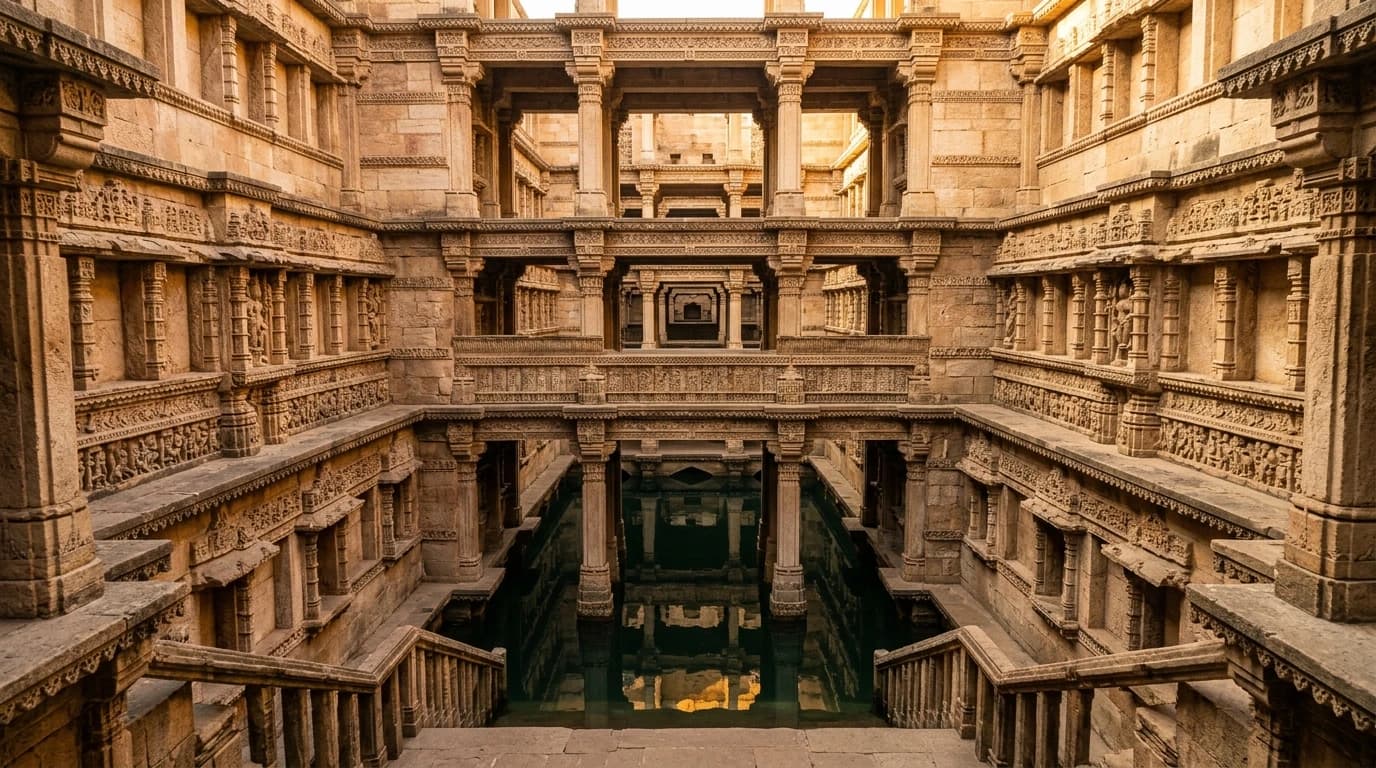
In the semi-arid and arid zones of Western and North-Central India—where surface water evaporates under searing summer temperatures exceeding 45°C and monsoon precipitation is compressed into fewer than sixty days a year—ancient civilizational genius inverted monumental architecture downward into the earth. Rather than building towering ziggurats or surface cisterns, the Sompura master architects and guild masons of Gujarat, Rajasthan, Delhi, and Madhya Pradesh engineered Vāpīs, Vāvs, and Bāolīs (monumental stepwells). These subterranean complexes function simultaneously as structural retaining walls resisting extreme active lateral earth pressure, multistory hypostyle resting halls (Kūṭas), convective microclimatic oases, and inverted temples dedicated to water divinities (Varuṇa, Jaladevī, and Nāgas). This codex examines the geotechnical engineering of stepwell retaining walls, the fourfold architectural classification (Nandā, Bhadrā, Jayā, Vijayā), the thermodynamic thermodynamics of subsurface evaporative cooling, and the iconographic program uniting secular water conservation with sacred liturgy.
Geotechnical & Hydrogeological Foundations: Chasing the Phreatic Table
Unlike surface tanks (Taṭāka, Pokhar, Tāl), which suffer from high solar evaporation rates (losing up to 2.5 meters of water column annually in the Thar Desert) and organic contamination, a monumental stepwell (Vāpī) is a phreatic well coupled to a monumental descending access corridor.
1.1 Hydrogeological Site Selectionभूपरीक्षा एवं जल-शास्त्र
In Chapter 74 of the Aparājitapṛcchā and Chapter 53 of Varāhamihira’s Bṛhat Saṁhitā, the site selection process (Bhūparīkṣā) for sinking a Vāpī combines empirical hydrology with ecological indicators:
Master hydrologists (Jalāśaya-vid) tracked subterranean water veins (Jalashira) by observing moisture-loving termite mounds (Valmīka), the directional leaning of Jāmula (Syzygium cumini) and Khejrī (Prosopis cineraria) trees, and the micro-meteorological morning mist (Jaladābhā) hovering over subsurface aquifers.
Hydrological Science: Empirical botanico-geological mapping of unconfined alluvial water tables.
The bottom of the stepwell shaft (Kūpa) had to penetrate beneath the seasonal drawdown curve of the unconfined water table into the saturated alluvial or fractured-rock aquifer, ensuring a permanent year-round water column even during severe multi-year droughts (Durbhikṣa).
1.2 Retaining Wall Mechanics: Deflecting Rankine Lateral Earth Pressureपार्श्व भू-दाब एवं प्राचीर स्थायित्व
Excavating a 20-to-30-meter-deep linear trench through loose alluvial sand, silt, or weathered basalt creates severe structural instability. According to Rankine’s Earth Pressure Theory, lateral active earth pressure (σ_a) exerted against a retaining wall increases linearly with depth z:
σ_a:Lateral active earth pressure (in kN/m²) acting perpendicular to the subterranean retaining wall.K_a:Active earth pressure coefficient, defined as K_a = tan²(45° - ϕ/2), where ϕ is the internal friction angle of the soil.γ:Unit weight of the surrounding soil matrix (typically 18 to 21 kN/m³ in alluvial desert basins).z:Vertical depth coordinate beneath the ground surface, reaching up to 25 to 30 meters.c:Soil cohesion coefficient (approaching zero in cohesionless desert sands).Structural Failure Risk: In cohesionless sandy soils, unprotected vertical walls would undergo immediate inward shear failure.
The Sompura guild masters neutralized this geological pressure through three structural strategies:
The flanking masonry walls are stepped inward or battered backward into the earth embankment, increasing structural stability.
As the corridor descends across multiple stories (2, 4, 6, or 7 tiers), heavy stone hypostyle pavilions (Kūṭas) supported by monolithic columns and massive transverse lintels span completely across the corridor from the north wall to the south wall. These stone pavilions function structurally as rigid horizontal compression struts that prop the opposing earth-retaining walls apart against lateral soil movement.
Built from locally quarried Dhrangadhra sandstone, Malwa basalt, or Jaisalmer limestone, the stones are locked together using mortise-and-tenon joints and metal dowels without rigid mortar, allowing the entire subterranean structure to flex elastically and absorb seismic ground motions without catastrophic brittle fracture.
Shastric Typology: The Four Orders of Vāpīs in the Aparājitapṛcchā
In the architectural compendiums of Western India—most notably the Aparājitapṛcchā (12th century CE) and the Rājavallabha of Maṇḍana (15th century CE)—stepwells are classified into four structural categories based on plan geometry and the number of descending access pavilions (Kūṭas):
| Stepwell Order वापी-भेद | Entrances द्वार संख्या | Pavilions कूट / मण्डप | Plan Geometry & Iconic Example विन्यास एवं ऐतिहासिक उदाहरण |
|---|---|---|---|
Nandā Vāpī नन्दा वापी | 1 Entrance (Linear descent from one end) एकद्वार | 3 Pavilions (Kūṭas) त्रिकूट | Linear single-axis corridor terminating in a round well shaft. Exemplar: Rānī-kī-Vāv (Patan) & Dādā Harīr Vāv (Ahmedabad) |
Bhadrā Vāpī भद्रा वापी | 2 Entrances (Typically opposing linear axes) द्विद्वार | 6 Pavilions (Kūṭas) षट्कूट | Bi-axial linear corridor with descending steps entering from two opposite sides. Exemplar: Bholeshwar Stepwell or regional Malwa types |
Jayā Vāpī जया वापी | 3 Entrances (Arranged in a T-shape or L-shape) त्रिद्वार | 9 Pavilions (Kūṭas) नवूट | Tri-axial complex converging on a central landing platform before descending to the water. Exemplar: Adalaj Vāv (Rudra Bai Stepwell, 1499 CE) |
Vijayā (Sarvatobhadra) Vāpī विजया (सर्वतोभद्र) वापी | 4 Entrances (Cruciform from all four cardinal points) चतुर्द्वार | 12 Pavilions (Kūṭas) द्वादशकूट | Quadri-axial stepped pool (Kuṇḍa-vāv) where steps descend from North, South, East, and West into a central water basin. Exemplar: Surya Kund at Modhera & Chand Baori (Abhaneri, Rajasthan) |
Microclimatic Thermodynamics & Evaporative Cooling
Stepwells were not merely water-harvesting utilities; they were sophisticated thermodynamic microclimate regulators designed to provide thermal refuge during extreme desert summers.
3.1 Subsurface Temperature Stabilizationभूगर्भ ऊष्मीय संतुलन एवं तापीय जड़त्व
While surface air temperatures in Gujarat and Rajasthan frequently spike above 45°C to 48°C with relative humidity dropping below 15%, the earth mass surrounding a subterranean stepwell acts as a massive thermal flywheel. At depths of 10 to 25 meters, the surrounding soil and rock maintain a nearly constant temperature equal to the mean annual ambient air temperature of the region (typically 24°C to 28°C).
Depth at which soil mass is completely decoupled from surface diurnal solar swings.
Stable subterranean ambient range while ambient desert air reaches 45°C–48°C.
3.2 Adiabatic Evaporative Cooling Dynamicsरुद्धोष्म वाष्पीकरण शीतलन प्रभाव
As dry desert air flows over the exposed water surface at the base of the stepwell and passes upward through the shaded, stone-lined subterranean corridors, sensible heat is transferred to latent heat through adiabatic evaporation:
This humidified, cooled air rises naturally out of the stepwell opening due to thermal buoyancy, creating a localized oasis around the stepwell mouth where ambient temperatures remain 5°C to 7°C cooler than the surrounding sun-baked terrain.
Consequently, stepwells served historically as community gathering spaces where women collected water, spun thread, exchanged community news, and performed daily worship shielded from solar radiation.
Architectural Masterworks: From Patan and Adalaj to Abhaneri and Bundi
Adalaj Vāv (Rudra Bhawani Stepwell, 1499 CE)
अडालज वापी (रुद्रा भवानी वाव)Commissioned by Queen Rudābāī (wife of the Vaghela ruler Mīrā Sena) and completed under Mahmud Begada’s sultanate administration, Adalaj is a five-story octagonal Jayā Vāpī built of fine white sandstone. It features a unique hybrid architectural vocabulary: while its ground plan follows strict Hindu Vāstu canons and its columns are carved with Hindu motifs (such as the Karṇa-vela leaf friezes, Kīrti-mukhas, and the mythical Aśva-surya horse), the Islamic stone-carving guilds introduced exquisite, lace-like perforated stone window screens (Jālī) depicting stylized Pala-pallava (banana leaf and floral arabesque) patterns that filter golden shafts of sunlight across the descending flights of steps.
Chand Baori at Abhaneri (8th–9th Century CE)
चाँद बावड़ी (आभनेरी)Dating to the early medieval Nikumbha dynasty, Chand Baori is one of India’s deepest and largest stepwells, descending 20 meters across 13 tiers in a staggering geometric maze of 3,500 symmetrical narrow steps arranged in an inverted square pyramid. Flanked on three sides by pillared corridors housing classical stone sculptures of Mahiṣāsuramardinī, Gaṇeśa, and Viśnu, Chand Baori represents the ultimate integration of pure mathematical symmetry and water architecture.
Rani Ji ki Baori (1699 CE, Bundi, Rajasthan)
रानी जी की बावड़ी (बूँदी)Commissioned by Queen Nathavati Ji of Bundi, this 46-meter-deep marvel features a high arched entrance gateway (Torana), carved elephant brackets, multistoried pillared galleries, and exquisite narrative friezes depicting the incarnations of Vishnu (Matsya, Kurma, Varaha, Krishna), establishing Bundi as the "City of Stepwells" (Bāolīs).