
Sandhyavandanam: The Timeless Solar Meditation
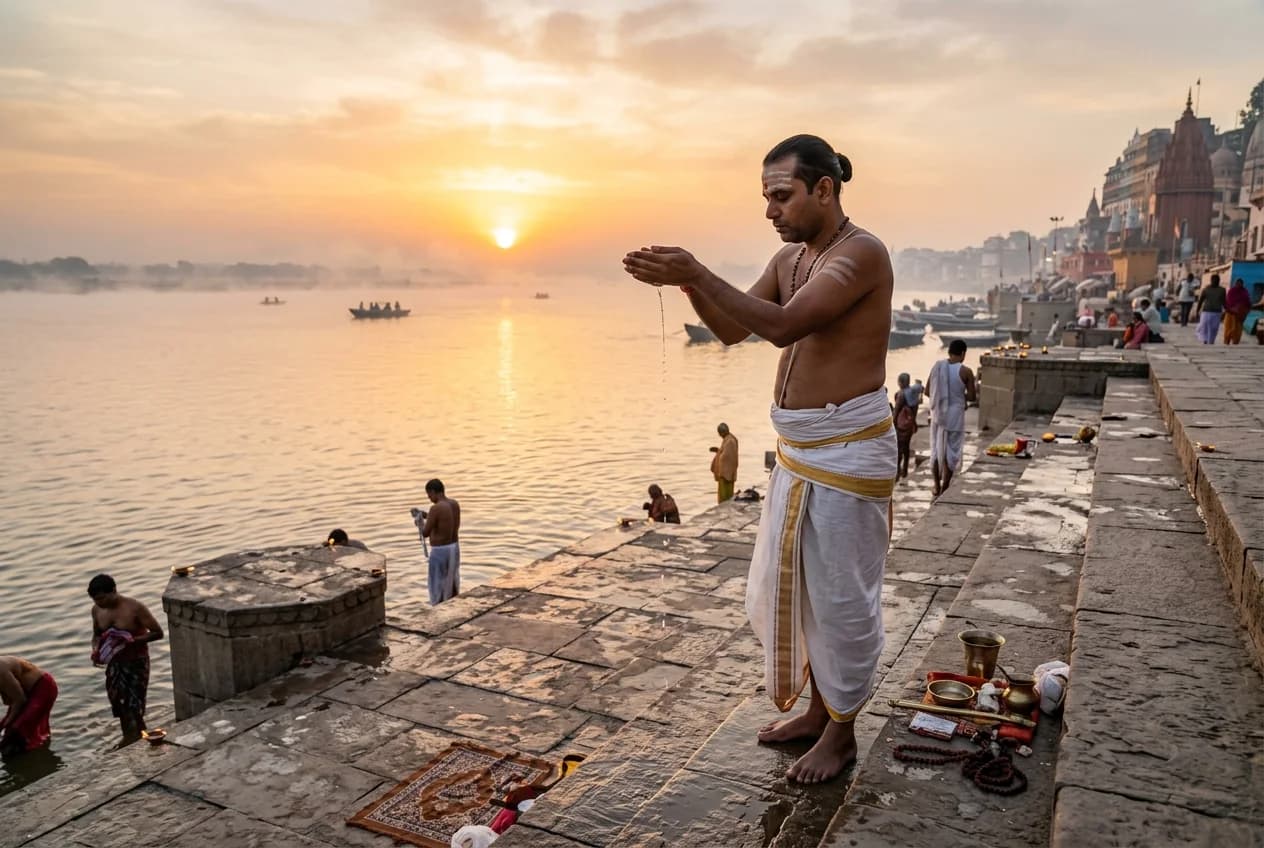
In the canonical architecture of Vedic Dinacharya (daily spiritual discipline), Sandhyavandanam (सन्ध्यावन्दनम्) stands as the foundational daily meditation synchronizing human consciousness with the cosmic circadian order (Rta). Etymologically, the compound term derives from सन्ध्या (Sandhyā)—denoting both the temporal twilight junctions (Sandhi) of dawn, solar noon, and dusk, as well as intensive contemplative absorption (Sam-dhyai)—and वन्दनम् (Vandanam), signifying reverential communion. Integrating elemental purification (Achamana and Marjana), breath regulation (Pranayama), solar water libation (Arghya-pradana), and the silent contemplation of the Savitri-Gayatri Mantra, Sandhyavandanam transforms the turning of the Earth relative to the Sun into an unbroken meditative dialogue between the individual intellect (Dhi) and the Supreme Solar Intelligence (Savitr).
What Is It?
1. Phenomenological Definition & Core Liturgical Anatomy
Far from being a single prayer, Sandhyavandanam is a composite Vedic Upasana (meditative ritual) synthesized from Samhita hymns, Brahmana injunctions, and Grihya Sutra protocols. It systematically purifies the physical body (Sthula Sharira), stabilizes the vital breath and mind (Sukshma Sharira), and directs cognitive awareness toward the non-dual Witness (Atman / Brahman).
Classical Dharmashastra digests (Nibandhas) and ritual manuals (Paddhatis) structure the observance around seven interdependent limbs (Saptanga):
| Sanskrit Term | Liturgical Limb | Core Action & Mantric Medium | Psychophysical & Spiritual Function |
|---|---|---|---|
| १. आचमनम् (Ācamanam) | Internal Purification | Sipping three measured droplets of sanctified water from the base of the right thumb (Brahma-tirtha) with Vedic names or Vyahritis. | Cleanses speech (Vak) and internal vital channels (Nadis) prior to sacred recitation. |
| २. प्राणायामः (Prāṇāyāmaḥ) | Breath Regulation | Rhythmic inhalation (Puraka), retention (Kumbhaka), and exhalation (Rechaka) accompanied by the Saptavyahritis and Gayatri. | Stills sensory fluctuations (Chitta-vritti) and kindles internal cognitive clarity. |
| ३. मार्जनम् (Mārjanam) | External Consecration | Sprinkling consecrated water over the crown and body using Darbha grass while chanting the Apohishtha hymns (Rigveda 10.9.1–3). | Invokes the healing, revitalizing essence of cosmic waters (Apas Tattva). |
| ४. अर्घ्यप्रदानम् (Arghyapradānam) | Solar Water Libation | Offering three cupped handfuls (Anjali) of water upward toward the Sun while reciting the Savitri-Gayatri Mantra. | Expresses cosmic reciprocity with Surya and refracts solar Prana through the falling water curtain. |
| ५. गायत्री जपः (Gāyatrī Japaḥ) | Mantric Contemplation | Rhythmic silent (Upamshu or Manasika) repetition (108, 54, or 28 counts) of the Gayatri Mantra. | Aligns individual intellect (Buddhi) with the self-luminous Divine Consciousness (Savitr). |
| ६. उपस्थानम् (Upasthānam) | Solar Communion | Standing meditation facing the Sun reciting Mitrasya Charshanidhritah (dawn) or Imam Me Varuna (dusk). | Establishes direct contemplative union with the Indwelling Person in the Solar Orb (Aditya-Mandala-Purusha). |
| ७. दिग्देवता वन्दनम् एवं समर्पणम् (Dig-Devatā Vandanam & Samarpaṇam) | Cosmic Salutation & Surrender | Saluting the cardinal directions, Rishis, and cosmic guardians, culminating in Kayena Vacha surrender to Brahman. | Dissolves egoic agency (Kartritva-bhava) into universal ecological and spiritual harmony. |
2. The Three Temporal Junctions (Trikala Sandhya)
According to the Shatapatha Brahmana and Smriti texts, the solar cycle passes through three primary thresholds (त्रिकाल सन्ध्या / Trikāla Sandhyā), each governed by a distinct aspect of Divine Consciousness (Shakti) and Vedic meter:
Performed at the pre-dawn transition (Brahma Muhurta into Usha-kala), ideally begun while stars remain faintly visible and culminating as the solar disc rises in the East. Contemplated in the aspect of Gayatri (associated with the Rigveda, creative awakening, and morning vitality).
Performed when the Sun reaches its meridian zenith (Abhijit Muhurta). Contemplated in the aspect of Savitri (associated with the Yajurveda, sustaining radiance, and dharmic action).
Performed at twilight as the lower rim of the solar disc touches the western horizon. Contemplated in the aspect of Sarasvati (associated with the Samaveda, contemplative assimilation, and inward rest).
What Does It Mean?
1. Verified Shastric & Upanishadic Foundations
A. The Savitri-Gayatri Mantra (Rigveda 3.62.10; Yajurveda 36.3)
At the heart of Sandhyavandanam resides the Savitri-Gayatri Mantra, revealed to the sage Brahmarshi Vishvamitra in the third Mandala of the Rigveda (3.62.10) and prefaced by the three cosmic planes (Mahavyahritis):
In his monumental Vedic commentary, Sayana explains the keyword भर्गः (Bhargaḥ) via two complementary etymologies: it is that self-effulgent Reality which bharjayati (roasts or consumes) the seeds of metaphysical ignorance (Avidya) and karmic afflictions (Papa), and which simultaneously illuminates all cognitive faculties from within. The Chandogya Upanishad (3.12.1) further defines the meter and principle of Gayatri: गायत्रं त्रायते इति गायत्री (Gāyantaṃ trāyate iti Gāyatrī)—“Because It protects (Trayate) the vital breaths and awareness of the one who meditates upon It (Gayantam), It is known as Gayatri.”
B. The Theology of Solar Libation and Non-Duality (Taittiriya Aranyaka 2.2)
The foundational scriptural treatise on Sandhyavandanam appears in the Taittiriya Aranyaka (2.2) of the Krishna Yajurveda. After explaining how the offering of Arghya (water libation) neutralizes Forces of Darkness (Mandeha-Rakshasas—interpreted esoterically by commentators as inertia, doubt, and unrighteousness obstructing spiritual light), the text proclaims the non-dual culmination of the rite:
C. Consecration through Cosmic Waters — The Apohishtha Sukta (Rigveda 10.9.1)
During Marjana (the sprinkling of water over the body), the practitioner recites the Apohishtha triad (Rigveda 10.9.1–3), recognizing water not merely as a chemical solvent, but as a conscious medium of vitality (Urja) and spiritual vision:
D. Communion with the Solar Purusha (Isha Upanishad 16)
The philosophical pinnacle of Surya Upasthana (standing before the Sun) is captured in the closing verses of the Isha Upanishad (15–16), where the seeker looks past the blinding physical photosphere to affirm identity with the indwelling Cosmic Person (Purusha):
2. Philosophical, Chronobiological & Psychological Hermeneutics
Far beyond mechanical ritualism, classical treatises and modern insights interpret Sandhyavandanam across three interconnected hermeneutic registers:
In both Ayurveda and modern chronobiology, the twilight junctions (Sandhya) represent critical inflection points in solar radiation, atmospheric ionization, and human neuroendocrine balance (the shift between daytime sympathetic activity and nighttime parasympathetic restoration). Pausing all worldly activity at dawn and dusk to regulate the breath (Pranayama) and gaze toward the horizon entrains the circadian pacemaker and prevents psychological fragmentation.
Unlike sectarian petitions for personal material gain, the Savitri-Gayatri Mantra is intentionally composed in the collective first-person plural (धीमहि / Dhīmahi — "We meditate"; नः / Naḥ — "Our intellects"). It asks solely for the awakening of Dhi (luminous, ethical discernment) across all humanity, recognizing that an enlightened intellect is the true source of both worldly welfare (Abhyudaya) and spiritual liberation (Nihshreyasa).
By affirming Asav Adityo Brahma ("Yonder Sun is Brahman") and So'ham Asmi ("I am He"), Sandhyavandanam trains the practitioner to see that the physical Sun illuminating the external cosmos and the Witness-Consciousness (Sakshi-Chaitanya) illuminating internal thoughts are one and the same Reality.
How Is It Practiced?
1. Canonical Liturgical Sequence
While specific mantras follow one's ancestral Vedic recension (Shakha), the classical daily practice follows a unified seven-stage progression:
2. Vedic Shakha (Recension) & Regional Variations Across Bharat
| Vedic Recension / Tradition | Primary Regions | Distinctive Liturgical Features |
|---|---|---|
| Rigveda (Shakala Shakha) | Maharashtra, Konkan, Karnataka, Kerala | Recites the Mitrasya Charshanidhritah hymn (Rigveda 3.59.1) for morning Upasthana; holds the hands at heart level at dawn, nose level at noon, and ear level at dusk during Gayatri Japa with strict Vedic pitch accents (Svara). |
| Krishna Yajurveda (Taittiriya Shakha) | Tamil Nadu, Andhra Pradesh, Telangana, Karnataka | Follows the Taittiriya Aranyaka 2.2 liturgy verbatim; includes elaborate Navagraha Keshava Tarpana, explicit non-dual affirmation (So'ham Asmi), and formal Pravara-Abhivadanam naming ancestral Rishis. |
| Shukla Yajurveda (Madhyandina & Kanva Shakha) | Uttar Pradesh, Bihar, Mithila, Madhya Pradesh, Rajasthan, Gujarat | Incorporates the full Aghamarshana Sukta (Rigveda 10.190 — Ritam cha Satyam cha) and the 24 Mudras of Gayatri; Surya Arghya is often poured in an unbroken stream from a raised copper Lota so the morning sunrays refract through the water onto the eyes and Ajna Chakra. |
| Samaveda (Kauthuma & Jaiminiya Shakha) | Bengal, Tamil Nadu, parts of Gujarat & Uttar Pradesh | Employs Samavedic chanting cadences, specialized Marjana verses (Apohishtha combined with Sama formulas), and integrated daily Deva-Rishi Tarpana. |
| Universal Grihastha & Simplified Sadhana | Pan-Indian & Global Diaspora | Practiced by men, women, and youth across communities: morning ablution, lighting the domestic Diya, offering water (Surya Arghya) from a copper vessel to the rising Sun, practicing Pranayama, and chanting 27 or 108 counts of the Gayatri Mantra. |
Primary Scriptural Corpus & Academic References
- 1.Rigveda Samhita: Mandala 3, Sukta 62, Rik 10 (Savitri-Gayatri Mantra revealed to Vishvamitra); Mandala 10, Sukta 9, Riks 1–3 (Apohishtha Sukta for Marjana); Mandala 10, Sukta 190 (Aghamarshana Sukta).
- 2.Taittiriya Aranyaka (Krishna Yajurveda): Prapathaka 2 (Svadhyaya Brahmana), Anuvakas 1–2 (foundational Vedic treatise on Sandhyavandanam, Arghya-pradana, and the non-dual realization Asav Adityo Brahma), with the Bhashya of Sayana.
- 3.Shatapatha Brahmana (Shukla Yajurveda): Kanda 11, Adhyaya 5, Brahmana 6 (prescriptions on daily Svadhyaya and solar alignment).
- 4.Brihadaranyaka Upanishad & Chandogya Upanishad: Brihadaranyaka 5.14 (Gayatri-Vidya — esoteric exposition of the four Padas of Gayatri); Chandogya 3.12 (Gayatri Brahma — etymology of Gayatri as Gayanstrayate).
- 5.Isha Upanishad (Vajasaneyi Samhita 40): Mantras 15–16 (Hiranmayena Patrena and Pushan Ekarshe — invocation of the Solar Purusha and the identity statement So'ham Asmi).
- 6.Manusmriti & Baudhayana Dharmasutra: Manusmriti 2.101–103 and Baudhayana Dharmasutra 2.4.7 (canonical definitions of Pratah and Sayam Sandhya timings and contemplative disciplines).
- 7.Kane, Pandurang Vaman (1941): History of Dharmaśāstra (Ancient and Mediaeval Religious and Civil Law in India), Vol. II, Part I, Chapter XVIII ("Āhnika — Daily Duties: Sandhyā, Snāna, Japa"), pp. 312–326, Bhandarkar Oriental Research Institute, Pune.
- 8.Gonda, Jan (1963): "The Indian Mantra," Oriens, Vol. 16, pp. 244–297 (philological and ritual study of the Savitri-Gayatri and Vedic Japa).