
Atman(आत्मन्)
The true self, unconditioned witness consciousness, and indwelling spirit
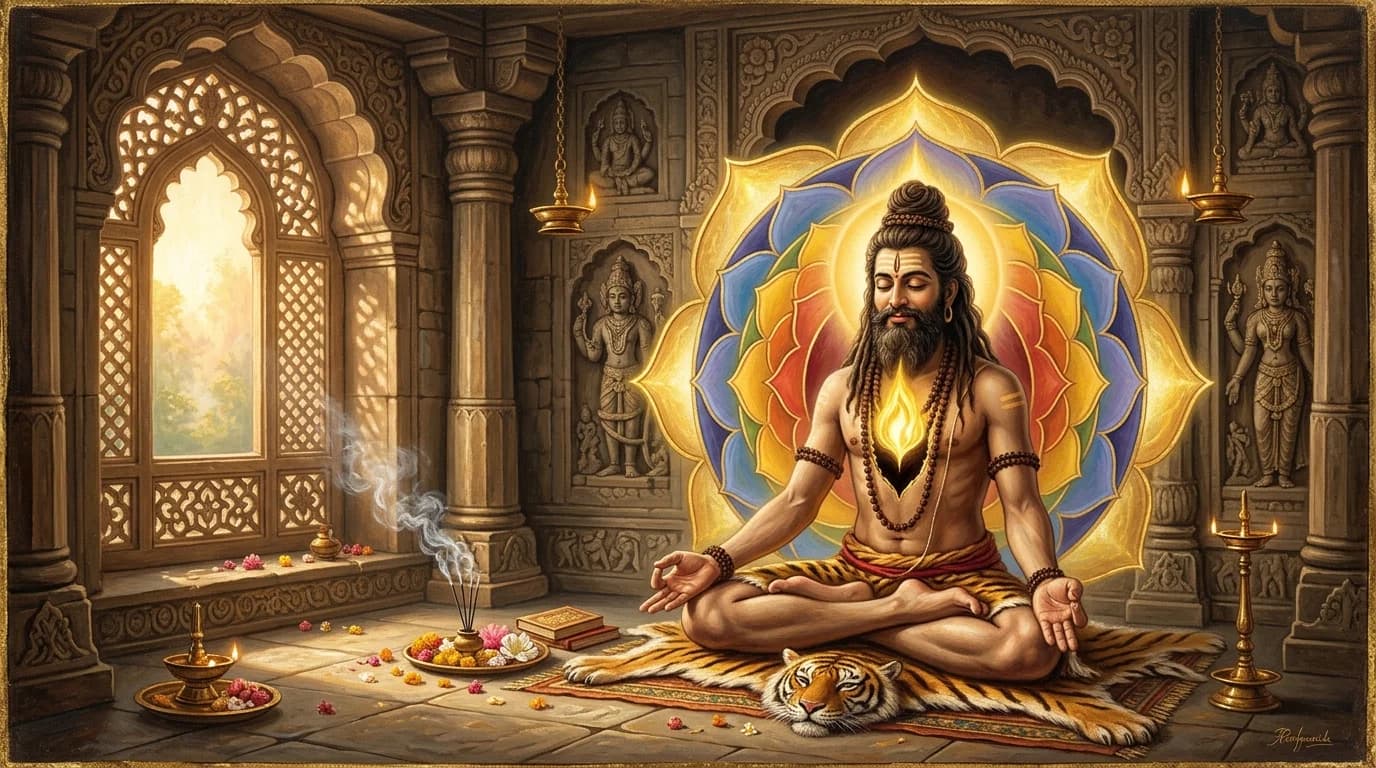
Section 1: Taxonomic Header & Etymology (Nirukta & Vyutpatti)
| Devanagari Forms | आत्मन् (Sanskrit masculine n-stem: ātman; nominative singular: आत्मा, ātmā) |
|---|---|
| IAST Transliteration | Ātman / Ātmā |
| Verbal Root (Dhātu) | √at (अत् सातत्यगमने — ata sātatya-gamane, "to move continuously, pervade") · √āp (आप् व्याप्तौ — āpḷ vyāptau, "to pervade, encompass, or attain") · √an (अन् प्राणने — ana prāṇane, "to breathe, animate") |
| Grammatical Derivation (Vyutpatti) | In Yāska’s Nirukta (3.15) and Pāṇinian grammatical commentaries (Uṇādi Sūtra 4.152: ateḥ manin), Ātman is derived from the verbal root √at with the Uṇādi suffix manin (ateḥ manin), signifying that which moves or pervades continuously. Alternatively, classical exegetes trace the term to √an (ana prāṇane) with prefix ā- (denoting animating breath) and √āp (āpḷ vyāptau, denoting all-encompassing presence). Grammatically, Ātman is an an-stem masculine noun: stem ātman, nominative singular ātmā (आत्मा), accusative ātmānam, instrumental ātmanā. |
“Because it pervades (āpnoti), because it receives (ādatte), because it experiences objects here (atti), and because its ontological presence is continuous and unbroken (santato bhāvaḥ), therefore it is proclaimed as Ātman.”
— Ādi Śaṅkarācārya in Kaṭhopaniṣad-bhāṣya 2.1.1 & Liṅga Purāṇa 1.70.96Complementary Verbal Roots in Yāska’s Nirukta (3.15) & Pāṇinian Grammars:
Semantic Evolution & Why “Soul” or “Ego” is an Inadequate Translation
In Western philosophical and theological discourse, the English word "soul" (translating Greek psychē and Latin anima) typically denotes an individual's created immaterial essence encompassing mind, will, emotion, memory, and personal identity. In the taxonomy of Sanātana Dharma, however, all mental faculties—the deliberative mind (Manas), determinative intellect (Buddhi), memory-substances (Citta), and ego-sense (Ahaṃkāra)—belong to the subtle physical instrument (Antaḥkaraṇa / Sūkṣma-śarīra), which is an evolute of changeable nature (Prakṛti). Ātman lies deeper than the mind and personality:
A thing created at a point in time is subject to eventual dissolution. Ātman is never born and never dies; it has neither a temporal beginning nor an end.
Whereas thoughts, emotions, and memories constantly fluctuate, Ātman is the unchanging screen of awareness upon which all mental states appear and disappear.
The ego (Ahaṃkāra) is a psychological construct formed when pure consciousness mistakenly identifies with a particular body, name, biography, and social status. Ātman is the universal conscious principle prior to egoic contraction.
Section 2: Abstract & Philosophical Core
At the heart of the Upaniṣads, Bhagavad Gītā, and the six Āstika Darśanas stands the foundational inquiry of self-knowledge (Ātma-vidyā): Ko'ham? ("Who am I?") and Kena iṣitaṃ patati preṣitaṃ manaḥ? (Kena Upaniṣad 1.1: "By whom impelled and directed does the mind alight upon its objects?").
Classical Indian philosophy executes a radical epistemological turn regarding the nature of consciousness: In materialist accounts (such as ancient Cārvāka / Lokāyata), consciousness is treated as an emergent byproduct of physical elements—comparable to intoxicating power arising from fermented grain. In Sanātana Dharma, consciousness (Cit) is recognized as irreducible and primary. The physical brain, sensory organs (Indriyas), and mental faculties (Antaḥkaraṇa) are intrinsically insentient (Jaḍa). Like iron filings that move only in the presence of a magnet, or a mirror that reflects only when illuminated by the sun, the mind and senses appear conscious solely because they reflect the self-luminous light (Svayaṃ-prakāśa) of the Ātman.
The Three Relational Terms of Self-Inquiry (त्रिपुटी विमर्श)
The empirical, embodied individual self—consciousness conditioned by the limiting adjuncts (Upādhis) of the physical, subtle, and causal bodies, experiencing itself as a finite agent (Kartā) and experiencer (Bhoktā).
The unattached, impartial Witness Consciousness that observes the waking, dreaming, and deep-sleep states without being modified by them.
The Supreme Self—the ultimate cosmic ground of all existence and the indwelling ruler (Antaryāmī) of the universe.
Human suffering (Duḥkha), existential fear (Bhaya), and bondage (Bandha) arise from a fundamental cognitive error called Avidyā (spiritual ignorance) or Adhyāsa (mutual superimposition): superimposing the mortality, sickness, and limitations of the body-mind complex (Anātman) onto the immortal Self, while superimposing the sentience of the Ātman onto the inert body. Liberating wisdom (Mokṣa) is the direct experiential recognition of the Ātman in its pristine nature.
Section 3: Primary Scriptural Anchors (Śruti, Smṛti, and Itihāsa)
This luminous Conscious Self is neither born, nor does it ever die; it did not spring from anything, nor did anything spring from it. Unborn, eternal, changeless, and primordial, this Self is never destroyed when the body is destroyed.
Revealed by Yama (the Lord of Death) to the young seeker Naciketas in the Kaṭha Upaniṣad and reiterated by Śrī Kṛṣṇa to Arjuna in Bhagavad Gītā 2.20. In his commentary, Ādi Śaṅkarācārya explains that every material object in the cosmos undergoes the Ṣaḍ-bhāva-vikāras (the six modifications of becoming formulated by the ancient grammarian Vārṣyāyaṇi in Yāska’s Nirukta 1.2): (1) Jāyate (birth), (2) Asti (post-natal existence), (3) Vipariṇamate (alteration/modification), (4) Vardhate (growth), (5) Apakṣīyate (decay/waning), and (6) Vinaśyati (death/destruction). This verse systematically negates all six material modifications in the Ātman.
He is the Unseen Seer, the Unheard Hearer, the Unthought Thinker, the Unknown Knower. There is no other seer than He, no other hearer than He, no other thinker than He, no other knower than He. This is your Self, the Inner Ruler (Antaryāmī), the Immortal. Whatever is other than this is perishable and subject to sorrow.
Spoken by Sage Yājñavalkya to Uddālaka Āruṇi, and reinforced in Bṛhadāraṇyaka 2.4.14 (vijñātāram are kena vijānīyāt—"Through what instrument could one objectify the Knower himself?"). Just as a camera cannot take a photograph of its own lens without a mirror, and fire cannot burn itself, the Ātman cannot be grasped as an external sensory object precisely because it is the foundational Subject behind every act of seeing, hearing, and thinking.
The Self (Ātman) which is free from evil, free from old age, free from death, free from grief, free from hunger and thirst, whose desires are true and whose resolves are true—that Self must be sought out, that Self must be inquired into and known.
This proclamation by Prajāpati initiates the famous dialogue with Indra and Virocana. While Virocana mistakenly concludes that the physical body is the Ātman (Dehātmavāda), Indra persists through 101 years of contemplative discipline to realize that neither the mortal waking body, nor the fluctuating dream-mind, nor the blankness of deep sleep is the ultimate Ātman, but rather the luminous Consciousness that animates all three.
Two birds of beautiful plumage, inseparable companions, perch upon the selfsame tree. Of the two, one eats the sweet and bitter fruit of the fig tree, while the other looks on in serene majesty without eating.
Originally a Ṛgvedic riddle (Ṛgveda 1.164.20) by Sage Dīrghatamas Aucathya, this verse serves as a rich hermeneutical bridge across Vedāntic schools. The "tree" (Vṛkṣa) is the living body (Śarīra). For Advaita, the two birds represent the ego-bound Jīva (reflected in the intellect, tasting pleasure and pain) and the unconditioned Sākṣī-ātmā / Īśvara. For Viśiṣṭādvaita and Dvaita, they represent the finite individual soul (Jīvātman, the experiencer of karma) and the Supreme Lord (Paramātman, the indwelling Antaryāmī who remains eternally untouched by karmic fruits). In the very next verse (Muṇḍaka 3.1.2), when the grieving lower bird turns upward and beholds the glory of the Lord/Witness, its sorrow vanishes instantly (juṣṭaṃ yadā paśyaty anyam īśam asya mahimānam iti vīta-śokaḥ).
Neither inwardly cognitive, nor outwardly cognitive, nor cognitive both ways; neither an undifferentiated mass of cognition, nor collective cognition, nor non-cognition. Unseen by the senses, beyond transactional dealings, ungraspable by organs of action, without inferential marks, unthinkable, unnameable, whose sole proof is the unbroken certainty of self-awareness, in which all phenomenal plurality subsides—peaceful, auspicious, and non-dual: this the wise recognize as the Fourth (Turīya). That is the Ātman; that is to be realized.
Mantra 7 is the jewel of the Māṇḍūkya Upaniṣad, establishing Turīya not as a fourth sequential state of consciousness alongside waking, dreaming, and sleeping, but as the transcendent and immanent non-dual substratum of all three. Through twelve negative and positive attributes, the mantra systematically negates all empirical categories while asserting the self-certifying reality (ekātma-pratyaya-sāra) of the pure Self.
Section 4: Phenomenological & Ontological Architecture of the Self
To guide the seeker systematically from gross physical identification to subtle self-realization, the Upaniṣads employ two complementary pedagogical methodologies (Prakriyās):
The Five Sheaths & Three Bodies (पञ्चकोश एवं शरीर-त्रय विवेक)
In the Brahmānanda Vallī of the Taittirīya Upaniṣad, Sage Varuṇa guides his son Bhṛgu through five concentric layers (Kośas, literally "scabbards" or "sheaths") that encase and obscure the Ātman, mapped across the three bodies (Śarīra-traya):
| Embodied Layer (Śarīra) | Sheath (Kośa) | Constituent Principles | Experiential Function & Limitation |
|---|---|---|---|
1. Sthūla-śarīra Gross Body | Annamaya Kośa अन्नमय कोश (Sheath of Food) | The physical anatomy formed from the five gross elements (Pañca-mahābhūtas), nourished by food (Anna), and returning to earth. | Subject to birth, growth, illness, aging, and death; inert without vital breath. |
2. Sūkṣma-śarīra Subtle Body | Prāṇamaya Kośa प्राणमय कोश (Sheath of Vital Energy) | The five vital physiological winds (Prāṇa, Apāna, Vyāna, Udāna, Samāna) and the five organs of action (Karmendriyas). | Animates physiological metabolism and movement, yet lacks cognitive awareness of its own. |
2. Sūkṣma-śarīra Subtle Body | Manomaya Kośa मनोमय कोश (Sheath of Mind & Emotion) | The deliberative mind (Manas) and the five sensory faculties (Jñānendriyas—hearing, touch, sight, taste, smell). | Generates thoughts, emotions, doubts (Saṅkalpa-vikalpa), and sense of "mine" (Mamatva). |
2. Sūkṣma-śarīra Subtle Body | Vijñānamaya Kośa विज्ञानमय कोश (Sheath of Intellect) | The determinative intellect (Buddhi) joined with the sense of "I-agency" (Ahaṃkāra / Kartṛtva). | Exercises judgment, scientific reasoning, and moral choice; acts as the transmigrating empirical agent (Jīva). |
3. Kāraṇa-śarīra Causal Body | Ānandamaya Kośa आनन्दमय कोश (Sheath of Latent Bliss) | The subtle seed-state of unmanifest impressions (Vāsanās) experienced during deep dreamless sleep and aesthetic joy (Priya, Moda, Pramoda). | Tranquil and free from mental agitation, yet still conditioned by latent ignorance (Avidyā). |
Beyond the 3 Bodies & 5 Sheaths The Transcendent Ground | Ātman / Turīya आत्मन् / तुरीय (Pure Witness Consciousness) | Satyaṃ Jñānam Anantam Brahma (Existence, Consciousness, Infinity — Taittirīya 2.1.1). | The innermost tail-support (Brahma pucchaṃ pratiṣṭhā) that illuminates all five sheaths without being modified by any of them. |
The Three States of Consciousness (अवस्था-त्रय परीक्षा)
Whereas Western philosophy historically privileged the waking state (Jāgrat) as the sole data-set for epistemology, the Māṇḍūkya and Bṛhadāraṇyaka Upaniṣads examine the totality of human experience across three alternating states:
Consciousness turns outward (Bahiṣ-prajña) through the physical senses to experience the shared macrocosmic world of physical forms and actions.
The physical senses rest, and consciousness turns inward (Antaḥ-prajña), projecting an entire internal universe of space, time, and objects constructed purely from waking impressions (Vāsanās).
Both external objects and internal dream-thoughts dissolve into an undifferentiated unity (Ekībhūtaḥ prajñānaghanaḥ). Upon waking, every person reports: "I slept peacefully; I knew nothing then."
The waking person disappears in dream; the dreamer disappears in deep sleep; the deep sleeper disappears upon waking. Yet the "I"—the pure Witness Consciousness (Turīya)—was continuously present across all three states, enabling the unbroken thread of memory that links them together. Turīya is not a fourth sequential state in time, but the eternal ground of awareness itself.
Section 5: Comparative Darśana & Sampradāya Perspectives (Bhāṣya Analysis)
Across the classical Āstika and Nāstika traditions, the investigation into the Self (Ātman) revolves around four fundamental philosophical questions:
Is consciousness the intrinsic essence of the Self, or an adventitious quality produced by mind-contact?
Is it atomic (Aṇu) and localized in the heart, or infinite and all-pervasive (Vibhu)?
Does agency belong to the spiritual self itself, or to the insentient material apparatus of Prakṛti/Upādhis?
Are individual souls eternally separate substances, or reflections of one indivisible universal Consciousness?
1. Nyāya & Vaiśeṣika
Gautama & KaṇādaNyāya-Vaiśeṣika classifies the Ātman as one of the nine eternal substances (Dravyas). It establishes the existence of the Ātman against materialism through inference: desire (Icchā), aversion (Dveṣa), volitional effort (Prayatna), pleasure (Sukha), pain (Duḥkha), and cognition (Jñāna) are qualities (Guṇas) that require an enduring immaterial substratum. Each Ātman is distinct, plural (Nānātma-vāda), and all-pervasive (Vibhu). Uniquely, Nyāya holds the doctrine of Āgantuka-caitanya (adventitious consciousness): consciousness (Jñāna) is not the intrinsic essence (Svarūpa) of the soul, but a quality that arises only when the Ātman comes into contact with the mind (Manas), senses, and objects. In final liberation (Apavarga), when the soul is severed from the mind, it abides as a pure substance free from all pain—and also devoid of empirical cognition.
2. Pūrva Mīmāṃsā
Jaimini, Śabara, Kumārila Bhaṭṭa, and Prabhākara MiśraMīmāṃsā defends an eternal, enduring, plural Ātman (Vibhu in size) because without an enduring self, the moral law of Karma would collapse: the person who performs a Vedic sacrifice today must be the exact same ontic entity who reaps its fruit in the future. Kumārila refutes Buddhist momentariness through the argument of Pratyabhijñā (cross-temporal recognition: "I, who perceived this object in the past, am remembering it now"). For Kumārila (Bhāṭṭa school), the Ātman is Dravya-bodha-svarūpa (both substantial and conscious in nature) and is directly self-known as the object of the "I-cognition" (Ahaṃ-pratyaya-gamya). For Prabhākara (Prābhākara school), the Ātman is revealed simultaneously as the subject (Jñātā) in every act of knowing an external object (Triputī-pratyakṣa-vāda—simultaneous revelation of knower, known, and knowledge).
3. Sāṃkhya & Classical Yoga
Kapila, Īśvarakṛṣṇa, and PatañjaliRejecting the Nyāya view that consciousness is merely an accidental attribute, Sāṃkhya-Yoga establishes that the Self (Puruṣa) is Pure Consciousness (Cit-svarūpa / Dṛśi-mātra). Puruṣa is completely distinct from Prakṛti (matter, energy, and mind); it is unattached (Asaṅga), changeless (Kūṭastha-nitya), non-agent (Akartā), and neutral witness (Sākṣī / Madhyastha). All agency belongs to Prakṛti, while all sentience belongs to Puruṣa. However, Sāṃkhya-Yoga maintains Puruṣa-bahutva (ontological plurality of pure selves, Sāṃkhya Kārikā 18: Janana-maraṇa-karaṇānāṃ pratiniyamād ayugapat pravṛtteś ca / puruṣa-bahutvaṃ siddhaṃ), arguing that if there were only one Puruṣa, when one person attained liberation or died, all beings would simultaneously be liberated or die.
4. Advaita Vedānta
Gauḍapāda, Ādi Śaṅkarācārya, Padmapāda, and SureśvaraAdvaita resolves the Sāṃkhya paradox of "many infinite consciousnesses" by demonstrating that two infinite, attributeless realities cannot be differentiated from one another. Pure Consciousness (Ātman) is one, indivisible (Akhaṇḍa), all-pervasive (Vibhu), and identical with the Absolute Reality (Brahman), as declared in the four Mahāvākyas: (1) Prajñānam Brahma ("Consciousness is Brahman" — Aitareya Upaniṣad 3.1.3), (2) Ahaṃ Brahmāsmi ("I am Brahman" — Bṛhadāraṇyaka Upaniṣad 1.4.10), (3) Tat Tvam Asi ("That Thou Art" — Chāndogya Upaniṣad 6.8.7), and (4) Ayam Ātmā Brahma ("This very Self is Brahman" — Māṇḍūkya Upaniṣad 2). Individual births and deaths differ solely due to the plurality of Upādhis (limiting adjuncts—individual intellects). Śaṅkara illustrates this via Ghaṭākāśa-nyāya (just as infinite space appears divided by clay pots, yet space itself remains unbroken when a pot breaks) and Pratibimba-vāda (the Sun reflected in ten water-pots trembles only when individual water surfaces are stirred).
5. Viśiṣṭādvaita Vedānta
Nāthamuni, Yāmunācārya, and Śrī RāmānujācāryaRāmānuja critiques Advaita’s notion of an attributeless (Nirviśeṣa) consciousness, arguing that all experience testifies to a self-conscious "I" (Ahaṃ-padārtha) who knows: "I know this." In Viśiṣṭādvaita, each Jīvātman is real, eternal, and numerically plural, possessing an atomic spiritual dimension (Aṇu-parimāṇa, citing Śvetāśvatara Upaniṣad 5.9: bālāgra-śata-bhāgasya and Muṇḍaka 3.1.9: eṣo'ṇur ātmā) seated within the heart. Rāmānuja reconciles the atomic soul with bodily experience through the distinction between Dharmi-jñāna (substantive self-luminous soul, the flame of a lamp) and Dharmabhūta-jñāna (attributive consciousness, the radiating light). Though the flame is localized, its light contracts in Saṃsāra due to Karma and expands to infinite omniscience (Vibhu) in Mokṣa. Every Jīvātman is an inseparable mode (Prakāra) and organic body (Śarīra) of Śrīman Nārāyaṇa, the indwelling Soul of all souls (Śarīrī / Antaryāmī).
Each Jīvātman is numerically unique, atomic in size, and seated within the cardiac cave (Hṛdaya-kuhara), possessing self-luminosity (Svayaṃ-prakāśatva).
Like light radiating from a flame, attributive consciousness radiates from the atomic soul throughout the physical frame, contracting under karmic bondage and expanding infinitely in liberation.
The individual soul stands to the Supreme Lord as body to soul—completely dependent (Śeṣa), controlled (Niyāmya), and supported (Dhārya) by Bhagavān.
6. Dvaita Vedānta
Śrī Madhvācārya, Jayatīrtha, and VyāsatīrthaMadhvācārya affirms that every Jīvātman is eternally distinct from God (Īśvara-jīva-bheda) and from every other soul (Jīva-jīva-bheda). Each Jīva is atomic (Aṇu), essentially Sat-Cit-Ānanda in a finite, dependent measure (Paratantra), and possesses a unique, irreducible spiritual personality (Svarūpa-bheda / Tāratamya) that persists even in liberation. Furthermore, Madhva’s system contributes the epistemological doctrine of the Sākṣī (the intrinsic spiritual witness of the Jīva): while the physical senses and mind can occasionally err, the Sākṣī is the infallible inner faculty of the soul that directly intuits the self's own existence, time (Kāla), space (Avyākṛtākāśa), and the validity of knowledge (Svataḥ-prāmāṇya).
7. Āgamic Śaiva Traditions
Meykaṇḍa Devar, Tirumūlar, Utpaladeva, and AbhinavaguptaIn Śaiva Siddhānta, the soul (Paśu / Ānmā) is an eternal, pervasive (Vibhu) conscious reality described as Sat-Asat: when it identifies with the binding fetters (Pāśa / Asat), it behaves as finite and ignorant; when purified by Lord Śiva’s grace (Śaktipāta), it unites inextricably with Śiva (Sat) in non-dual love (Advaita understood as inseparable union, Ananya-bhāva). In Non-Dual Kashmir Śaivism (Utpaladeva & Abhinavagupta), rather than viewing the Ātman as a passive, static witness (Śānta-brahma), the Trika tradition celebrates the Self as Citi or Paramaśiva—endowed with both self-luminous awareness (Prakāśa) and dynamic, creative self-reflective freedom (Vimarśa / Spanda). Liberation is Pratyabhijñā—the thrilling recognition that one’s own innermost awareness is the universal Sovereign of the cosmos.
The soul sheds the three impurities (Āṇava, Māyā, and Karma malas) through divine grace (Śaktipāta) to attain inseparable communion with Lord Śiva.
Consciousness is not merely inert light; it possesses Vimarśa—the sovereign power of self-recognition and universal vibration (Spanda) that generates the cosmos.
Section 6: Epistemology of Self-Inquiry — Dṛg-Dṛśya-Viveka & Ātma-Vicāra
How does a seeker move from an intellectual concept of the Ātman to direct experiential realization (Aparokṣānubhūti)? Classical contemplative traditions employ three rigorous epistemic methods:
1. Svayaṃ-Prakāśatva & Indubitability (Self-Luminosity)
स्वयंप्रकाशत्व एवं अपरोक्षानुभूतिIn his commentary on Brahma Sūtra 2.3.7, Ādi Śaṅkarācārya anticipates and surpasses the Cartesian Cogito by nearly a millennium: No one can ever deny or doubt the existence of their own Ātman, because the very consciousness that attempts to doubt or deny is itself the Ātman. Every external object requires a Pramāṇa (means of knowledge) to be established, but the Ātman is Pramāṇa-siddha—the self-evident presupposition behind all instruments of knowledge.
2. Dṛg-Dṛśya-Viveka (Discrimination between the Seer and the Seen)
दृग्-दृश्य-विवेकThe fundamental methodology for isolating pure consciousness from phenomenal appearances through the rigorous principle that whatever can be observed cannot be the observer.
3. Anvaya-Vyatireka (The Logic of Co-Presence and Co-Absence)
अन्वय-व्यतिरेक एवं नेति-नेतिIn contemplative inquiry (Ātma-vicāra / Neti-neti—"Not this, not this"), what remains constant while states change (Anvaya) is real; what appears and disappears (Vyatireka) is an incidental appearance. By detaching identification from transient physical sensations and emotional storms, awareness settles naturally into its own unshakeable peace (Svātmany avasthitiḥ).
Section 7: Living Praxis — Ethical & Psychological Fruit of Ātma-Darśana
Far from encouraging solipsistic withdrawal from society, the recognition of the Ātman serves in Sanātana Dharma as the ultimate ontological foundation for universal ethics, compassion, and psychological resilience:
1. Samadarśitva (Universal Empathy & Reverence for All Life)
समदर्शित्व एवं सर्वभूतहितWhy should a human being practice non-violence (Ahiṃsā), compassion (Karuṇā), and justice toward others? Because the very same Ātman that shines within oneself shines equally within every sentient being—from the learned scholar to the humble outcaste, the cow, the elephant, and the stray dog (Bhagavad Gītā 5.18: Paṇḍitāḥ sama-darśinaḥ).
2. Abhaya (Existential Fearlessness)
अभयं सत्त्वसंशुद्धिःAs the Bṛhadāraṇyaka Upaniṣad (1.4.2) diagnoses: द्वितीयाद्वै भयं भवति (Dvitīyād vai bhayaṃ bhavati)—"Fear arises only from a sense of duality/otherness" and from identifying with the fragile physical organism. Anchored in the imperishable Ātman, a person acts in the world with fearless moral integrity (Abhayam sattva-saṃśuddhiḥ — Bhagavad Gītā 16.1), untouched by panic or dread of death.
3. Sākṣī-Bhāva (Psychological Resilience in Daily Life)
साक्षी-भाव एवं मानसिक शान्तिIn modern daily practice, cultivating Sākṣī-bhāva means stepping back from immediate reactive identification with anger, anxiety, praise, or insult. Instead of saying "I am angry" or "I am broken," the practitioner observes: "A wave of anger or sorrow is passing through the Manomaya Kośa, while I—the Witness Ātman—remain clear, steady, and whole."
Section 8: Verified Academic & Traditional Bibliography
Primary Sanskrit texts cited according to their standard critical editions, supplemented by classical commentaries and twentieth-century Indological scholarship: