
Unstitched Textiles & Energetic Purity: The Metaphysics of the Loom, Ritual Shuddhi, and the Drape Mechanics of the Saree, Dhoti, and Angavastramअस्यूत वस्त्र परंपरा एवं ऊर्जा शुचिता: धोती, शाटिका और उत्तरीय का आध्यात्मिक एवं वैज्ञानिक विधान
From the Upanishadic Metaphor of Warp and Weft to Dharmashastric Injunctions Against Needle-Pierced Garments, Panchakaccha Knot Topology, and Tropical Microclimate Ergonomics
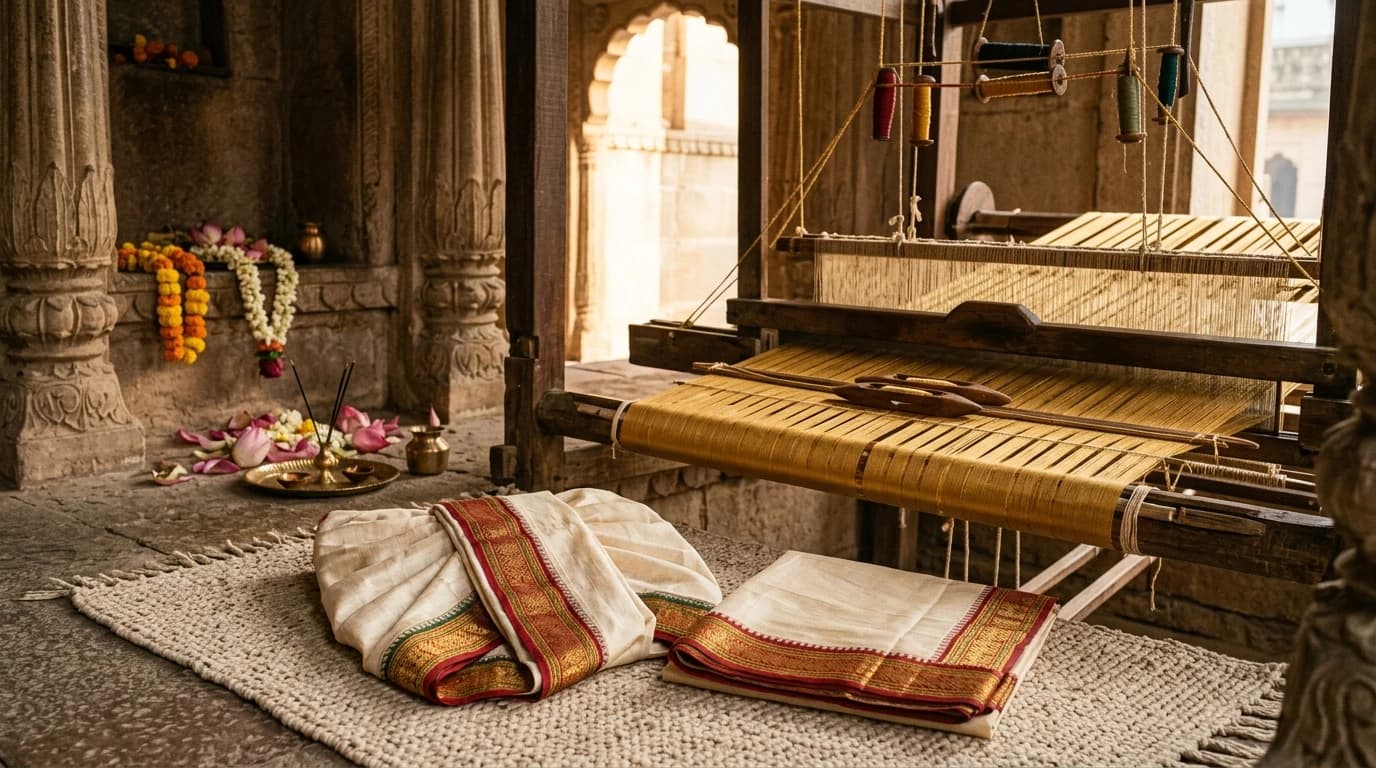
“That which is above the heavens, O Gārgī, that which is beneath the earth, and that which lies between heaven and earth—across what, indeed, is space itself woven as warp (Ota) and weft (Prota)?”
— Yājñavalkya to Gārgī Vācaknavī, Bṛhadāraṇyaka Upaniṣad (3.8.3–7)Although archaeological excavations at Harappa, Mohenjo-daro, and Chanhu-daro have yielded copper and bronze eyed needles dating back to 2500 BCE—proving that ancient Indians possessed the complete technical mastery of tailoring and sewing—Vedic, Āgamic, and Dharmaśāstric canons consistently mandated that garments worn for sacred liturgy (Yajña and Pūjā), contemplative meditation (Dhyāna), and rites of passage (Saṁskāra) must remain unstitched (Asyūta or Sūcī-aviddha). Far from reflecting technological primitivism, the preference for the rectangular loom-finished drape—the Antarīya / Dhotī / Veshti, the Śāṭikā / Saree, and the Uttarīya / Aṅgavastram—arises from an integrated cosmology in which the woven cloth is a microcosmic model of the universe (Tantra). To shear a woven textile with blades and pierce it with iron needles is, in ritual metaphysics, to rupture its continuous warp-and-weft lattice, create permanent seams that trap organic impurity (Ucchiṣṭa), and constrict the subtle currents of Prāṇa with rigid tailored waistbands. This codex examines the Vedic ontology of warp (Tantu) and weft (Otu), the Smṛti laws of textile purification (Vastra-śuddhi), the dielectric and energetic properties of silk (Kauśeya), wool (Ūrṇā), and cotton (Kārpāsa), the topological geometry of Trikaccha, Pañcakaccha, and Navavārī drapes, and the thermodynamic ergonomics of unstitched garments in the Indian monsoon and tropical climate.
1. The Metaphysics of the Loom: Why the Universe Is Called a Tantra
In Sanskrit philosophical vocabulary, the foundational terms for scripture, cosmic order, and meditative methodology are drawn directly from the handloom. Woven fabric is not treated merely as passive physical matter; it is revered as a visible manifestation of continuous cosmic generation, where threads of light and consciousness intersect to create time, space, and phenomenal existence.
Tantra (तन्त्र)
तन्त्रम्Derived from the verbal root tan- ("to stretch, to expand, to weave upon a loom").
Originally denoting the warp stretched longitudinally across the loom beams. By extension, it signifies the overarching metaphysical loom upon which all practices, scriptures, and cosmic energies are expanded and integrated into non-dual wholeness.
Sūtra (सूत्र)
सूत्रम्Literally "a spun thread or cord" (from the verbal root siv- / syū- "to sew, to connect").
Denotes the unbroken, continuous thread that holds disparate jewels, aphorisms, or cosmic planes together without snapping. As Bhagwan Krishna declares: "All this is strung on Me, like pearls upon a thread" (मम सर्वमिदं प्रोतं सूत्रे मणिगणा इव, Bhagavad Gītā 7.7).
Tantu & Otu (तन्तु & ओतु)
तन्तुश्च ओतुश्चTantu denotes the longitudinal warp threads; Otu denotes the transverse crosswise weft threads.
In the Ṛgveda, the cosmic sacrifice (Yajña) is envisioned as a luminous textile stretched out by threads in all cardinal directions (यो यज्ञो विश्वतस्तन्तुभिस्ततः). The divine Fathers weave forward and backward across the loom of cosmic time (इमं तन्तुं प्र तिरते... ओतुं वयन्ति), maintaining the cosmic rhythm (Ṛta).
Ota-Prota (ओत-प्रोत)
ओतं च प्रोतं चOta refers to that which is woven lengthwise; Prota refers to that which is interwoven crosswise.
In the Bṛhadāraṇyaka Upaniṣad, the great philosopher Gārgī Vācaknavī cross-examines sage Yājñavalkya using the exact structural mechanics of the weaver’s grid: just as weft threads (Prota) are woven transversely across lengthwise warp threads (Ota), the manifest elements of water, air, sky, and intermediate worlds are woven step-by-step across the Imperishable Reality (Akṣara Brahman).
The Continuous Selvedge (Daśā / Karai): The Self-Contained Energetic Field
Because a fabric emerging from the traditional handloom is bounded on all four edges—on the left and right by continuous selvedges (Daśā in Sanskrit, Karai in Tamil) where the weft turns back upon itself without breaking, and at the top and bottom by twisted warp fringes (Prānta)—it constitutes a complete, self-contained, unbroken energetic field (Maṇḍala). To sever these edges with steel blades is, in Shastric ritual terms, to rupture this continuous electromagnetic and spiritual skin, turning an organic whole into an artificial, fragmented shard.
2. Shastric Injunctions: Ahata-Vastra vs. Sūcī-Viddha (Needle-Pierced Cloth)
Despite the everyday historical existence of tailored tunics (Kañcuka, Vārabāṇa, Kurpāsaka) worn by soldiers, horsemen, and court attendants in classical India, the Kalpasūtras, Smṛtis, and Āgamas strictly prohibit tailored or needle-pierced garments (Sūcī-viddha or Syūta-vastra) inside the Garbhagṛha sanctum, at the Vedic fire altar (Vedī), during Sandhyāvandanam, and during consecrated dining (Bhojana-vidhi).
2.1 The Threefold Rationale in Dharmaśāstra and Āgama
Texts such as the Gobhila Gṛhyasūtra, Manusmṛti (5.118–120), Devaṇṇabhaṭṭa’s Smṛticandrikā, and the Vīramitrodaya (Āhnika-prakāśa) articulate three interdependent reasons—metaphysical, ritual-hygienic, and material—for prohibiting stitched clothing during worship:
Loom Mechanics & Injunction: In the Gṛhyasūtras and Śatapatha Brāhmaṇa, the highest ritual garment is termed Ahata-vastra ("unbeaten, uncut, unblemished cloth" fresh from the loom). Cutting cloth with iron shears (Kartarī) severs the continuous Tantu (warp filaments), and piercing it with a steel needle (Sūcī) introduces thousands of perforations (Viddha).
Ritual & Physiological Consequence: Just as a cracked clay vessel (Bhinna-bhāṇḍa) or a chipped stone idol (Khaṇḍita-mūrti) cannot hold consecrated ritual presence (Prāṇa-pratiṣṭhā), a cut-and-sewn garment is considered structurally fragmented (Khaṇḍita) and incapable of maintaining a coherent subtle bio-field during sacred incantation.
Loom Mechanics & Injunction: In a tailored garment, fabric edges are folded inward and bound tightly by overlapping thread seams. In a humid tropical climate, these enclosed seam channels trap human sweat (Sveda—classified as one of the twelve bodily excretions or Dvādaśa Malas in Manusmṛti 5.135), dead epidermal cells, and microscopic food particles.
Ritual & Physiological Consequence: Even when washed in river water, folded seams do not open flat to the sterilizing ultraviolet rays of the sun (Sūrya-raśmi). An unstitched Dhotī or Saree, by contrast, unfolds into a single flat two-dimensional sheet (4.5 to 8.2 meters long), allowing 100% of every warp and weft intersection to be flushed clean by water and direct solar radiation every single day.
Loom Mechanics & Injunction: Historically, tailors (Sūcīkāras / Tunnavāyas) lubricated sewing threads with beeswax, animal tallow, or saliva to pass the thread through the needle’s eye and prevent fraying under high friction.
Ritual & Physiological Consequence: This practice rendered the internal seam ritually contaminated (Ucchiṣṭa) by involuntary bodily fluid contact at the very moment of manufacture, conflicting directly with the uncompromising Shaucha standards required for sacrificial liturgy.
3. Material Science of Fiber Purity: Silk (Kauśeya), Wool (Ūrṇā), Bast (Kṣauma), and Cotton (Kārpāsa)
In Chapter 5 of the Manusmṛti (Verses 118–121) and the Yājñavalkya Smṛti (1.182–183), textiles are ranked not by monetary cost or decorative vanity, but by their physical, electrostatic, and hygroscopic properties during meditation and ritual liturgy:
| Fiber Class & Sanskrit Name | Botanical / Zoological Source | Ritual Purification Method (Dravya-Śuddhi) | Electrostatic, Thermal & Meditative Properties |
|---|---|---|---|
| Kārpāsa (कार्पास) (Cotton) | Seed hairs of Gossypium arboreum / herbaceum. | Must be washed thoroughly in water (उदकेन) and dried in direct sunlight after every single use or sleep cycle before re-entering worship. | Hydrophilic hollow cellulose fibers; absorbs sweat and conducts terrestrial grounding currents; ideal for daily tropical Gṛhastha life, but loses ritual Śuddhi immediately upon absorbing perspiration or touching impure surfaces. |
| Kauśeya / Paṭṭa (कौशेय / पट्ट) (Mulberry, Muga, Eri & Tussar Silk) | Continuous protein fibroin filament of Bombyx mori or wild Antheraea moths (especially non-violent Ahimsa / Eri Silk where the moth emerges alive). | Purified with water, weak alkaline earth (Ūṣa), or remains ritually pure (Maḍi / Solā) across multiple days if kept free from cooked food and bodily fluids, needing only solar airing and Prokṣaṇa (sprinkling). | High Dielectric Insulator (Kuśala-Avarodhaka): Protein beta-sheet structure exhibits extremely high electrical resistivity (ρ > 10¹⁴ Ω·cm), insulating the practitioner’s subtle bio-electromagnetic field (Prāṇamaya Kośa) from dissipation into the ground during Japa and Homa. |
| Ūrṇā / Āvika (ऊर्णा / आविक) (Pure Sheep or Pashmina Wool) | Keratin fleece of sheep or Himalayan mountain goats. | Purified using Śrīphala / Ariṣṭa (Sapindus mukorossi soapnut), white mustard paste (Gaurasarṣapa), or solar exposure; considered inherently pure (Nitya-śuddha) against ambient dust. | Supreme thermal and electrostatic insulator; prescribed alongside Kuśa grass (Desmostachya bipinnata) and deer skin in the Bhagavad Gītā (6.11) as the essential meditation seat (Āsana) to prevent downward Prāṇa leakage into the earth. |
| Kṣauma / Dukūla / Śāṇa (क्षौम / दुकूल) (Linen, Ramie & Hemp Bast Fibers) | Phloem bast fibers of Flax (Linum usitatissimum), Boehmeria nivea, and Cannabis sativa / Crotalaria juncea. | Purified with crushed Bilva fruit pulp (Śrīphala) and water (Manusmṛti 5.120). | High tensile crystallinity, rapid moisture wicking, and cooling evaporative conductivity; favored by forest ascetics (Vānaprasthas) and temple priests in eastern and Himalayan shrines. |
4. Anatomical & Energetic Topology of the Classical Drapes
From the Sanchi and Bharhut stupa reliefs (2nd century BCE) to the Chola bronzes and Vijayanagara murals, classical Indian attire consists of a tripartite unstitched system engineered to support both kinetic freedom and yogic containment:
1. Antarīya (अन्तरीय)
अन्तरीयम्The lower garment (modern Dhotī, Veshti, Mundu, Panche, or the lower pleats of the Saree) wrapped around the pelvis and bifurcated through the legs for dynamic stability.
2. Uttarīya (उत्तरीय)
उत्तरीयम्The upper shoulder/chest drape (modern Aṅgavastram, Uparṇā, Chādar, or the Pallu / Āñcal of the Saree) protecting the heart and lung fields.
3. Kāyabandhana / Mekhalā (कायबन्धन / मेखला)
कायबन्धनम् / मेखलाThe waist sash or cord securing the Antarīya at the navel center, functioning as a somatic anchor for diaphragmatic control.
Rather than relying on buttons, zippers, or tight elastic bands that compress the inferior vena cava and abdominal viscera, unstitched drapes use self-locking tension knots (Nīvī-bandha and Brahma-granthi) and radial accordion pleats (Cūṇī / কুঁচি / கொசுவம்) aligned directly with the subtle anatomy of Yoga and Āyurveda.
4.1 The Mechanics of Trikaccha and Pañcakaccha (पञ्चकच्छ)
“Having secured the three-tuck (Trikaccha) or five-tuck (Pañcakaccha) drape, one should perform sacred rites; without the rear Kaccha tuck, offerings to the Gods and Ancestors bear no fruit.”
— Smṛticandrikā & Āhnika SūtrasThe primary accordion pleats are tucked directly over or slightly below the navel. The gentle, broad inward pressure of the folded cotton/silk knot stimulates diaphragmatic breathing (Prāṇāyāma) and tones the abdominal wall without constriction.
Securing the cloth across the iliac crests distributes the entire gravitational load of the drape onto the skeletal pelvic girdle rather than compressing soft visceral organs, stabilizing the pelvis for prolonged sitting in Padmāsana, Siddhāsana, or Vajrāsana without cutting off femoral artery circulation.
One end of the pleated cloth is passed between the legs (Antarā-pāda) from front to back and tucked firmly into the rear waistband directly over the sacrum and coccyx. Anatomically and energetically, this between-the-legs Kaccha strap creates a gentle perineal sling that supports Mūla Bandha (containment of downward Apāna Vāyu), prevents the lower spine from slumping during three-hour Yajñas, and bifurcates the single sheet of cloth into two independent leg channels—allowing a warrior, dancer, or equestrian to leap, squat in Araimandi, or mount a horse with complete freedom of hip abduction.
The upper unstitched cloth (2.5 to 3.0 meters) is draped over the left shoulder and under the right arm (Upavītī mode for Deva-kārya), wrapped around the waist during active service (Parikara-bandha), or draped over both shoulders during Dhyāna to cocoon the chest from ambient thermal drafts.
5. Comparative Matrix of Regional Unstitched Drape Archetypes Across India
While the underlying Shastric ontology of unstitched cloth remains unified across Bharatavarsha, regional geoclimatic realities, martial requirements, and cultural lineages generated distinct architectural drape traditions:
| Regional Drape & Geography | Standard Dimensions (Cubit / Meter) | Structural Knot & Pleating Architecture | Primary Ritual, Social & Kinetic Context | Textual / Sculptural Attestation |
|---|---|---|---|---|
Pañcakaccha Veshti / Dhotī Pan-Indian Vedic & Āgamic Liturgy | 9 × 5 Cubits (4.1 m × 1.25 m) + 2.5 m Aṅgavastram | Five-point tuck with between-the-legs Kaccha passed to the sacral waistband and double front pleats. | Mandatory for Yajña, Homa, temple Archakas, weddings (Kanyādāna), and Upanayana. | Gobhila Gṛhyasūtra, Smṛticandrikā, Vaikhānasa & Śaiva Āgamas. |
Nīvī-Bandha Śāṭikā (Standard Saree) Pan-Indian Classical & Modern | 6 Yards (5.5 m × 1.15 m) | Nīvī Knot at the navel with 5–9 radial front pleats (Cūṇī) and left-shoulder Pallu drape. | Daily householder grace, festive worship, and classical vocal/instrumental performance. | Mahābhārata (Sabhā Parva), Hāla’s Gāthāsaptaśatī, and Gupta sculptures. |
Madisār (Iyer & Iyengar 9-Yard Saree) Tamil Nadu | 9 Yards (8.2 m × 1.2 m), typically Kanchipuram or Kūṟaināḍu silk-cotton | Kaccham + Kosavam: Between-the-legs dorsal tuck combined with right-shoulder (Iyer) or left-shoulder (Iyengar) Pallu. | Vaidika marriage consecration, Vrata observances, and Pitṛ-tarpaṇa ceremonies. | Śrīvaiṣṇava & Smārta domestic ritual manuals (Sadācāra Smṛti). |
Nauvārī / Kāṣṭhā Saree Maharashtra & Goa | 9 Yards (8.2 m × 1.2 m), Paithani, Shahgad, or Ichalkaranji weave | Kāṣṭhā (Dorsal Tuck): Bifurcated trouser-like drape tucked at the back center spine without needing an inner petticoat. | Historically worn by Maratha warrior queens (Rani Lakshmibai, Tarabai) for horseback riding and Lavani dance. | Yates & Hemādrī Dharmaśāstra digests; Maratha court chronicles. |
Kasavu Mundu & Neriyathu (Mundum Neriyathum) Kerala | Two-piece set: 2.0 m lower Mundu + 2.5 m upper Neriyathu with gold Kara | Left-or-right waist overlap tuck (Thattu-dukkuka in ritual Kaccha mode) paired with diagonal chest drape. | Daily temple Darśana (where stitched shirts for men are still prohibited inside Kerala Nālambalam sanctums), Ōṇam, Viṣu. | Tantrasamuccaya, Śilparatna, and Sangam-era Chera records. |
Mekhela Chādor & Rihā Assam & Brahmaputra Valley | Three-piece unstitched set: cylindrical Mekhela, chest Rihā, and upper Chādor | Front-right waist pleats (3–5 folds) paired with triangular Chādor tuck at the left waist and shoulder drape. | Sattriya monastic dance, Bihu, and Nāmghar congregational worship in golden Muga or Pāṭ silk. | Kālikā Purāṇa (10th c. Kamarupa); Ahom royal Buranjis. |
Koorgī (Kodava) Saree Drape Kodagu, Karnataka | 6 Yards (5.5 m) + separate head veil (Vastra) | Rear-Pleated Architecture: All accordion pleats are tucked at the back of the waist (allowing rapid uphill climbing through coffee/forest estates), with the Pallu drawn under the left arm and pinned over the right shoulder (Molakattu). | Kodava weddings, Kaveri Sankramana pilgrimage, and ancestral Ainmane rituals. | Paṭṭōle Palame (oral folklore and customs compendium of Kodagu). |
6. Tropical Microclimate Ergonomics & Cutaneous Physiology
Beyond metaphysics and liturgy, the persistence of unstitched textiles across three millennia of Indian civilization represents a triumph of bioclimatic human-factors engineering tailored to the Indian subcontinent’s dual climate extremes (intense 40°C+ summer radiative heat and 85%+ monsoon relative humidity):
Cutaneous Boundary Layer Dynamics: A tailored trouser or buttoned shirt traps a stagnant boundary layer of saturated air against the skin; once relative humidity exceeds 75%, sweat ceases to evaporate inside tight clothing, triggering prickly heat (Miliaria rubra), fungal intertrigo, and thermal fatigue.
Practical Living Observation: In an unstitched Dhotī, Mundu, or Saree, the radial accordion pleats at the front (or back) act as a mechanical air-bellows: with every single step the wearer takes, the pleats fan open and close, pumping cool ambient air upward from the ankles across the lower extremities and exhausting warm humid air through the loose waist folds.
Cutaneous Boundary Layer Dynamics: Because a single 5.5-to-8.2-meter unstitched textile varies in thickness according to how it is folded, the wearer can adjust its thermal resistance (Clo value) in seconds without changing clothes.
Practical Living Observation: During humid midday heat, the Uttarīya or Pallu is gathered into a narrow pleated band over one shoulder, leaving 60% of the upper torso ventilated through a single sheer layer of cotton. At cool pre-dawn Brahma-muhūrta or evening riverfront Āratī, the exact same Pallu or Aṅgavastram is spread double-or-quadruple-ply across the back, shoulders, chest, and head, trapping insulating dead-air pockets between the folds.
Cutaneous Boundary Layer Dynamics: Tailored garments freeze a single static bodily measurement in time; a change of five kilograms in weight, pregnancy, postpartum recovery, or aging renders tailored clothing unwearable and generates textile waste.
Practical Living Observation: An unstitched Saree or Dhotī adapts effortlessly to every stage of the human lifecycle—from adolescence through pregnancy and old age—without altering a single thread, embodying a zero-waste circular material economy in which aged silk and cotton drapes are eventually repurposed into multi-layered quilted Kānthā or Godhaḍī blankets for newborn infants.
7. Primary & Secondary Bibliography
Primary Sanskrit Texts & Dharmashastric Digests
- 1.Ṛgveda & Bṛhadāraṇyaka Upaniṣad. The Principal Upaniṣads. Edited and translated with notes by S. Radhakrishnan. London: George Allen & Unwin, 1953 (esp. Bṛhadāraṇyaka Upaniṣad 3.6 & 3.8 on Ota-Prota warp-and-weft cosmology).
- 2.Manusmṛti. Manu’s Code of Law: A Critical Edition and Translation of the Mānava-Dharmaśāstra. Edited and translated by Patrick Olivelle. New York: Oxford University Press, 2005 (Chapter 5, Verses 118–121 on Dravya-śuddhi of cotton, silk, wool, and bast textiles).
- 3.Devaṇṇabhaṭṭa. Smṛticandrikā (Āhnika-kāṇḍa). Edited by L. Srinivasacharya. Government Oriental Library Series, Bibliotheca Sanskrita No. 43. Mysore: Government Branch Press, 1914 (Sections on Vastra-dhāraṇa-vidhi and Pañcakaccha).
- 4.Mitra Miśra. Vīramitrodaya: Āhnika-Prakāśa. Edited by Pandit Vishnu Prasad Bhandari. Chowkhamba Sanskrit Series, Vol. 30. Varanasi, 1913.
- 5.Kāmikāgama & Tantrasamuccaya. Tantrasamuccaya of Nārāyaṇa, with the commentaries Vimarśinī of Śaṅkara and Vivaraṇa of Nārāyaṇaśiṣya. Edited by T. Ganapati Sastri. Trivandrum Sanskrit Series, Nos. 67 & 71. Trivandrum, 1919–1921.
Modern Textile-Historical, Indological & Anthropological Scholarship
- 6.Alkazi, Roshen. Ancient Indian Costume. New Delhi: Art Heritage Books, 1983.
- 7.Boulanger, Chantal. Saris: An Illustrated Guide to the Indian Art of Draping. New York: Shakti Press International, 1997 (Documenting over 100 regional unstitched drape typologies).
- 8.Chandra, Moti. Costumes, Textiles, Cosmetics and Coiffure in Ancient and Mediaeval India. New Delhi: Oriental Publishers / Indian Archaeological Society, 1973.
- 9.Chishti, Rta Kapur, & Martand Singh. Saris of India: Tradition and Beyond. New Delhi: Roli Books / Lustre Press, 2010.
- 10.Coomaraswamy, Ananda K. "The Tantric Doctrine of Divine Bi-Unity" & Notes on Vedic Textile Metaphors (Tantu, Otu, Sūtra). Annals of the Bhandarkar Oriental Research Institute / Ignis & Loom Essays, 1938–1945.
- 11.Fabri, Charles. A History of Indian Dress. Calcutta: Orient Longmans, 1960.
- 12.Ghurye, G. S. Indian Costume (Bhāratīya Veṣabhūṣā). Mumbai: The Popular Book Depot, 1951 (2nd ed. 1966).
- 13.Gopal, Lallanji. "Textiles in Ancient India." Journal of the Economic and Social History of the Orient 4, no. 1 (1961): 53–79.