
Shad Rasa: The Harmony of Six Tastes — Ayurvedic Pharmacognosy, Digestive Biochemistry, and Seasonal Nutritionषड्रस सिद्धान्त एवं संतुलित आहार: आयुर्वेद, पाचक अग्नि और ऋतुचर्या पोषण विज्ञान
From the Caraka Samhita and Sushruta Samhita to the Five-Element Constitution of Taste, Agni Metabolism, and the Balancing of Vata, Pitta, and Kapha
Executive Indological Monograph Abstract
In the Indian culinary and medical paradigm codified in the Caraka Saṁhitā, Suśruta Saṁhitā, and Aṣṭāṅga Hṛdayam, food (Āhāra) is considered the highest form of medicine and the primary material foundation of both physical vitality and mental consciousness (Āhāraḥ sarva-sattvānām ojaḥ sthity-arthaṁ matam). Rather than reducing nutrition to microscopic calorie counting or isolated macronutrient partitioning, traditional Indian gastronomy (Pāka-śāstra) and Ayurvedic pharmacognosy operate through the framework of Ṣaḍ Rasa (the Six Tastes)—Madhura (Sweet), Amla (Sour), Lavaṇa (Salty), Kaṭu (Pungent), Tikta (Bitter), and Kaṣāya (Astringent). Every taste is formed by a specific pairing of the Five Great Elements (Pañca Mahābhūta), possessing inherent energetic properties (Guṇa, Vīrya, and Vipāka) that modulate the three metabolic humors (Doṣas: Vāta, Pitta, Kapha) and fuel the biological fire (Agni). This codex examines the elemental derivation of the six tastes, their physiological and psychological actions, their harmonization in the traditional Indian thali, and their seasonal adjustment through Ṛtucharya.
1. The Elemental Genesis of Taste (Rasa) & The Five Elements
रस-उत्पत्ति एवं पञ्चमहाभूत संघटन
In Ayurveda, Rasa (taste) is defined as that which is perceived by the sensory receptors of the tongue (Rasanā-grāhya), resulting from the intimate combination of two of the Pañca Mahābhūtas (Five Great Elements: Ākāśa [Ether], Vāyu [Air], Agni [Fire], Jala [Water], and Pṛthvī [Earth]).
According to Chapter 26 of the Caraka Saṁhitā (Sūtrasthāna), when food or medicinal herbs are ingested, the tongue perceives their primary Rasa immediately upon dissolution in saliva. Each taste is governed by a dominant elemental pair:
| Taste (Rasa) | Sanskrit Name | Component Elements (Mahābhūtas) | Primary Physiological Action on Doṣas | Typical Dietary Sources & Spices |
|---|---|---|---|---|
| 1. Sweet | Madhura (मधुर) | Earth (Pṛthvī) + Water (Jala) (पृथ्वी + जल) | Decreases Vāta & Pitta; Increases Kapha. | Rice, wheat, milk, ghee, jaggery, ripe mangoes, dates, licorice. |
| 2. Sour | Amla (अम्ल) | Earth (Pṛthvī) + Fire (Agni) (पृथ्वी + अग्नि) | Decreases Vāta; Increases Pitta & Kapha. | Tamarind, lemon, raw mango, yogurt, kokum, vinegar, fermented foods. |
| 3. Salty | Lavaṇa (लवण) | Water (Jala) + Fire (Agni) (जल + अग्नि) | Decreases Vāta; Increases Pitta & Kapha. | Rock salt (Saindhava), sea salt, black salt (Kālavona), seaweed. |
| 4. Pungent | Kaṭu (कटु) | Fire (Agni) + Air (Vāyu) (अग्नि + वायु) | Decreases Kapha; Increases Vāta & Pitta. | Black pepper, chili, ginger, garlic, cloves, mustard seeds, asafoetida. |
| 5. Bitter | Tikta (तिक्त) | Ether (Ākāśa) + Air (Vāyu) (आकाश + वायु) | Decreases Pitta & Kapha; Increases Vāta. | Fenugreek (Methi), bitter gourd (Karelā), turmeric, neem leaves, cumin. |
| 6. Astringent | Kaṣāya (कषाय) | Earth (Pṛthvī) + Air (Vāyu) (पृथ्वी + वायु) | Decreases Pitta & Kapha; Increases Vāta. | Haritaki, pomegranate rind, raw banana, turmeric, lentils, okra. |
Sweet · Madhura (मधुर)
Dominant Elements: Earth (Pṛthvī) + Water (Jala)
Composed of the dense, cohesive, and unctuous elements (Pṛthvī and Jala). It provides anabolic building materials for bodily tissues (Dhātus), instills satisfaction, stabilizes the sensory faculties, and prolongs lifespan when used in moderation.
Sour · Amla (अम्ल)
Dominant Elements: Earth (Pṛthvī) + Fire (Agni)
Combining the grounded density of Earth with the radiant heat of Fire, Amla stimulates salivation, kindles gastric acid secretion (Agni-dīpana), softens food mass, and dispels sluggish peristalsis while nourishing the heart.
Salty · Lavaṇa (लवण)
Dominant Elements: Water (Jala) + Fire (Agni)
Combining liquid liquidity (Jala) with acute penetrating heat (Agni), Lavaṇa acts as a digestive stimulant, prevents stagnation, liquefies viscous secretions (Chedana), softens cellular matrices, and maintains electrolyte equilibrium.
Pungent · Kaṭu (कटु)
Dominant Elements: Fire (Agni) + Air (Vāyu)
The union of dynamic kinetic energy (Vāyu) and radiant combustion (Agni). Kaṭu cleanses the oral cavity, destroys parasites (Kṛmighna), dissolves stagnant mucous and lipid accumulations, and stimulates peripheral micro-circulation.
Bitter · Tikta (तिक्त)
Dominant Elements: Ether (Ākāśa) + Air (Vāyu)
Formed of non-material spatial Ether and desiccating Air. Though unpleasant to an untrained palate, Tikta is the supreme antitoxic (Viṣaghna) and antipyretic rasa, draining excess moisture, purifying the bloodstream, and sharpening metabolic sensitivity.
Astringent · Kaṣāya (कषाय)
Dominant Elements: Earth (Pṛthvī) + Air (Vāyu)
Combining stabilizing Earth with drying Air. Kaṣāya causes constriction of oral tissues (Saṁgrāhī), dries excessive bodily secretions, binds the bowels, promotes wound epithelialization (Ropaṇa), and halts vascular weeping.
2. The Threefold Pharmacological Profile: Rasa, Vīrya, and Vipāka
त्रिधा परीक्षा: रस, वीर्य एवं विपाक सिद्धान्त
To understand how a food item transforms inside the human body beyond its immediate taste on the tongue (Rasa), Ayurveda evaluates every edible substance across three thermodynamic and metabolic dimensions (Tridhā Parīkṣā):
Rasa — Immediate Gustatory Perception
रस (प्राथमिक स्वाद)The direct, immediate sensation experienced at the tongue upon ingestion, dissolved through salivary enzymes and recognized through the sensory nerves of taste (Rasanā indriya).
Primary Rasa
प्रधान रसAction: Instantaneous neuro-gustatory stimulation
Doṣic Impact: Initial signaling to autonomic and enteric nervous system
Key Dravyas: Sweetness of sugar cane or sharp bitterness of raw neem leaves.
Anurasa
अनुरस (गौण स्वाद)Action: Secondary subtle aftertaste revealed upon mastication
Doṣic Impact: Deepens systemic receptor response after swallowing
Key Dravyas: Astringent aftertaste of amla (amalaki) following its initial sour punch.
Vīrya — Thermodynamic Potency during Digestion
वीर्य (ऊष्मीय एवं जैविक शक्ति)The inherent dynamic energy or thermal potency of the substance during gastric breakdown and intestinal assimilation, divided into two universal thermodynamic poles:
Uṣṇa Vīrya (Hot Potency)
उष्ण वीर्यAction: Stimulates cellular metabolism, heats the core, and kindles biological fire (Agni)
Doṣic Impact: Pacifies Vāta and Kapha; aggravates Pitta
Key Dravyas: Fresh ginger, pippali, black pepper, garlic, mustard, fermented spirits.
Śīta Vīrya (Cooling Potency)
शीत वीर्यAction: Soothes systemic inflammation, calms cellular heat, and quenches dehydration
Doṣic Impact: Calms Pitta; increases Vāta and Kapha
Key Dravyas: Cow milk, cultured ghee, tender coconut water, aged basmati rice, fennel seeds.
Vipāka — Systemic Post-Digestive Metabolic End-Product
विपाक (पाकोत्तर रस रूपान्तरण)The systemic chemical transformation of the substance after complete digestion and assimilation by the master gastric fire (Jāṭharāgni), categorized into three permanent metabolic end-products:
Madhura Vipāka
मधुर विपाकAction: Sweet metabolic end-product; promotes cellular anabolism, unctuousness, and heavy tissue building
Doṣic Impact: Nourishes the seven bodily tissues (Dhātus), promotes Kapha, and facilitates easy bowel elimination
Key Dravyas: Most sweet and salty items, wheat, milk, ghee, almonds, dates.
Amla Vipāka
अम्ल विपाकAction: Acidic metabolic end-product; stimulates bile and digestive secretions, accelerates blood flow
Doṣic Impact: Increases Pitta, depletes heavy fluids, and maintains metabolic alertness
Key Dravyas: Most sour items, fermented preparations, citrus fruits, yogurt.
Kaṭu Vipāka
कटु विपाकAction: Pungent metabolic end-product; exerts a desiccating, catabolic, and moisture-drying systemic action
Doṣic Impact: Stimulates nervous and excretory networks, dries tissues, and increases Vāta
Key Dravyas: Pungent, bitter, and astringent herbs, black pepper, dry ginger, lentils, turmeric.
3. Agni Metabolism & The Ayurvedic Law of Balanced Meals
अग्नि चयापचय एवं षड्रस युक्त संतुलित आहार का नियम
In the Caraka Saṁhitā (Sūtrasthāna Ch. 15), health is defined as the unobstructed equilibrium of Doṣas, Dhātus (seven bodily tissues: Rasa, Rakta, Māṁsa, Medas, Asthi, Majjā, Śukra), Malas (wastes), and a robust Jāṭharāgni (digestive fire).
Why Every Meal Must Incorporate All Six Tastes
Ayurvedic nutrition teaches that consuming a meal dominated by only one or two tastes (such as a modern fast-food diet dominated by salt, sugar, and refined fat) creates chronic metabolic imbalances (Doṣa-vaiṣamya), dulls taste perception, and overwhelms the digestive fire (Mandāgni). Conversely, a properly formulated traditional Indian meal—exemplified by the Ayurvedic Thali—systematically integrates all six tastes in a precise sequence of ingestion:
The chronological sequence of food ingestion during a meal corresponds to the physiological phases of gastric and duodenal digestion (Avasthāpāka):
Beginning of the Meal: Sweet & Heavy Foods
आद्ये मधुरम् (प्रथम चरण)
Physiological Rationale: Digestion begins with sweet, nourishing carbohydrates and unrefined fats (rice, flatbreads, ghee) because Kapha is naturally stimulated at the start of digestion when the stomach (Āmāśaya) is empty.
Anatomical Locus: Upper digestive tract / Stomach (Āmāśaya — Bodhaka & Kledaka Kapha zone)
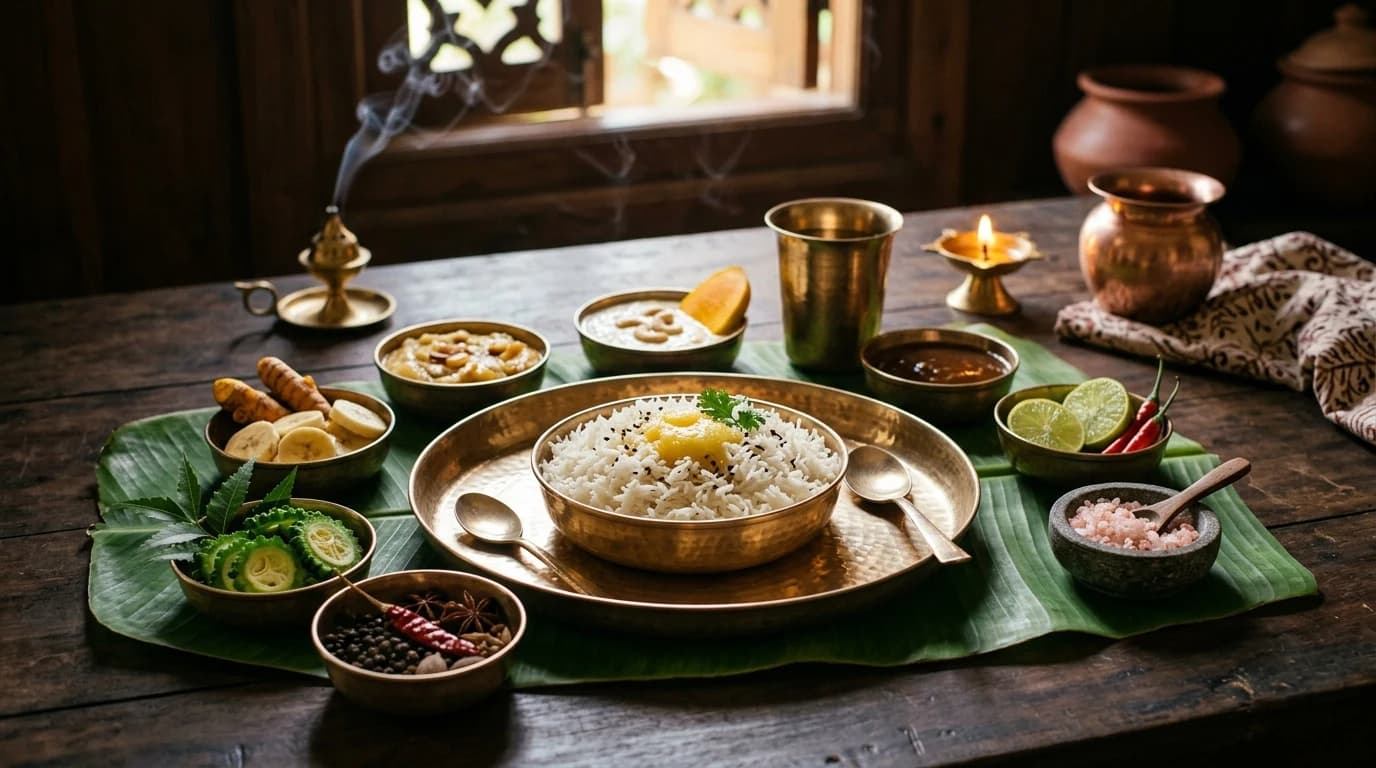
Traditional Thali Elements: Steaming basmati rice with a spoonful of pure A2 cow ghee, warm sweet flatbreads, sweet payasam / kheer.
Middle of the Meal: Sour, Salty & Pungent Foods
मध्येऽम्ललवणौ कटुकं च (द्वितीय चरण)
Physiological Rationale: Spiced lentil broths (Sambar, Dal), fermented items, pickles, and pungent vegetables stimulate Pitta and gastric acid secretion (Jāṭharāgni) at the peak of digestive power.
Anatomical Locus: Duodenum and small intestine (Grahani / Pittāśaya — Pācaka Pitta zone)
Traditional Thali Elements: Slow-simmered spiced toor dal, sour tamarind rasam, vegetable curry tempered with cumin, mustard, and ginger, lemon pickle.
End of the Meal: Bitter and Astringent Foods
अन्ते तिक्तकषायौ (तृतीय चरण)
Physiological Rationale: Closing the meal with bitter greens, digestive spices (fennel seeds, betel leaf), or astringent pulses clears the palate, pacifies Pitta and Kapha, prevents post-meal lethargy, and prevents blood sugar spikes.
Anatomical Locus: Colon and lower enteric tract (Pakvāśaya — Samāna & Apāna Vāyu zone)
Traditional Thali Elements: A small cup of buttermilk (Chāch / Takra) tempered with roasted cumin, chewed betel leaf (Tāmbūla) with clove and cardamom, bitter vegetable preparation.
4. Ṛtucharya: Seasonal Nutrition and the Rotation of Tastes
ऋतुचर्या: षट् ऋतुओं में आहार रसों का कालानुरूप परिवर्तन
Just as the human body changes across the solar year, traditional Indian culinary philosophy adjusts the dominance of the six tastes according to the Six Seasons (Ṛtus) governed by the sun’s northward (Uttarāyaṇa) and southward (Dakṣiṇāyaṇa) solstices:
| Season (Ṛtu) | Months (Approximate) | Dominant Environmental Quality | Aggravated Doṣa | Prescribed Tastes to Balance & Nourish |
|---|---|---|---|---|
| Śiśira (Winter / Frost) शिशिर ऋतु · Uttarāyaṇa | Jan — Feb | Cold, dry, windy | Vāta | Sweet, Sour, Salty (Warm, unctuous, heavy foods: sesame seeds (Tila), raw jaggery (Guḍa), whole wheat flatbreads, cow ghee, root vegetables, hot herbal decoctions.) |
| Vasanta (Spring) वसन्त ऋतु · Uttarāyaṇa | Mar — Apr | Warming, damp, pollen-rich | Kapha | Bitter, Pungent, Astringent (Light, dry, easily digestible foods: roasted barley (Yava), aged honey, bitter greens (neem, methi), fresh ginger tea; complete abstinence from heavy dairy and daytime sleep.) |
| Grīṣma (Summer) ग्रीष्म ऋतु · Uttarāyaṇa | May — Jun | Scorching heat, dry winds, intense evaporation | Vāta | Sweet, Bitter, Astringent (Cooling, liquid, sweet, and soothing foods: aged rice, fresh milk, ripe sweet mangoes, tender coconut water, diluted churned buttermilk (Takra), cooling sattu beverages.) |
| Varṣā (Monsoon) वर्षा ऋतु · Dakṣiṇāyaṇa | Jul — Aug | Damp, humid, erratic rain, weakened digestive fire | Vāta & Pitta | Sour, Salty, Oily (Warming, easily digestible soups (Yūṣa), roasted grains, fresh ginger, garlic, aged rice, rock salt; all raw and street foods strictly prohibited due to microbial proliferation.) |
| Śarad (Autumn) शरद् ऋतु · Dakṣiṇāyaṇa | Sep — Oct | Sudden intense sun heat after rains, clear skies | Pitta | Sweet, Bitter, Astringent (Cooling, light, sweet foods: green gram (Mudga / Moong), fragrant basmati rice, Indian gooseberry (Āmalakī), bitter gourd, pure ghee; avoidance of sour curd, mustard, and heavy oils.) |
| Hemanta (Early Winter) हेमन्त ऋतु · Dakṣiṇāyaṇa | Nov — Dec | Cold, foggy, crisp air, long nights, robust digestive fire | Vāta | Sweet, Sour, Salty (Nutritious, high-protein, fatty, rich foods: winter roots, almonds, walnuts, fresh milk confections, millets (Bajra, Ragi), unrefined sugarcane juice derivatives.) |
5. Primary & Secondary Bibliography
ग्रन्थ सन्दर्भ एवं शोध ग्रन्थ सूची
Primary Sanskrit Ayurvedic Texts
- [1]
Agniveśa. Caraka Saṁhitā, with the Āyurveda-Dīpikā commentary of Cakrapāṇidatta. Critically edited by Vaidya Jadavji Trikamji Acharya. Mumbai: Nirnayasagar Press, 1941 (Sūtrasthāna Ch. 26: Āhāra-dravya-vijñānīya; Ch. 15: Āhāra-vidhi-vidhānīya).
- [2]
Suśruta. Suśruta Saṁhitā, with the Nibandha-Saṅgraha commentary of Śrīhaḷa Ḍalhaṇa. Edited by Vaidya Jadavji Trikamji Acharya. Mumbai: Nirnayasagar Press, 1945 (Sūtrasthāna Ch. 42 & 46).
- [3]
Vāgbhaṭa. Aṣṭāṅga Hṛdayam, with the commentaries Sarvaṅga-Sundarī of Aruṇadatta and Āyurveda-Rasāyana of Hemādri. Edited by Harisastri Paradkar. Varanasi: Chaukhamba Orientalia, 1982 (Sūtrasthāna Ch. 6: Annasvarūpa Vijñāna; Ch. 3: Ṛtucaryā).
- [4]
Bhāva Miśra. Bhāvaprakāśa (2 vols.). Edited and translated by K. R. Srikantha Murthy. Varanasi: Chaukhamba Krishnadas Academy, 1998.
Modern Ayurvedic, Pharmacological & Culinary Scholarship
- [5]
Dash, Bhagwan. Ayurvedic Cure for Common Diseases; and Materia Medica of Ayurveda. Delhi: Hind Pocket Books, 1974; and New Delhi: Concept Publishing Company, 1980.
- [6]
Lad, Vasant. Ayurveda: The Science of Self-Healing; and The Complete Book of Ayurvedic Home Remedies. Albuquerque: Lotus Press, 1984; and New York: William Morrow, 1998.
- [7]
Murthy, K. R. Srikantha. Doctrine of Food and Nutrition in Ayurveda. Varanasi: Chowkhamba Sanskrit Series Office, 2000.
- [8]
Svoboda, Robert E.. Prakriti: Your Ayurvedic Constitution. Albuquerque: Geocom / Lotus Press, 1989.
- [9]
Wujastyk, Dominik. The Roots of Ayurveda: Selections from Sanskrit Medical Writings. London: Penguin Books, 2003.