
Chitrasutra & Temple Frescoes: Sacred Visuality, Mineral Alchemy, and the Canons of Indian Paintingचित्रसूत्र एवं भित्तिचित्र परंपरा: अजन्ता से तंजौर और लघुचित्र शैलियों तक
From the Vishnudharmottara Purana's Theory of Foreshortening and Yashodhara's Six Limbs (Shadanga) to Ajanta Murals, Chola Frescoes, Tanjore Gold-Leaf Icons, and Pahari Miniatures
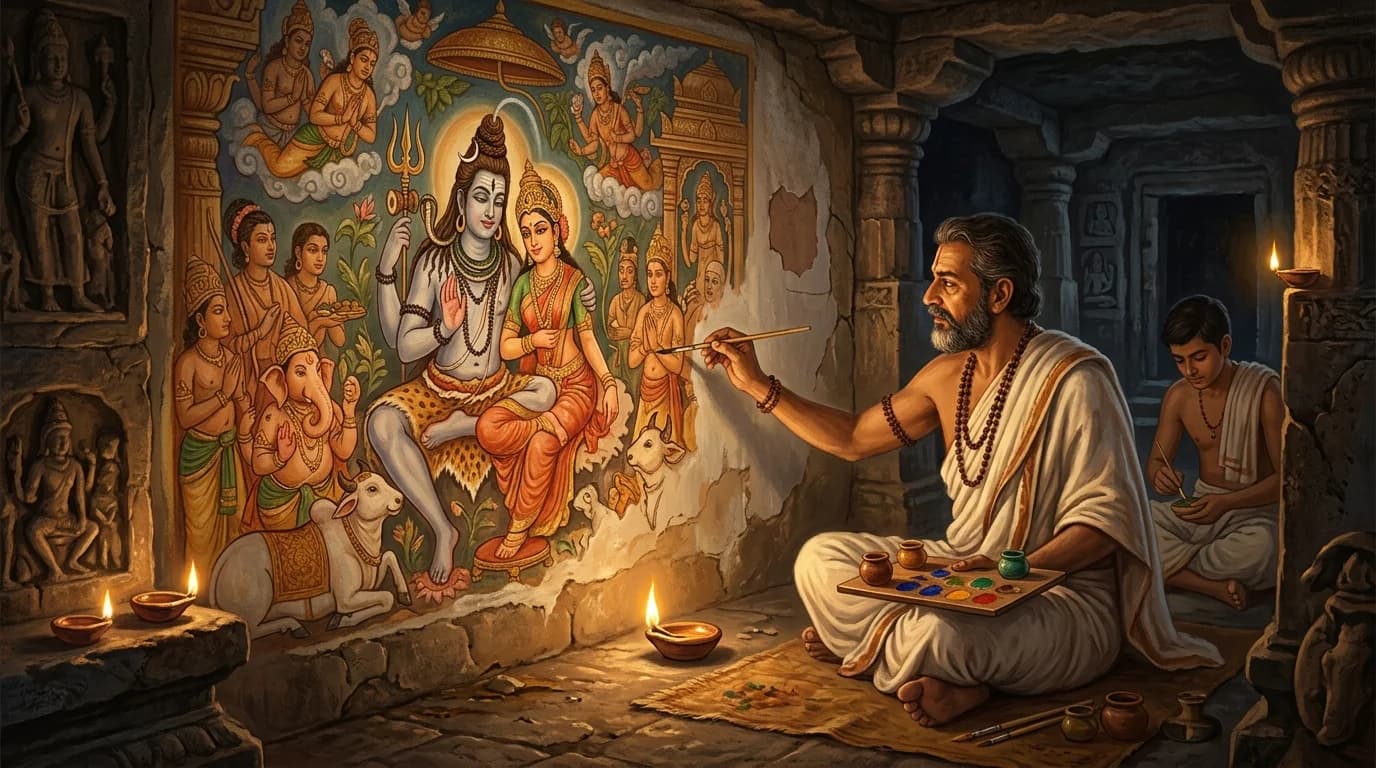
“Among all arts, painting (Citra) is the foremost; it bestows Dharma, Artha, Kāma, and Mokṣa. Wherever it is established in a sanctuary or home, it brings the highest auspiciousness.”
— Viṣṇudharmottara Purāṇa, Citrasūtra (Khaṇḍa III, Adhyāya 43, Verse 38) (c. 5th–6th Century CE)In the classical Indian aesthetic tradition, painting (Citra-kalā) is not an exercise in optical illusionism or retinal mimicry of transient surfaces. Derived from the verbal root cit- ("to perceive, to awaken consciousness, to make visible"), a sacred painting is an instrument of Darśana—a contemplative diagram that renders unseen cosmic principles and archetypal emotional states (Rasa) perceptible to the inner eye. Codified in the fifth-to-seventh-century Citrasūtra of the Viṣṇudharmottara Purāṇa, Nagnajit’s Citralakṣaṇa, King Bhoja’s Samarāṅgaṇa Sūtradhāra, and King Someśvara’s Mānasollāsa, Indian visual art operates on a unified theory connecting music, dance, sculpture, and painting. This codex examines the interdependency of kinetics and line, Yaśodhara’s Six Limbs (Ṣaḍaṅga), the mathematics of proportional iconometry (Tālamāna) and spatial foreshortening (Kṣayavṛddhi), the mineral chemistry of Vajralepa mural plasters and natural pigments, and the unbroken continuity of Indian painting from the rock-cut caves of Ajanta and the Chola sanctum of Thanjavur to Tanjore gold-leaf panels and the poetic miniatures of Rajasthan and the Pahari hills.
1. The Shastric Foundations: Why the Painter Must First Know Dance
The theoretical cornerstone of Indian visual art is the Citrasūtra ("Aphorisms on Painting"), spanning Chapters 35 to 43 of the third Khaṇḍa of the Viṣṇudharmottara Purāṇa (c. 5th–6th century CE). The treatise opens in Chapter 2 with a celebrated pedagogical dialogue between King Vajra and the sage Mārkaṇḍeya that establishes the indivisible unity of all Indian arts:
- 1King Vajra
King Vajra asks Mārkaṇḍeya to teach him the canons of making sacred images (Pratimā-lakṣaṇa).
- 2Sage Mārkaṇḍeya
Mārkaṇḍeya replies that one who does not know the canons of painting (Citrasūtra) can never grasp the laws of sculpture.
- 3King Vajra & Sage Mārkaṇḍeya
When Vajra asks to be taught painting, Mārkaṇḍeya replies that painting cannot be understood without mastering the science of dance (Nṛtta-śāstra), because both disciplines imitate the three worlds (Trailokya-anukṛti) through rhythmic movement and ocular expression.
- 4Epistemological Chain
Dance, in turn, rests upon instrumental rhythm (Ātodya), which rests upon vocal music (Gīta).
Because of this foundational axiom, Indian painting never treats the human figure as a static anatomical mannequin. Every painted contour (Rekhā) is conceived as a trajectory of Prāṇa (vital breath) arrested in dynamic equilibrium, utilizing the exact hand gestures (Hasta Mudrās), torso flexions (Bhaṅgas), and glances (Dṛṣṭis) codified in Bharata’s Nāṭya Śāstra.
The Fourfold Classification in the Mānasollāsa
In 1129 CE, the Western Chalukya emperor Someśvara III compiled the encyclopedic Abhilaṣitārthacintāmaṇi (Mānasollāsa), which categorizes painting into four ontological modes (Vimśati 3, Chapter 1, Verses 132–900):
Viddha-citra (Pierced / Exact Likeness)
विद्धचित्र · दर्पणे प्रतिबिम्बवत्Portraiture or sacred representation possessing exact anatomical and proportional fidelity, as though reflected in a clear mirror (Sādṛśyaṁ dṛśyate yat tu दर्पणे प्रतिबिम्बवत्).
Aviddha-citra (Unpierced / Spontaneous Sketch)
अविद्धचित्र · आकस्मिकचित्रRapid, impressionistic draughtsmanship executed primarily for the delight of expressive line (Ākasmika-citra) without strict metric rules.
Bhāva-citra (Affective / Rasic Painting)
भावचित्र · नवरस भावNarrative compositions whose supreme purpose is the manifestation of the nine aesthetic moods (Navarasas)—such as Śṛṅgāra, Karuṇā, or Śānta—to awaken contemplation in the beholder.
Dhūli-citra (Powder / Ephemeral Threshold Painting)
धूलिचित्र · रङ्गोली एवं कोलमSacred geometric diagrams drawn with dry pulverized mineral and grain pigments on prepared floors or altars, directly linking classical court art to the living domestic tradition of Raṅgolī and Kolam.
2. Ṣaḍaṅga: Yaśodhara’s Six Canonical Limbs of Painting
In his thirteenth-century commentary Jayamaṅgalā on Vātsyāyana’s Kāmasūtra (1.3.16), the scholar Yaśodhara preserved an ancient Sanskrit couplet that summarizes the six essential aesthetic and technical pillars (Ṣaḍaṅga) of Indian painting:
The cognitive and visual discrimination of distinct typologies—not merely distinguishing physical shapes, but perceiving how inner character (Guṇa—Sāttvika, Rājasika, Tāmasika) differentiates a sage from a king, a celestial Gandharva from a mortal, or a lotus petal from a wave.
The mathematical system of measure (Tālamāna and Aṅgula), governing both anatomical ratios within a single figure and relative scale across compositions.
The visible articulation of inner psychic states (Citta-vṛtti) through ocular focus, eyebrow curvature, and postural tilt so that the painting breathes (Cetanā-vat—"as if alive").
If Pramāṇa provides the skeleton and Bhāva provides the emotional vital breath, Lāvaṇya (literally "the lustre of a pearl" or "the exact pinch of salt that brings out flavor") is the ineffable aesthetic grace that prevents strict mathematical proportions from looking mechanical or rigid.
Unlike Western photographic realism, Indian Sādṛśya is metaphorical correspondence. Because divine consciousness cannot be copied from a mortal model, the artist employs poetic archetypes drawn from nature: eyes shaped like a lotus petal (Padma-patra), a darting wagtail bird (Khañjana), or a silver fish (Matsya); eyebrows curved like a neem leaf or a drawn bow (Cāpa); shoulders sloped like an elephant's head (Gaja-mastaka); and fingers tapering like bean pods (Śimbī).
The mastery of color chemistry, tonal gradation, brush modulation (Lekhanī), and symbolic chromotherapy, wherein every pigment corresponds to a specific cosmic element and emotional Rasa.
3. Tālamāna, Kṣayavṛddhi (Foreshortening), and Vartanā (Shading)
The Five Archetypal Proportions (Pañca-Puruṣa Tālamāna)
Rather than measuring figures in fixed inches or centimeters, the Citrasūtra (III.35–36) and Śilparatna employ a self-referential modular unit: the Aṅgula (the breadth of the subject’s own middle finger) and the Tāla (the span of the face from hairline to chin, equal to 12 Aṅgulas). The Citrasūtra establishes five canonical male archetypes corresponding to spiritual and cosmic hierarchies:
| Archetypal Figure | Total Height | Tāla Measure | Iconographic Application |
|---|---|---|---|
| Haṁsa | 108 Aṅgulas | 9 Tālas (or Navatāla) | Supreme Deities, Mahāpuruṣas, Awakened Beings, and Sovereign Emperors (Cakravartins). |
| Bhadra | 106 Aṅgulas | 8 Tālas + 10 Aṅgulas | Celestial beings (Vidyādharas, Gandharvas), Great Ṛṣis, and Noble Heroes. |
| Mālavya | 104 Aṅgulas | 8 Tālas + 8 Aṅgulas | Worldly nobles, heroic warriors, and guardians. |
| Rucaka | 100 Aṅgulas | 8 Tālas + 4 Aṅgulas | Virtuous householders and attendants. |
| Śaśaka | 90 Aṅgulas | 7.5 Tālas | Earth spirits (Yakṣas, Gaṇas), dwarfs (Vāmanas), and comic archetypes. |
(In later Agamic and Śilpa texts such as the Mānasāra and Śilparatna, this expands into the Daśatāla [120 Aṅgulas] system subdivided into Uttama [124 Aṅgulas], Madhyama [120 Aṅgulas], and Adhama [116 Aṅgulas] for supreme divinities).
Kṣayavṛddhi & The Nine Stances (Navasthānāni)
One of the most sophisticated sections of the Citrasūtra (Chapter 39) is its mathematical formulation of Kṣayavṛddhi—the law of diminution (Kṣaya) and augmentation (Vṛddhi), or anatomical foreshortening as a three-dimensional body rotates in space around the vertical plumb-line (Brahmasūtra) and lateral axes (Pakṣasūtras):
Pure frontal symmetry, zero foreshortening (used for iconic Garbhagṛha deities).
Slight three-quarter turn where the nose-to-ear distance diminishes on the receding side.
Bent profile at a 45° angle, dynamic narrative posture.
Sharp profile where one eye is completely foreshortened out of view.
Strict lateral profile (Ekacasma in later miniature terminology).
Dorsal view with head turned back over the shoulder.
Complete back view of a figure moving into the picture plane.
Sharp waist-twist combining frontal upper torso with dorsal lower limbs.
Crouching or foreshortened aerial view from above (masterfully executed in the flying Apsarās and Vidyādharas of Ajanta Cave 16 and 17).
Tisro Vartanāḥ: The Three Classical Modes of Chiaroscuro
Contrary to the colonial misconception that Indian painting is flat, the Citrasūtra (III.41.5–7) states that a true master creates such three-dimensional plasticity that relief (Nimna-unnata—"concavity and convexity") seems palpable to the hand. It prescribes three distinct shading techniques (Vartanā):
Fine, intersecting linear strokes resembling the delicate veins of a Tamāla leaf.
Imperceptible, smoky tonal transitions blended with a soft stump or damp brush so that no boundary line remains visible.
Building luminous volume through microscopic dots applied with the vertical tip of a fine squirrel-hair brush.
“The great masters (Ācāryas) praise the purity of the contour line (Rekhā); the connoisseurs (Vicakṣaṇas) admire the tonal shading (Vartanā); others delight in rich ornament, while the general public is drawn to the brilliance of colors.”
— Citrasūtra III.41.114. Material Alchemy: Sudhā-Lepana Plasters & Natural Mineral Pigments
Traditional Indian murals (Bhitticitra) and manuscripts rely on organic earth chemistry designed to endure tropical humidity for millennia without synthetic fixatives.
Preparing the Sacred Wall (Bhitti-Saṁskāra)
Both the Viṣṇudharmottara Purāṇa (III.40), Samarāṅgaṇa Sūtradhāra (Ch. 72), and Śrīkumāra’s 16th-century Kerala treatise Śilparatna (Ch. 46) prescribe an elaborate multi-layered preparation of stone or brick walls:
Brick powder (Iṣṭakā-cūrṇa), anthill clay (Valmīka-mṛttikā), river sand, shredded paddy husks, and crushed plant fibers (Śaṇa hemp) are mixed with jaggery water (Guḍodaka), mashed Bilva fruit pulp (Aegle marmelos), and fermented extracts of Harītakī and Māṣa (black gram), left to cure for a month before being troweled onto the rough stone wall.
Pure slaked lime (Sudhā) obtained by burning river-clam or sea-conch shells (Śaṅkha-cūrṇa) is slaked with tender coconut water (Nālikera-jala) and plantain-pulp extract, ground to the smoothness of butter, applied in a paper-thin coat, and burnished with a polished agate stone or cowrie shell until it gleams like a mirror.
For tempera execution, pigments are bound using Vajralepa (animal hide glue boiled to transparency, attested in the Mānasollāsa) or vegetarian gums extracted from the Neem tree (Nimba-niryāsa) and Wood-Apple (Kapittha / Limonia acidissima).
The Five Primary Colors (Pañca-Mūla-Varṇa) & Mineral Sources
In Chapter 40 of the Citrasūtra and Chapter 46 of the Śilparatna, all hues are derived from five pure primary pigments (Śuddha-varṇas):
| Sanskrit Term | Color Identity | Natural Mineral / Botanical Source | Associated Rasa & Symbolic Resonance |
|---|---|---|---|
| Śveta / Sita | Luminous White | Kaolin clay (Śveta-mṛttikā), calcined conch shell (Śaṅkha), slaked lime (Sudhā). | Hāsya (Mirth) & Śānta (Purity, Sattva, Transcendence). |
| Rakta / Śoṇa | Crimson / Vermilion | Red ochre (Gairika), cinnabar/mercuric sulfide (Hiṅgula), red lead (Sindūra), lac insect resin (Lākṣā-rasa). | Raudra (Fury), Vīra (Heroic Energy), & Rajas (Dynamic Action). |
| Pīta | Golden Yellow | Yellow ochre (Rāma-raja), natural arsenic trisulfide / orpiment (Haritāla), gamboge (Pīta-niryāsa). | Adbhuta (Cosmic Wonder) & Vīra (Solar Radiance). |
| Kṛṣṇa / Asita | Deep Lampblack | Soot collected inside an earthen pot held over a sesame-oil or castor-oil flame (Kajjala). | Bhayānaka (Terror), Karuṇā (Grief), & Tamas (Dissolution). |
| Nīla / Śyāma | Ultramarine / Terre Verte | Ground Lapis Lazuli (Rājāvarta imported from Badakhshan), fermented Indigo (Nīlī), and green celadonite/glauconite earth (Śyāma-dhātu at Ajanta). | Śṛṅgāra (Erotic/Devotional Love — Śyāma) & Bībhatsa (Aversion). |
(For gilding, pure Suvarṇa-patra [24-karat or 22-karat beaten gold leaf] and liquid gold powder ground with honey and rock salt before washing with clear water were applied to crowns, aureoles, and divine garments).
5. Comparative Matrix of Major Indian Mural & Miniature Schools
The evolution of Indian painting across two millennia displays an unbroken canonical dialogue between monumental public architecture and intimate poetic manuscripts:
| School & Chronology | Architectural / Physical Support | Technical Medium & Palette | Signature Stylistic Features | Masterworks & Sites |
|---|---|---|---|---|
| Ajanta, Bagh & Badami (2nd c. BCE – 6th c. CE; Vākāṭaka & Early Chalukya) | Basalt & sandstone rock-cut cave walls coated with clay-husk plaster & lime Sudhā. | Tempera (Fresco-secco) using red/yellow ochre, terre verte (glauconite), lime white, lampblack, and lapis lazuli. | Continuous narrative composition (Avicchinna-kathā); Airika & Bindu Vartanā volumetric modeling; inward-looking meditative eyes (Dhyāna-netra). | Padmapāṇi & Vajrapāṇi (Ajanta Cave 1); Mahājanaka & Viśvantara Jātakas (Cave 17); Dying Princess (Cave 16). |
| Sittanavasal & Thanjavur Chola Murals (9th – 11th c. CE; Pandya & Imperial Chola) | Monolithic granite cave ceiling (Sittanavasal) & dark circumambulatory Pradakṣiṇāpatha around the Garbhagṛha (Brihadeeswara). | True Fresco (Fresco-buono) on wet slaked conch-shell lime plaster without organic glue binders, polished with smooth quartz. | Monumental scale; sinuous calligraphic outlines executed in a single sweeping stroke; dynamic Chola Karaṇa dance motion and Śaiva cosmology. | Lotus Pond Samavaśaraṇa (Sittanavasal); Śiva as Tripurāntaka, Sundaramūrti & Cēramāṉ Perumāḷ, and Rajaraja I with Karuvūr Dēvar (Thanjavur). |
| Vijayanagara & Kerala Temple Murals (14th – 18th c. CE; Vijayanagara, Nayaka & Malabar) | Mandapa ceilings (Lepakshi/Virupaksha) & laterite sanctum exterior walls (Kerala). | Lime-plaster tempera governed by the strict Pañcavarṇa canon (Śilparatna): red ochre, yellow ochre, green Harita, black Kajjala, white lime. | Linear rhythmic ornamentation; zero empty background space (Horror vacui filled with floral scrolls and Makara-toraṇas); Kathakali-like ocular majesty. | Vīrabhadra & Kirātārjunīyam (Lepakshi); Gajendra Mokṣam (Krishnapuram Palace); Mattancherry, Padmanabhapuram, & Guruvayur. |
| Tanjore & Mysore Sacred Panels (16th – 19th c. CE; Nayaka, Maratha & Wodeyar) | Seasoned Jackfruit (Palagai) or Teak wood board laminated with unbleached cotton cloth & Sukkān chalk paste. | Raised lime-putty gesso relief (Makku), 22-karat gold leaf (Thanga Rēku), cut Jaipur gems (Tanjore), and delicate muted shading (Mysore). | Iconic frontal Ṛjvāgata symmetry designed to glow under flickering oil lamps during domestic and temple Āratī; cherubic divine forms (Navanīta Kṛṣṇa). | Rāma Paṭṭābhiṣekam, Bāla Kṛṣṇa on Banyan Leaf, Gajalakṣmī, and Mysore Cāmuṇḍeśvarī. |
| Pāla Palm-Leaf & Western Indian Jain Manuscripts (10th – 15th c. CE; Bengal, Bihar & Gujarat) | Cured Tāḍapatra (Corypha palm leaf) and later handmade Wasli paper. | Mineral cinnabar, orpiment, indigo, and liquid gold/silver ink (Suvarṇa-ākṣara). | Pāla: miniature continuation of Ajanta’s plastic modeling; Western Indian: electric wire-like angular line and the projecting "Further Eye" (Savā-casma). | Aṣṭasāhasrikā Prajñāpāramitā (Pāla); Kalpasūtra & Kālakācārya Kathā (Patan/Ahmedabad). |
| Rajasthani & Pahari Miniatures (16th – 19th c. CE; Mewar, Kishangarh, Kangra, Basohli) | Multi-layered burnished Wasli paper painted with single-hair squirrel brushes (Qalam). | Pure mineral pigments, Gogulī (Indian yellow), crushed beetle-wing emeralds (Basohli), and burnished gold. | Visual translation of Rāgamālā, Rasamañjarī, Bārah-māsā, and Gītagovinda poetry; lyrical architectural framing and psychological intimacy. | Chawand Rāgamālā (Mewar); Nihāl Chand’s Rādhā (Bani Thani) (Kishangarh); Nainsukh & Manaku’s Gītagovinda (Kangra/Guler). |
6. Historical Evolution & Regional Lineages
6.1 The Classical Golden Age: Ajanta, Bagh, and the Visual Bodhisattva
Carved into a horseshoe-shaped gorge of the Waghora River in Maharashtra across two historical phases—the Hīnayāna / Sātavāhana phase (Caves 9 and 10, c. 2nd century BCE – 1st century CE) and the Mahāyāna / Vākāṭaka phase under Emperor Harishena (Caves 1, 2, 16, and 17, late 5th century CE)—the murals of Ajanta represent the zenith of classical Citrasūtra aesthetics.
Rather than dividing narratives into sequential comic-strip boxes, the masters of Ajanta employed continuous spatial-temporal composition: scenes from the Jātakas flow organically into one another across architectural pavilions, banana groves, and mountain crags, guided by the directional gestures and glances of the figures. In the iconic Bodhisattva Padmapāṇi of Cave 1, the artist utilizes the Tribhaṅgi flexion, Airika-vartanā shading along the bridge of the nose and rounded shoulders, and downward-cast Padma-patra eyelids to embody the simultaneous coexistence of supreme royal grandeur and infinite Karuṇā (compassion) for all sentient beings.
6.2 Imperial Chola Fresco-Buono at Brihadeeswara (Thanjavur)
For decades, art historians believed that the murals inside the dark, narrow circumambulatory passage (Andhakārikā / Pradakṣiṇāpatha) surrounding the Garbhagṛha of Rajaraja Chola I’s Brihadeeswara Temple (consecrated 1010 CE) dated entirely to the seventeenth-century Nayaka period. In 1931, S. Paramasivan and S. K. Govindaswami discovered that the Nayaka paintings were peeling away to reveal an intact eleventh-century Imperial Chola layer underneath.
Scientific pigment and cross-section analysis revealed a major technological milestone: unlike Ajanta’s clay-and-glue tempera, the Chola royal guilds executed these murals in true fresco (Fresco-buono) on wet, three-layered slaked conch-shell lime plaster (Sudhā), relying on carbonation (Ca(OH)₂ + CO₂ → CaCO₃ + H₂O) to lock the mineral pigments permanently into a crystalline calcite matrix. Across Chambers 5, 7, 9, and 11, the Chola masters painted cosmic visions of Dakṣiṇāmūrti, Naṭarāja at Chidambaram adored by Rajaraja I and his queens, the saint Sundaramūrti ascending to Kailāsa on a white elephant alongside King Cēramāṉ Perumāḷ on a galloping horse, and a monumental battle scene of Śiva as Tripurāntaka—where the muscular tension of Śiva’s Ālīḍha warrior stance contrasts with the serene grief of the demon wives clinging to their warriors.
6.3 Tanjore (Palagai Padam) & Mysore Sacred Iconography
Following the fall of the Vijayanagara Empire after the Battle of Talikota (1565 CE), hereditary guilds of Rāju and Naidu master painters (Citrakāras) migrated southward to the Nayaka and Maratha courts of Thanjavur and the Wodeyar court of Mysore. There, they transformed monumental wall painting into portable sacred altar icons (Palagai Padam—"picture on a wooden plank"):
A seasoned plank of jackfruit (Artocarpus heterophyllus) or teak wood is coated with tamarind-seed paste and wrapped in unbleached Mull cotton fabric. Over this, layers of Sukkān (finely sieved limestone powder mixed with gum Arabic) are applied and sanded with kūḻāṅkal river pebbles.
Using a fine cotton cone filled with Makku (unboiled limestone powder and glue), the artist builds three-dimensional raised relief arches (Prabhāvalī), crowns (Kirīṭa), and necklaces, setting uncut rock crystals, rubies, and emeralds directly into the wet paste.
Beaten gold foil is burnished over the relief areas before mineral colors are applied to the faces and robes. Crucially, this gold is not meant for museum floodlights; in the darkened Pūjā room of a traditional home, the gold leaf catches the shifting flame of the camphor Āratī lamp, making the deity appear to breathe and move within the sanctum.
6.4 The Poetic Miniature (Laghucitra): Rāgamālā, Bhakti, and the Pahari Hills
Between the fifteenth and nineteenth centuries, the portable paper miniature (Laghucitra) became the primary vehicle for synthesizing Sanskrit and vernacular Bhakti poetry with visual art across Rajasthan (Mewar, Marwar, Bundi, Kota, Amber, Kishangarh) and the Pahari Himalayan courts (Basohli, Guler, Kangra, Chamba, Garhwal):
Rāgamālā ("Garland of Rāgas")
Giving visible form to the Dhyāna-ślokas (contemplative verses) of the 36 Rāgas and Rāgiṇīs, these paintings unify music, time of day, season (Ṛtu), and human longing—such as Rāgiṇī Toḍī enchanting wild deer in a forest clearing with her Vīṇā, or Rāga Megha Malhār dancing amidst indigo monsoon clouds flashed with golden lightning.
The Pahari Lyricism of Pandit Seu, Manaku, and Nainsukh
In the eighteenth-century Kangra and Guler ateliers, the family lineage of Pandit Seu and his sons Manaku and Nainsukh fused keen naturalistic observation with the ecstatic mysticism of Jayadeva’s Gītagovinda, Bihari’s Satasaī, and the Bhāgavata Purāṇa. Here, the Himalayan landscape itself becomes an active participant in Śṛṅgāra Rasa: blossoming Kadamba trees lean toward Rādhā and Kṛṣṇa, twining creepers mirror their embrace, and the silver currents of the Yamunā reflect the quiet luminosity of Śānta.
7. Primary & Secondary Bibliography
Primary Sanskrit Texts & Translations
- [1]Viṣṇudharmottara Purāṇa (Citrasūtra). Viṣṇudharmottara-Purāṇa, Third Khaṇḍa (2 vols.). Critically edited with introduction and notes by Priyabala Shah. Gaekwad’s Oriental Series, Nos. 130 & 137. Baroda: Oriental Institute, 1958–1961.Foundational Sanskrit critical edition for Chapters 35–43 covering iconography, foreshortening, and plaster alchemy.
- [2]Mukherji, Parul Dave (Ed. & Trans.). The Citrasūtra of the Viṣṇudharmottara Purāṇa. Critical edition with English translation and extensive technical commentary. Kalāmūlaśāstra Series, Vol. 32. New Delhi: Indira Gandhi National Centre for the Arts (IGNCA) & Motilal Banarsidass, 2001.Standard academic monograph on shastric aesthetics, proportional metrics, and the philosophy of Darśana.
- [3]Nagnajit. An Early Document of Indian Art: The Citralakṣaṇa of Nagnajit. Translated and introduced by B. N. Goswamy and Anna L. Dallapiccola (from the Tibetan Tanjur ed. of Berthold Laufer). New Delhi: Manohar, 1976.Early canonical treatise on divine proportions and the mythological genesis of painting.
- [4]Bhojadeva. Samarāṅgaṇa-Sūtradhāra. Edited by T. Ganapati Sastri and revised by Vasudeva Saran Agrawala. Gaekwad’s Oriental Series, No. 25. Baroda: Oriental Institute, 1966.Chapter 72 outlines the architectural science of plastering, ground preparation, and mural binders.
- [5]Someśvara III. Mānasollāsa (Abhilaṣitārthacintāmaṇi), Vol. II. Edited by G. K. Shrigondekar. Gaekwad’s Oriental Series, No. 84. Baroda: Oriental Institute, 1939.Vimśati 3 establishes the fourfold ontological taxonomy (Viddha, Aviddha, Bhāva, Dhūli).
- [6]Śrīkumāra. Śilparatna (Citralakṣaṇam — Chapter 46). Edited by K. Sambasiva Sastri (Translated by Asoke Chatterjee Sastri as The Citralakṣaṇam, Calcutta: Asiatic Society, 1987). Trivandrum Sanskrit Series, No. 98. Trivandrum: Government Press, 1929.Comprehensive 16th-century Kerala manual detailing the Pañcavarṇa color hierarchy and fresco-secco ground chemistry.
Modern Art-Historical & Scientific Scholarship
- [7]Agrawal, O. P., & Rashmi Pathak. Examination and Conservation of Wall Paintings of India. New Delhi: Sundeep Prakashan / INTACH, 2001.Scientific material analysis of lime plasters, binders, and pigment degradation across Indian monuments.
- [8]Chandra, Moti. Jain Miniature Paintings from Western India & Studies in Early Indian Painting. Ahmedabad: Sarabhai Manilal Nawab, 1949; London: Asia Publishing House, 1970.Pioneering work on palm-leaf manuscript traditions and Western Indian angular draughtsmanship.
- [9]Coomaraswamy, Ananda K.. Rajput Painting (2 vols.) & The Transformation of Nature in Art. Oxford: Clarendon Press, 1916; Cambridge, MA: Harvard University Press, 1934.The seminal philosophical treatise articulating Sādṛśya, ideal visual form, and Pahari lyrical mysticism.
- [10]Goswamy, B. N., & Eberhard Fischer. Pahari Masters: Court Painters of Northern India. Zurich: Museum Rietberg / Artibus Asiae, 1992.Exhaustive reconstruction of family ateliers (Pandit Seu, Manaku, Nainsukh) and stylistic lineages in the Himalayan foothills.
- [11]Kramrisch, Stella. A Survey of Painting in the Deccan. London: India Society, 1937.Classic exploration of spatial dynamism and metaphysical depth in Ajanta, Badami, and Vijayanagara wall paintings.
- [12]Sivaramamurti, C.. Chitrasūtra of the Vishnudharmottara & South Indian Paintings. New Delhi: Kanak Publications, 1978; New Delhi: National Museum, 1968.Definitive Indological monograph on the Citrasūtra with exhaustive shastric cross-references to Chola and Vijayanagara murals.
- [13]Spink, Walter M.. Ajanta: History and Development (7 vols.). Handbook of Oriental Studies. Leiden & Boston: Brill, 2005–2017.The monumental archaeological and epigraphic authority documenting the patronage, sequence, and painting guilds of Ajanta Caves.